

At the base of many fingernails lies a pale crescent, a small moon resting just beneath the cuticle. It is most visible on the thumbs, faint on the smaller fingers, and often hidden entirely on the toes. This quiet shape has invited curiosity for centuries. It appears familiar yet enigmatic, ordinary yet strangely poetic. Many people wonder whether it carries meaning, whether it reflects health, or whether it is simply an anatomical detail that the body reveals without ceremony. A similar sense of quiet patterning appears in the subtle arcs and ridges of palm lines, which also trace the ways in which the body shapes visible features from deeper developmental structures.
The journey into this crescent begins with what we see on the surface, then moves gently beneath it, following the layers of structure and growth that give rise to the pale crescent called the lunula. Each section builds on the previous one, forming a continuous narrative that connects appearance, anatomy, variation, and the subtle rhythms of the body.
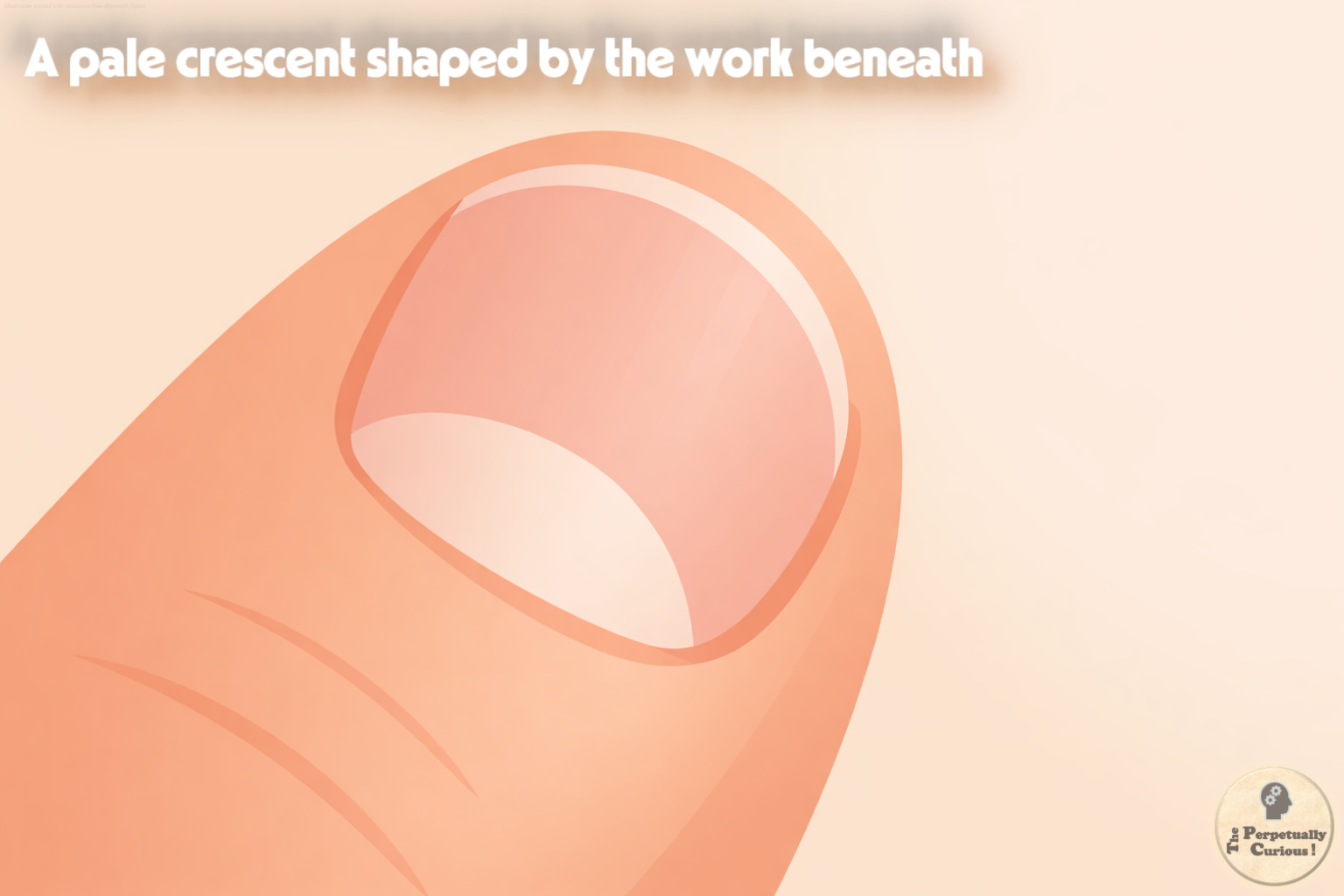
The pale crescent rests at the base of the nail like a small memory of the deeper work beneath the surface.
It holds the quiet shape of growth that continues whether we notice it or not.
In its soft arc, the body leaves a gentle reminder of the patient rhythms that carry us forward.
🌱 The foundation beneath the crescent: How the nail grows
To understand the lunula, it helps to begin with the architecture of the nail itself. A fingernail is not simply a plate resting on the finger. It is a layered structure shaped by living cells beneath the skin.
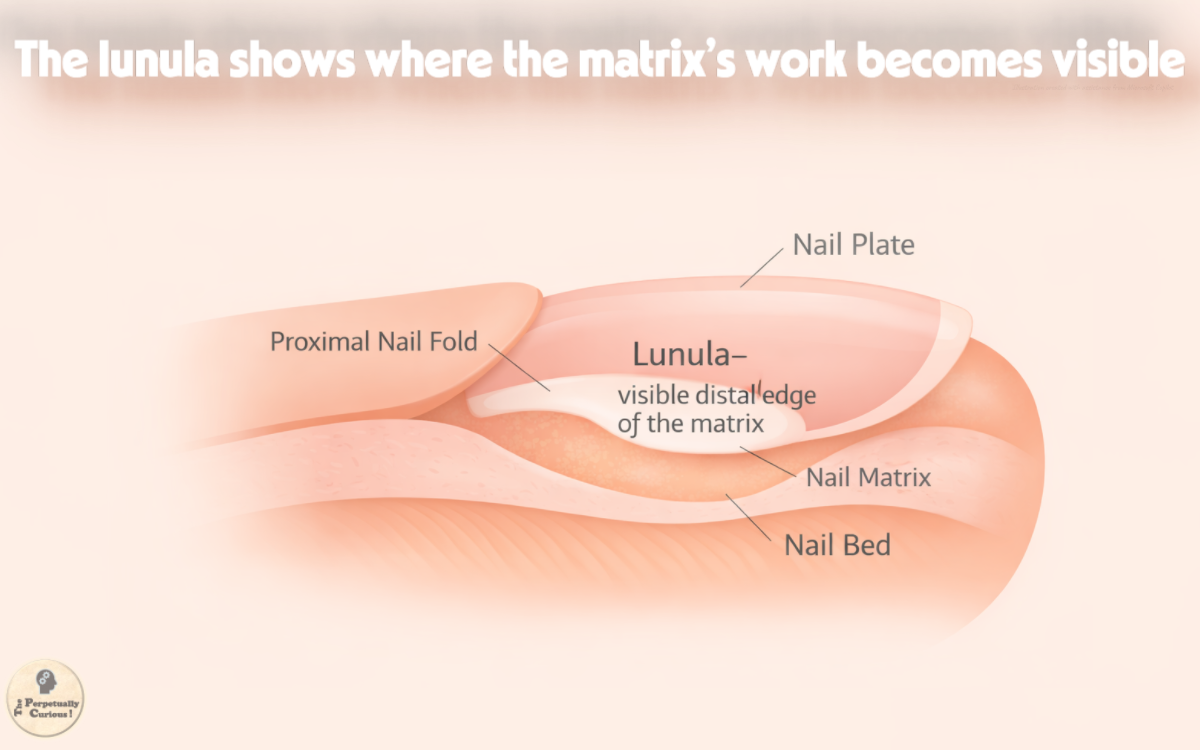
The visible hard portion is the nail plate, a smooth sheet of keratin that protects the fingertip. Because this plate is rich in keratin, henna can stain fingernails, and the stained portion can remain visible as the nail grows outward. Beneath the plate lies the nail bed, a vascular tissue that gives most of the nail its pink color. At the base, tucked beneath the proximal nail fold, is the nail matrix, where new nail cells are produced.
The lunula is the visible portion of this matrix. It appears pale because the matrix in that region is thicker and contains newly forming keratinocytes that have not yet fully compressed or keratinized. These cells scatter light and obscure more of the underlying blood vessels that give the rest of the nail its pink appearance. As a result, the lunula looks opaque and whitish, while the remainder of the nail appears more translucent and pink.
Keratin formation is one example of how the body depends on the precise behavior of proteins. Readers interested in how changes in protein structure can alter biological function may find broader context in the science of protein misfolding.
The nail matrix begins developing around the seventh to eighth week of gestation, and the lunula becomes distinguishable by approximately the fourteenth week. By that stage, the foundation of the crescent is already forming, quietly preparing the structures that will later appear at the base of each nail.
This anatomy provides the foundation for everything that follows. The lunula is neither a symbol nor a separate organ. It is a visible window into the nail’s growth zone, offering a glimpse of the cellular machinery that continually builds the nail over time.
🌜 Why the lunula looks like a moon
The lunula takes the shape of a crescent because of the geometry of the matrix. The matrix extends beneath the skin as a broad, curved region tucked under the proximal nail fold. Only the distal portion is visible through the emerging nail plate. The curved boundary between the thicker matrix and the thinner nail bed creates the familiar arc.
This shape is not decorative. It is simply the visible edge of a deeper structure. The pale color arises because the matrix in that region is thicker, with developing cells that have not yet fully compressed or keratinized. These cells scatter light and, in doing so, obscure the underlying blood vessels that give the rest of the nail its pink color. Understanding the shape and color together prepares us for the next question that many people ask: why the thumb lunula stands out so clearly.
👍 Why the thumb lunula is often the most visible
The lunula on the thumb is usually larger and more distinct than on other fingers. This is a common and normal pattern.
The thumb nail is broader, and the matrix beneath it is often more extensive. Because of this, a larger portion of the matrix may be visible through the nail plate. The curvature of the thumb and the openness of the proximal nail fold also expose more of the matrix.
On smaller fingers, the matrix may be shorter or more deeply covered by the proximal nail fold. In such cases, the lunula may appear faint or may not be visible at all. This variation is expected and reflects differences in anatomy rather than differences in health.
This leads naturally to a broader question about variation across individuals.
🌈 Why lunulae vary from person to person
Lunulae differ widely among individuals. Some people have large, clearly visible crescents on several fingers. Others have small or nearly invisible lunulae. These differences arise from several overlapping factors:
- Nail thickness and transparency
- Matrix size and position
- Skin coverage
- The overall pace of nail growth
Variation is a natural feature of biological systems. The lunula is not meant to look identical on every finger or every person. It reflects the quiet diversity of human anatomy. Readers who enjoy exploring how the body expresses individuality in subtle ways may find a parallel in how people differ in caffeine metabolism.
Environmental factors also play a role. Warmer temperatures, increased circulation, and seasonal changes may subtly influence nail growth rate, which can affect how distinct the lunula appears.
🧬 Heritable influences on lunula appearance
Although the lunula itself is not inherited as a single trait, several anatomical features that shape its visibility often run in families. These include nail plate thickness, matrix length, the overall shape of the nail, and the prominence of the proximal nail fold.
These heritable characteristics can make lunulae appear more or less visible across generations. The pattern is indirect rather than genetic in a strict sense, but it explains why family members sometimes share similar nail features.
The same anatomical tendencies extend beyond the fingers, showing up, often more discreetly, in the toenails.
🦶 Lunulae in toenails
Lunulae occur in both fingernails and toenails. However, they are often less visible on the toes because toenails tend to be thicker, the proximal nail fold covers more of the matrix, and the curvature of the toe can obscure the lunula. Many people never notice a crescent at the base of their toenails, even though the nail matrix is present beneath the nail.
🐾 Are lunulae unique to humans?
Lunulae are most familiar in human nails, but the broader anatomy behind them belongs to a larger family of keratin‑producing digit structures. Many mammals have claws, nails, or hoof‑like coverings that grow from specialized epidermal tissues. In claws, the growth zone is usually hidden beneath thicker keratin and surrounding tissue, so a visible crescent like the human lunula is often absent or difficult to compare directly.
This makes the lunula less a uniquely mysterious mark and more a visible expression of a deeper biological pattern: specialized skin can produce durable structures that protect, support, and interact with the world.
🧪 The lunula as a living growth zone
The lunula marks the visible distal portion of the nail matrix, where the nail plate is actively forming. In this zone, keratinocytes divide, accumulate keratin, and gradually flatten as they move forward. Over time, these cells become part of the hard nail plate that protects the fingertip.
Because the lunula corresponds to the visible edge of the matrix, this region is sensitive to injury. Trauma near the matrix can lead to ridges, splits, or changes in nail shape. In some cases, the effects may persist for several months, since a fingernail can take roughly three to six months to grow out completely, depending on the finger and the person.
The slow and steady nature of nail growth reflects the broader theme of biological timing, and readers interested in how the body maintains long-term rhythms may appreciate the exploration of biological clocks.
This understanding prepares us for the next section, which explores what the lunula may or may not suggest about health.
🩺 What the lunula may reflect about health
Researchers have explored whether changes in the lunula may correlate with systemic conditions. It is important to approach this topic with scientific caution.
Some studies have described enlarged lunulae in association with certain thyroid conditions, diminished or absent lunulae in individuals with anemia or malnutrition, and color changes in the lunula in some circulatory or metabolic disorders.
However, these associations are not specific. Many healthy individuals have large lunulae, small lunulae, or no visible lunulae. Similarly, individuals with medical conditions may have entirely typical lunulae.
Nails can reflect long‑term physiological changes, but the lunula alone cannot diagnose any condition. It is one small clue among many, and it is best understood as part of a broader picture rather than a standalone indicator.
🧭 Cultural interpretations and scientific clarity
Across cultures, visible features of the body have sometimes been given symbolic meanings. The lunula, with its moonlike shape, has occasionally been included in such interpretations. These cultural perspectives can be meaningful within their own traditions.
From a scientific standpoint, the lunula is an anatomical feature shaped by growth patterns, tissue thickness, and light scattering. Understanding it through anatomy does not diminish its poetic appeal. Instead, it reveals the quiet beauty of a structure that reflects the body’s continuous work beneath the surface. Readers who enjoy exploring how different cultures interpret the body may appreciate the broader context of traditional medicine.
🔍 Observing without interpreting too much
As people become more aware of body features, it is easy to overinterpret small variations. The lunula is a good example of a feature that invites curiosity but does not require constant monitoring.
Nails reflect long‑term processes. They grow slowly, change gradually, and respond to many influences, including minor injuries, aging, and everyday activities. The lunula is best appreciated as a subtle anatomical detail rather than a diagnostic sign.
🌐 A small crescent that reveals a larger story
By now, the narrative has moved from surface observation to deeper structure, from structure to growth, and from growth to cautious interpretation. The lunula becomes a symbol of how the body reveals its inner workings through small, visible clues.
This small crescent connects the everyday act of looking at one’s hands to the continuous work of cell division and renewal. It reminds us that even familiar parts of the body contain layers of complexity that can be explored with curiosity and respect. In this way, the lunula becomes a quiet reminder that the body often reveals its deeper patterns through subtle and familiar forms.
Pass this article along to someone curious and let the learning travel.
💡 Did You Know
🌙 The lunula is not a separate object beneath the nail; it is the visible edge of the nail matrix.
🌙 The lunula is usually most visible on the thumbs and may be nearly invisible on the little fingers in many healthy individuals.
🌿 The average fingernail grows by approximately 0.1 to 0.14 inch (about 2.5 to 3.5 millimeters) per month, with the typical adult average close to 3.5 millimeters.
🦶 Toenail lunulae are often less visible because toenails tend to be thicker and the surrounding skin covers more of the matrix.
⏳ Lunula visibility may change with age as nail thickness and growth rate shift over time.
🌡 Temporary changes in lunula appearance may occur after illness, stress, or minor injury, reflecting the slow and steady nature of nail growth.
🌬 Nails often grow faster in warmer climates, which may subtly influence lunula visibility.
🖐 Nails on the more active hand may grow slightly faster in some people, likely because use and minor mechanical stimulation can influence local circulation and nail growth.
🧒 Children often have more visible lunulae because their nail plates are thinner.
What is the white half moon on my nail called?
It is called the lunula. It is the visible portion of the nail matrix, the tissue that produces new nail cells.
Why is the lunula more visible on my thumb?
The thumb nail is broader and the matrix beneath it is often larger, which makes the lunula more visible.
Is it normal to have no visible lunula on some nails?
Yes. Many healthy individuals have visible lunulae only on the thumbs or on a few fingers.
Can the lunula indicate health problems?
Changes in the lunula have been described in association with certain conditions, but these changes are not specific and do not provide a diagnosis on their own.
Why is the lunula white?
It appears white because the matrix in that region is thicker and filled with developing cells that scatter light while also obscuring the underlying blood vessels that give the rest of the nail its pink color.
Why do toenail lunulae look different?
Toenails are often thicker and the surrounding skin covers more of the matrix, which can make the lunula less visible.
Can lifestyle factors influence lunula visibility?
Lifestyle factors may influence nail growth rate or nail thickness, which can subtly affect how the lunula appears.
Why do some people have very large lunulae?
A larger lunula may reflect a longer or more distal matrix, which is a normal anatomical variation.
Is lunula appearance hereditary?
The lunula itself is not inherited directly, but several anatomical traits that influence its visibility often run in families.
Do other parts of the body show similar individual variation?
Yes. The body expresses individuality in many subtle ways, and readers who enjoy this theme may appreciate the exploration of diverse neurons.
Do animals have lunulae?
Many mammals have claws, nails, or related keratin‑producing digit structures, but a visible crescent like the human lunula is most clearly associated with nails and may be hidden or absent in other forms.
🤝 A gentle invitation to share
We invite you to share this article with readers who appreciate quiet science in everyday details. Every share helps more people discover how familiar features of the body can carry thoughtful biological stories.
“Little Moons at the Base of Our Nails: The Quiet Science of the Lunula.” The Perpetually Curious!, May 2026.
https://www.theperpetuallycurious.org/articles/white-half-moon-on-nails/Continue Exploring
For the curious mind: want to explore this theme through a few questions? Visit the Classic Quiz Studio, nestled under Explorations opens in a new tab ,and see where a few well-placed questions lead: Biology & Health Quizzesopens in a new tab
For what comes next
Site Updates gathers occasional notes, new additions, and ways to keep in touch. RSS brings new publications to your feed reader in chronological order.
Choose the path that speaks to you, and let the next curiosity find you wherever your wondering takes you.