
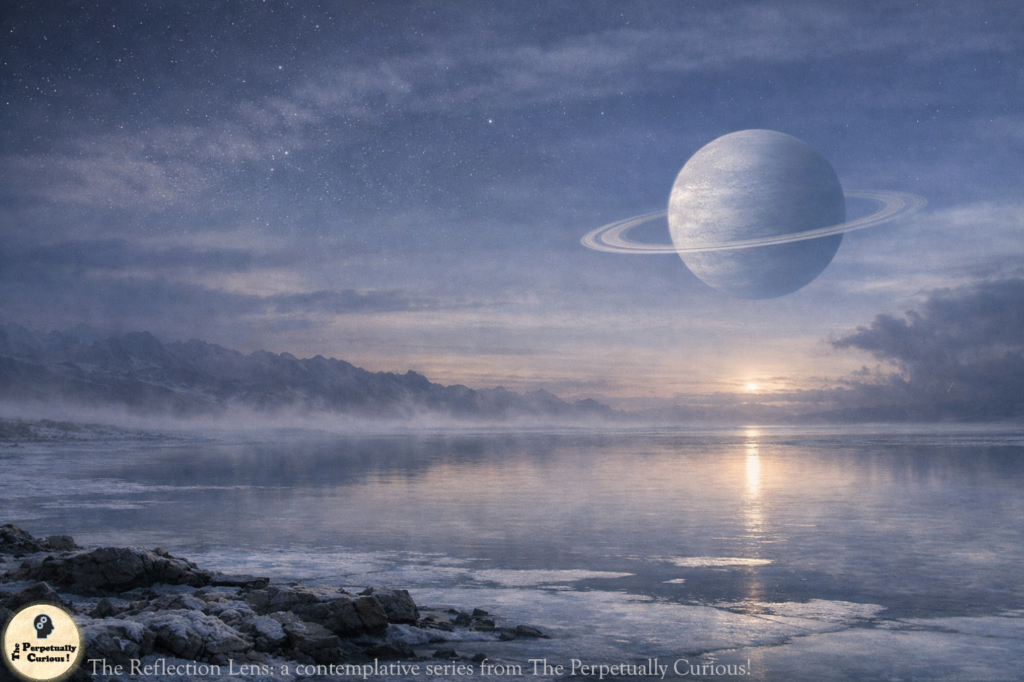
A Quiet Descent on the Reflection
We often meet distant worlds through the limits of our own biology. Temperatures, pressures, and atmospheres that fall outside what human life can tolerate are quickly labeled harsh or unwelcoming. Yet these descriptions reveal more about our perspective than about the worlds themselves. Each world carries the conditions shaped by its own history, and those conditions exist whether or not they support us.
This reflection offers a quieter way of seeing. Instead of measuring a world by how closely it resembles Earth, we can observe it as a place that is complete on its own terms. Its storms, its calm, its heat, and its cold are not directed toward anyone. They are simply the outcomes of natural processes unfolding over time. To imagine a world speaking is to picture a quiet request to be allowed to remain what it is, not as a literal voice but as a way to shift perspective that helps us recognize how often we center our own needs in our interpretations.
In this light, habitability becomes a relative idea rather than a judgment. A world that remains beyond human reach continues to be shaped by its own conditions rather than by ours. It does not require our presence to retain its character. This understanding creates space for humility. It reminds us that what suits us is not the same as what completes a world, and that the universe contains many forms of order that persist whether or not human life is present.
From a place of observation and curiosity, other worlds can be approached with respect rather than expectation. This shift allows us to notice how language shapes perception and how easily human requirements become universal measures. We return to where we began: our interpretations are only one way of seeing, and many worlds remain fully themselves whether or not they make room for us.