
A Quiet Descent into the Reflection
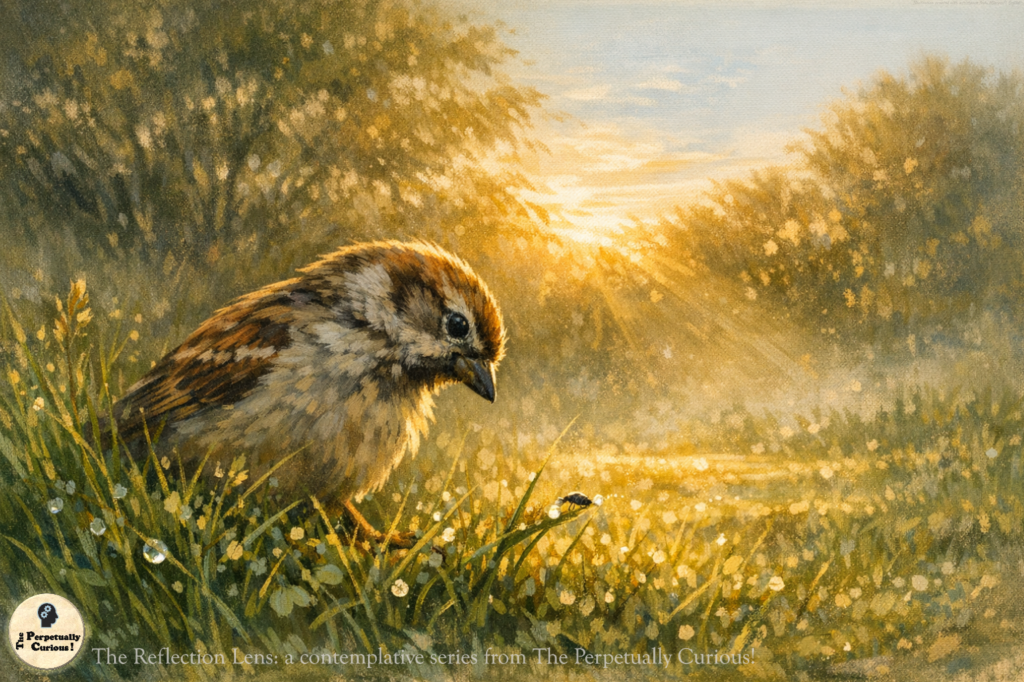
Many birds move their heads in small, precise angles because their eyes have more limited mobility within the socket than those of many mammals. These movements allow them to extend their visual coverage, refine depth and motion cues through processes such as motion parallax, and gather information from different parts of their surroundings. What appears to be a simple gesture is a careful method of visual sampling shaped by the structure of avian vision.
This behavior offers a clear parallel for human perception. We often expect clarity to arrive in a single moment, yet most understanding develops gradually. A slight shift in perspective can reveal what was hidden, and returning to a familiar moment can show what was overlooked. The bird demonstrates that perception is built through a series of small, attentive adjustments.
This way of seeing reflects an acceptance that no single angle is sufficient. The world exceeds what any one view can hold, and each new angle contributes another piece of understanding. When we allow ourselves to shift perspective, even slightly, we create room for new information to settle into place.
The reflection encourages patience with the pace at which understanding forms. Clarity is not a sudden arrival but a process shaped by repeated engagement and steady attention. In this sense, the bird becomes a quiet model of perception. Its movements show that understanding is not fixed but something assembled over time through curiosity and the willingness to look again.
The moment of the bird turning its head becomes more than an observation. It becomes a reminder that clarity often begins with a small adjustment in how we look, and that meaning emerges through the simple act of returning to what we wish to understand more fully.