
A Quiet Descent into the Reflection
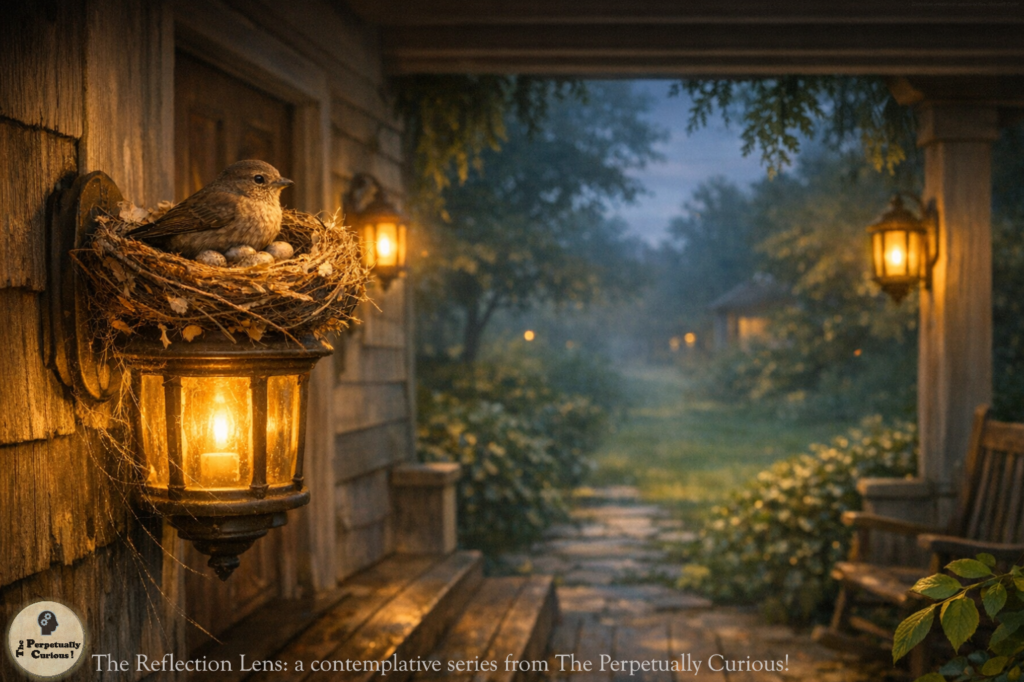
A small nest on a porch light or tucked above a door frame can seem almost incidental, as if it simply appeared there one morning. Yet behind that placement lies a long period of quiet work. A bird has moved through the same space many times, sensing air movement, watching the motion of people, and responding to shifts in sound and light across the day. What looks like a simple choice of location is the visible outcome of many moments of attention that passed without leaving any mark on the surface of the world.
In many small bird species, this work begins long before a single strand of nesting material is carried. The bird returns to a potential site again and again, appearing to assess height, shelter, and the patterns of nearby human activity. It tests the stability of the structure beneath it and notes how exposed the space is to wind and rain. Human architecture becomes part of this evaluation. A porch light, a door frame, or a quiet corner offers a stable ledge that can support a nest, but only if the surrounding activity proves predictable enough to be trusted.
Biologically, this behavior depends on the integration of many subtle sensory signals. In birds, forebrain regions such as the nidopallium are associated with sensory integration and complex information processing, although this should not be read as a direct map of a specific nest‑site decision circuit. During the long span of assessment, the bird is not simply waiting. Its nervous system is integrating cues related to stability, disturbance, safety, and opportunity. The eventual choice to build is the outcome of this ongoing evaluation, not a sudden impulse. The brief period of construction is supported by a much longer period of invisible work.
When the choice is made, the act of building can unfold with striking speed. Materials are gathered, carried, and woven into a structure that fits the chosen ledge or corner with precise economy. The nest records the outcome of the earlier assessment. Its position reflects a balance between shelter and exposure, between proximity to human activity and the need for relative quiet. Even the bird’s brief retreats during disturbance, when it moves to a nearby perch and watches until the unfamiliar becomes known, are part of the same pattern of careful responsiveness.
Seen in this way, the nest is not only a shelter but also a record of how information has been gathered and integrated. The alignment of timing and opportunity is written into its placement. The bird has used the stability of human‑made structures to meet a biological need, but only after testing whether that stability can be trusted. The quiet shape of the nest reflects the quality of the observation that came before it, not only the speed of the final act.
This reflection invites a parallel in human experience without forcing it. Many important choices in a life are preceded by periods that appear, from the outside, to be pauses or delays. There may be no visible progress, no outward sign that anything is happening. Yet attention is moving across details, testing possibilities, and discarding options that do not feel stable enough to hold the weight of a future commitment. Readiness becomes a form of work that leaves almost no trace until the moment of action.
To notice the nest on the porch light is to notice this pattern in another being. To stay with that observation a little longer is to recognize a similar pattern in one’s own pauses and retreats. The reflection does not claim that human and avian minds are the same. It simply suggests that careful choice, in many forms of life, may have a quiet shape that is easy to overlook. The nest becomes a small, careful structure that invites the reader to consider how their own periods of stillness might be part of a larger alignment of timing, safety, and opportunity.