
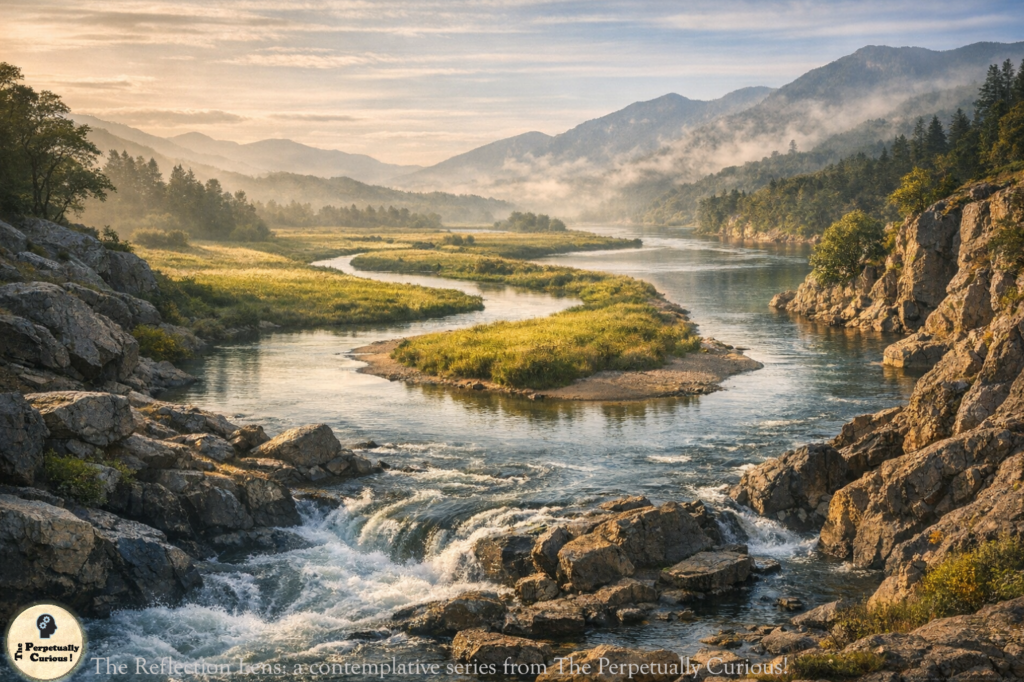
A Quiet Descent into the Reflection
A river does not travel by force alone. It moves by responding to the land that holds it, shaping itself to every rise and hollow, every bank and bend. Its journey is not a straight line but a long conversation between water and ground.
In its upper reaches, a river begins as something narrow and newly formed. It threads through rock and soil, following the openings that exist and leaving the closed ones untouched. Harder ground turns it aside, softer ground receives it, and in that quiet exchange a pattern begins to appear. The river does not erase what stands before it. It traces what is possible within the limits it meets.
Over distance, this pattern becomes more visible. The channel bends where resistance is greatest, widens where the banks allow, and slows where the land grows broad and level. None of these changes are a failure of direction. Each curve is a record of contact. Each shift in pace is a response to the shape of the world beneath it. The river keeps moving, not by ignoring what stands in its way, but by folding each encounter into the path it takes.
Seen in this light, a river is not a symbol of escape. It is a record of persistence. Water that stays in one place remains contained within the hollow that surrounds it. Water that moves continues onward, carrying traces of every surface it has touched. The journey is not a clean line from origin to end. It is a layered history of movement, written in silt, in depth, and in the gradual widening of the banks.
There is a quiet sense of purpose in this continuity, although it is not a purpose shaped by intention or plan. The river does not decide to arrive. It arrives because it does not stop responding. Its direction holds through uninterrupted movement. The bends that might appear to delay its progress are the paths that the land makes possible. Distance is completed through these turns, not apart from them.
To watch a river in this light is to notice how continuity forms through steady contact. The focus shifts from where the water began and where it will end, to how it remains in relation to what it crosses. Progress becomes a matter of touch rather than speed. The river is always shaped by what surrounds it. It never moves in isolation.
Meaning emerges through this patient attention to the physical world. The river is not asked to teach a lesson. It is observed as it is, and in that observation a quiet question opens. What if direction is less about holding a fixed line and more about continuing to move while the landscape changes around us?
Water that turns when the land turns is not lost. It remains in conversation with its surroundings. Water that continues onward does not erase where it has been. It carries those places within its flow.
By the time the river reaches its end, whether in the sea or in an inland basin, its path forms a complete shape. Every bend is part of that shape. Every place where it slowed or narrowed or widened is included. Each segment contributes to the whole. The journey is not a straight mark across a map, but a continuous line that reveals its meaning when seen in full.