

Soil on Earth and soil on the Moon appear, at first glance, to be simple surfaces beneath our feet or beneath a distant sky. One is familiar, often damp, and threaded with roots. The other is pale, powdery, and silent, seen mostly through photographs and the memories of a few explorers. Yet both are made from the same periodic table of elements, and both carry the memory of how their worlds were born.
From their shared birth in cosmic violence to the quiet divergence of two surfaces shaped by entirely different forces, Earth and Moon reveal how the same elemental ingredients can follow profoundly different paths across time.
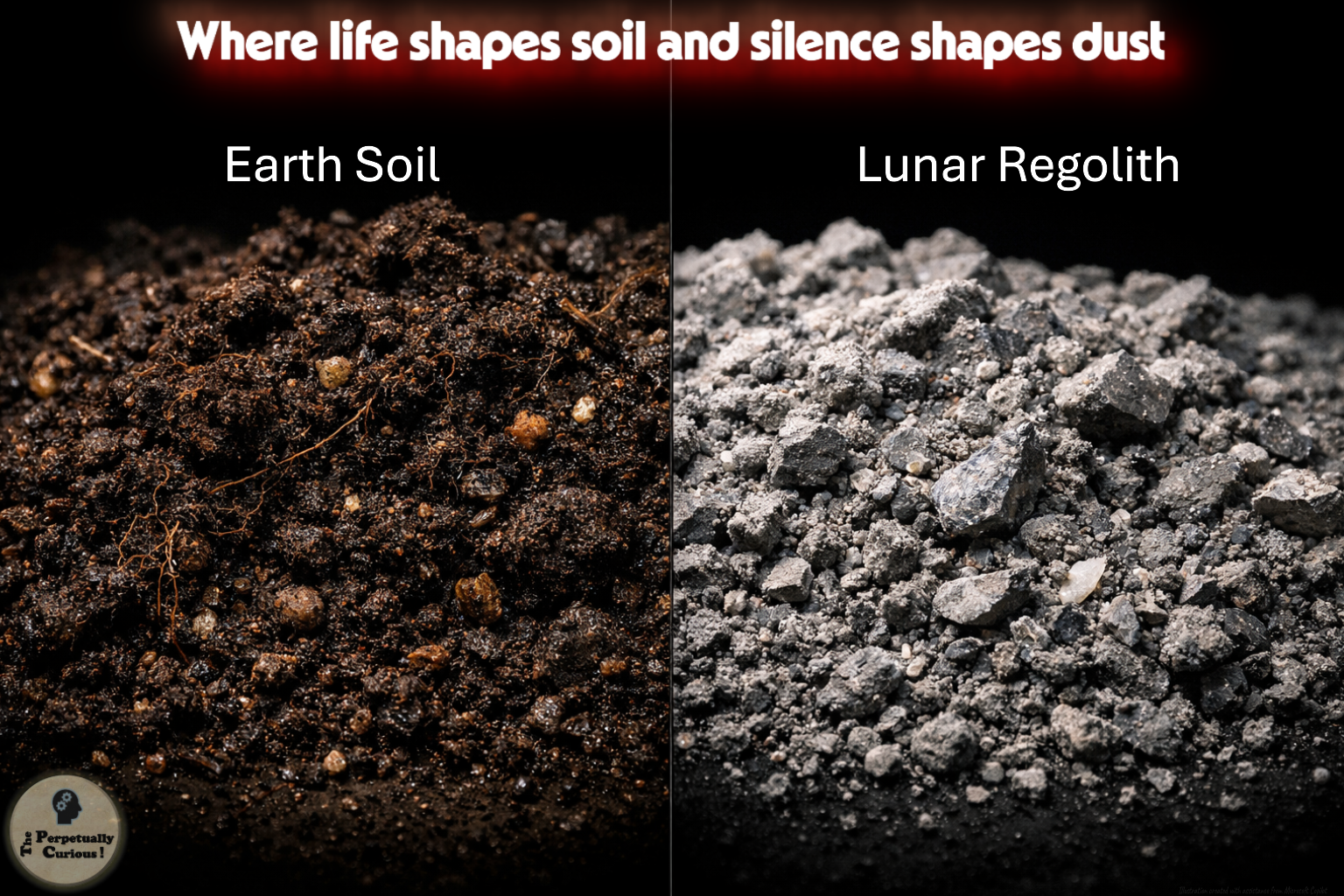
The Earth keeps its stories in living soil that shifts and breathes, while the Moon holds its history in dust shaped by silence and light.
Between them lies a record of two worlds that began together yet grew apart.
In their grains and shadows, the long memory of their shared origin still waits in quiet patience.
🌋 From a Shared Beginning to Divergent Worlds
Earth and Moon are companions in space, and their relationship is not only poetic but also physical. The leading scientific view is that the Moon formed after a giant impact in the early history of the solar system, when a large body collided with the young Earth and ejected material into orbit. Over time, this debris gathered into the Moon, which retained a composition broadly similar to Earth’s mantle.
This shared origin explains why both bodies contain similar elemental building blocks. Oxygen, silicon, iron, magnesium, and aluminum appear prominently in rocks from both worlds. Their isotopic signatures are also remarkably similar, which strengthens the view that they were once part of the same planetary system.
The Moon’s smaller size, early heating, impact‑driven history, and differences in planetary gravity left it more depleted in many volatile elements than Earth, setting the two bodies on increasingly different evolutionary paths.
The Moon also cooled more quickly, forming a thick crust and limiting long‑term volcanic activity compared to Earth, with most lunar volcanism ceasing within the first few billion years of solar system history. These differences set the stage for the very different soils that formed on each surface.
To understand how two worlds built such different materials from the same elements, it helps to look more closely at the chemistry that governs their minerals.
🧪 One Periodic Table, Many Pathways
Earth soil and lunar regolith are built from minerals that contain familiar elements, each shaped by the fundamental properties that define them. The periodic table provides the ingredients, but the recipes differ, shaped by the presence or absence of water, atmosphere, and biological activity.
Silicate minerals, iron‑bearing compounds, and aluminum‑rich phases appear in both environments. Yet the chemistry that acts upon these minerals is governed entirely by context. Even minerals such as olivine, which occur in both terrestrial basalt and lunar mare rock, follow different pathways depending on the conditions around them.
On Earth, water, atmosphere, and life continually rearrange and transform minerals. Iron cycles between oxidized and reduced forms. Clay minerals form through long‑term weathering. Organic matter accumulates as plants and microbes live and die. Hydrated minerals become common, and carbon‑based compounds enrich the soil. Earth’s ability to sustain these processes is closely tied to its living atmosphere, which maintains the water cycle and supports the chemistry that allows soil to evolve.
On the Moon, vacuum, micrometeorites, and solar wind shape the surface. Impacts fracture and melt minerals, creating glassy coatings. Solar wind particles, including predominantly hydrogen and helium ions as well as minor amounts of carbon, nitrogen, and noble gases, implant themselves into mineral grains. Nanophase metallic iron forms within glassy rims, altering how the surface reflects light. Minerals remain largely anhydrous, and oxidation is limited due to the absence of free oxygen.
🌾 How Earth Builds Soil Through Water, Air, and Life
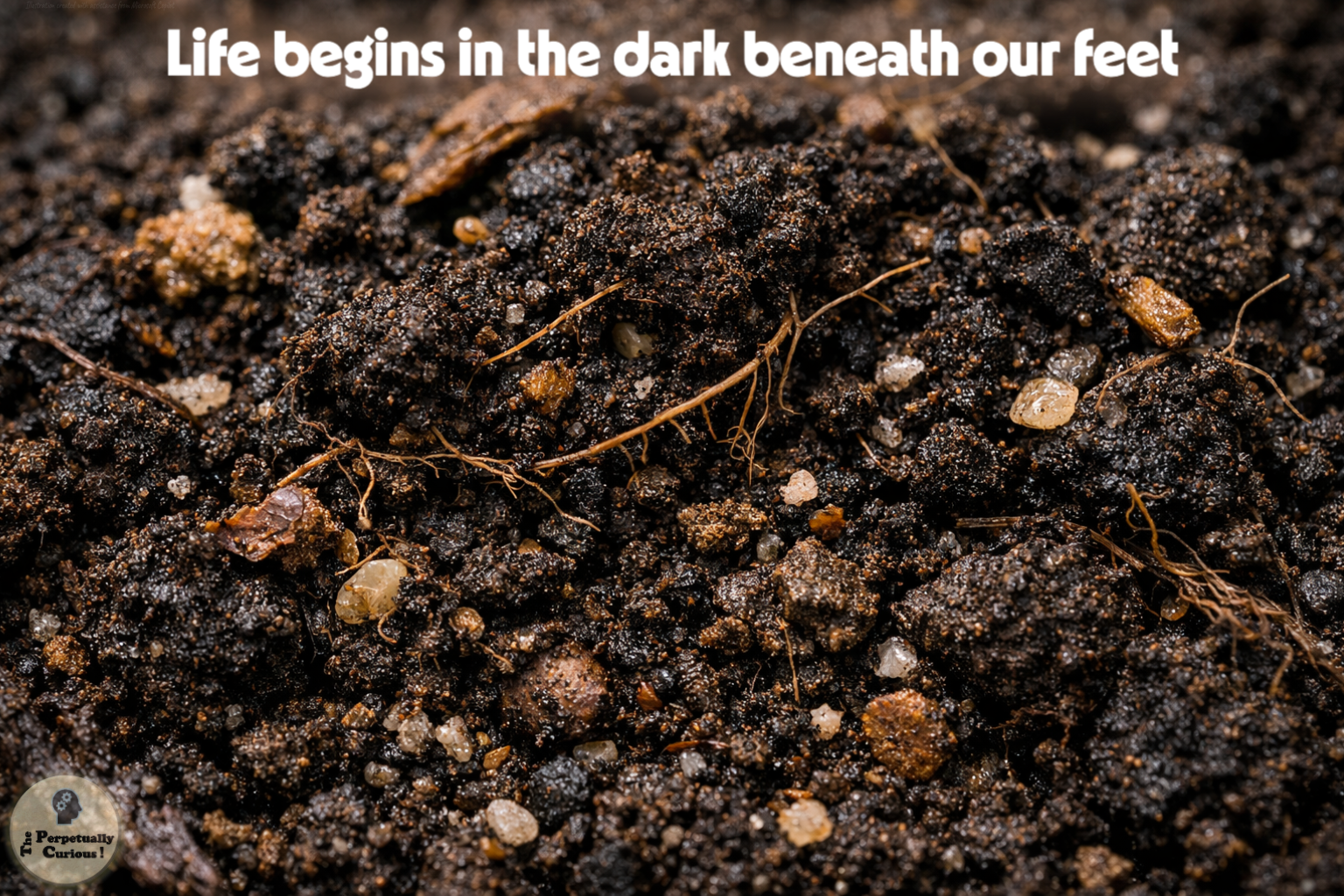
Earth soil forms through a combination of physical, chemical, and biological processes that act over thousands to millions of years. Bedrock and sediments break down through freeze–thaw cycles, abrasion, and chemical reactions with water. Rainwater, slightly acidic due to dissolved carbon dioxide, slowly dissolves and alters minerals, creating clays such as kaolinite and smectite.
Biology plays a central role. Roots penetrate cracks, microbes transform nutrients, and decaying plant material becomes humus. This organic matter darkens many soils, improves their ability to hold water, and provides a reservoir of carbon and nutrients.
Earth soil also develops layers known as horizons. These layers reflect differences in organic content, mineral composition, and weathering intensity. Over time, wind and flowing water round soil particles, transport them across landscapes, and sort them into distinct textures. The chemistry that gives Earth soil its varied hues is similar to the processes that influence why mud turns brown or black, where iron minerals and organic matter interact to create familiar browns and blacks.
Because Earth soil is shaped by water, air, and life, it becomes a dynamic and evolving system. To see how different lunar regolith is, it helps to step outward to the Moon, where none of these familiar agents are present.
🌙 How the Moon Builds Regolith Through Impacts and Vacuum
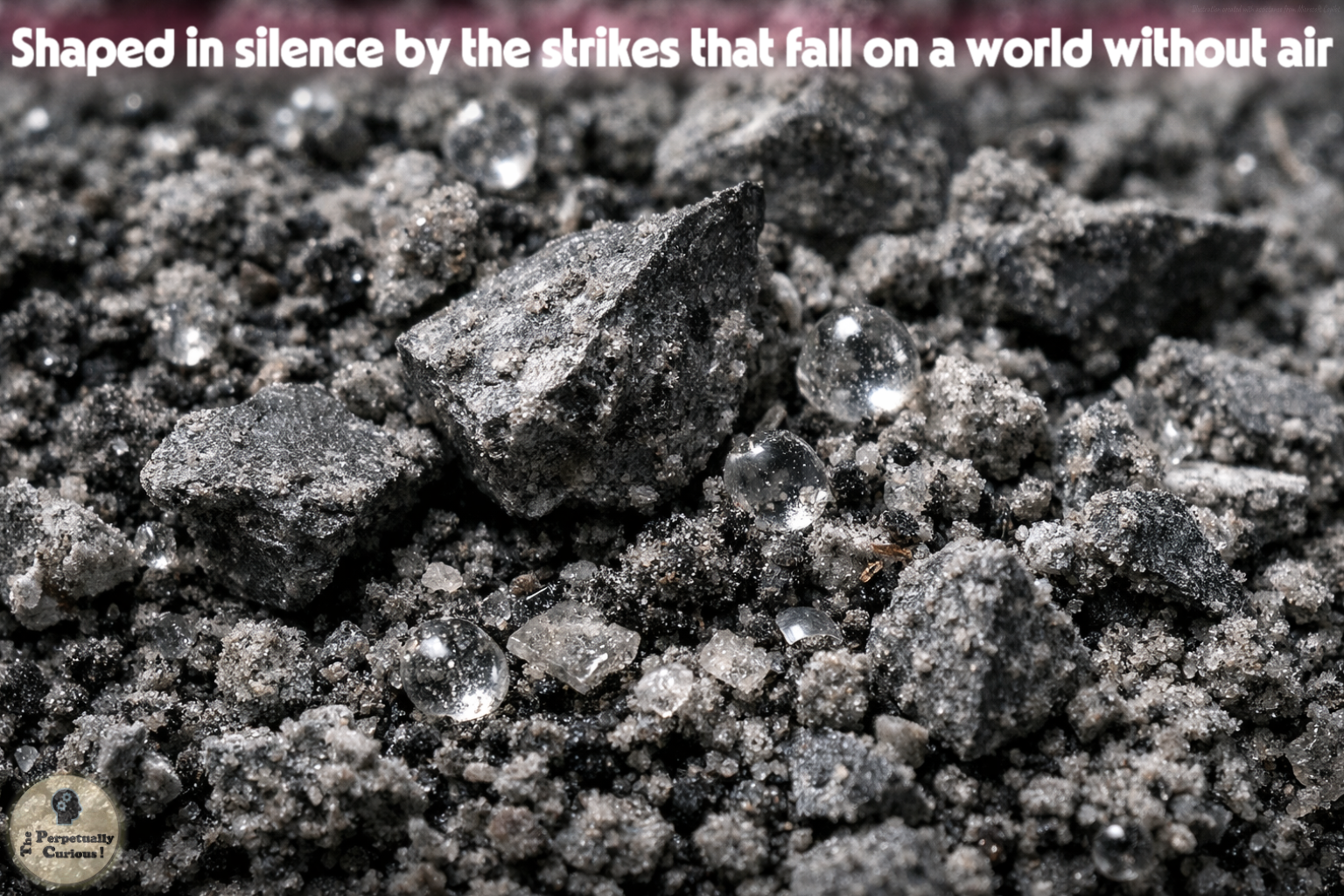
The Moon has only a tenuous exosphere, no liquid water, and no surface life. As a result, its “soil,” known as regolith, forms through entirely different processes. The primary agents are meteoroids and micrometeorites, which strike the surface at high speeds. These collisions fracture rocks, pulverize them into smaller fragments, and sometimes melt them, creating glassy materials that weld together broken pieces into structures known as agglutinates.
Because there is no wind or flowing water to smooth edges, lunar regolith grains remain sharp and angular. With no substantial atmosphere to filter or slow incoming particles, solar wind ions directly strike the surface. These particles implant themselves into mineral grains or contribute to chemical changes that produce nanophase metallic iron within glassy coatings.
The Moon’s surface is constantly churned by impacts, a process known as impact gardening. Over millions of years, this churning mixes older and younger materials, creating a complex and layered regolith. Some regions also contain tiny volcanic glass beads formed by ancient fire fountains, which add further variety to the surface.
Extreme temperature swings, from about +250°F (+121°C) during the lunar day to about –208°F (–133°C) at night, contribute to thermal fracturing of rocks and grains. In permanently shadowed polar craters, temperatures can fall even lower, approaching –400°F (–240°C). Without a substantial atmosphere or an Earth‑like global magnetic field, the surface is also exposed to cosmic rays, which subtly alter grain chemistry over time. A deeper look at the structure and behavior of the lunar regolith offers additional insight into how repeated impacts and radiation shape the Moon’s surface.
With these processes in view, Earth soil and lunar regolith can be placed side by side in a direct comparison.
🧭 Grain by Grain: Texture, Color, and Composition Compared
Placed side by side, Earth soil and lunar regolith reveal striking differences. Earth soil often contains rounded grains, mixed with organic fragments, roots, and sometimes visible organisms. It may feel soft or crumbly, and its color can range from light tan to deep brown or black, depending on mineral content and organic matter. Moisture is frequently present, and the soil may release a characteristic scent after rain.
Lunar regolith, in contrast, is dry and essentially devoid of organic matter. Its grains are angular and may be coated with glassy films that contain nanophase iron. These coatings darken the regolith and influence how it reflects light. The regolith is also electrostatically active, especially under sunlight, which may cause dust to cling to surfaces.
Particle size distribution differs as well. Lunar regolith can be extremely fine, sometimes comparable to talcum powder, while also containing larger rock fragments, including breccias. Earth soil, shaped by water and life, often contains mixtures of sand, silt, and clay that vary widely across different landscapes.
These differences arise from the contrasting forces that shape each world. Understanding these contrasts provides a foundation for examining how impacts, radiation, and time continue to transform the lunar surface.
☄️ Asteroids, Micrometeorites, and the Quiet Work of Space Weathering
On Earth, small meteoroids burn up in the atmosphere, and only a fraction reach the ground. Soil is shaped primarily by weather, water, and biology. Over time, erosion and vegetation obscure impact features, and soil continues to evolve under terrestrial conditions.
On the Moon, every meteoroid, from tiny grains to larger bodies, has the potential to reach the surface. Micrometeorites strike at high velocities and create microcraters. These impacts melt small volumes of material, forming glass that cements fragments together. Repeated bombardment gradually reduces particle size and increases regolith thickness. Many of the small meteoroids that strike the Moon are fragments of asteroids, including bodies that trace their origins to the asteroid belt, along with debris from other sources that together shape the lunar surface over time.
Space weathering, which includes micrometeorite impacts, solar wind irradiation, and cosmic ray exposure, modifies the surface over millions of years. These processes produce nanophase iron, alter grain surfaces, and change the optical properties of the regolith. The influence of the solar wind becomes especially clear in the way it implants particles into mineral grains and contributes to the formation of nanophase iron.
This contrast explains why lunar regolith retains sharp edges and complex glassy structures, while Earth soil is smoothed and reshaped by water and air. These differences provide a foundation for understanding how planetary surfaces evolve under different environmental conditions.
🔭 What Two Soils Reveal About Two Worlds
Earth soil and lunar regolith reflect deeper differences in planetary environments. Earth’s surface supports liquid water, a thick atmosphere, and a biosphere that extends from microscopic life in soil to forests and grasslands. Studies of life in extreme environments help clarify why biological activity transforms Earth soil so profoundly while remaining absent from the lunar surface. These conditions allow soil to become a medium for growth, nutrient cycling, and climate regulation.
The Moon, by contrast, presents a surface exposed directly to space. Its regolith records the history of impacts and solar wind, but it does not host active biological cycles. The absence of liquid water and atmosphere limits chemical weathering and prevents the formation of the kind of soil that supports terrestrial ecosystems. Earth’s magnetic field also protects its surface from radiation that alters lunar grains. The Moon, lacking such protection, preserves a long record of solar and cosmic processes.
Understanding both materials together provides a more complete picture of how planets and moons transform the same elemental building blocks into very different landscapes. This comparison sets the stage for examining the scientific futures written in soil and dust.
🚀 Looking Ahead: Scientific Futures Written in Soil and Dust
As space agencies and research institutions advance plans for sustained lunar presence and surface science, lunar regolith has become a focus of scientific study. Its mechanical properties, chemical composition, and response to radiation are important for understanding how equipment and experiments may interact with the surface.
Regolith also contains oxygen bound within minerals, which has led to studies on how this oxygen might be extracted. Plant growth experiments using regolith simulants explore how terrestrial organisms respond to such material under controlled conditions, although these studies remain exploratory.
On Earth, soil science continues to investigate how mineral composition, organic matter, and climate interact to shape ecosystems. Comparing Earth soil and lunar regolith offers a way to place terrestrial processes within a broader planetary context.
This broader view prepares the ground for a gentle invitation to share the story, followed by educational highlights and a FAQ.
Pass this article along to someone curious and let the learning travel.
💡 Did You Know
🌕 Lunar regolith is generally thicker in the ancient highland regions than in the younger mare lowlands. Highlands typically reach depths of about 33 to 49 feet (10 to 15 meters), while mare regions average closer to 13 to 16 feet (4 to 5 meters), a difference that reflects billions of years of additional bombardment in the highlands.
🌍 A single teaspoon of healthy Earth soil may contain hundreds of millions to more than one billion microorganisms, a level of biological richness that has no counterpart on the lunar surface.
🌑 Nanophase metallic iron in lunar regolith alters how the surface reflects light, contributing to the mature appearance of older regions.
🌕 Some lunar regolith contains tiny beads of volcanic glass formed by ancient fire fountains.
🌡️ Lunar regolith experiences temperature swings of several hundred degrees Fahrenheit between sunlight and darkness, with equatorial surface conditions often ranging from about +250°F (+121°C) in daylight to about –208°F (–133°C) after nightfall, while colder shadowed regions can fall much lower.
🧲 Some lunar rocks preserve traces of an ancient magnetic field, suggesting that the Moon once had a molten core capable of generating magnetism.
🌱 The scent noticed after rain on Earth arises from compounds released by soil and microbes, a sensory experience that would not occur on the effectively airless lunar surface.
Is lunar regolith considered soil in the same way as Earth soil?
Lunar regolith is often described as lunar soil in informal contexts, but scientifically it differs from Earth soil because it contains no organic matter, no liquid water, and no active biological processes. A closer look at the structure of the lunar regolith helps clarify why it does not function as soil in the terrestrial sense.
Are the elements in Earth soil and lunar regolith the same?
Many of the major elements are shared, including oxygen, silicon, iron, magnesium, and aluminum. However, their proportions and mineral forms differ, and Earth soil typically includes significant organic carbon and hydrated minerals.
Why are lunar regolith grains sharper than Earth soil grains?
On the Moon, there is no wind or flowing water to round particle edges. Grains are created and modified by impacts, which fracture and sometimes melt material, producing angular fragments and glassy coatings.
How does space weathering change lunar regolith over time?
Space weathering includes micrometeorite impacts, solar wind irradiation, and cosmic ray exposure. These processes may melt small volumes of material, create glassy agglutinates, and produce nanophase metallic iron. The role of the solar wind is especially important in shaping the chemistry of grain surfaces.
Does the Moon have anything similar to soil horizons?
The Moon does not have soil horizons in the terrestrial sense. However, regolith layers can show differences in maturity, impact history, and glass content.
Why is lunar regolith difficult to handle in laboratory settings?
Lunar regolith grains are sharp, fine, and electrostatically active, which makes them cling to surfaces and equipment. Their angularity also increases abrasion.
Does the Moon have anything similar to soil moisture?
The Moon does not have liquid water in its regolith. However, trace amounts of water molecules and hydroxyl groups may be present in some grains due to solar wind interactions, and ice exists in permanently shadowed polar regions. These forms of water do not create moisture in the terrestrial sense and do not make the regolith wet.
Would Earth soil or lunar regolith experience more asteroid impacts?
Lunar regolith experiences far more direct impacts than Earth soil because the Moon has no substantial atmosphere to burn up small meteoroids. Every grain of lunar regolith has been shaped by countless micrometeorite strikes, while Earth soil is largely protected by atmospheric entry, weather, and biological activity that erase or soften impact traces. Some of these meteoroids are fragments of asteroids, including bodies that trace their origins to the asteroid belt, along with debris from other sources.
If water is added to lunar regolith, can it support life or plant growth?
Adding water alone does not allow lunar regolith to support life or plant growth. Lunar regolith lacks organic matter, nutrients, and the chemical buffering that Earth soil provides. The grains are sharp, reactive, and anhydrous, and they contain no plant‑available nitrogen, no biological carbon, and no microbial communities. Under controlled laboratory conditions, plants have germinated and grown in small samples of Apollo lunar regolith, but they exhibited stress responses and reduced vigor. Any sustained plant growth requires extensive modification of the regolith, including nutrient supplementation, organic matter, and environmental control.
Does the Moon receive rain, and can its surface ever become wet?
The Moon does not receive rain because it has no atmosphere capable of forming clouds or precipitation. Without an atmosphere, water cannot condense, fall, or pool on the surface. Any liquid water exposed to the lunar environment would either boil away in the vacuum or freeze solid in the extreme cold. Although trace water molecules, hydroxyl groups, and polar ice exist, the lunar surface never becomes wet in the terrestrial sense, and moisture cannot accumulate within the regolith.
Would microbes survive if placed directly on lunar regolith?
Most unprotected microbes would not remain viable or metabolically active for long on the lunar surface. The environment exposes them to vacuum, intense ultraviolet radiation, charged particles from the solar wind, and extreme temperature swings. Without atmospheric pressure, liquid water cannot exist, and without water, microbial metabolism cannot proceed. The regolith also contains reactive surfaces that may damage biological molecules. These conditions relate to the limits explored in the study of extremophiles, which clarifies why active biology cannot persist on the unprotected lunar surface.
Could lunar regolith become fertile if heavily modified?
Lunar regolith could only become fertile through extensive engineering. It would require the addition of organic matter, nutrients, water, microbial communities, and environmental control. These changes would transform the regolith into a soil‑like medium, but the resulting material would no longer be natural lunar regolith. It would be a human‑created substrate designed to mimic the ecological functions of Earth soil.
🌸 A Gentle Invitation to Share
Under the quiet light of two very different skies, Earth soil and lunar regolith tell stories about time, impact, and transformation. If this journey through dust and origin has sparked curiosity, that curiosity may travel further when shared.
We kindly invite you to share and spread the word. Within this gentle reflection, readers are encouraged to help this piece reach a wider audience by sharing it with friends, colleagues, and fellow explorers of ideas. Support in spreading the story of how two soils, born from the same elements, became such different worlds is deeply appreciated.
“Where Two Soils Part Ways: Earth, Moon, and the Stories Written in Dust.” The Perpetually Curious!, June 2026.
https://www.theperpetuallycurious.org/articles/lunar-regolith-vs-earth-soil/Continue Exploring
For what comes next
Site Updates gathers occasional notes, new additions, and ways to keep in touch. RSS brings new publications to your feed reader in chronological order.
Choose the path that speaks to you, and let the next curiosity find you wherever your wondering takes you.