

On certain nights, the planets appear as quiet lanterns suspended in the dark, drifting along their ancient paths. To the eye, they seem serene and still. Yet each one is a massive world in motion, circling the Sun with tremendous momentum. For spacecraft, these worlds are not only destinations. They are moving sources of energy that can be borrowed with careful timing. The gravity assist, often called the gravitational slingshot, is the technique that allows small machines from Earth to ride these planetary motions and travel far beyond what their own fuel would permit. A sense of how planets shine and move across the sky can be found in the quiet behavior of planetary brightness, which offers a gentle reminder that these worlds are never truly still.
This article follows that journey from the challenge of reaching distant planets to the elegant physics that makes gravity assists possible. It traces how a subtle idea in orbital mechanics became one of the most important tools in cosmic exploration, and how it continues to shape the paths of spacecraft today.
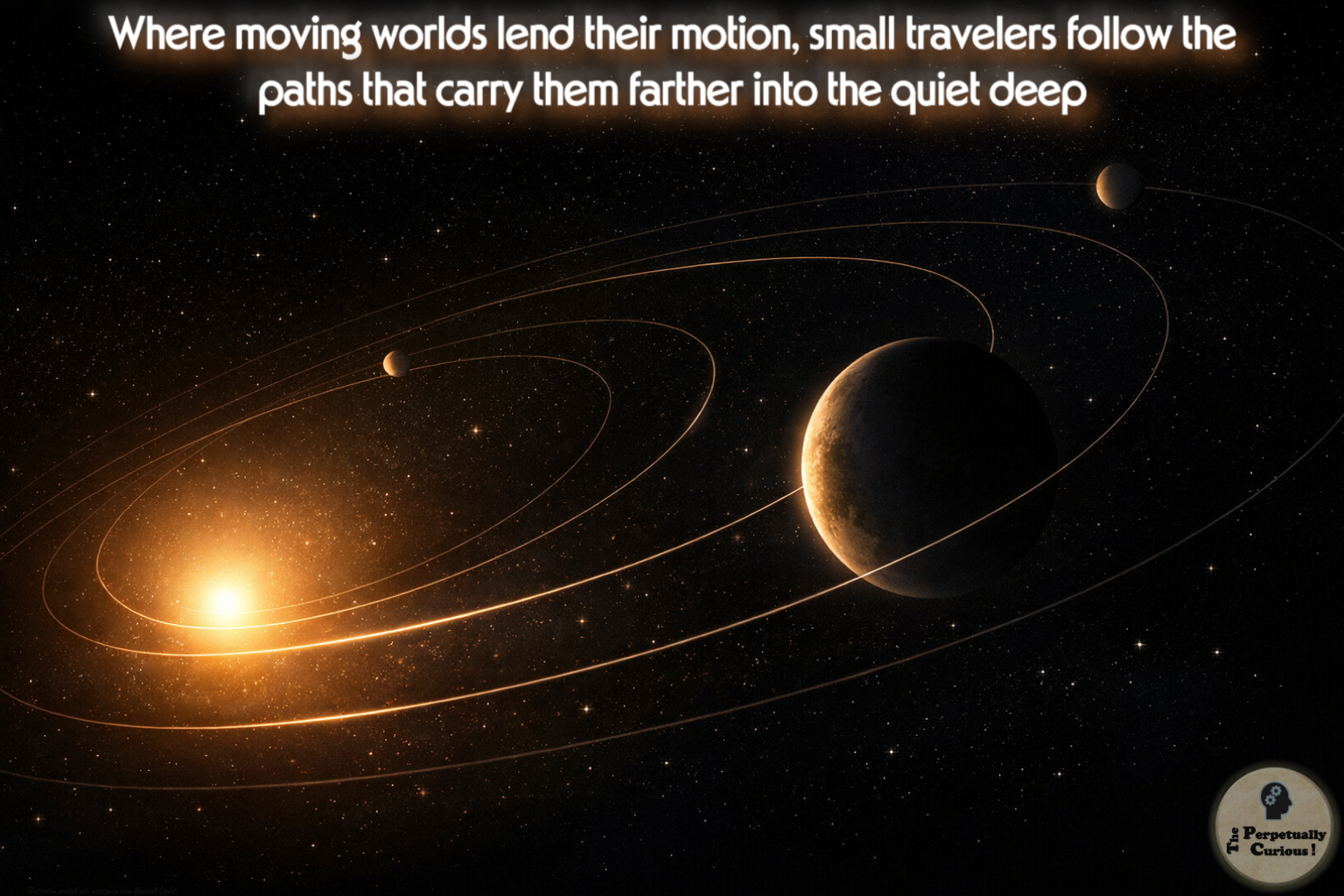
In the long sweep of the solar wind, small machines drift along the quiet paths shaped by worlds in motion.
Each encounter becomes a brief exchange of momentum and light, a moment when the sky opens a little farther.
Through these borrowed arcs, the solar system reveals itself as a place of gentle guidance as much as distant destinations.
🚀 Why Space Is Too Vast for Rockets Alone
Space is immense, and the distances between planets are far greater than they appear on classroom diagrams. Rockets are powerful, but they pay a steep price for every increase in speed. To send a spacecraft directly to the outer planets, engineers would need enormous fuel reserves. Every additional pound of propellant requires more structure to hold it, more thrust to lift it, and therefore even more propellant. This compounding requirement is often described as the tyranny of the rocket equation.
Reaching distant planets usually requires high heliocentric energy, especially when mission designers want travel times measured in years rather than many decades. Slow transfers may be possible in principle, but they can become impractical for spacecraft power, communication, and mission lifetime. A probe that attempted to reach Neptune or beyond using only its launch vehicle and onboard fuel would either take decades or require a launch system far larger than what is typically available.
Mission designers therefore began to look for another source of energy, one that did not need to be carried in tanks. The answer was already present in the solar system itself. The planets are not fixed targets. They are massive bodies in motion, and their orbital momentum can be tapped by a spacecraft that approaches them in the right way.
That search points directly to the gravity assist.
🪐 The Core Idea of a Gravity Assist
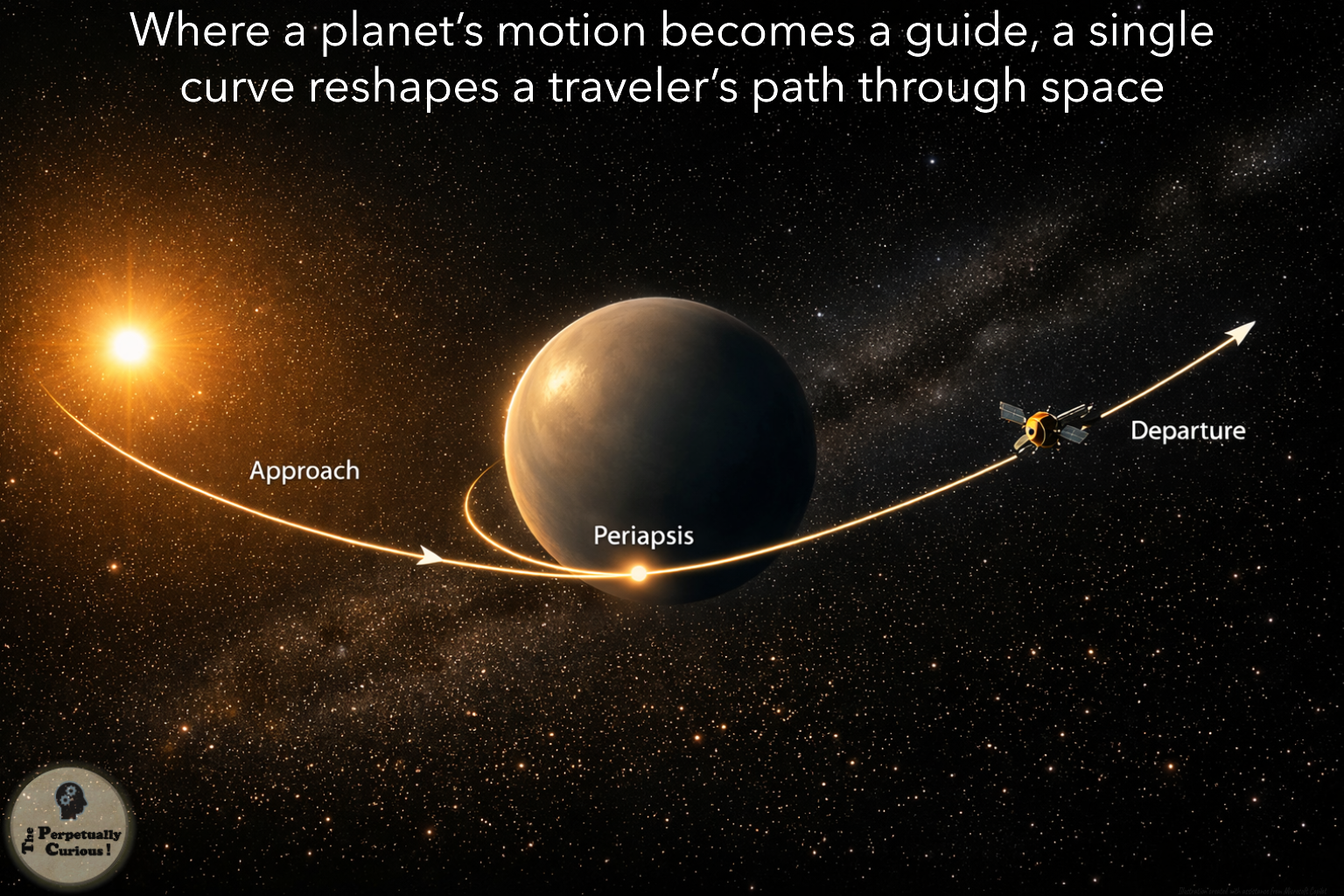
A gravity assist is a carefully planned flyby of a planet or moon that changes a spacecraft’s speed and direction relative to the Sun. The spacecraft falls into the planet’s gravitational field, curves around it, and then departs on a new trajectory. In the frame of reference of the planet, the spacecraft arrives and leaves with nearly the same speed. In the frame of reference of the Sun, however, the story is different.
The key is that the planet itself is moving. When a spacecraft approaches from behind a planet along its orbital path, the planet’s gravity pulls the spacecraft into a curved path and effectively drags it forward. The spacecraft leaves the encounter moving faster relative to the Sun than when it arrived. It has gained kinetic energy and momentum.
This gain is not created from nothing. The spacecraft has taken a tiny amount of orbital energy from the planet. The planet loses an almost unimaginably small fraction of its own momentum. Because the planet is so massive compared with the spacecraft, the change in the planet’s motion is effectively undetectable, while the change in the spacecraft’s motion is dramatic.
Seen from this perspective, the intuition behind the technique becomes clearer.
🌍 A Simple Analogy: A Ball and a Moving Train
Imagine a train moving along a track at a steady speed. Someone standing beside the track gently throws a ball toward the side of the train. If the train were not moving, the ball would simply bounce back with about the same speed it had when it was thrown.
If the train is moving, the situation changes. When the ball hits the side of the train, it interacts with something that is already in motion. If the ball bounces off in the direction the train is moving, it can leave with a much higher speed than it had before. The ball has gained energy from the motion of the train. The train, in turn, has lost a tiny amount of energy, although the change is far too small to notice.
A gravity assist works in a similar way. The spacecraft is like the ball. The planet is like the train. The gravitational field replaces the physical impact, but the exchange of momentum is analogous. In the planet’s frame, the spacecraft comes in and goes out with nearly the same speed. In the Sun’s frame, the spacecraft can leave with a higher or lower speed, depending on how the encounter is arranged.
This analogy is not perfect, because gravity acts continuously rather than at a single point of contact. However, it captures the essential idea that the spacecraft is not receiving free energy. It is participating in a momentum exchange with a massive body that is already in motion.
This analogy sets the stage for how mission planners shape these encounters.
🧭 How Mission Planners Shape a Slingshot
Designing a gravity assist is not a matter of simply aiming at a planet and hoping for the best. Mission planners must calculate the spacecraft’s approach path, the closest distance to the planet, and the angle at which it will depart. These parameters determine how much the spacecraft’s speed will change and in what direction it will be redirected.
The path is often described using the concept of a hyperbolic trajectory around the planet. As the spacecraft approaches, it follows a curved path shaped by the planet’s gravity. The point of closest approach, sometimes called periapsis, is critical. A closer pass generally produces a stronger deflection because the gravitational gradient is steeper near the planet. However, close passes also require careful attention to the planet’s atmosphere, radiation environment, and any nearby moons.
In the planet’s frame, the spacecraft’s speed before and after the encounter is nearly the same, although its direction changes. In the Sun’s frame, the spacecraft’s velocity vector is effectively rotated and either lengthened or shortened. This is what allows mission designers to send a spacecraft outward toward the outer planets, inward toward the Sun, or into a new orbital plane.
Because the planets move along predictable paths, these encounters must be timed with great precision. A gravity assist that arrives too early or too late may miss the desired alignment and produce a less useful change in trajectory. These principles become clearer when seen in the missions that first demonstrated their power.
🌠 The Grand Tour: Voyager and the Outer Planets
One of the most famous uses of gravity assists occurred with the Voyager missions. In the late 1970s, the outer planets happened to be aligned in a way that occurs roughly once every 175 years. This rare configuration arises because the giant planets have long orbital periods, and their relative positions repeat only over very long timescales.
Voyager 2, launched in 1977, first flew past Jupiter. During that encounter, Jupiter’s gravity increased the spacecraft’s speed by about 6 miles per second (about 10 kilometers per second) relative to the Sun. This boost allowed Voyager 2 to continue on to Saturn, where another gravity assist redirected it toward Uranus, and then Neptune. Without these planetary flybys, a mission that visited all four giant planets would have been extremely difficult with the launch vehicles available at the time. The longevity of these missions was supported by radioisotope thermoelectric generators, which provided steady power far from the Sun.
Voyager 1 followed a different path. It used Jupiter and Saturn to gain enough energy to leave the solar system entirely. The gravity assists provided the additional speed needed to reach what is called escape velocity from the Sun. Today, both Voyager spacecraft are traveling through interstellar space, carrying with them a record of their journey and a small golden message from Earth.
These missions demonstrated that gravity assists are not a minor refinement. They are a central technique that can transform what is possible in deep space exploration. The next generation of missions continued to refine this approach.
🛰️ Cassini, New Horizons, and the Art of Multiple Flybys
The Voyager missions were not the only ones to rely on gravity assists. Later spacecraft used the technique in more complex ways. The Cassini mission to Saturn, for example, used a sequence of flybys to build up the energy needed to reach its distant target.
Cassini launched in 1997 and did not travel directly to Saturn. Instead, it first flew past Venus twice, then Earth, and then Jupiter. Each encounter added a little more speed and adjusted the trajectory. This series of assists allowed Cassini to reach Saturn in about seven years without requiring an impractically large rocket. Once in the Saturn system, Cassini also used gravity assists from Saturn’s moon Titan to reshape its orbit many times. These encounters highlight the vital role that large planetary moons can play when navigating complex systems like Saturn’s.
New Horizons, the mission that flew past Pluto in 2015, also benefited from a gravity assist. After launch in 2006, it passed Jupiter in 2007. That encounter increased its speed by about 2.5 miles per second (about 4 kilometers per second) and shortened its travel time to Pluto by approximately three years. Without that assist, the spacecraft would have taken significantly longer to reach the distant dwarf planet. Its journey continued into the Kuiper Belt, where it explored the icy frontier beyond Pluto.
These examples show that gravity assists are not only about reaching the outer solar system. They are also about making missions more efficient, shortening travel times, and enabling complex paths that would otherwise be out of reach. They also reveal that gravity assists can remove energy as well as add it.
🔥 Falling Toward the Sun: Using Gravity Assists to Slow Down
Gravity assists are often associated with speeding up spacecraft, but they can also be used to slow them down. This may seem counterintuitive at first. However, the same momentum exchange that can add energy to a spacecraft’s orbit can also remove it, depending on the geometry of the encounter.
The Parker Solar Probe, launched in 2018, is a striking example. Its goal is to travel closer to the Sun than any previous spacecraft in order to study the solar corona and the solar wind. To fall inward toward the Sun, the probe must lose a significant amount of orbital energy and angular momentum inherited from Earth’s motion around the Sun. Objects near the Sun move faster in their orbits, so a spacecraft must shed energy to lower its perihelion rather than attempt to match those speeds. The solar corona and solar wind that the probe is designed to study directly shape the environment it must survive during each close pass.
Instead of aiming behind a planet, Parker Solar Probe repeatedly passes in front of Venus, against the direction of Venus’s motion. Each Venus flyby removes a small amount of energy from the spacecraft’s orbit. Over multiple encounters, this gradually lowers the probe’s closest approach to the Sun. Parker Solar Probe passed within approximately 3.8 million miles (about 6.2 million kilometers) of the solar surface on December 24, 2024, the closest any human-made object has ever come to the Sun.
Other missions have used similar techniques to enter orbit around inner planets. The MESSENGER mission to Mercury, for example, used flybys of Earth, Venus, and Mercury itself to shed energy gradually before settling into orbit. These examples show that gravity assists can act as a kind of gravitational braking system.
Seen through these missions, the underlying physics becomes easier to approach.
🧮 The Physics Behind the Elegance
Although the basic idea of a gravity assist can be described with analogies, the underlying physics rests on well‑established principles of orbital mechanics and conservation laws. The total energy and momentum of the planet‑spacecraft system are conserved. The spacecraft’s path is governed by the gravitational attraction between it and the planet, combined with the motion of both bodies around the Sun.
In the simplest description, the encounter can be treated as an almost elastic interaction in the planet’s frame of reference. The spacecraft approaches on a hyperbolic trajectory, swings around the planet, and departs with nearly the same speed. The direction of its velocity vector changes, and when that vector is transformed back into the Sun’s frame, the spacecraft’s speed relative to the Sun may be higher or lower.
The amount of speed change depends on several factors. These include the planet’s mass, the spacecraft’s approach speed, the angle of approach, and the distance of closest approach. Massive planets such as Jupiter can provide very large boosts, while smaller bodies provide more modest changes. However, even modest changes can be extremely valuable when accumulated over long distances and times. The broader variation in gravity across worlds is explored in the companion piece on gravity across the planets, a context that deepens appreciation for why some assists are far more powerful than others.
In practice, mission designers use detailed numerical simulations to plan these encounters. They must account for the gravitational influence of multiple bodies, the shape of the planet’s gravitational field, and any non‑gravitational forces such as solar radiation pressure. The resulting trajectories are often described using the patched conic approximation, in which the spacecraft’s path is modeled as a sequence of conic sections around different bodies. In simple terms, this means the spacecraft’s path is treated as a series of two‑body problems, each governed by a single dominant body at a time. This method simplifies the complex multi‑body problem into manageable segments.
Once these physical principles are in view, the role of gravity assists in shaping ambitious missions becomes clearer.
🌌 Why Gravity Assists Matter for Cosmic Exploration
Gravity assists have reshaped what is possible in space exploration. They allow spacecraft to reach distant targets with smaller launch vehicles and more modest fuel reserves. They make it feasible to visit multiple worlds in a single mission, to enter orbit around difficult targets, and to explore regions of the solar system that would otherwise be out of reach.
They also embody a particular kind of ingenuity. Instead of overpowering the solar system with larger rockets, engineers learned to work with the existing motions of planets. The technique is a reminder that careful understanding of physics can open doors that brute force alone cannot. The ability to communicate across these vast distances depends on radio waves, which carry signals between spacecraft and Earth and make it possible for these missions to return their discoveries home.
These principles continue to shape mission design. As new missions are planned to explore icy moons, distant dwarf planets, and perhaps one day interstellar space, gravity assists remain a central part of the toolkit.
As these ideas continue to evolve, they point toward the future paths that spacecraft may follow.
🌉 From Planetary Flybys To Future Journeys
The story of gravity assists is still unfolding. Future missions may chain together even more complex sequences of flybys, not only around planets but also around large moons. Some proposed concepts for interstellar precursor missions rely on powerful assists from Jupiter combined with close solar passes to reach very high speeds. These trajectories weave through the inner solar system in carefully timed arcs that take advantage of planetary motion.
At the same time, gravity assists will continue to support more modest but equally important missions. Probes that study the Sun, inner planets, or small bodies may use multiple flybys to fine‑tune their orbits. Each encounter will be another example of how a deep understanding of orbital mechanics can turn the vastness of space into a navigable landscape. Some of these paths may eventually extend toward the distant frontier of the solar system, where the outermost reservoirs of comets reside.
In this way, gravity assists connect the practical needs of mission design with a broader sense of wonder. They show that the solar system is not only a collection of destinations. It is also a network of pathways. Along those pathways, small machines from Earth travel by borrowing, for a moment, the motion of giants.
This brings us to a gentle invitation.
Pass this article along to someone curious and let the learning travel.
💡 Did You Know
🌍 Gravity assists can change a spacecraft’s orbital inclination, not only its speed. This allows missions to reach targets that lie above or below the plane of the planets.
🛰️ Mariner 10, launched in 1973, was the first spacecraft to use a gravity assist in operational spaceflight, using Venus’s gravity to redirect its path toward Mercury, which it reached in March 1974.
🧮 Michael Minovitch was among the early pioneers who formalized the mathematics of gravity assist trajectories in the 1960s, when he was a graduate student at UCLA. His calculations helped demonstrate that multi‑planet missions were achievable with existing technology.
🪐 Some missions within the Jupiter and Saturn systems have used moon flybys to reshape their orbits without large fuel expenditures.
☀️ The Parker Solar Probe used a sequence of seven Venus flybys to remove orbital energy gradually, allowing it to reach its record‑setting closest approach to the Sun in 2024.
☄️ Comets and asteroids also experience natural gravity assists. When a small body passes near a planet, its orbit can be altered significantly over long timescales.
What is a gravity assist in simple terms?
A gravity assist is a maneuver in which a spacecraft flies close to a planet or moon in order to change its speed and direction relative to the Sun. The spacecraft uses the gravity and motion of the larger body to gain or lose energy without burning additional fuel.
Does a gravity assist give the spacecraft free energy?
The spacecraft does gain kinetic energy, but it is not free in an absolute sense. The energy comes from the orbital motion of the planet or moon. The larger body loses a very small amount of energy and momentum, although the change is so tiny that it is effectively impossible to detect.
Why does the planet not noticeably slow down?
The planet is enormously more massive than the spacecraft. Even if the spacecraft gains a significant amount of speed, the corresponding loss of speed for the planet is extremely small. The change in the planet’s orbit is far below any measurable threshold.
Can gravity assists be used to slow a spacecraft down?
Yes. If a spacecraft passes in front of a planet, against the direction of the planet’s motion, the gravitational interaction can remove energy from the spacecraft’s orbit. This allows the spacecraft to slow down relative to the Sun and fall inward, which is useful for missions to the inner solar system or for entering orbit around certain planets.
How accurate do the trajectories need to be for a gravity assist to work?
Gravity assist trajectories require very precise planning. The spacecraft must arrive at the right place at the right time and with the correct speed and direction. Small errors can be corrected with course correction maneuvers, but the overall alignment with the planet’s position and motion must be carefully calculated.
Which missions are famous for using gravity assists?
The Voyager 1 and Voyager 2 missions are well known for using gravity assists from the giant planets to visit multiple worlds and eventually reach interstellar space. Cassini used a series of assists from Venus, Earth, and Jupiter to reach Saturn. New Horizons used a Jupiter assist to reach Pluto more quickly. Parker Solar Probe used repeated Venus flybys to move closer to the Sun.
Can gravity assists be used around moons?
Yes. Large moons such as Titan and Ganymede can provide useful gravity assists. Cassini used Titan repeatedly to adjust its orbit within the Saturn system, and these encounters demonstrated how moon flybys can reshape a spacecraft’s path without large fuel expenditures.
Are there risks during flybys?
There can be risks related to radiation belts, atmospheric drag, or close approaches to moons or rings. Mission planners account for these factors when designing trajectories, and they choose paths that balance scientific goals with spacecraft safety.
Can gravity assists change a spacecraft’s orbital plane?
Yes. A gravity assist can tilt a spacecraft’s orbit, allowing it to reach targets that lie above or below the plane of the planets. This capability is especially valuable when visiting moons or when approaching bodies with inclined orbits.
Why are gravity assists sometimes preferred over rocket burns?
Gravity assists provide changes in speed and direction without requiring additional fuel. This allows missions to reach distant or difficult targets using smaller launch vehicles and more modest onboard propellant reserves.
How long will gravity assists remain important in space exploration?
As long as missions rely on conventional rockets and operate within planetary systems, gravity assists are likely to remain important. They provide a way to extend the reach of spacecraft without requiring impractically large amounts of fuel, and they complement other technologies that support deep‑space exploration.
Was Mariner 10 the first spacecraft to use a gravity assist?
Mariner 10, launched in 1973, was the first spacecraft to use a gravity assist in operational spaceflight. It used Venus’s gravity to redirect its trajectory toward Mercury, demonstrating the technique before the Voyager missions made it widely known.
Can a spacecraft receive multiple gravity assists from the same body?
Yes. The Parker Solar Probe, for example, made seven separate Venus gravity assist flybys during its mission, each one removing a small amount of orbital energy to bring the spacecraft progressively closer to the Sun. The Cassini mission similarly made over one hundred Titan flybys to reshape its orbit within the Saturn system.
🤝 A Gentle Invitation to Share
We kindly invite you to share and spread the word. Under the quiet arcs of these planetary paths, stories like this one travel farther when they are carried from person to person. If you found this exploration of gravity assists illuminating or beautiful, you may consider sharing it with friends, students, or colleagues who are curious about how spacecraft move among the planets. Your support in helping this story reach a wider audience is deeply appreciated.
“Borrowing the Orbits of Giants: How Gravity Assists Carry Spacecraft into the Deep.” The Perpetually Curious!, June 2026.
https://www.theperpetuallycurious.org/articles/gravity-assist-spacecraft/Continue Exploring
For the curious mind: want to explore this theme through a few questions? Visit the Classic Quiz Studio, nestled under Explorations opens in a new tab ,and see where a few well-placed questions lead: Cosmic Exploration Quizzesopens in a new tab
For what comes next
Site Updates gathers occasional notes, new additions, and ways to keep in touch. RSS brings new publications to your feed reader in chronological order.
Choose the path that speaks to you, and let the next curiosity find you wherever your wondering takes you.