
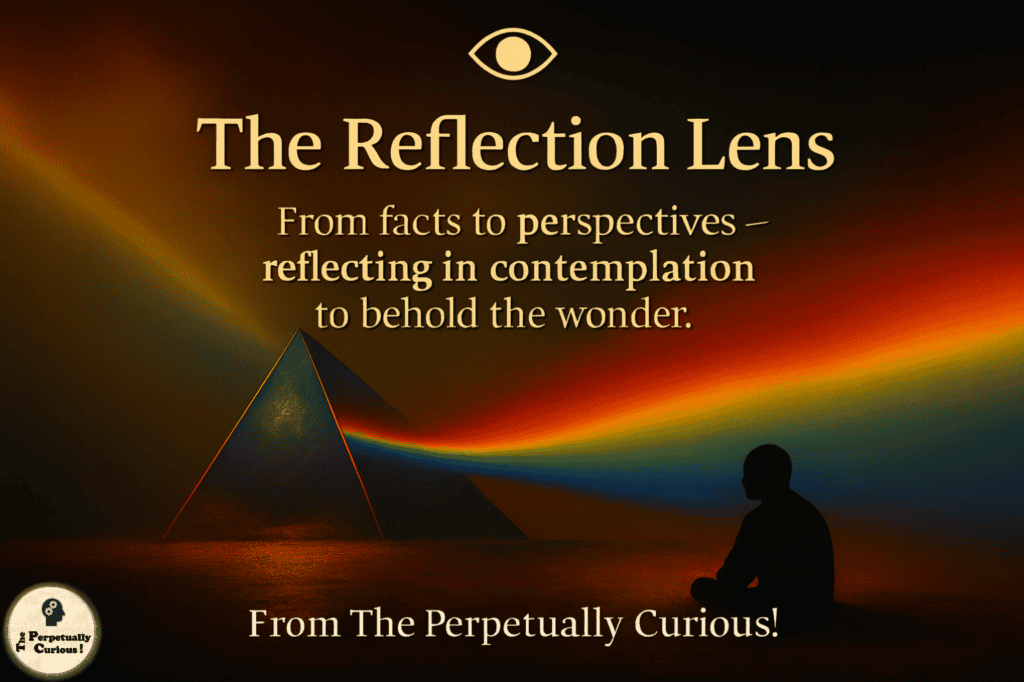
From facts to observation, moving through perspective and contemplation to sense the wonder
This series was born from a conviction: facts are powerful, yet they gain depth when held in reflection. Knowledge becomes more than information when it is seen through a wider frame, one where observation, philosophy, and perspective meet to reveal meaning.
A lens does not alter reality. It sharpens, clarifies, and sometimes uncovers what might otherwise remain unseen. In the same way, The Reflection Lens begins with what is observable and true, then pauses long enough to consider what unfolds when we sit with it.
Each reflection is a brief meditation on a fact, an observable truth. It may begin with something simple: the chemistry of a star, the rhythm of a heartbeat, the pattern of a leaf, or the instinct of an animal. Through reflection, it becomes a quiet shift in perspective, a way of sensing how the smallest detail belongs to a larger story.
These reflections do not seek final answers. They invite a return to the familiar, a willingness to linger, and a curiosity about how understanding changes when viewed through a different lens.
Through The Reflection Lens, The Perpetually Curious! brings together the precise and the contemplative, the intimate and the expansive, the known and the quietly unfolding. It is a chapter devoted to slowing down, sitting with what is true, and finding meaning in what endures.
Two ways into The Reflection Lens
The collection can be entered in two complementary ways. Begin with the lenses to understand the recurring perspectives that shape the series, or begin with the Atlas to browse the reflections themselves.
Explore the lenses that shape this series through Reflection Types.
Browse the published reflections across the growing collection.
A map for a growing collection
Memory, Silence, Time, Perception, Connections, and Earth are recurring ways of looking rather than rigid compartments. A reflection may begin with one lens and brush against another, but each offers a place from which attention can begin.
As the collection has grown, the Reflection Atlas provides a map through it. Its Lens Map gathers published reflections around these perspectives, while the Timeline offers a chronological path through the same collection.
Prefer to follow the collection through time?
The lenses offer orientation. The Atlas offers the collection. The Timeline offers its unfolding.
Choose a lens, follow a reflection, or simply begin with what catches your attention.