

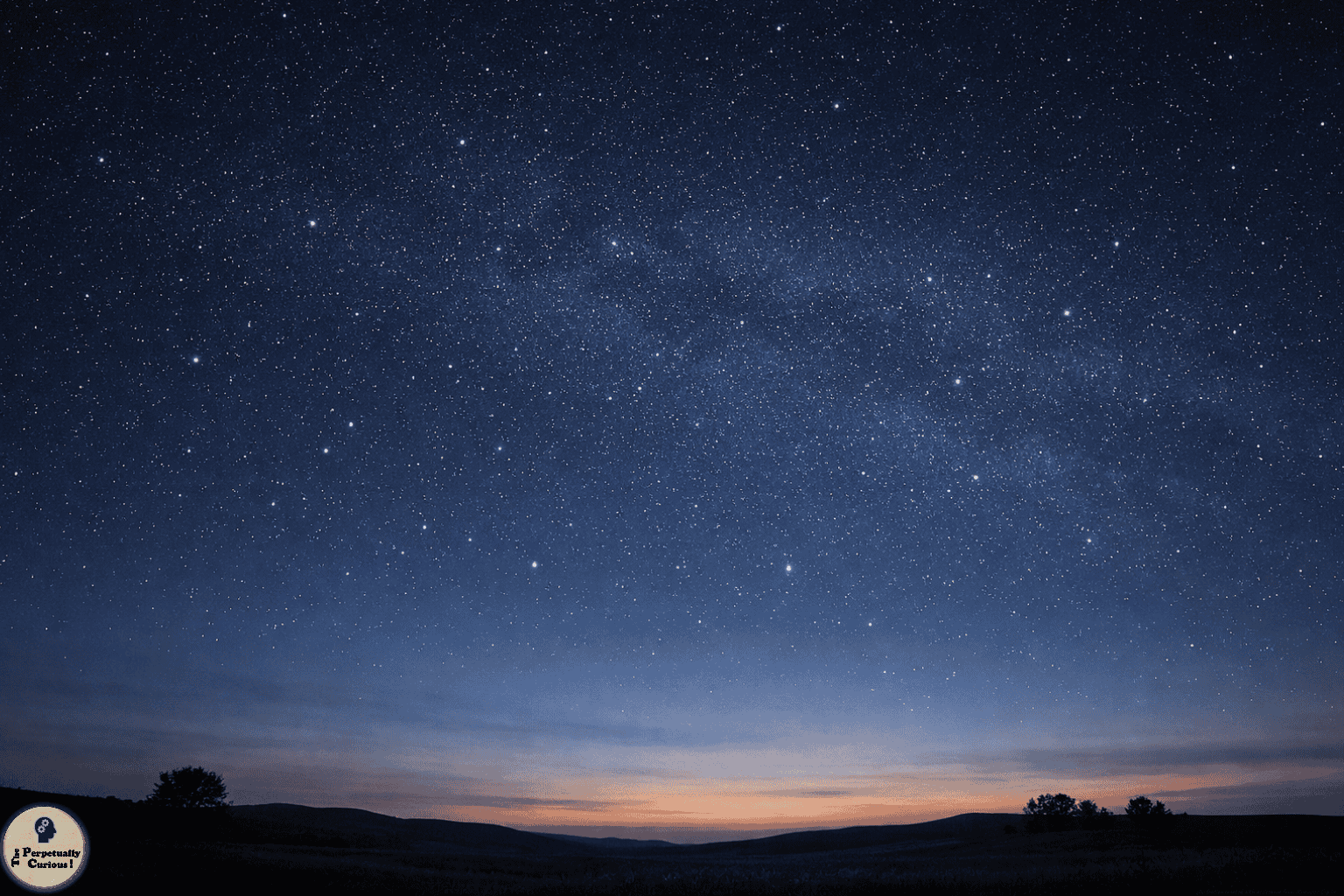
On a clear night, the sky stretches outward in a quiet sweep of light, and the stars appear as scattered points that invite the human mind to connect them. Across generations, people have traced patterns among these distant suns, creating constellations that carry memory, orientation, and meaning. These patterns are not only scientific markers on a celestial map. They are also part of how human beings have learned to live with the night, to navigate through seasons, and to share stories across time.
In the quiet after the facts settle, the subject reveals its softer edges.
What remains is the simple wonder of how it lives, moves, or changes the world around it.
🌌 What a constellation really is
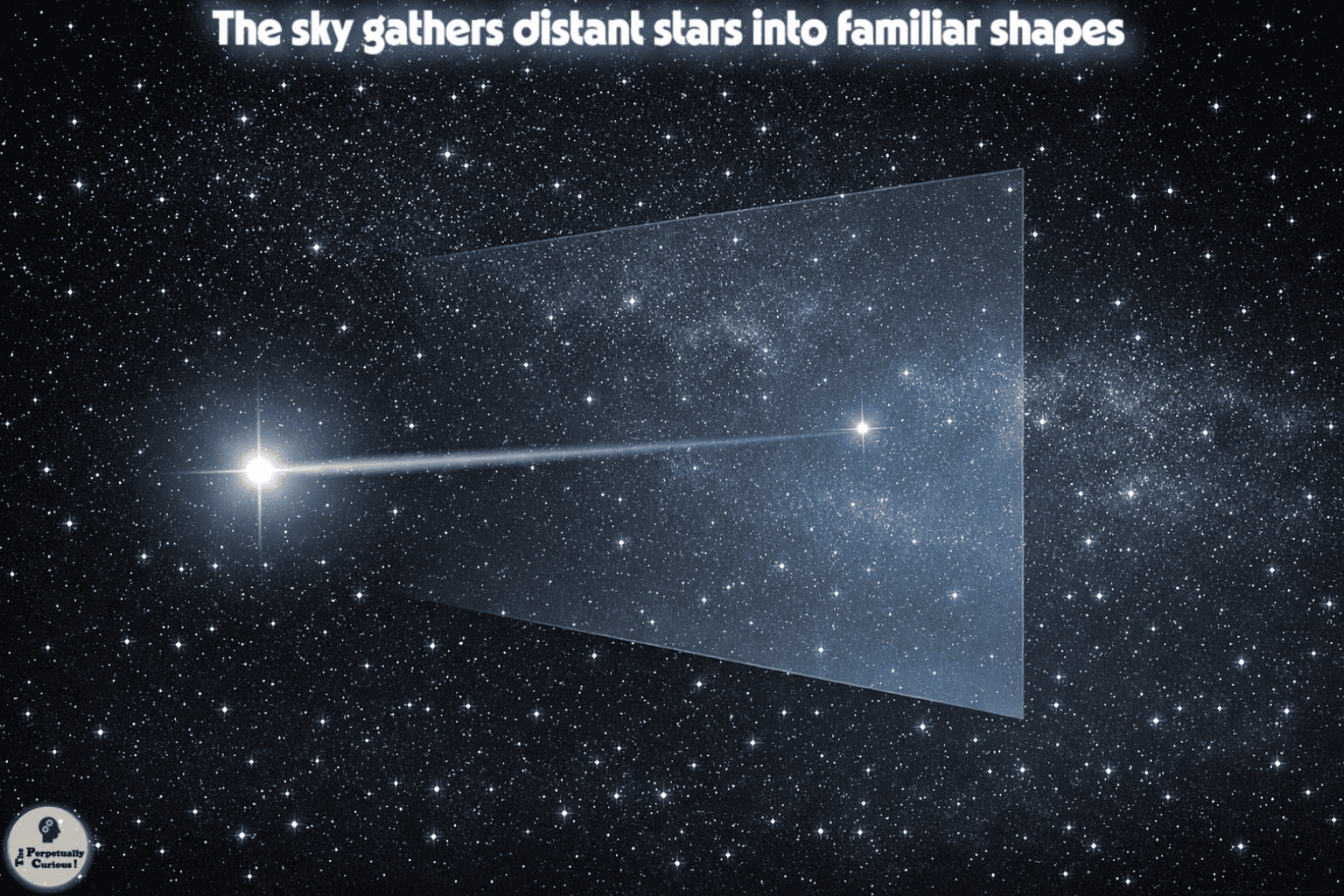
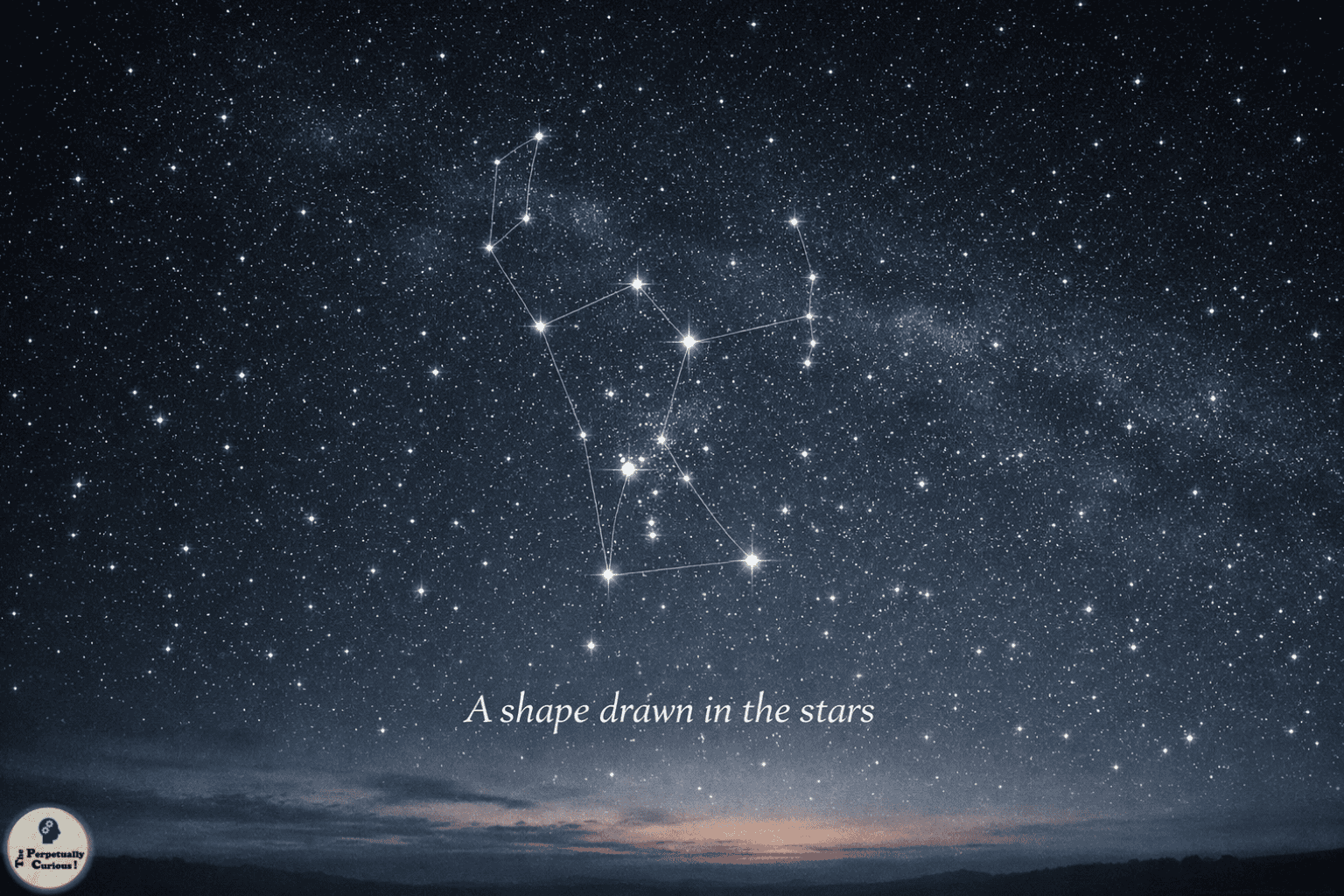
A constellation, in modern astronomy, is a defined region of the sky rather than a physical gathering of stars. The stars that appear to form a shape are usually separated by vast distances. In Orion, for example, Bellatrix lies roughly 250 light years away, while Alnilam, the central star of the belt, stands well over 1,200 light years distant. They share a line of sight from Earth, but nothing more.
This distinction reveals something important. Constellations are patterns of perception rather than structures of nature. They help astronomers describe where an object is located on the celestial sphere, much like neighborhoods on a map. Once this idea becomes clear, the rest of the story unfolds more naturally. Constellations become a bridge between human imagination and scientific mapping, between cultural memory and celestial geometry. Because every star that forms a visible constellation belongs to our own galaxy, constellations are a distinctly local sky language shaped by the stars within our own galactic neighborhood. Stars in other galaxies are far too distant to appear as individual points of light to the unaided eye and do not form part of the naked‑eye constellation patterns seen from Earth.
🧭 Constellations as tools for orientation
After understanding what a constellation is, it becomes natural to ask why people created them. Long before modern instruments, the night sky served as a clock, a calendar, and a compass. Constellations helped communities remember when seasonal rains might arrive, when certain animals might migrate, or when planting seasons might begin. Their daily rising and setting patterns reflect Earth’s rotation, while their changing visibility across the year reflects Earth’s orbit around the Sun, and these predictable motions allowed observers to mark the passage of time.
Constellations also guided navigation. Sailors in the Pacific used star paths to cross vast ocean distances, while travelers in deserts used bright patterns near the celestial poles to maintain direction at night. These patterns became memory devices in the sky, linking practical knowledge with cultural meaning.
Familiar patterns such as Orion, the Big Dipper in Ursa Major, and the Southern Cross in Crux became especially important, serving as reliable seasonal markers and directional guides across different cultures.
This functional role forms a natural transition to the next idea. Once patterns become part of daily life, they begin to accumulate stories, symbols, and cultural significance.
🕰️ Constellations across cultures and time
Different cultures have looked at the same stars and traced different shapes. In parts of the ancient Mediterranean world, observers recognized hunters, lions, and mythological figures. In Indigenous Australian traditions, dark constellations formed from the shadows of the Milky Way represented animals and ancestral beings. In Polynesian navigation traditions, star lines and clusters guided long-distance voyaging across the Pacific. In Andean cultures, constellations were linked to agricultural cycles and spiritual narratives. In Indian astronomical traditions, the sky is divided into 27 lunar mansions called nakshatras and 12 rāśis, which are ecliptic divisions rather than constellations. The mythological figures preserved in the classical Mediterranean sky traditions share deep roots with the same ancient stories that gave rise to planetary names, weaving a continuous thread between the heavens and classical storytelling.
These diverse sky traditions show that constellations arise from the meeting of human imagination with the night. The same group of stars can be a hunter in one tradition, a canoe in another, or part of a completely different pattern in a third. Oral traditions preserved this knowledge, passing it from one generation to the next.
This diversity leads naturally to the next development. As astronomy became more global and scientific communication expanded, observers needed a shared map that could support consistent cataloging and research.
📐 Modern astronomy and the 88 official constellations
As astronomy grew more systematic, astronomers required a consistent way to describe positions on the sky. This need led to the formal definition of constellations as complete regions that cover the entire celestial sphere.
These eighty‑eight regions are defined from the perspective of Earth’s sky, and while they cover the entire celestial sphere, no single location on Earth can see all of them on any given night; which constellations are visible from a given place depends on latitude, and some are never visible from far northern or far southern locations.
Today, the International Astronomical Union recognizes eighty‑eight official constellations. Their boundaries follow lines of right ascension and declination, similar to longitude and latitude on Earth.
Many northern constellations trace back to classical sources that described forty‑eight patterns. Later observers mapping the southern sky added new constellations to fill regions not visible from earlier observing sites. In 1922, the International Astronomical Union agreed on the list of eighty‑eight constellations. In 1928, the official boundaries were approved, and in 1930 Eugène Delporte’s work formally published those boundaries in a standardized reference. Modern surveys use these fixed boundaries to locate and catalog objects across the full celestial sphere, and space telescopes have expanded that effort by revealing faint stars and distant structures far beyond the reach of ground‑based instruments.
With this shared map in place, constellations continue to guide observers in practical ways, linking ancient patterns with modern science.
🔭 How constellations guide observing today
Constellations help observers find bright stars, star clusters, nebulae, and galaxies by relating them to familiar patterns. Orion often serves as a starting point for learning the winter sky in northern midlatitudes. Its belt stars form a clear line that guides the eye toward nearby regions rich in star-forming clouds, where glowing gas and dust reveal the early stages of star formation and the environments where new stars and planetary systems eventually emerge. Our own Solar System followed a related path, beginning with a young Sun surrounded by a disk of material from which Earth eventually formed.
In the Southern Hemisphere, the Southern Cross helps observers locate the approximate position of the south celestial pole. Constellations also help observers understand which parts of the sky are visible from different places on Earth. Some constellations are circumpolar at certain latitudes, meaning that they never set and can be seen throughout the year. Others rise and set seasonally, and some are never visible from a given hemisphere. These patterns reflect Earth’s curvature and tilt, linking local experience with planetary geometry.
Learning the sky becomes a slow accumulation of familiarity. Over time, the patterns become companions that guide the eye from one region to another, forming a mental map that grows with each night of observation.
This sense of familiarity leads naturally to a deeper realization. Even though constellations feel stable, the stars themselves are not fixed.
🌍 A changing sky and moving stars
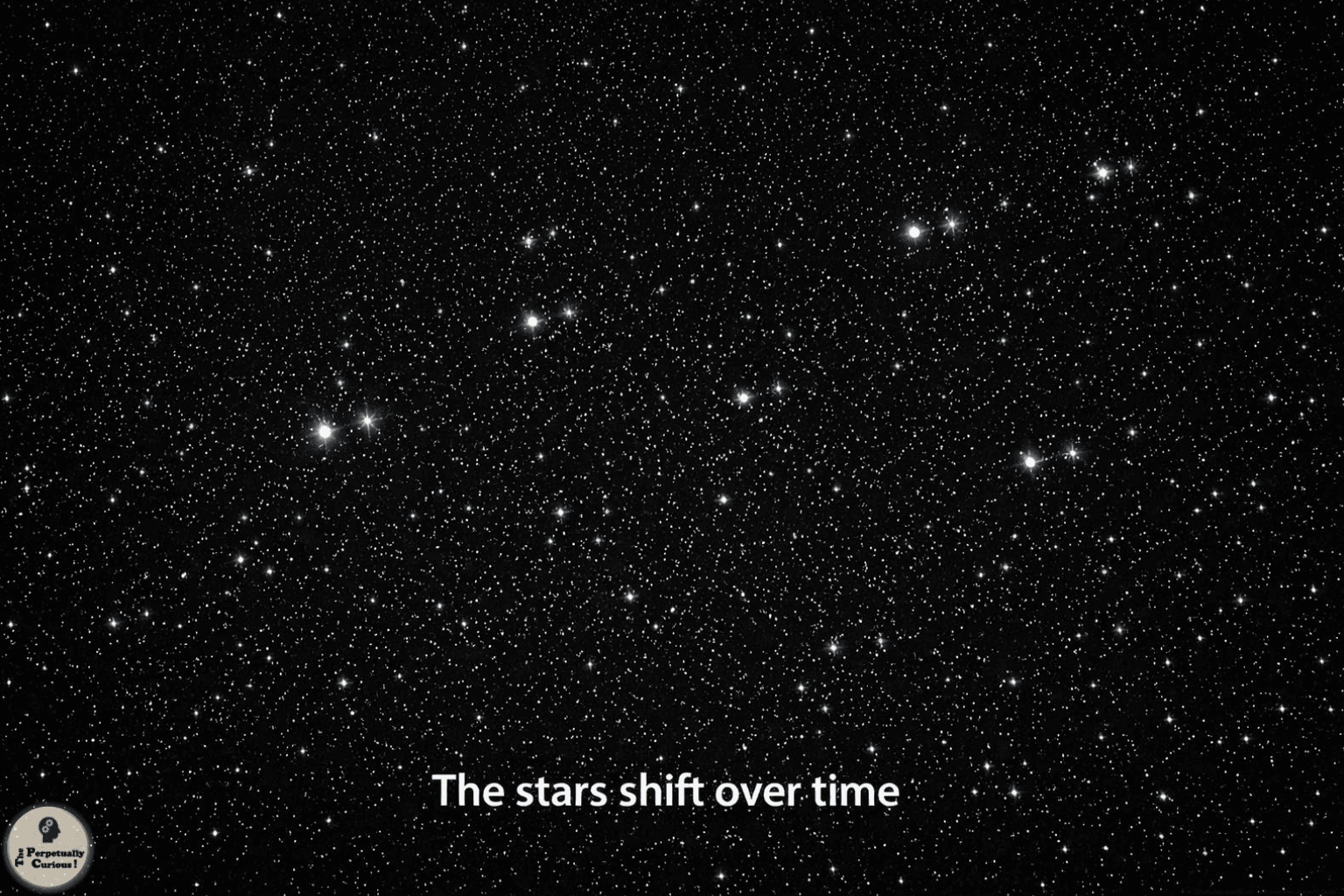
Although constellations appear stable within a human lifetime, the stars are slowly moving. Astronomers measure this motion, called proper motion, in arcseconds per year, with most stars shifting by only tiny fractions of an arcsecond annually. Over tens of thousands of years, these motions will gradually alter the shapes of constellations. Some patterns will stretch, others will compress, and some may become unrecognizable.
Earth’s axis also undergoes precession, a slow wobble that shifts the celestial poles over a cycle of about 26,000 years. This motion changes which stars appear near the poles and subtly alters the seasonal timing of rising and setting patterns.
Beyond these changes, the Sun itself is traveling around the center of the Milky Way. This journey takes approximately 225 to 250 million years to complete. As the Sun moves through different regions of the galaxy, the set of nearby stars slowly changes. New stars drift into our local neighborhood, while others drift away. This slow migration is part of the larger cycle known as the galactic year, a period during which the Sun completes one full orbit around the center of the Milky Way.
These changes reveal that constellations are temporary alignments in a restless galaxy. They are snapshots in a much longer story of stellar motion and planetary geometry. Yet this impermanence does not diminish their value. Instead, it highlights how human beings have learned to find orientation and meaning within a universe that is always in motion.
Pass this article along to someone curious and let the learning travel.
💡 Did You Know
🌠 The stars that form visible constellations are all within the Milky Way. They are patterns traced from Earth using stars in our own galaxy. Stars in other galaxies are far too distant to appear as individual points of light to the unaided eye and do not form part of the naked‑eye constellation patterns seen from Earth.
🌀 The Sun’s orbit around the Milky Way slowly changes our stellar neighborhood. Over millions of years, new stars drift into view and old ones drift away.
⏳ Future humans will see different constellations. Stellar motion and our galactic orbit gradually reshape the sky.
🌟 Some constellations contain no bright stars. A few constellations are composed mostly of faint stars that require dark skies to see clearly.
🧩 Dark constellations exist. In some traditions, shapes are traced not by bright stars but by the dark lanes of dust within the Milky Way.
📏 Constellation boundaries were finalized in 1928. The modern map was created to support consistent star cataloging.
Are constellations real physical groups of stars?
Constellations are not usually real physical groups in space. They are patterns and regions defined from Earth’s point of view. A small number of visible groupings, such as the Pleiades star cluster, are genuine physical associations whose member stars formed from the same cloud of gas and dust through star formation. Most constellation patterns are chance alignments with no physical connection.
Do constellations exist in other galaxies?
Constellations are defined from Earth using stars in the Milky Way. Stars in other galaxies are far too distant to appear as individual points of light to the unaided eye and do not form part of the naked-eye patterns seen from Earth.
Will future humans see new constellations?
Yes. Stellar motion and the Sun’s orbit around the Milky Way gradually change the shapes of constellations and introduce new stars into our sky. These long-term changes unfold across the span of the galactic year, which slowly reshapes the stellar neighborhood that surrounds our Solar System.
How many official constellations are there?
Modern astronomy recognizes eighty-eight official constellations that cover the entire sky without gaps. These regions are defined from the perspective of Earth’s sky, and no single location on Earth can see all of them on any given night.
What is the difference between a constellation and an asterism?
A constellation is an officially defined region of the sky. An asterism is a recognizable pattern that may be part of one or more constellations.
Do all cultures use the same constellations?
Different cultures have developed their own constellations and sky stories. Some traditions in the ancient Mediterranean world traced figures among bright stars. Indigenous Australian traditions recognized shapes in the dark lanes of the Milky Way. In Indian astronomical systems, the sky is divided into twenty-seven lunar mansions called nakshatras and twelve rāśis, which are ecliptic divisions rather than constellations. The modern set of eighty-eight constellations is a standardized system for scientific use.
Why do many constellation names come from Latin?
Latin was widely used in early scientific texts, and many classical constellations were recorded in Latin sources.
How do astronomers decide where a constellation begins and ends?
Constellation boundaries follow lines of right ascension and declination, which are similar to longitude and latitude on Earth.
Which constellation is the largest?
Hydra is the largest constellation, covering more than one thousand three hundred square degrees of sky.
Which constellation is the smallest?
Crux, also known as the Southern Cross, is the smallest constellation, covering only about sixty-eight square degrees.
Which constellations contain some of the nearest stars to Earth?
The constellation Centaurus contains the Alpha Centauri system, which includes some of the nearest stars to the Sun.
Which constellations contain some of the farthest bright stars visible to the unaided eye?
Some of the farthest bright stars that can be seen without a telescope lie in Cassiopeia and Carina, thousands of light-years away.
What are some of the most recognizable constellations?
Orion, Ursa Major, Scorpius, and Cassiopeia are among the most widely recognized patterns in the night sky.
Do stars within constellations move over time?
Yes. Stars drift through space, and their positions change slowly. Nearby stars such as Barnard’s Star shift noticeably over centuries, and bright stars such as Arcturus also move across the sky over long spans of time.
🌱 A gentle closing reflection
If this exploration of constellations has offered a moment of calm curiosity, you are welcome to pass it along to others who enjoy thoughtful science writing. Each shared reading may become a small moment of reflection under the same sky, whether in a city courtyard or a quiet rural field. In this way, the patterns above us continue to spark conversations that travel farther than the stars themselves.
“Constellations: Quiet Patterns, Shared Skies, and the Stories We Trace Together.” The Perpetually Curious!, April 2026.
https://www.theperpetuallycurious.org/articles/constellations/Continue Exploring
For the curious mind: want to explore this theme through a few questions? Visit the Classic Quiz Studio, nestled under Explorations opens in a new tab ,and see where a few well-placed questions lead: Cosmic Exploration Quizzesopens in a new tab
For what comes next
Site Updates gathers occasional notes, new additions, and ways to keep in touch. RSS brings new publications to your feed reader in chronological order.
Choose the path that speaks to you, and let the next curiosity find you wherever your wondering takes you.