

The ocean has always carried stories. It carries the weight of tides, the drift of plankton, and the quiet pulse of currents that circle the planet. Today, it carries something else as well. It carries countless fragments of human life that have become small enough to slip between grains of sand and cells of plankton. These fragments, known as microplastics, are usually defined as plastic particles smaller than about 0.2 inches (5 millimeters). Even smaller nanoplastics reach sizes far below what the human eye can perceive.
Microplastics originate from many sources. Some form when larger plastic items break apart through sunlight, abrasion, waves, and time. Others begin as intentionally manufactured particles, or as synthetic fibers released when fabrics are washed, worn, and weathered. They have now been detected in coastal shallows, mid-ocean gyres, polar seas, tropical lagoons, and deep ocean trenches. Their presence is quiet but persistent, forming a subtle thread between human activity and marine ecosystems.
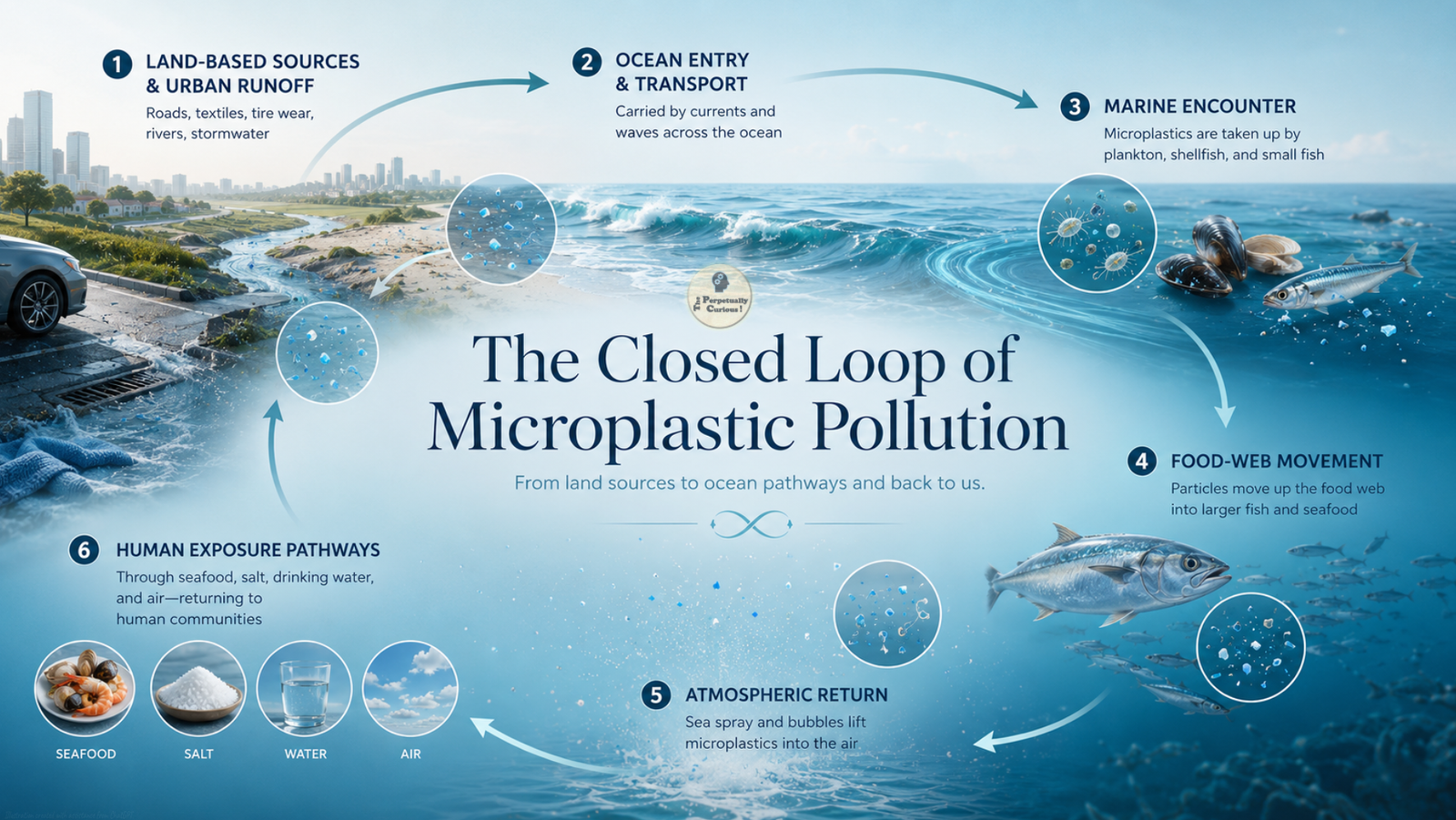
Their journey begins with movement. Plastic fragments leave roads, rivers, shorelines, vessels, and cities, then enter waters that do not hold still. Currents carry them, waves mix them, organisms encounter them, and some eventually return to human communities through food, water, salt, and air. The story of microplastics is therefore not a single event, but a closed loop of material, motion, and connection.
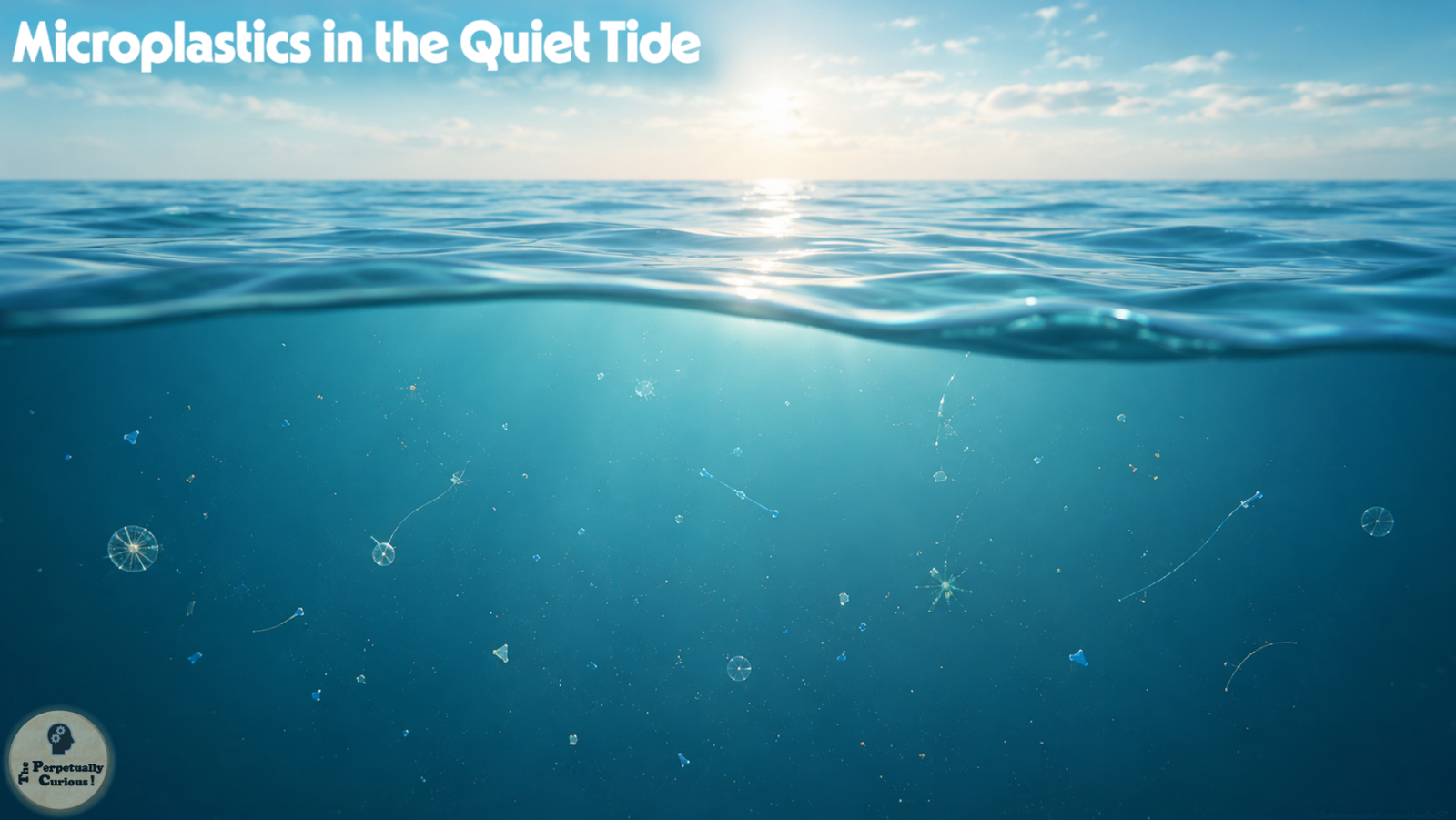
The ocean carries more than water. It carries memory shaped by currents and time.
In the quiet drift of its surface and the slow turning of its depths, our fragments move with its living stories.
Here, in the meeting of matter and meaning, the ocean reminds us that nothing we create is ever truly alone.
🌊 From land to sea: how microplastics enter and move through the oceans
Microplastics reach the ocean through many pathways. Mismanaged plastic waste may fragment on beaches, roadsides, and coastal land, with wind and runoff carrying pieces into rivers and estuaries. Urban stormwater can transport tire wear particles and synthetic fibers from roads, drains, and laundry effluent. Fishing gear, shipping materials, aquaculture infrastructure, and lost fishing gear may also contribute fragments and fibers when they degrade, fray, or are abandoned at sea.
Once in the water, microplastics do not remain in one place. Ocean currents, tides, and waves transport them horizontally across basins and vertically through the water column. Their movement depends partly on particle size, shape, density, surface texture, and whether organisms or organic matter begin to coat them over time. Near the surface, floating particles may follow complex paths shaped by wind-driven circulation, turbulence, Stokes drift, and convergence zones where water motion gathers floating material.
This movement matters because it determines which organisms encounter microplastics and how often. Transport patterns can create encounter zones where particles and marine life meet in surface waters, sediments, estuaries, and feeding grounds. Once the ocean has carried these fragments into the spaces where organisms live and feed, the story shifts from physical movement to biological contact.
🐚 Meeting the particles: how marine organisms encounter microplastics
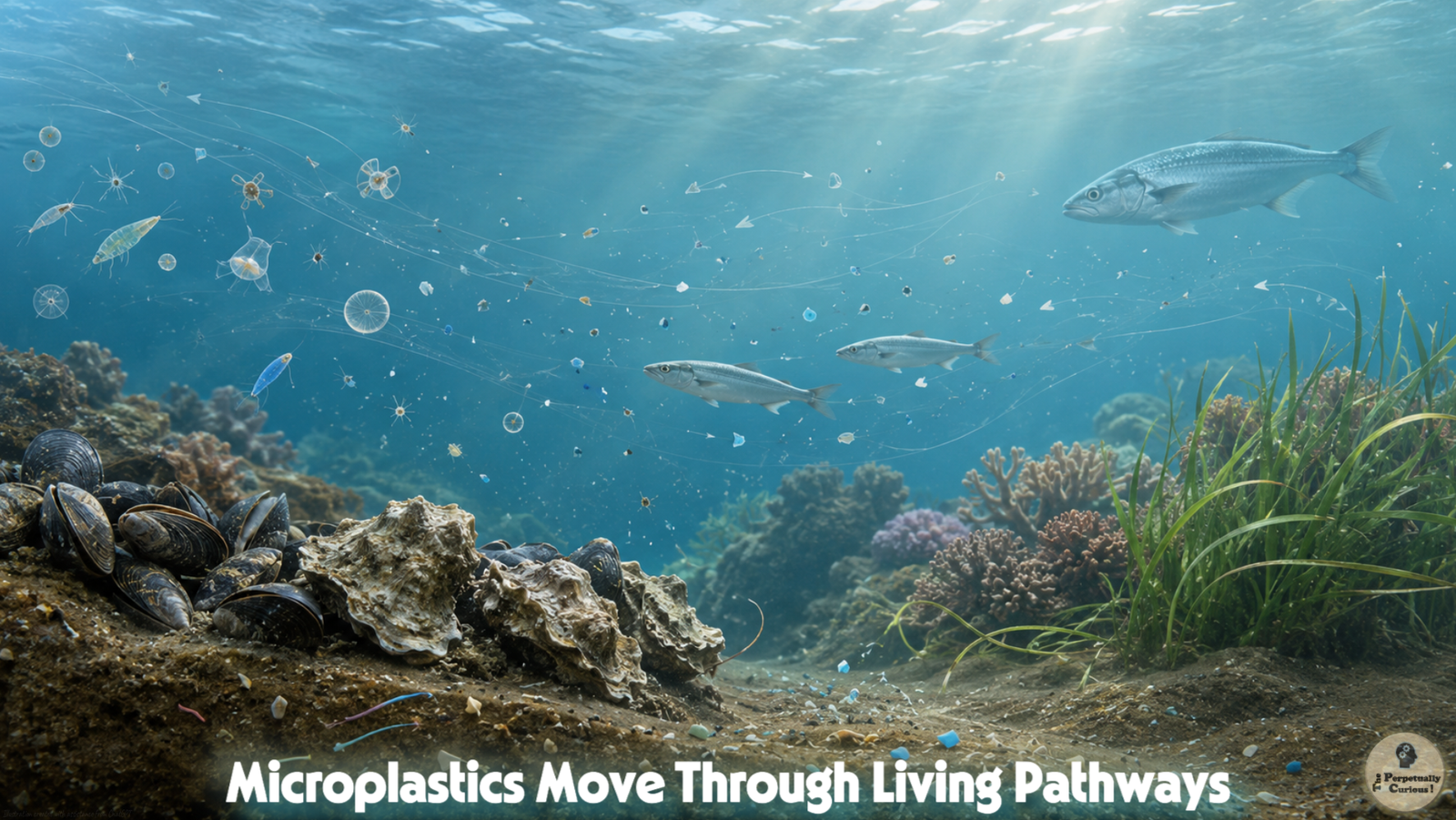
Marine organisms encounter microplastics in ways that often reflect how they feed, move, and occupy their habitats. Filter feeders such as mussels, oysters, and clams draw large volumes of water across their gills and may capture microplastics along with plankton, sediment, and organic particles. Zooplankton and small crustaceans may ingest particles that resemble food in size or shape, while fish may encounter fragments in the water column or in sediments when they feed on invertebrates, plankton, or detritus. Larger animals, including sea turtles, seabirds, and marine mammals, may encounter plastics directly or indirectly when particles are present in prey.
Ingestion is not the only pathway. Microplastics can also interact with organisms externally. Fibers and fragments may become caught on gills, appendages, mouthparts, or feeding structures, especially in species that filter water or move through particle-rich environments. Sediment-dwelling organisms may be exposed when microplastics accumulate in seabed material, where particles can influence sediment texture, porosity, and feeding or burrowing conditions. These effects vary with particle size, shape, abundance, and local habitat.
Microplastics can also become small floating surfaces for microbial life. This plastisphere may contain microbial communities that differ from those found on natural particles, although its ecological importance depends on where the particles travel, how long they persist, and which organisms colonize them. In this way, exposure is not limited to plastic as a material alone. It also includes the biological and chemical surroundings that form around these fragments as they move through marine environments.
Once organisms encounter microplastics, the next question is what those encounters may do. Exposure does not always lead to harm, but repeated contact, ingestion, or retention can create conditions in which physical stress, chemical exposure, and biological response begin to matter.
🐠 Inside the body: biological effects on ocean life
When microplastics are ingested, they may pass through the digestive tract or remain for longer periods, depending on particle size, shape, surface texture, and material. Larger or sharper particles can sometimes contribute to physical irritation, abrasion, or blockage. In affected organisms, these effects may reduce feeding efficiency, change energy intake, or interfere with normal digestion. Laboratory and field studies have reported associations between microplastic exposure and changes in growth, reproduction, behavior, and survival in several marine species, although the size and consistency of these effects vary with exposure level, particle type, species, and experimental design.
Beyond physical effects, microplastics can also interact with organisms at cellular and biochemical levels. Some studies have linked exposure with oxidative stress, a condition in which reactive oxygen species exceed the cell’s ability to neutralize them. If this imbalance persists, it can affect lipids, proteins, DNA, and normal cellular function. Research has also reported changes in gene expression, enzyme activity, immune responses, and inflammatory pathways in fish, mollusks, and crustaceans exposed to certain microplastic conditions.
Microplastics may also act as carriers for other substances. Their surfaces can adsorb persistent organic pollutants, metals, and other hydrophobic chemicals already present in seawater. When organisms ingest these particles, they may encounter both the plastic material and substances attached to it. The degree to which this combined exposure contributes to overall toxicity remains an active area of research, because outcomes depend on local contamination levels, polymer type, particle age, particle size, and the biology of the exposed organism.
These effects do not occur in isolation. A single organism’s response may seem small, but repeated exposure across many individuals can begin to matter at the scale of populations, habitats, and food webs. From there, the question widens from what microplastics may do inside one body to how they may influence the functioning of marine ecosystems.
🌐 Ecosystems under quiet pressure: community and habitat level impacts
Marine ecosystems are built from many interacting species that share space, resources, and energy flows. Microplastics may influence these systems in subtle and uneven ways, depending on particle type, concentration, habitat, and exposure conditions. In coral reef environments, microplastics can settle on coral surfaces or become trapped within reef structures. Some studies have reported associations with tissue irritation, altered feeding behavior, microbial changes, disease susceptibility, or reduced photosynthetic performance in symbiotic algae, but these effects are not uniform across reef systems and may vary with coral species, particle type, experimental exposure level, and local conditions.
In seagrass meadows and coastal sediments, microplastics can mix with sand, silt, and organic matter. This mixing may alter sediment texture, porosity, and stability, which can influence how seagrass roots anchor and how benthic organisms burrow, feed, and move through the seabed. Changes in sediment conditions may also affect oxygen flow and nutrient cycling, both of which help support primary productivity and the organisms that depend on these habitats.
In open-water systems, microplastics can interact with plankton communities that help move energy and carbon through the ocean. Plankton form the base of many marine food webs, and some also contribute to the biological carbon pump, the process by which carbon-rich material moves from surface waters into deeper layers. If microplastics affect plankton feeding, growth, sinking particles, or fecal pellets under certain conditions, they may influence how efficiently carbon and energy move through the water column. This potential effect remains an active area of research, and its scale is likely to depend on local conditions, particle abundance, plankton community structure, and water-column dynamics.
These ecosystem-level questions matter because they connect habitat change with food-web movement. Once microplastics enter feeding relationships, they are no longer only scattered fragments in water or sediment. They can become part of the pathways through which energy, prey, and particles move from smaller organisms to larger animals, including species that eventually reach human communities.
🍽 From sea to table: trophic transfer and human exposure
Microplastics do not always remain where they first enter the food web. When plankton, shellfish, worms, or small crustaceans ingest particles, those particles may be transferred to predators that consume them. This process, known as trophic transfer, has been documented in several marine systems, although its strength varies by species, particle size, particle shape, habitat, and feeding behavior. Over successive feeding steps, microplastics can move from small organisms to fish and larger predators, including some species harvested for human consumption.
Seafood provides one direct pathway for microplastics to reach humans. Filter-feeding shellfish such as mussels and oysters may retain particles in soft tissues, which are often eaten whole. Fish may contain particles in the gastrointestinal tract, and in some cases, smaller particles have been reported in tissues outside the gut. Findings in fish muscle tissue remain inconsistent across studies and depend heavily on tissue type, detection sensitivity, and analytical technique. The number of particles associated with a serving can vary widely depending on species, location, tissue type, preparation method, and the methods used to detect them.
Sea salt produced from evaporated seawater has also been found to contain microplastics. Drinking water can be another pathway, since particles have been detected in some surface waters, groundwater, bottled water, and treated drinking water. Water treatment and desalination systems can reduce many particles, especially larger ones, but removal efficiency depends on treatment design, filtration stage, particle size, and material type. Nanoplastics remain especially difficult to measure and evaluate because their small size pushes the limits of detection.
Microplastics can also return to land through the atmosphere. At the ocean surface, breaking waves, sea spray, and bursting bubbles may lift tiny particles or plastic-associated droplets into the air. Once airborne, these particles can travel with winds, settle onto land or water, and contribute to inhalation or indirect ingestion pathways. Airborne microplastic concentrations can vary widely, and measurement methods are still evolving. The scale of this atmospheric pathway is still being studied, but it reinforces the larger pattern: ocean plastic does not remain neatly contained within the ocean.
These pathways do not necessarily imply immediate or severe health outcomes, but they do show that human exposure is real, variable, and likely ongoing. The next question is not only whether microplastics reach people, but what current research can and cannot yet say about their biological significance.
🧬 Within us: what microplastics may mean for human health
Research on microplastics and human health is still developing, and many questions remain open. Laboratory studies using human cell lines and model organisms have shown that microplastics and nanoplastics can interact with cells and tissues. In some experiments, exposure has been associated with oxidative stress, inflammatory responses, and changes in cell membrane integrity. Very small particles may be able to cross biological barriers under certain conditions, particularly in animal and cell-culture models. This raises questions about how such particles might move, persist, or be cleared within the body.
There is also interest in how microplastics may influence the human gut microbiome. Some early studies suggest that exposure could alter the composition or function of microbial communities, although results are not yet fully consistent and long-term implications remain uncertain. These outcomes may depend on particle size, polymer type, surface chemistry, chemical additives, dose, exposure duration, and the biological system being studied. Dose-response relationships also remain uncertain, partly because methods, exposure conditions, and particle characterization vary across studies. In addition, microplastics may carry chemical contaminants or microbial passengers that could contribute to broader exposure profiles.
At present, many scientific reviews emphasize that exposure is evident, but the full health significance of environmental microplastic exposure is not yet completely understood. One reason is methodological: detecting and characterizing very small particles requires refined tools, strict contamination controls, and standardized approaches that are still improving across the field. The strongest current position is therefore cautious rather than conclusive. Microplastics are present in human exposure pathways, but research is still working to clarify which particles matter most, at what levels, and under which biological conditions.
With this perspective in mind, the narrative can return to the wider loop. The particles that begin as discarded materials do not simply vanish into the ocean. They move through water, organisms, food, and air, while research works to trace those pathways back toward the human systems that first produced them.
🔄 A closed loop of matter and meaning
Microplastics illustrate how human activity can become woven into the fabric of the ocean. Plastics are produced, used, and discarded on land. They fragment and drift into rivers and seas. They travel with currents and waves, settle into sediments, rise again in surface waters, and move through the living pathways of plankton, shellfish, fish, corals, birds, and mammals. Eventually, some return to human communities through seafood, salt, water, and air.
This loop is not only physical. It is also symbolic. At the beginning, the ocean seemed to carry stories; here, it carries evidence of connection. The boundaries between human systems and natural systems are porous, and materials released in one place can reappear far from their source. The ocean does not simply receive our fragments. It transforms them, redistributes them, and sends them back in altered form.
In this sense, microplastics become markers of connection as well as concern. They invite careful observation, thoughtful research, and a renewed appreciation for the subtle ways in which the ocean and humanity are intertwined.
Pass this article along to someone curious and let the learning travel.
💡 Did You Know?
🌐 Microplastics have been found in polar ice, snow, and sea ice environments Researchers have detected microplastics in polar ice, snow, and sea ice environments, showing that particles can travel long distances through atmospheric and oceanic pathways before becoming trapped in frozen regions.
🌨️ Some planktonic organisms can ingest microplastics Some planktonic organisms, including certain dinoflagellates studied in laboratory settings, have been observed with microplastics inside their digestive systems. This creates a subtle intersection between drifting particles and some of the smallest organisms in marine food webs.
🌫️ Microplastics can accumulate in the ocean’s surface microlayer The surface microlayer is the thin boundary at the top of the ocean and is often about 0.00004 to 0.04 inches (1 to 1,000 micrometers) thick. Because buoyant particles can gather there, this layer may contain higher concentrations of microplastics than the water just below it.
🧬 Microplastics can shape microbial communities The plastisphere hosts microbial communities that may differ from those found on natural particles. Related studies of plastic-decomposing organisms show that living systems can interact with plastic in complex ways, although breakdown is often slow, partial, and highly dependent on material and environment.
🧭 Deep-sea sediments can contain microplastics Microplastics have been detected in deep-sea sediments, including ocean trench environments. These particles may persist in seabed layers for long periods, although their long-term geological significance is still uncertain.
🌧️ Microplastics interact with light in distinctive ways Because microplastics can scatter and absorb light differently from organic particles, researchers are studying how their optical properties may affect detection methods and surface-water observations. These differences are most relevant to measurement and detection, rather than to visible changes in ocean color.
🌬️ Microplastics can interact with bubbles and sea spray Microplastics may attach to bubbles or become involved in sea spray when waves break at the ocean surface. This process may help move some particles between water and air, although the scale of this pathway varies with wind, wave conditions, and particle abundance.
What are microplastics in the ocean?
Microplastics are small plastic particles, typically smaller than about 0.2 inches (5 millimeters). They can form when larger plastic items break apart, or they can come from intentionally manufactured small particles, synthetic fibers, tire wear, coatings, and other sources.
How do microplastics reach the ocean?
Microplastics often come from mismanaged plastic waste on land, which can fragment and enter rivers, storm drains, estuaries, and coastal waters. Additional sources include degraded fishing gear, shipping materials, tire wear particles, and synthetic fibers released during washing, wearing, and weathering.
How do microplastics affect marine animals?
Microplastics may affect marine animals through ingestion, external contact, or exposure to chemicals associated with the particles. Ingested particles can sometimes contribute to blockage, abrasion, reduced feeding efficiency, oxidative stress, immune responses, or changes in growth and reproduction, although effects vary by species, exposure level, and particle type.
Do microplastics accumulate in seafood?
Microplastics can be present in seafood. Filter-feeding shellfish may retain particles in soft tissues, and fish may contain particles in the gastrointestinal tract or, in some cases, smaller particles in other tissues.
The broader movement through marine food webs depends on species, location, particle size, tissue type, preparation method, detection sensitivity, and analytical technique.
Are microplastics found in sea salt and drinking water?
Microplastics have been detected in some sea salt and drinking-water samples, although reported levels vary widely by region, source, processing method, and detection technique. Nanoplastic detection remains technically challenging, and results can vary by analytical method. Their presence does not automatically indicate a known health outcome, but it does show that exposure pathways can extend beyond seafood.
Do wastewater treatment plants filter out microplastics?
Wastewater treatment plants can remove many microplastics, and removal is often high, commonly above 90 percent in many plants. Efficiency still varies by treatment stage, particle size, polymer type, and especially for fibers, which can be removed less efficiently than solid particles. Some particles may remain in treated effluent, while others can accumulate in sewage sludge.
What is known about microplastics and human health?
Research on microplastics and human health is ongoing. Laboratory studies suggest that microplastics and nanoplastics can interact with cells and may be associated with oxidative stress, inflammatory responses, and changes in cell membranes. The full health significance of environmental exposure is not yet fully understood.
How do scientists detect microplastics?
Scientists use filtration, microscopy, spectroscopy, and chemical analysis to detect and characterize microplastics. Because airborne fibers and laboratory contamination can affect results, careful sampling methods, procedural blanks, clean handling, and polymer confirmation are important parts of reliable measurement.
What is the difference between microplastics and nanoplastics?
Microplastics are typically smaller than about 0.2 inches (5 millimeters). Nanoplastics are much smaller, often below about 0.00004 inches (1 micrometer). Because of their size, nanoplastics may behave differently in water, organisms, and tissues, and they are more difficult to detect and measure.
Do microplastics influence ocean chemistry?
Microplastics may interact with dissolved chemicals by adsorbing pollutants, releasing additives, or carrying surface-bound substances through the water. Their overall influence on ocean chemistry is still being studied, and effects may vary with particle type, location, weathering, and local contamination levels.
Can microplastics travel through the air?
Yes. Microplastics can become airborne through wind, dust, sea spray, and bubble bursting at the ocean surface. Once in the atmosphere, some particles may travel with air currents before settling back onto land or water. The scale of this pathway is still being studied.
🌊 A Small ripple of curiosity
If this reflection helped you see microplastics in a new way, we warmly invite you to share it with friends, colleagues, or fellow curious readers. Microplastics reveal a quiet web of connection: between land and sea, small particles and vast systems, human choices and the living ocean.
🎥 Continue the journey in video
This article follows microplastics through currents, marine food webs, and human exposure pathways. For a visual companion to the topic, you can also watch our related video from The Perpetually Curious!
“Tides of Plastic: Microplastic Pollution in the Oceans and Its Journey Back to Us.” The Perpetually Curious!, July 2026.
https://www.theperpetuallycurious.org/articles/microplastics-in-the-ocean/Continue Exploring
For what comes next
Site Updates gathers occasional notes, new additions, and ways to keep in touch. RSS brings new publications to your feed reader in chronological order.
Choose the path that speaks to you, and let the next curiosity find you wherever your wondering takes you.