

Most sky‑watchers can name a handful of large moons such as Ganymede, Titan, or Earth’s own Moon, yet scattered across the outer darkness are smaller, quieter companions that rarely appear in familiar summaries. These lesser-known moons do not dominate by size. Instead, they invite curiosity through unusual orbits, fractured surfaces, hidden oceans, and mysterious origins.
This article begins with that sense of quiet wonder. Rather than listing facts in isolation, we will move through these worlds as if walking through a gallery of celestial objects. Each moon offers a different texture, a different history, and a different clue about how planetary systems evolve.
As we travel from the inner reaches of the solar system outward through the Saturn system, then farther still to Neptune before turning inward again toward Uranus, the narrative will unfold in a continuous arc that shows how these modest worlds deepen our understanding of the solar system.
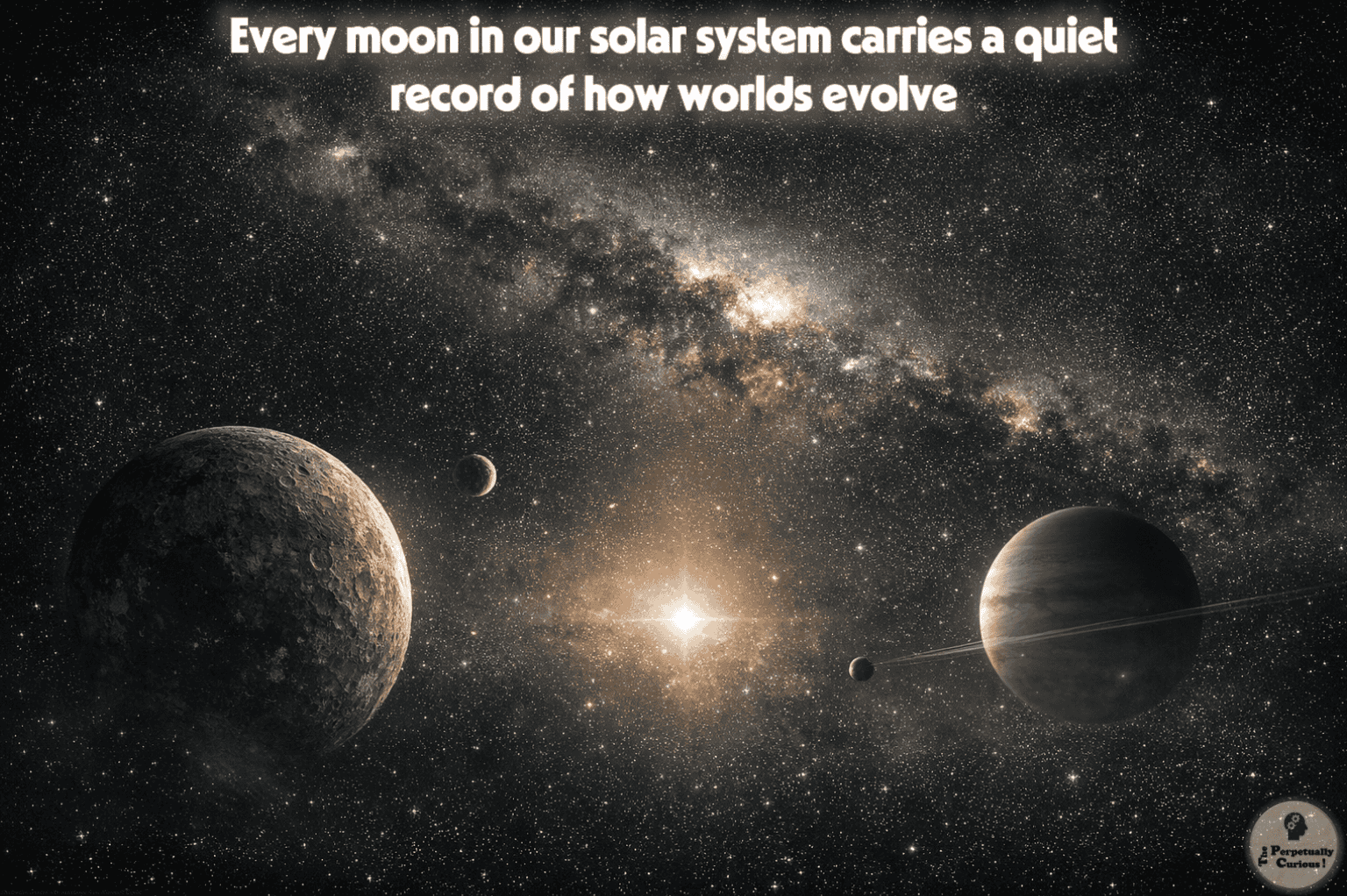
Worlds turn in silence, carrying their hidden stories through shadow and light.
Each surface holds a memory of what shaped it, waiting for the patient eye to see.
🔭 Why lesser-known moons matter
After learning about the largest moons, it is natural to wonder what lies beyond the giants. Smaller moons may seem modest at first glance, yet they often preserve clues about the early solar system. Their surfaces record ancient impacts. Their interiors may hide oceans or porous layers. Their orbits reveal past gravitational encounters.
A broader view of the solar system’s architecture can be found in studies of gravity across the planets, which helps explain why some moons remain stable while others drift or tumble.
By focusing on lesser known moons, we shift the lens from scale to character. Instead of asking which moon is largest, we ask which moon carries the scars of a violent past, which moon tumbles unpredictably, or which moon may have been captured from distant regions. This change in perspective prepares us for the journey ahead. We now move from the inner solar system outward toward Saturn, then farther still to Neptune, before turning inward again toward the moons of Uranus.
🚀 Phobos and Deimos: The small companions of Mars
Phobos and Deimos, discovered in 1877, are the two small moons of Mars. Phobos is about 17 miles (27 kilometers) across at its widest and has a mean diameter of about 14 miles (22 kilometers). Deimos is about 9 miles (15 kilometers) across at its widest and has a mean diameter of about 8 miles (13 kilometers). Both moons are irregular in shape and covered with loose, dusty material. Their surfaces resemble dark, battered asteroids, which has led to the idea that they may be captured asteroids, although their origin remains under study.
Their dusty surfaces share similarities with the fine, ancient material described in research on lunar regolith, which helps illustrate how airless bodies accumulate and preserve surface layers over time.
Phobos orbits very close to Mars and completes a full orbit in a little over 7 hours. It rises in the west and sets in the east, a reversal of the familiar pattern on Earth. Tidal forces are slowly pulling Phobos inward, and over tens of millions of years it may break apart. Deimos orbits farther out and drifts slowly away from Mars. Together, they show how even small moons can trace the long gravitational history of a planet. These orbital paths also place Phobos and Deimos within the wider geometry of eclipses beyond Earth: both can cross the Sun’s disk in transit or pass through Mars’s shadow.
As we leave the rocky austerity of Mars’s moons, we move toward Saturn, where ice and distance from the Sun create very different kinds of worlds.
🧊 Mimas: The cratered sentinel of Saturn
Mimas orbits Saturn at a distance of about 115,000 miles (185,000 kilometers) from the planet’s center and has a diameter of about 246 miles (396 kilometers). Its most striking feature is a large impact crater named Herschel, which is about one third of the moon’s diameter. This crater gives Mimas a distinctive appearance in spacecraft images.
For many years, Mimas appeared to be a simple, heavily cratered ice‑rich body. However, a 2024 study of its orbital motion provided strong evidence that a global subsurface ocean lies beneath its icy shell, possibly between 5 and 15 million years old. Because the surface shows no clear signs of this hidden ocean, Mimas has been described as a stealth ocean world.
The contrast between Mimas and more geologically active moons becomes clearer when compared with the intense volcanic activity described in studies of Io, which demonstrates how tidal forces can shape very different outcomes across moons.
🌊 Enceladus: The small moon that breathes ice
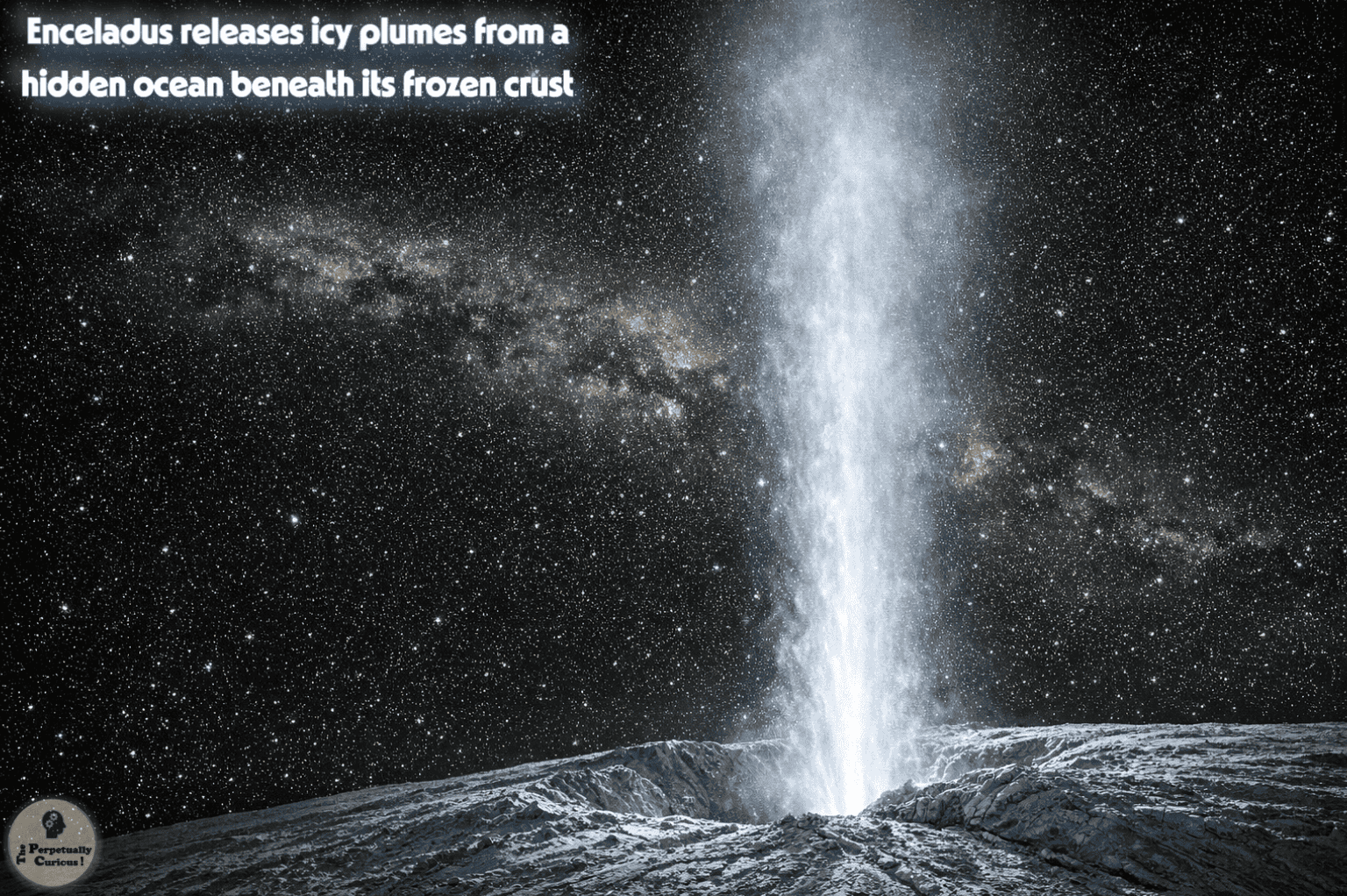
Enceladus, another moon of Saturn, is slightly larger than Mimas, with a diameter of about 313 miles (504 kilometers). Despite its modest size, it has become one of the most scientifically important moons in the solar system. Its south polar region hosts long fractures, often called tiger stripes, from which plumes of water vapor and ice particles erupt into space.
These plumes suggest the presence of a global or near‑global subsurface ocean beneath an icy shell. Measurements of the material in the plumes indicate that this ocean may contain salts and simple organic molecules. While this does not confirm the presence of life, it does make Enceladus a key location for studies of habitability.
The activity at Enceladus highlights the diversity of geological processes found across icy worlds and shows how even small moons can sustain complex internal environments.
Enceladus also influences Saturn’s system. Material from its plumes feeds Saturn’s E ring, creating a delicate halo of ice particles. From here, we move outward to moons that are less active on the surface, yet still carry unusual shapes and histories.
🌀 Hyperion: The sponge‑like drifter of Saturn
Hyperion orbits Saturn at a distance of about 930,000 miles (1.5 million kilometers) and has an average diameter of about 168 miles (270 kilometers). Its shape is irregular, and its surface is covered with deep, dark‑floored craters that give it a sponge‑like appearance. The low density of Hyperion suggests that it is porous, with many voids inside. Some researchers propose that Hyperion may be a remnant of a larger moon shattered by an ancient major impact, which would help explain both its irregular shape and its unusually porous interior.
One of the most intriguing aspects of Hyperion is its chaotic rotation. Instead of spinning in a steady, predictable way, Hyperion tumbles, and its orientation in space changes in a complex manner over time. This behavior arises from its irregular shape and gravitational interactions with Saturn and the nearby large moon Titan.
Hyperion reminds us that not all moons follow simple patterns. Its chaotic motion provides a bridge to another class of moons that also seem out of place, those with distant, tilted, or retrograde orbits that may point to origins far beyond their current homes.
🪐 Phoebe: A likely captured wanderer
Phoebe orbits Saturn much farther out than Hyperion, at a distance of about 8 million miles (13 million kilometers). It has a diameter of about 132 miles (213 kilometers) and follows a retrograde orbit, which means it travels around Saturn in the opposite direction to most of the planet’s major moons. Its surface is dark and heavily cratered, and its composition appears rich in carbon‑bearing material.
The idea that Phoebe may have originated far from Saturn aligns with broader studies of the distant region known as the Kuiper belt, where many small, icy bodies reside.
The combination of its distant, inclined, and retrograde orbit suggests that Phoebe did not form in the same region as Saturn’s larger moons. Instead, it may be a captured object from the outer solar system, possibly from the Kuiper Belt. Its composition supports this idea and hints at a past far from Saturn.
Phoebe shows how giant planets can gather small bodies from beyond their original neighborhoods. From this distant Saturnian moon, we now turn to Neptune, where other irregular and lesser known moons orbit in the cold outer reaches.
🌌 Proteus: The almost‑round moon of Neptune
Proteus is one of Neptune’s larger inner moons, yet it remains relatively obscure. It has a diameter of about 260 miles (420 kilometers) and orbits Neptune at a distance of about 73,000 miles (118,000 kilometers) from the planet’s center. Proteus deviates significantly from a perfect sphere, though at this size gravity pulls it toward a more rounded form than most smaller irregular moons.
Its surface is dark and heavily cratered, with one particularly large crater that dominates one hemisphere. Proteus is thought to have formed from material in a disk around Neptune, possibly after the capture of the large moon Triton, which may have disrupted earlier satellites. As a result, Proteus may preserve a record of how Neptune’s system reassembled after a major event.
Proteus tells one part of Neptune’s story through its shape and proximity, but another moon nearby carries that story further through the extraordinary geometry of its orbit.
🌠 Nereid: The eccentric drifter of Neptune
Nereid orbits Neptune on a highly elongated path. Its distance from Neptune varies from about 853,000 miles (1.37 million kilometers) at closest approach to about 6 million miles (9.6 million kilometers) at its farthest point. Its diameter is about 211 miles (340 kilometers). This extreme eccentricity makes Nereid one of the most dynamically unusual moons in the outer solar system.
The kind of orbital stretching seen in Nereid’s path finds a broader parallel in studies of the distant Oort cloud, where long‑period gravitational disturbances can alter the trajectories of small bodies over immense timescales.
The origin of Nereid’s orbit is still a subject of study. One possibility is that the capture of Triton by Neptune disturbed the orbits of preexisting moons, leaving Nereid on its current stretched path. Another possibility involves past gravitational encounters with other bodies. In either case, Nereid illustrates how a single dramatic event can leave long‑lasting signatures in a planetary system.
From Neptune we now turn inward again, this time to Uranus, whose moons carry subtle but rich geological stories on their icy surfaces.
❄️ Ariel: The bright, fractured moon of Uranus
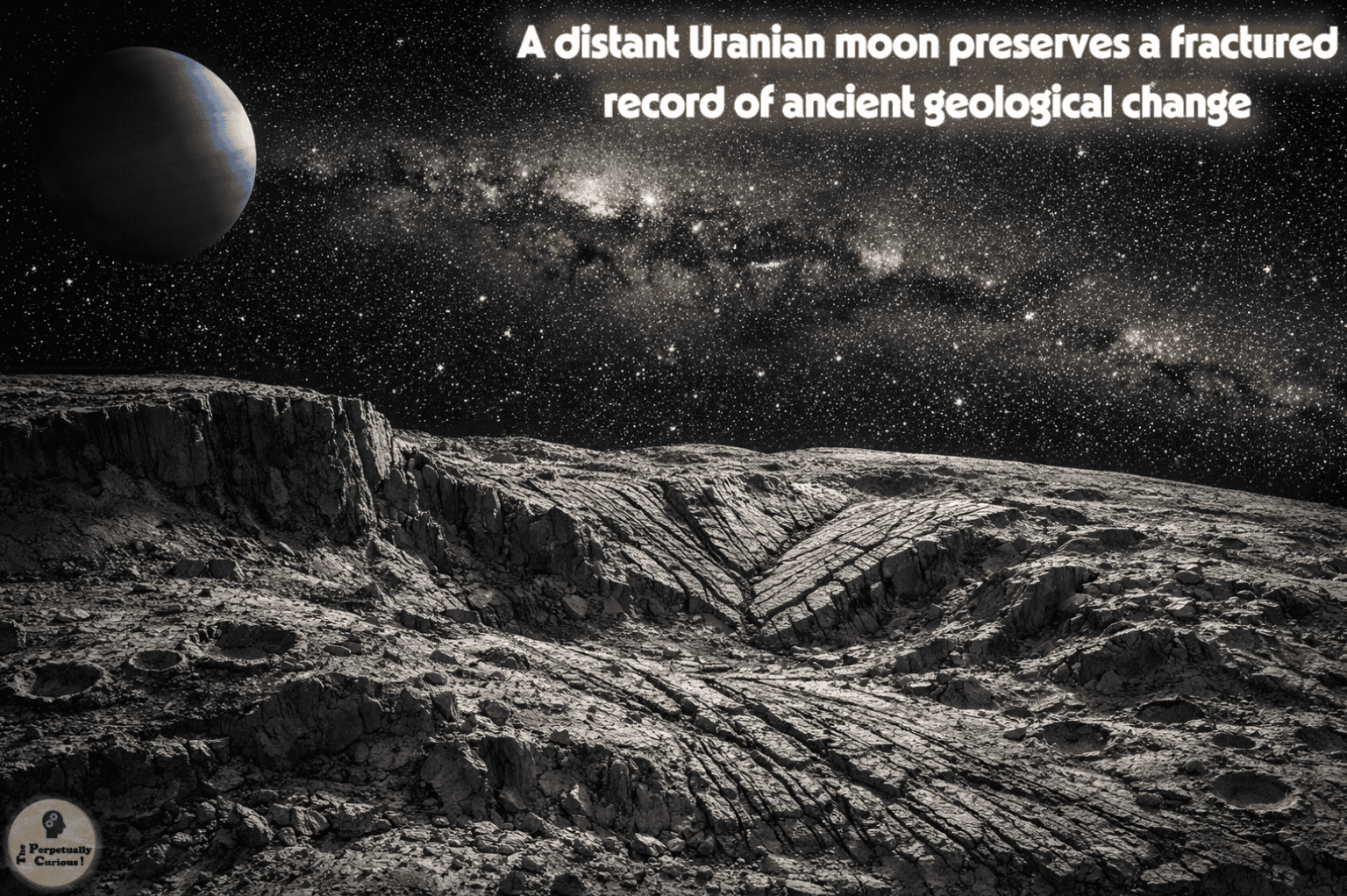
Ariel is one of the mid‑sized moons of Uranus, with a diameter of about 719 miles (1,155 kilometers). It orbits at a distance of about 118,000 miles (190,000 kilometers) from the planet’s center. Ariel’s surface is relatively bright compared with some of Uranus’s other moons and shows a mixture of impact craters, valleys, and fault systems.
The presence of long canyons and smooth plains suggests that Ariel experienced internal activity in the past. Flows of icy material may have resurfaced parts of the moon, softening older craters. Although Ariel appears geologically quiet today, its landscape hints at a more active history when internal heat was stronger.
Ariel prepares the way for another Uranian moon that appears darker and more subdued, yet still carries its own quiet mysteries.
🌑 Umbriel: The shadowed storyteller of Uranus
Umbriel is slightly larger than Ariel, with a diameter of about 727 miles (1,169 kilometers), and orbits Uranus at a distance of about 166,000 miles (267,000 kilometers). Its surface is darker and more heavily cratered than Ariel’s, which gives it a more ancient appearance. One of its most distinctive features is a bright ringed structure known as Wunda, a relatively large crater with a bright central region.
The darkness of Umbriel’s surface may indicate that it has experienced less resurfacing than Ariel. If so, Umbriel could preserve an older record of impacts and surface processes in the Uranian system. By comparing Ariel and Umbriel, scientists can explore how similar moons may follow different evolutionary paths depending on internal heat, composition, and orbital history.
Among the moons of Uranus, one smaller world stands apart in complexity. Miranda follows next, with a surface so fractured and varied that it invites a closer look.
🧩 Miranda: The patchwork moon of Uranus
Miranda is one of the most visually striking moons in the solar system, despite its modest size. It has a diameter of about 293 miles (471 kilometers) and orbits Uranus at a distance of about 80,000 miles (129,000 kilometers). When the Voyager 2 spacecraft flew past in 1986, it revealed a surface that looks almost stitched together, with large regions called coronae that contain ridges, valleys, and cliffs.
One of the most dramatic features on Miranda is Verona Rupes, a cliff that may be up to about 12 miles (20 kilometers) high. If this estimate is correct, it would make Verona Rupes one of the tallest known cliffs in the solar system. The origin of Miranda’s patchwork terrain is still debated. Some hypotheses suggest that Miranda may have been partially disrupted and then reassembled, while others propose intense tectonic activity driven by tidal heating in the past.
Miranda stands as a fitting culmination of this tour. It is a lesser known moon that clearly deserves a deeper, dedicated exploration. In a future article, Miranda can step out of the list and into a full narrative of its own.
🌌 Drawing the arc together
By moving from Mars to Saturn, then outward to Neptune before turning inward again to Uranus, we have followed a deliberate path through some lesser known moons. Each world adds a different piece to the larger picture. Phobos and Deimos hint at captured asteroids and tidal evolution. Mimas and Enceladus show how icy moons can range from seemingly simple to surprisingly active. Hyperion and Phoebe reveal irregular shapes and possible captured origins. Proteus and Nereid trace the reshaping of Neptune’s system. Ariel, Umbriel, and Miranda display the varied geological histories of Uranus’s moons.
Readers who wish to explore the larger moons that frame this smaller collection may find additional context in studies of the largest moons, which provide a natural counterpoint to the quieter worlds described here.
The connective thread through all of these worlds is that small size does not mean small significance. These moons influence rings, record ancient impacts, preserve traces of internal oceans, and carry the scars of past gravitational upheavals. Together, they invite readers to see the solar system not as a collection of isolated objects, but as a dynamic, evolving family of worlds, each with a story that is still unfolding.
Pass this article along to someone curious and let the learning travel.
💡 Did You Know
🌄 Miranda’s towering cliff, Verona Rupes, may be so high that a rock dropped from the top, in the absence of air resistance, could take several minutes to reach the bottom.
❄️ Enceladus’s icy plumes contribute material to Saturn’s E ring.
🔄 Hyperion’s chaotic rotation means that no two sunrises on its surface are alike.
🌓 Phoebe’s retrograde orbit suggests that it may have originated far beyond Saturn.
🌑 Proteus is so dark that it reflects only a small fraction of the sunlight that reaches it.
🌀 Nereid’s orbit is so stretched that its distance from Neptune changes by millions of miles.
🏔️ Ariel’s canyons may reach several miles in depth.
🌘 Umbriel is the darkest of the five major moons of Uranus, reflecting notably less sunlight than its brighter Uranian companions.
🛰️ Phobos is slowly spiraling toward Mars.
🌙 Deimos is drifting away from Mars.
Why are these moons considered lesser known?
These moons are considered lesser known because they rarely appear in popular summaries that focus on the largest or most visually familiar satellites.
Are any of these moons gaseous?
All of the moons described in this article have solid surfaces made of rock, ice, or a mixture of both. Some moons in the solar system, such as Titan, can retain dense atmospheres, but none are gaseous worlds like the giant planets.
Are any of these moons likely to host life?
At present, there is no confirmed evidence of life on any of these moons. However, some icy moons may host subsurface oceans that are of interest for studies of habitability.
How do moons become captured by planets?
Moons may become captured when a passing object loses energy through gravitational interactions or collisions. This process can place a moon into an orbit that differs from those of moons that formed alongside the planet.
How do scientists determine whether a moon might have been captured rather than formed in place?
Scientists study a moon’s orbit, composition, and inclination to determine whether it may have been captured. Retrograde motion, unusual orbital tilt, or a composition that differs from nearby moons can suggest an external origin. These clues are similar to the evidence used when studying distant reservoirs such as the Kuiper belt, where many small icy bodies reside.
Why do some moons show signs of past geological activity?
Geological activity on moons can arise from internal heat, tidal forces, or past impacts. Some moons may have experienced periods of internal heating that allowed icy material to flow or fracture, leaving visible traces on their surfaces.
What role do tidal forces play in shaping the geology of moons?
Tidal forces can stretch, compress, or heat a moon’s interior, which may lead to fractures, resurfacing, or even volcanic or cryovolcanic activity. These forces help explain why some moons remain geologically active while others appear ancient and unchanged. A broader view of these interactions can be found in research on gravity across the planets, which explores how gravitational relationships shape planetary systems.
Why do some moons have surfaces that appear darker than others?
Surface darkness can result from accumulated dust, radiation‑processed material, or the gradual settling of fine particles over time. This process is comparable to the slow buildup of ancient material described in studies of lunar regolith, which helps explain how airless bodies preserve surface layers.
Why do some moons orbit very close to their planets while others orbit far away?
Orbital distance depends on how and when a moon formed, as well as the gravitational history of the system. Some moons may have formed in a disk close to the planet, while others may have been captured from elsewhere and settled into distant orbits.
Why do some moons have chaotic rotations?
Chaotic rotation can occur when a moon has an irregular shape and experiences gravitational interactions with nearby bodies. These interactions can cause the moon’s spin to vary unpredictably over time.
Why are some moons brighter than others?
Brightness depends on surface composition and texture. Icy surfaces reflect more sunlight and appear brighter, while surfaces coated with dark material absorb more light and appear dimmer.
How do scientists determine the composition of distant moons?
Scientists study the composition of distant moons by analyzing the light reflected from their surfaces. Different materials reflect and absorb light in characteristic ways, allowing researchers to infer the presence of ices, minerals, or organic compounds.
How do scientists estimate the height of cliffs or geological features on moons?
Scientists estimate heights by analyzing shadows in spacecraft images. The length of a shadow, combined with the angle of sunlight, allows researchers to calculate the height of cliffs or ridges.
How do scientists study moons that have only been visited once by spacecraft?
Scientists rely on a combination of spacecraft images, telescopic observations, computer modeling, and comparisons with better‑studied moons. Even a single flyby can provide enough data to support decades of research. These methods are similar to the approaches used when studying remote regions of the solar system, such as the Kuiper belt, where direct exploration remains limited.
Do all planets have moons?
No. Mercury and Venus do not have moons. Their proximity to the Sun may have prevented stable moon formation or long‑term moon capture.
Where can I learn more about the distant regions where captured moons may originate?
Readers interested in the outermost reservoirs of icy bodies may find additional context in studies of the Kuiper belt, which describe how small, distant objects move through the solar system.
🌱 A gentle invitation to share
We kindly invite you to share and spread the word. Under this quiet sky of lesser-known moons, every new reader becomes part of the story of discovery. If you found these worlds intriguing, you may wish to share this piece with friends, students, or colleagues who enjoy thoughtful journeys through space. Your support in spreading the message is deeply appreciated and helps these distant, silent moons find a place in more curious minds.
“Quiet Worlds, Vast Stories: Some Lesser-Known Moons of Our Solar System.” The Perpetually Curious!, May 2026.
https://www.theperpetuallycurious.org/articles/lesser-known-moons/Continue Exploring
For the curious mind: want to explore this theme through a few questions? Visit the Classic Quiz Studio, nestled under Explorations opens in a new tab ,and see where a few well-placed questions lead: Cosmic Exploration Quizzesopens in a new tab
For what comes next
Site Updates gathers occasional notes, new additions, and ways to keep in touch. RSS brings new publications to your feed reader in chronological order.
Choose the path that speaks to you, and let the next curiosity find you wherever your wondering takes you.