

Citrus fruits often feel like familiar companions. A bowl of oranges on a table, a slice of lemon in water, or the quiet fragrance of a peeled mandarin can seem like separate, everyday moments. Yet beneath these simple experiences lies a single botanical story. All of these fruits belong to one genus, Citrus, and most trace their origins to a few ancestral species that once grew wild in the foothills of the Himalayas and adjoining regions of Southwest China, South Asia, and Southeast Asia.
This article follows that shared ancestry. It begins with the original wild citrus, then moves outward to the fruits that many people know by name, including mandarin, orange, sweet lime, clementine, grapefruit, lemon, lime, citron, and regional forms from India such as kamala orange, naarthangai, and kadarangai. The aim is to offer a clear and gentle map of relationships, so that the next time a citrus fruit is peeled, it may feel like meeting a relative rather than a stranger.
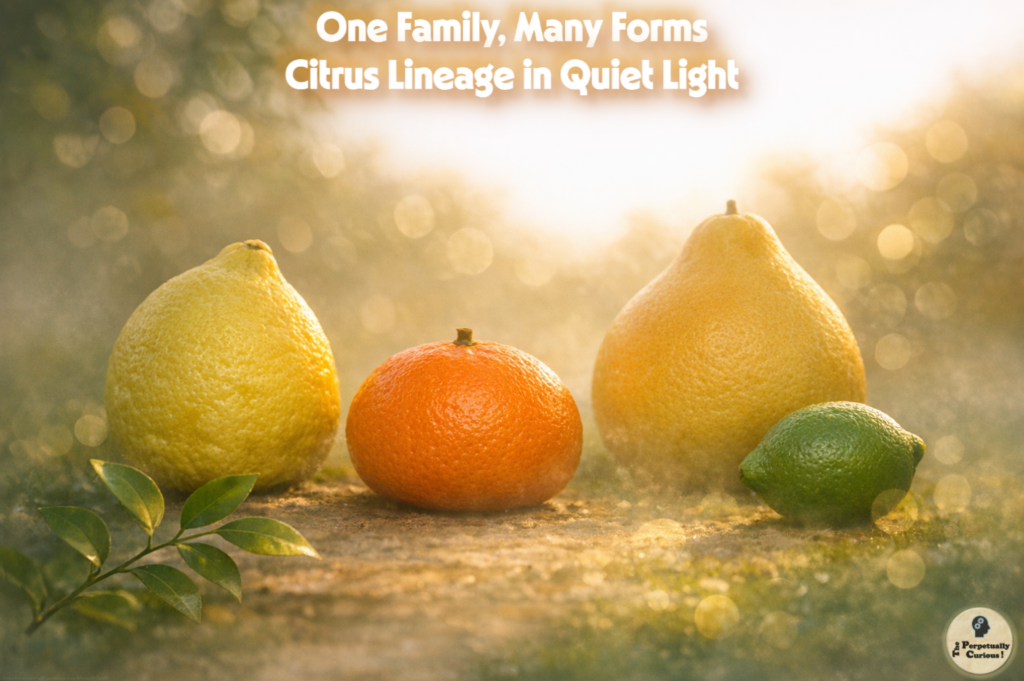
In every bright peel lies a memory of ancient groves, carried forward through crossings of sweetness, fragrance, and form.
Each fruit we meet today is a quiet echo of those first wild branches, still unfolding their lineage one season at a time.
🌳 The ancestral roots of the citrus family
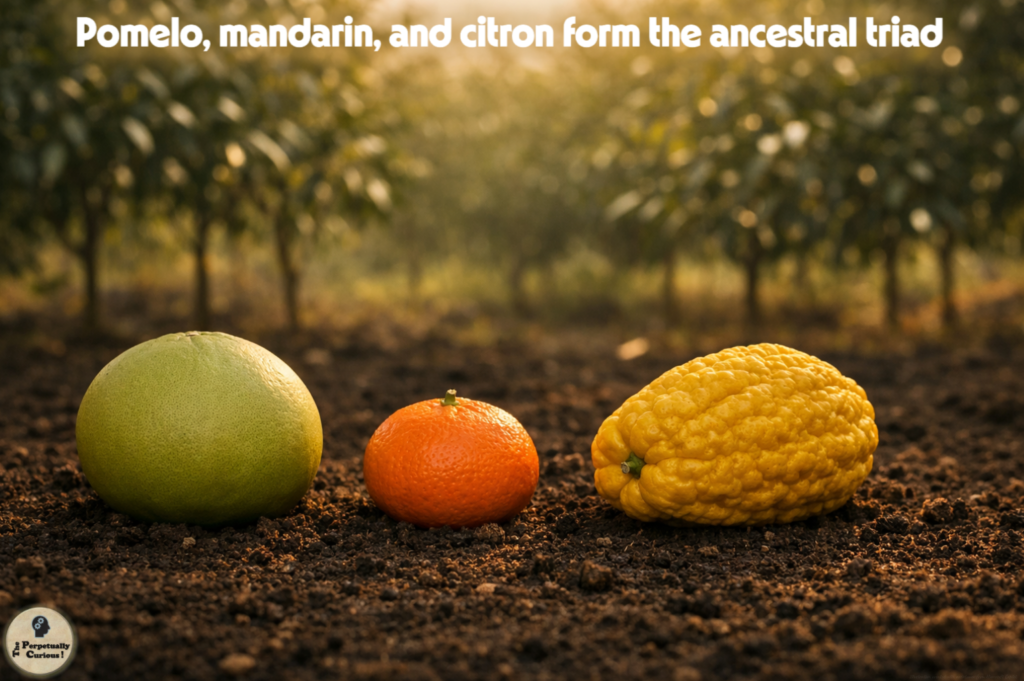
Modern genetic studies suggest that the diversity of cultivated citrus is built primarily from a small group of wild ancestors. Different research groups sometimes emphasize three or four core species, yet there is broad agreement that three of them are especially important in the history of familiar fruits. These three ancestors explain most of the citrus discussed in this article, although papeda lineages also contribute to the ancestry of certain limes.
Citron, Citrus medica, is one of the earliest cultivated citrus. It has a very thick rind, relatively little pulp, and a strong fragrance. Historically it has been valued more for its peel and aroma than for its juice.
Pomelo, Citrus maxima, is the largest of the citrus fruits. It can reach up to about 12 inches (about 30 centimeters) in diameter and often has a thick, soft pith. Its flavor ranges from sweet to tart, and its size and structure have influenced many later hybrids.
Mandarin, Citrus reticulata, is the source of many easy to peel fruits. Wild mandarins were probably smaller and more acidic than many modern varieties, but they contributed sweetness, aroma, and loose skin to a wide range of descendants.
These three ancestral species originated in the foothills of the Himalayas and adjoining regions of Southwest China, South Asia, and Southeast Asia. Over time, natural hybridization and human selection created new fruits that carried fragments of these ancestral traits. With this foundation in place, the next step is to understand where these ancestral species took root and how the landscapes they occupied shaped the long story that followed.
🌱 Where citrus grows: climate and conditions
Citrus trees grow best in warm regions with abundant sunlight. They prefer climates with mild winters and warm summers, and they often thrive in areas where temperatures remain above freezing for most of the year. Many citrus varieties benefit from cooler nights during the ripening season, which can influence acidity, sweetness, and color development. Soil conditions vary among regions, yet citrus trees generally grow well in well drained soils that allow their roots to breathe.
These patterns describe broad tendencies rather than strict requirements, and they reflect the long history of citrus cultivation across many landscapes and climates. With this environmental backdrop in place, the narrative can now turn to the first major branch of the citrus family tree, the mandarin line.
🍊 The mandarin line: mandarins, tangerines, clementines, and kamala
Mandarin is both an ancestral species and a familiar fruit in its own right. Modern mandarins are usually small, often between 2 and 3 inches (about 5 to 7.5 centimeters) in diameter, with a loose, easy to remove peel and segments that separate cleanly. Their aroma is bright and inviting, and their sweetness has made them a cherished fruit across many cultures.
Clementine is a hybrid that typically combines mandarin with sweet orange. It is usually small, seedless or nearly seedless, and very easy to peel. Its sweetness and low acidity make it a common choice for children and for quick snacks. Although it carries genetic material from both mandarin and sweet orange, its appearance and eating experience feel very close to the mandarin side of the family.
Tangerine is a broadly used term for deep orange mandarin varieties that share the same easy peel characteristics of the mandarin line.
Kamala orange, a regional name used in South India, usually refers to a mandarin type rather than a true sweet orange. These fruits are typically small, sweet, and easy to peel. The word “orange” in this context is vernacular rather than botanical. In a family tree, kamala would sit comfortably among mandarins and tangerines, not among the larger sweet oranges that are often used for juice.
Mandarin’s sweetness and gentle peelability became the foundation for many later fruits, including the sweet orange that would soon travel across the world.
🍊 The sweet orange: a layered blend of mandarin and pomelo ancestry
The familiar sweet orange, Citrus × sinensis, ultimately derives from mandarin and pomelo ancestry through historical hybridization and backcrossing. This category includes well known types such as navel oranges and Valencia oranges. These fruits are usually larger than mandarins, often around 3 to 4 inches (about 7.5 to 10 centimeters) in diameter, with a firmer peel and a balance of sweetness and acidity that suits both eating and juicing.
In genetic terms, sweet orange carries a significant contribution from mandarin, which provides sweetness and some peel characteristics, and a contribution from pomelo, which influences size, internal structure, and aspects of flavor. This blended lineage helps explain why sweet oranges feel related to both smaller mandarins and larger pomelos.
Although sweet orange became one of the most widely cultivated citrus fruits, not every pale, round fruit belongs to this lineage, as the gentle sweet lime reveals.
🍋 Sweet lime: the gentle world of Citrus limettioides
Sweet lime, Citrus limettioides (with Citrus limetta used in some classifications for related or overlapping sweet‑lime types), known regionally as saathukudi or mosambi, is widely consumed in parts of India and neighboring regions, especially as a juice. At first glance it may resemble a pale orange, yet its flavor is very mild, with low acidity and a subtle sweetness that can feel almost neutral compared with sharper lemons or limes.
The exact ancestry of sweet lime is still discussed in the scientific literature, but many analyses suggest that it carries a notable contribution from citron along with additional admixture from mandarin and pomelo lineages. Its lineage is therefore not fully resolved, and it is not simply a mild form of sweet orange. Instead, it belongs to a citron influenced branch of the citrus family, even though its appearance and culinary use may invite comparison with oranges.
Its mildness leads naturally into the broader citron influenced branch, where acidity, fragrance, and thick rinds shape a different citrus story.
🍋 Lemon, lime, naarthangai, and kadarangai: the citron influenced branch
To understand lemon, lime, and several regional fruits, it is helpful to return to citron. Citron, with its thick rind and limited pulp, may not be a common table fruit today, but it has played a central role in the creation of many familiar citrus types.
Lemon, Citrus limon, is widely regarded as a hybrid that combines citron with bitter orange, a mandarin–pomelo cross prized for its sharp, aromatic peel. It is typically about 2 to 3 inches (about 5 to 7.5 centimeters) long, with a bright yellow peel, high acidity, and a strong aroma. Its juice and zest are used in a wide range of culinary and cultural contexts.
The word “lime” covers several different citrus. Key lime, Citrus aurantiifolia, is usually small, often about 1 to 2 inches (about 2.5 to 5 centimeters) in diameter, with high acidity and a distinctive fragrance. Genetic studies suggest that it likely combines citron with members of the papeda group. Persian or Tahitian lime, Citrus latifolia, is larger and less aromatic, and appears to be a hybrid involving key lime and lemon.
Sweet lime, as described earlier, is different again. It is mild and low in acidity and is usually placed among citron influenced hybrids rather than among the sharper limes.
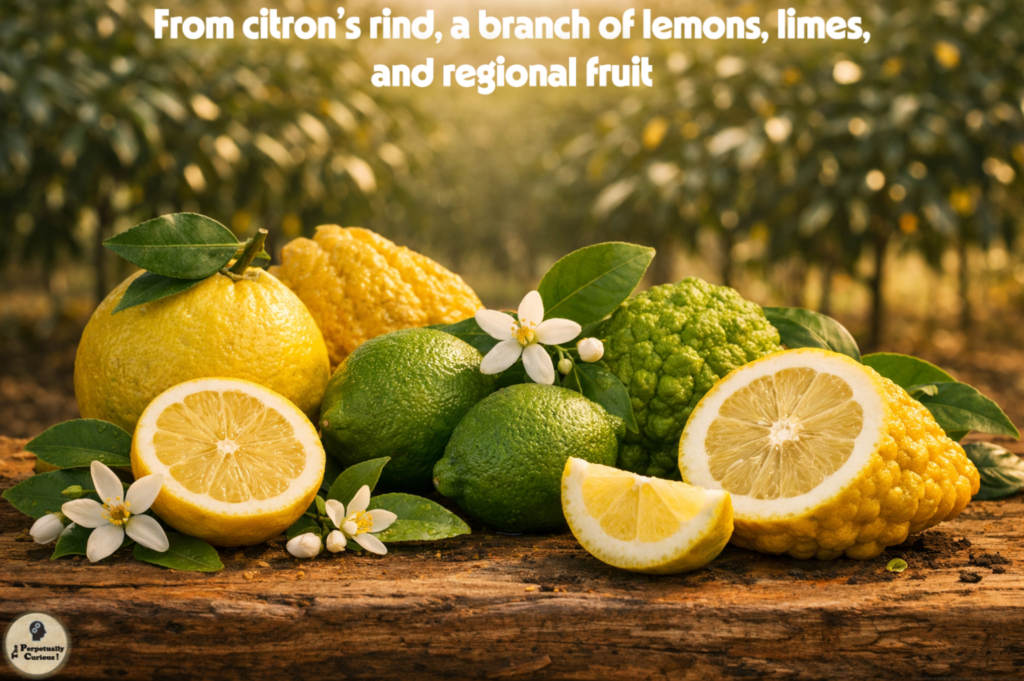
Naarthangai, a Tamil name for citron or rough lemon type fruits, is commonly used in pickles and traditional preparations.
Kadarangai, a Tamil name for small, intensely aromatic lemon like or citron like fruits, is also widely used in pickles and condiments. Although local usage varies across regions and households, these fruits generally sit within the citron influenced branch of the citrus family. These culinary traditions of preservation reflect a wider cultural intelligence surrounding regional foodways that stretches across many regions and centuries.
These citron influenced fruits reveal how a single ancestor can give rise to many forms, each shaped by climate, culture, and centuries of cultivation.
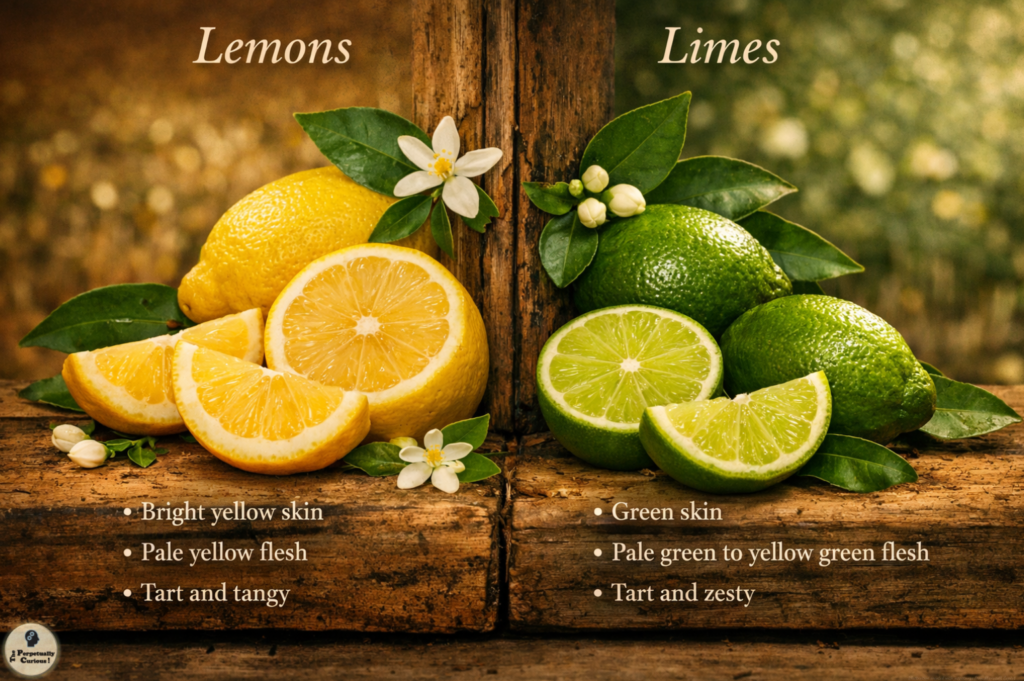
Lemon and lime: two paths from the same ancestor.
Although lemon and lime differ in color, aroma, and acidity, both trace their origins to citron. Lemon carries the influence of bitter orange, while many limes carry the influence of papeda. These different ancestral blends shape their flavor, rind texture, and culinary roles.
🍊 Grapefruit and the pomelo leaning hybrids
Grapefruit, Citrus × paradisi, is another citrus that reflects a combination of sweet orange and pomelo ancestry. It is usually larger than a typical orange, often about 4 to 6 inches (about 10 to 15 centimeters) in diameter, with a thick rind and segments that can range from pale yellow to deep pink or red. Its flavor is characteristically bitter sweet, with noticeable acidity.
Genetic studies indicate that grapefruit likely arose when sweet orange, itself a blend of mandarin and pomelo lineages, crossed again with pomelo or a closely related form. This additional contribution from pomelo helps explain the fruit’s size, structure, and distinctive bitterness.
Grapefruit’s bold flavor and size reflect the enduring influence of pomelo, completing the trio of major citrus branches.
🌸 Pollination and the quiet work of citrus blossoms
As citrus fruits vary in lineage, size, and flavor, they all return to a shared biological beginning in the flower, where each season’s new generation quietly takes shape.
Citrus trees begin their story each season with blossoms that release a soft, sweet fragrance. These flowers are usually white, with five petals and a cluster of bright yellow anthers at the center. Their scent carries easily on warm air, and it serves as a signal to visiting insects that nectar and pollen are available.
Bees are the primary pollinators of citrus. Honeybees, solitary bees, and small native bees visit the blossoms in search of nectar, and in doing so they transfer pollen from one flower to another. This movement of pollen allows fertilization to occur, which leads to the development of seeds in many citrus varieties. Even in fruits that are seedless or nearly seedless, pollination can still influence fruit set and shape.
Some citrus varieties are self compatible, which means that pollen from the same tree can fertilize the flower. Others benefit from cross pollination, where pollen from a different tree enhances fruit development. The exact pattern varies among species and hybrids, yet the underlying process remains the same. Blossoms open, pollinators arrive, and the next generation of fruit begins quietly within the flower.
A wider view of these seasonal exchanges appears in the study of pollinators, which explores how insects and flowering plants shape one another across many ecosystems.
🎨 The colors of citrus: why fruits turn green, yellow, orange, or red
Citrus fruits display a wide range of colors, and these colors arise from a balance of pigments that shift as the fruit matures. In warm tropical climates, chlorophyll often remains active in the peel, which is why some ripe oranges and mandarins stay green or partly green even when they are sweet inside. In cooler conditions, chlorophyll breaks down more readily, revealing carotenoids that create yellow and orange hues.
Lemons owe their bright yellow color to carotenoids that become more visible as the fruit ripens. Pomelos vary widely, with some remaining pale green and others turning yellow, depending on climate and variety. Mandarins often develop deeper orange tones because they accumulate specific carotenoids that intensify with maturity.
Blood oranges contain anthocyanins, pigments more commonly associated with berries and flowers. These pigments develop under cooler night temperatures and specific genetic conditions, which is why blood oranges appear in certain regions and not others. The pigments that shape blood oranges form part of a wider palette of plant chemistry that also appears in studies of vegetable color.
📊 A simple comparison of citrus varieties
| Fruit | Botanical lineage | Typical color when ripe | Flavor profile | Peelability | Seeds |
|---|---|---|---|---|---|
| Citron | Ancestral species | Pale yellow to green | Thick rind, low pulp, aromatic | Difficult | Few to several |
| Mandarin | Ancestral species | Orange | Sweet, low acid | Very easy | Few |
| Clementine | Mandarin × sweet orange | Deep orange | Sweet, very low acid | Very easy | Seedless or few |
| Sweet orange | Mandarin × pomelo ancestry | Orange | Sweet tart | Medium | Varies |
| Sweet lime | Citron influenced hybrid | Pale yellow to light green | Mild, low acid | Medium | Few to several |
| Lemon | Citron × bitter orange | Yellow | High acid | Medium | Few to several |
| Key lime | Citron × papeda lineage | Green to yellow | Sharp, aromatic | Medium | Many |
| Persian lime | Key lime × lemon | Green to yellow | Mild to moderately acidic | Medium | Few to several |
| Grapefruit | Sweet orange × pomelo | Yellow rind; pale yellow to deep pink flesh | Bitter sweet | Medium | Few to several |
| Pomelo | Ancestral species | Green to yellow | Sweet to tart | Medium | Few to several |
🌐 One genus, many stories: bringing the citrus family together
All of the fruits described so far belong to the genus Citrus. They differ in size, color, acidity, aroma, and cultural use, yet they share a common botanical framework. Most can be traced back, through hybridization and backcrossing, to a small group of ancestral species that once grew in overlapping regions of Asia.
Mandarin and its descendants provide sweetness, easy peeling, and a familiar snack like quality. Pomelo and its hybrids contribute size, structure, and a range of flavors from gentle to sharply bitter. Citron and its derivatives bring intense fragrance, thick rinds, and the sharp or subtle acidity that shapes many culinary traditions.
Regional names such as sweet lime, kamala orange, naarthangai, and kadarangai reflect local histories and uses. Scientific names such as Citrus limon or Citrus × sinensis reflect lineage and classification. Both naming systems carry meaning. When they are placed side by side, they reveal how cultural practice and botanical history intertwine.
The citrus family continues to evolve, shaped by human hands and natural forces, and each fruit carries a quiet echo of its ancestors.
📚 A gentle guide to reading the citrus tree
Understanding the citrus family tree does not require memorizing every hybrid combination. Instead, it may be helpful to keep a few guiding ideas in mind. Many familiar fruits are hybrids rather than original wild species. Similar appearance does not always mean close ancestry, and different looking fruits may be closely related. Vernacular names often describe how a fruit is used or perceived, while botanical names aim to describe how it is related.
With these ideas, the citrus tree becomes less of a tangle and more of a story. Citron, pomelo, and mandarin stand as ancestral pillars. Sweet orange, grapefruit, lemon, lime, clementine, sweet lime, kamala orange, naarthangai, and kadarangai become chapters in a long narrative of crossing, selection, and cultural meaning.
A similar diversity shaped by ancestry and selection appears in the study of apple varieties, where flavor, texture, and lineage form their own quiet patterns.
Pass this article along to someone curious and let the learning travel.
💡 Did You Know
🍊 Many citrus fruits can produce seeds that contain more than one embryo. Some of these embryos are true hybrids, while others are genetic copies of the mother plant.
🍃 The color of citrus peel can depend strongly on climate. In warmer tropical regions, some oranges and mandarins may remain green or partly green on the outside even when they are fully ripe and sweet inside.
🍊 Blood oranges owe their deep red flesh to pigments known as anthocyanins. These pigments are more commonly associated with berries and some flowers, and their presence in citrus reflects a particular genetic background and environmental conditions.
🍃 Citrus peel contains aromatic oils stored in tiny sacs on the surface of the rind. When the peel is pressed or twisted, these sacs release a fine mist of fragrant oil that contributes to the characteristic scent of citrus.
🍊 The balance of acidity and sweetness in citrus can shift with temperature. Cooler nights often encourage higher acidity, while warmer conditions may lead to gentler, sweeter flavors.
🍃 The white threads visible inside citrus fruits are part of a network of internal fibers and vascular strands within the albedo, the spongy inner layer of the peel, which help transport water, sugars, and nutrients into each developing segment.
🍯 Citrus blossoms produce nectar that varies in composition among species, which shapes the distinctive character of citrus blossom honey, one of the most aromatic and regionally prized forms of floral honey.
🌿 Some citrus trees can produce both flowers and fruit at the same time, creating a unique seasonal overlap that is uncommon in many temperate fruit trees.
🍇 The interplay of climate, genetics, and cultivation that shapes citrus diversity follows patterns found across many fruit families, including the wide spectrum of grape varieties, where similar forces produce a rich range of colors, flavors, and textures.