

There is a quiet elegance in the way crude oil begins its transformation. It arrives as a dark, ancient liquid shaped by geological time, yet it enters the refinery as a material waiting to be understood. Towers rise, pipes weave, and heat flows through steel corridors, guiding molecules through a landscape shaped by human curiosity and engineering discipline. What appears from a distance as an industrial maze is, at its core, a patient choreography of separation, transformation, and refinement. The refinery becomes a place where matter is encouraged to reveal its hidden structure, one temperature rise and pressure shift at a time.
Chemical engineering gives this choreography its form. Every column, reactor, and exchanger reflects decades of thermodynamic insight, reaction kinetics, and process design. The refinery becomes a living system where heat, pressure, and molecular behavior are guided with precision. This article follows that journey step by step, allowing each stage to unfold naturally into the next, so that the entire process becomes a continuous narrative rather than a collection of isolated units.
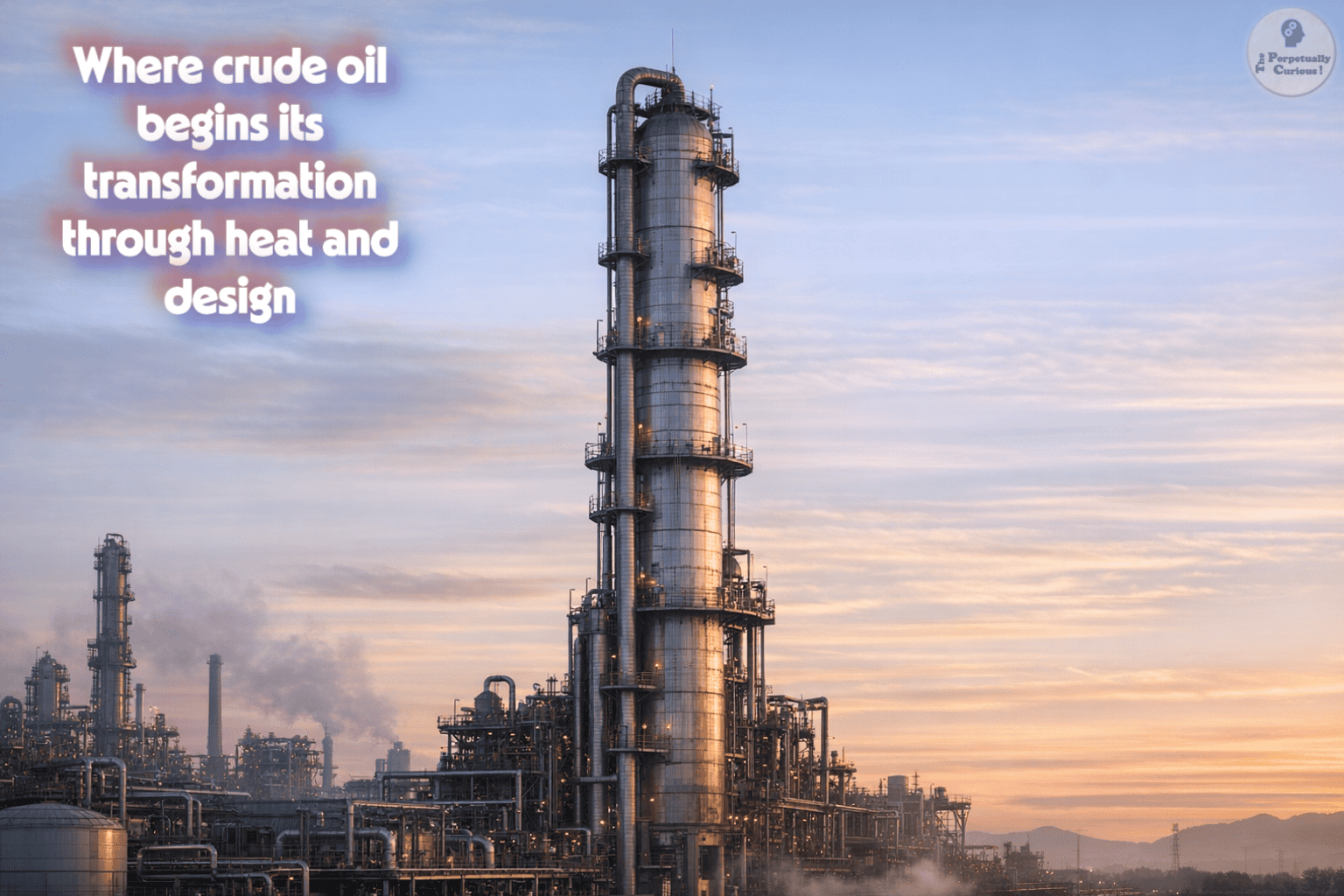
Heat rises through steel towers, molecules wander and return, ancient liquids reshaped by thoughtful design.
From deep time to present flame, the refinery listens to matter and guides it toward clarity.
🛢️ Crude oil arrives: The beginning of a long transformation
Crude oil enters the refinery as a complex mixture of hydrocarbons that may include paraffins, naphthenes, aromatics, and small amounts of sulfur, nitrogen, oxygen, and trace metals. Its composition varies depending on its geological origin, which means that each batch carries a slightly different fingerprint. Light crudes may yield more gasoline and naphtha, while heavier crudes may require more extensive conversion. Understanding how these elements behave at the molecular level becomes clearer when viewed through the lens of atomic numbers, which define the identity and chemical character of each atom present in crude oil.
Before any major transformation can occur, the crude is desalted. It is typically heated to about 200 to 300 degrees Fahrenheit (about 100 to 150 degrees Celsius) and mixed with fresh water so that dissolved salts and fine solids can migrate into the water phase and be removed. This step protects downstream equipment from corrosion and fouling, shields catalysts from contaminants that can shorten their useful life, and improves the stability of streams entering the first major separation step. By the time the crude leaves the desalter, it is cleaner and typically heated further to about 480 to 500 degrees Fahrenheit (about 250 to 260 degrees Celsius), ready for the first major act of separation.
The natural next step is to sort this complex mixture by boiling point, which leads directly into atmospheric and vacuum distillation.
🌡️ Separation by boiling point: Atmospheric and vacuum distillation
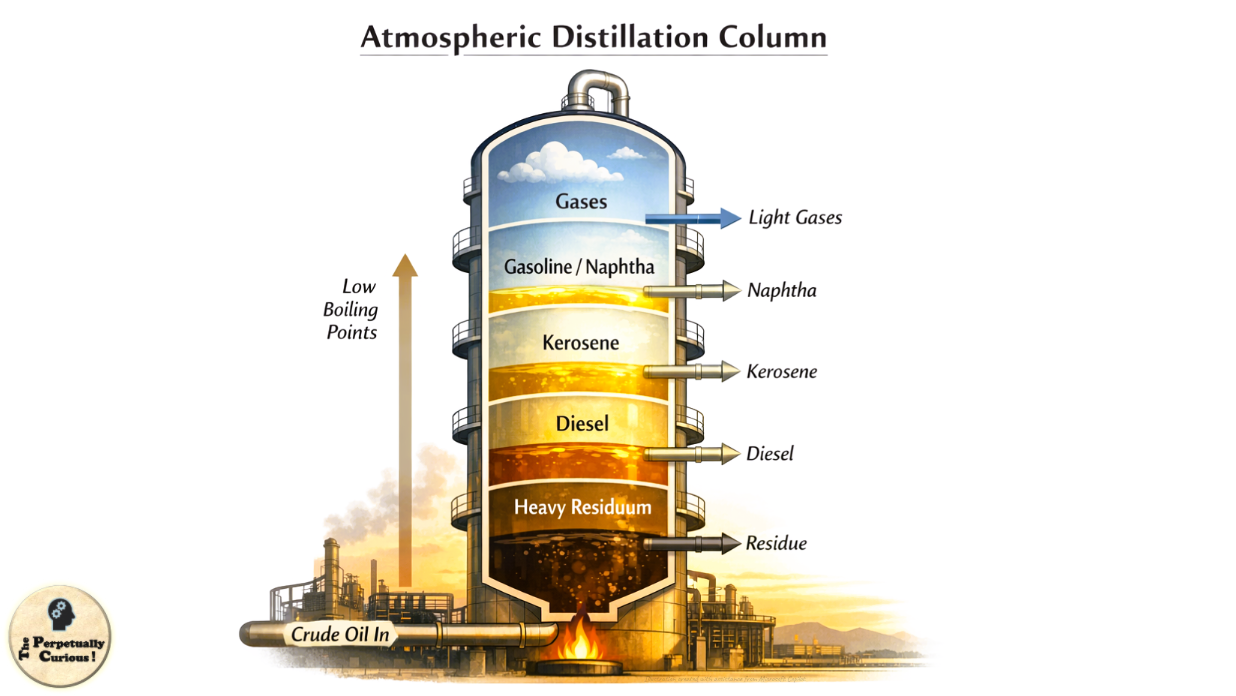
Distillation is the refinery’s first major sorting mechanism. It relies on differences in boiling range. In the atmospheric distillation unit, the preheated crude is raised to about 660 to 680 degrees Fahrenheit (about 350 to 360 degrees Celsius) and introduced into a tall column operating near atmospheric pressure. Inside, trays or structured packing provide surfaces where rising vapors meet descending liquids. Lighter components rise toward the top, condensing into gases and light naphtha. Middle fractions such as kerosene and diesel condense on trays in the central region. Heavier gas oils remain lower in the column, while the heaviest material collects at the bottom.
As vapors rise and liquids fall, the column naturally arranges hydrocarbons by their boiling points. Light gases near the top become feedstocks for liquefied petroleum gas, while light and heavy naphtha streams move toward gasoline and petrochemical applications. Kerosene condenses lower in the tower and becomes the foundation for aviation fuel, followed by diesel range gas oils that settle further down. The heaviest material remains at the base as atmospheric residue, which becomes the starting point for deeper processing. This vertical progression reflects the principles of vapor–liquid equilibrium that chemical engineers use to guide each fraction toward its most suitable future product.
Seen from a conceptual distance, the column resembles a quiet ladder of boiling points, with the lightest vapors gathering near the top and the densest liquids resting at the bottom.
Once the atmospheric column has collected all fractions that can vaporize under normal pressure, the remaining material requires a different approach. Some fractions are too heavy to boil at atmospheric pressure without cracking. To preserve their structure, they are routed to a vacuum distillation unit. By lowering the pressure, the boiling points of heavy fractions decrease, allowing them to vaporize at lower temperatures. Vacuum towers separate atmospheric residue into vacuum gas oils and vacuum residue, which become important feedstocks for later conversion units. This second stage allows the refinery to recover valuable gas oils that would otherwise thermally degrade, while leaving behind a residue that becomes feed for conversion units or the basis for asphalt roads and other heavy products.
Distillation sorts crude oil into families of hydrocarbons, but many of these fractions are not yet suitable as finished fuels. The next stage of the journey reshapes molecules themselves, guiding heavier components toward lighter, more valuable products.
🔧 Transforming molecules: Cracking, reforming, and molecular reshaping
Once crude oil has been separated into fractions, the refinery turns to conversion processes. These units exist because global demand leans heavily toward lighter fuels such as gasoline, jet fuel, and diesel, while crude oil naturally contains a significant proportion of heavier components. Conversion units reshape molecular structures so that the product slate aligns more closely with real world needs.
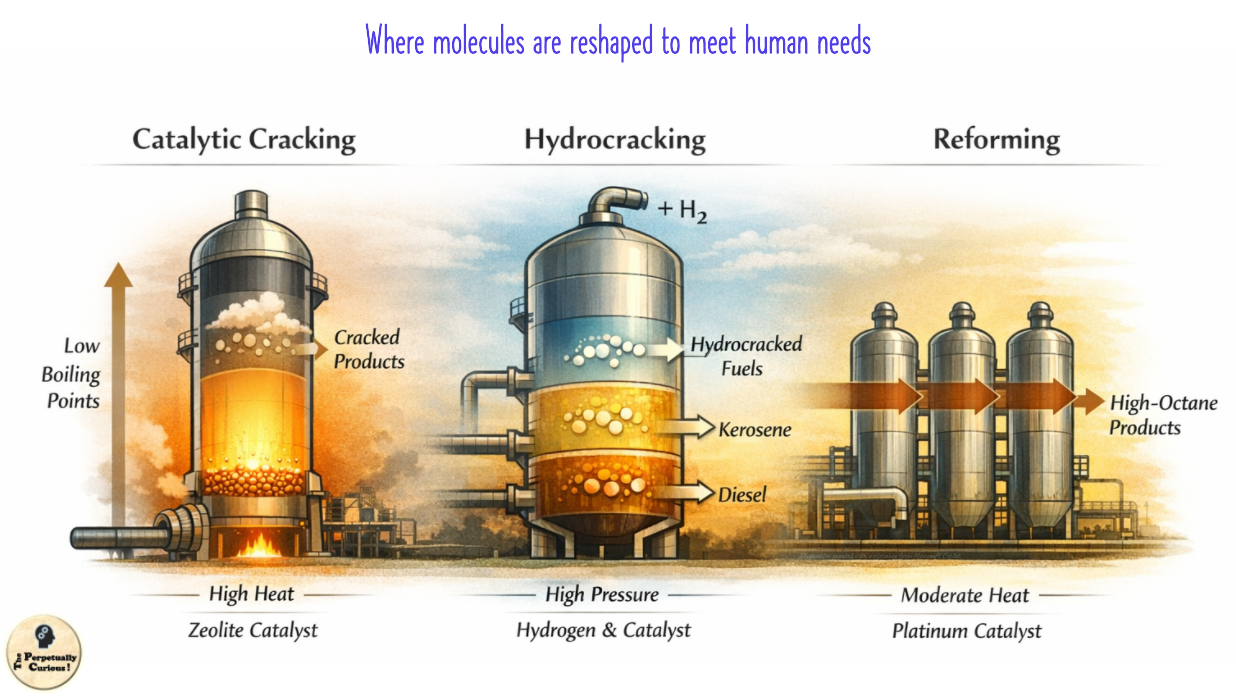
Catalytic cracking is one of the most important conversion processes. In a fluid catalytic cracking unit, heavy gas oils contact a finely powdered catalyst at temperatures of about 900 to 1,000 degrees Fahrenheit (about 480 to 540 degrees Celsius). Large hydrocarbon molecules break into smaller ones, forming gasoline range components and light olefins. The catalyst gradually accumulates carbon, known as coke, and is regenerated by controlled burning in a separate vessel. This cyclical regeneration allows continuous operation.
Hydrocracking combines high pressure hydrogen with a bifunctional catalyst that promotes both cracking and hydrogenation. Operating conditions may involve temperatures of about 650 to 800 degrees Fahrenheit (about 340 to 430 degrees Celsius) and elevated pressures under moderate‑severity conditions. Hydrocracking can produce very clean, low sulfur products and allows refiners to adjust product distribution by modifying operating conditions.
Catalytic reforming takes a different approach. Instead of breaking molecules apart, it rearranges them. Low octane naphtha is passed over a platinum containing catalyst at high temperature and moderate pressure. Straight chain hydrocarbons are converted into branched and aromatic structures with higher octane numbers. Hydrogen is produced as a byproduct, which becomes an essential resource for hydrotreating and hydrocracking units.
Other processes, such as alkylation and isomerization, further refine the molecular architecture of fuels. Alkylation combines light olefins with isobutane to form high octane, branched hydrocarbons. Isomerization rearranges straight chain molecules into branched forms without changing their carbon number. Together, these processes allow the refinery to sculpt the fuel pool with precision.
After conversion, many streams still contain sulfur, nitrogen, or other impurities. The next stage of the journey focuses on cleaning and stabilizing these streams.
💧 Cleaning the streams: Hydrotreating and treating processes
As fuels move closer to their final form, treating processes remove impurities that may affect performance or emissions. Hydrotreating is one of the most widely used methods. In a hydrotreating unit, a petroleum stream is mixed with hydrogen and passed over a catalyst at elevated temperature and pressure. Sulfur compounds convert to hydrogen sulfide, nitrogen compounds convert to ammonia, and unsaturated hydrocarbons become more stable saturated forms. Hydrogen sulfide is separated and routed to sulfur recovery handling, while ammonia is typically removed through sour water stripping and related downstream treatment. These purification steps matter because they protect catalysts in later units, improve storage stability, and ensure compatibility with downstream processes.
Hydrotreating severity influences product quality and hydrogen consumption. Lighter streams may require mild conditions, while heavier or more contaminated streams may require more intense treatment. Other treating methods include chemical sweetening and solvent based processes that selectively remove specific contaminants.
Once streams have been cleaned and stabilized, they are ready to be blended into finished products. This leads naturally to the final stage of fuel preparation.
🚢 Blending and storage: Bringing streams together
Finished fuels are rarely the output of a single unit. Instead, they are blends of multiple streams, each contributing specific properties. Gasoline may include reformate, cracked gasoline, alkylate, and isomerate, along with carefully selected additives. By adjusting proportions, refiners meet specifications for octane, vapor pressure, sulfur content, and other parameters. No single stream can usually satisfy all of these requirements on its own, which is why blending becomes the refinery’s final act of coordination.
Blending is followed by storage in dedicated tanks and eventual loading into pipelines, ships, trucks, or railcars. Quality control laboratories test samples to confirm that products meet required standards. The refinery therefore operates as a connected system, where changes in one unit influence the balance of others. That same interconnectedness extends beyond the product slate into the refinery’s energy economy, where the heat, pressure, and byproducts of every unit must be accounted for, recovered, or responsibly managed.
🔬 Energy, byproducts, and environmental controls as engineering systems
Refineries are energy intensive facilities, yet they are designed to recover and reuse as much energy as practical. Heat exchangers transfer energy from hot streams to colder ones, reducing the need for additional fuel firing. Steam networks distribute thermal energy across the site, and some refineries may use cogeneration systems that produce both electricity and steam. The disciplined recovery of heat across these interconnected streams reflects the broader principles of energy conservation that guide process integration throughout the facility.
Byproducts such as hydrogen sulfide are routed to sulfur recovery units, where they are converted to elemental sulfur through processes such as the Claus reaction. Wastewater passes through multi stage treatment plants that may include oil water separation, biological treatment, and polishing steps. Air emissions are managed through combustion controls, flares, and equipment designed to minimize leaks.
These systems do not change the fundamental chemistry of fuels, but they influence how refineries interact with air, water, and surrounding communities. They form an additional layer of engineering that surrounds the core refining processes, closing loops and guiding byproducts toward safer forms. These interlocking systems ultimately reveal a refinery’s deeper character: not merely a site of transformation, but a structure designed to account for every consequence of that transformation before the final reflection begins.
🌍 A closing reflection on matter, time, and human ingenuity
From the moment crude oil enters the refinery to the moment finished fuels leave the gate, the entire journey is guided by principles of physical chemistry, thermodynamics, and reaction engineering. Separation leads to transformation, transformation leads to purification, and purification leads to blending and control. Each stage builds on the last, forming a continuous chain that links ancient geological deposits to the fuels that support contemporary movement.
The refinery is often seen as a landscape of steel and flame, yet within that landscape molecules are constantly being separated, rearranged, and refined. Each column and reactor plays a role in guiding crude oil along a path shaped by human curiosity and the desire to understand and improve the materials that support daily life. This long chain of design and discovery reflects the broader heritage of scientific legends whose insights continue to shape how engineers understand matter and energy.
Pass this article along to someone curious and let the learning travel.
💡 Did You Know
⚗️ Catalysts in catalytic cracking are continuously regenerated, allowing the unit to operate without interruption while maintaining activity and selectivity.
🌡️ Vacuum distillation towers can be very tall structures, often comparable in height to multi‑story buildings, creating the space needed for heavy fractions to separate efficiently under reduced pressure.
🔬 Hydrogen produced in catalytic reforming often becomes a vital feed for hydrotreating and hydrocracking units, forming a refinery‑wide hydrogen network.
🛢️ Many refineries blend crude oils from multiple regions to achieve specific processing characteristics, improving flexibility and product quality.
🔥 Seasonal gasoline formulations change to account for temperature and evaporation behavior, ensuring consistent performance throughout the year.
🏭 Heat integration systems can significantly reduce fuel consumption by transferring heat from hot streams to colder ones, improving overall energy efficiency.
🌬️ Radar‑based level gauges installed in refinery tanks and distillation columns operate on the same electromagnetic reflection principles explored in radar signals, transmitting microwave pulses and measuring the returning echo to determine liquid levels without direct contact.
🌡️ Each fraction in a distillation tower condenses at a characteristic height that reflects its boiling range, creating a natural vertical map of products from aviation fuel precursors near the middle to heavy residues at the base.
Why can refineries not simply produce more gasoline on demand?
Refinery output is influenced by the composition of crude oil and the configuration of process units. Increasing gasoline production may reduce the availability of other products or require adjustments to conversion units.
How does crude oil quality affect refinery output?
Light, sweet crudes may yield more gasoline and require less treating, while heavy, sour crudes may require more extensive conversion and hydrotreating.
What determines refinery complexity?
Refinery complexity is influenced by the number and type of conversion and treating units. More complex refineries can process a wider range of crude oils and produce a broader slate of products.
Why is hydrogen important in refineries?
Hydrogen is essential for hydrotreating and hydrocracking, where it helps remove impurities and stabilize hydrocarbons.
How do refineries ensure product quality?
Quality control laboratories test samples throughout the process to confirm that products meet required specifications.
Why do refineries operate continuously?
Refineries operate continuously because many units rely on stable temperatures, pressures, and catalyst conditions. Starting and stopping frequently would reduce efficiency and increase wear.
What limits how much a refinery can change its product slate?
The design of process units, catalyst selection, and equipment capacity influence how much a refinery can shift production toward specific products.
Why do refineries use such high temperatures and pressures?
High temperatures and pressures are required to drive specific reactions, improve separation efficiency, and achieve desired product qualities.
Which products come from which fraction in the distillation column?
Light gases near the top become liquefied petroleum gas, naphtha streams move toward gasoline and petrochemical feedstocks, kerosene becomes the foundation for aviation fuel, gas oils form the basis for diesel, and the heaviest atmospheric residue becomes feed for vacuum distillation or the starting point for asphalt and other heavy materials.
How do refineries maintain safety under such extreme conditions?
Safety is maintained through multiple layers of engineering design, including pressure relief systems, automated shutdown controls, continuous monitoring, and equipment built to withstand high temperatures and pressures.
Why are refineries often located near coasts or major pipelines?
Refineries are frequently placed near coasts or pipeline networks to simplify the transport of crude oil and finished products, reduce shipping costs, and ensure reliable access to global supply routes.
Why do refineries use so much energy?
Refineries use significant energy because many processes require high temperatures, high pressures, or both, and because large volumes of material must be heated, cooled, separated, and transformed.
Why do refineries have flares that burn at night?
Flares act as safety devices that burn excess gases during process upsets or maintenance activities, ensuring that pressure remains within safe limits and preventing the release of uncombusted hydrocarbons.
How long can a refinery run before it needs major maintenance?
Many refineries operate continuously for several years between major maintenance periods known as turnarounds, which allow engineers to inspect, clean, and repair equipment that cannot be serviced during normal operation.
🌎 Share this journey
If this exploration of the petroleum refinery process offered insight or sparked curiosity, we encourage you to help us reach a wider audience by sharing it with friends and colleagues. Your support is deeply appreciated and may inspire others to look more closely at the science that quietly supports everyday life.
“Petroleum Refining: The Process Behind Heat, Pressure, and Design.” The Perpetually Curious!, May 2026.
https://www.theperpetuallycurious.org/articles/petroleum-refining-process/Continue Exploring
For what comes next
Site Updates gathers occasional notes, new additions, and ways to keep in touch. RSS brings new publications to your feed reader in chronological order.
Choose the path that speaks to you, and let the next curiosity find you wherever your wondering takes you.