

Ink is one of the most familiar materials in daily life, yet it remains quietly extraordinary. A thin film of color on a page can carry memory, instruction, art, or identity. It can last for a single day or endure for centuries. When we look closely, ink becomes a story about chemistry, physics, culture, and time. It is a material shaped by human intention, designed to move from liquid to mark with precision and purpose.
This article follows ink through its essential elements, its transformation during drying, its role in printing technologies, its varied lifespans, and its long cultural history. Each section builds on the last, so that ink emerges not as a simple fluid, but as a carefully engineered companion to human communication.
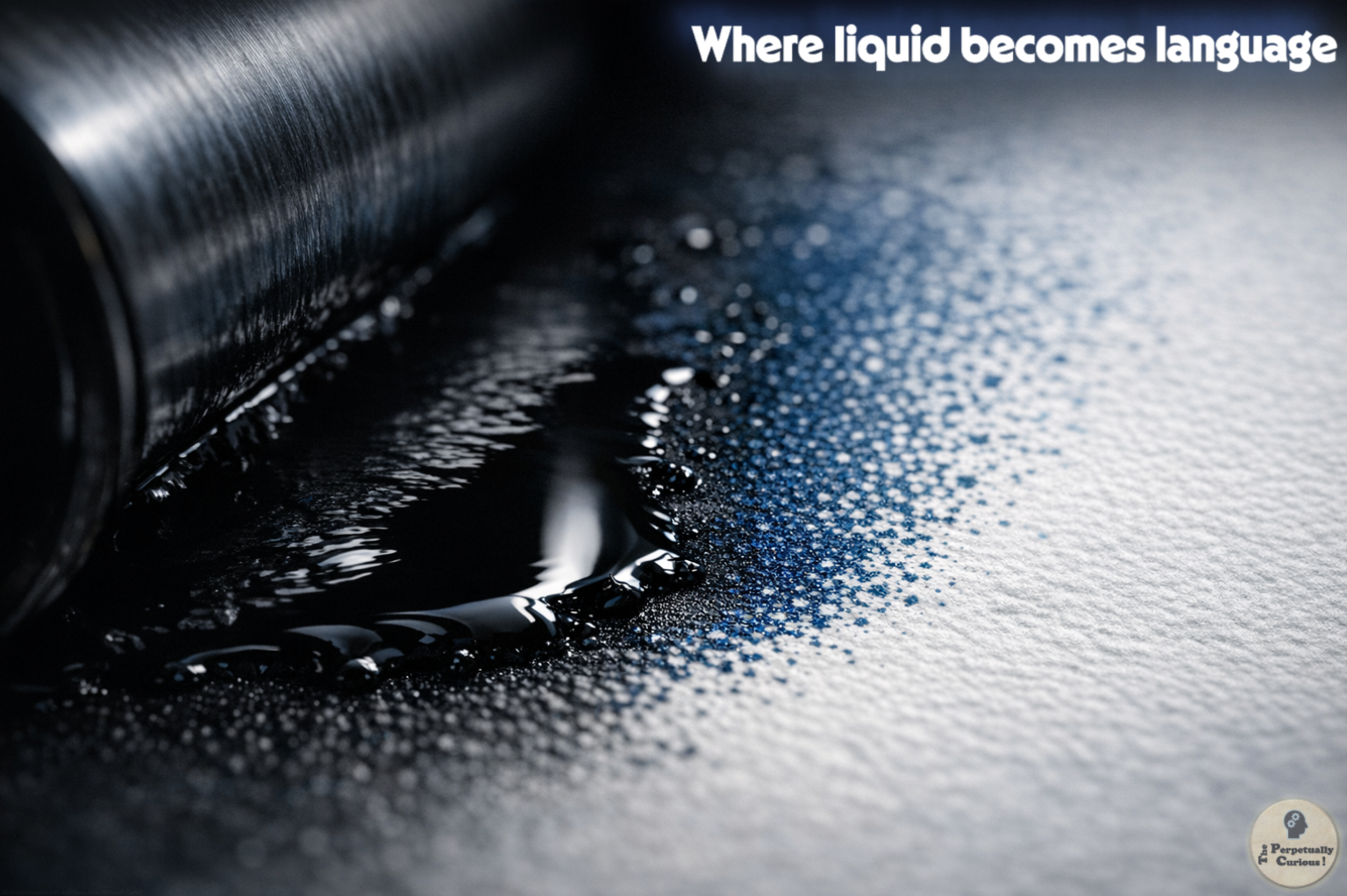
Ink gathers itself into motion, finding the surface that will hold its trace.
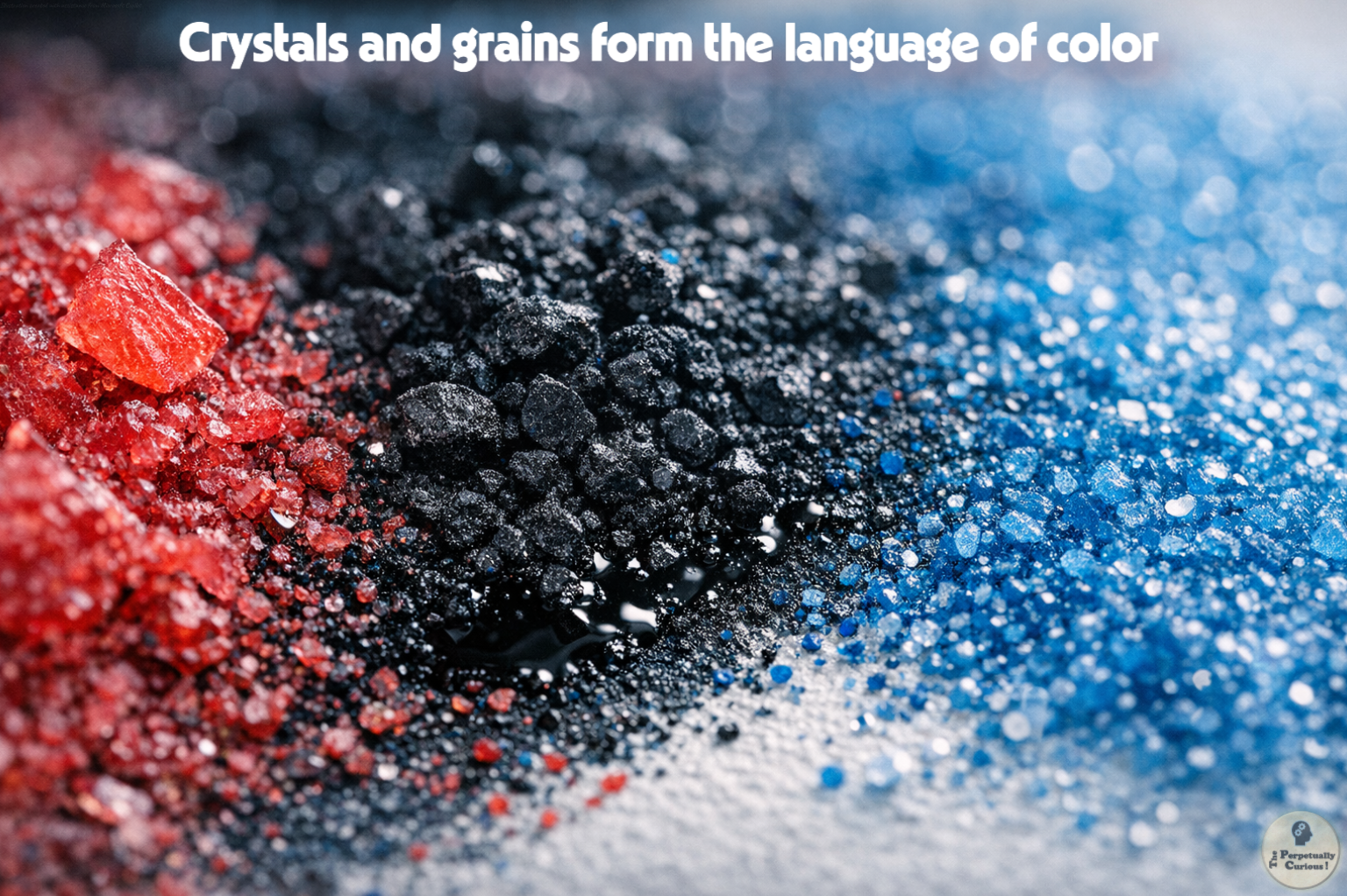
From particles to printed form, color becomes the quiet architecture of meaning.
🎨 What ink is made of: The foundation of color and form
To understand why inks behave differently across printing systems, it is helpful to begin with their shared structure. Most printing inks contain three main formulation elements: colorants, a vehicle‑binder system, and additives. These ingredients work together to carry color, control flow, and create a stable mark.
Colorants are either pigments or dyes. Pigments are solid particles that remain suspended in the liquid. Their particle sizes often range from roughly 100 nanometers to about 1 micrometer, and their surfaces may be treated with dispersants to prevent agglomeration. Because pigments do not dissolve, they often resist fading and provide strong opacity. Dyes dissolve in the liquid phase and can produce vivid, smooth color transitions, although they may be more sensitive to light and humidity. The vivid colors pigments produce arise from their electronic structure and, in many cases, from crystal form and particle properties that influence which wavelengths of light are absorbed, reflected, or scattered, a behavior rooted in the same principles that make each element chemically distinct, as explored through the lens of atomic numbers.
Binders and vehicles play distinct roles within the ink. The vehicle is the fluid carrier that transports the colorant to the surface, while the binder is the film‑forming component that anchors the dried colorant in place. Viscosity is a key property, often measured in centipoise, and it determines how the ink flows through rollers, nozzles, or plates.
Additives fine tune the ink’s behavior. Surfactants improve wetting, waxes enhance rub resistance, and driers accelerate oxidation in certain oil-based systems. These small adjustments allow inks to perform consistently across a wide range of substrates and conditions.
Understanding composition prepares us for the next question: how does this liquid mixture transform into a stable, enduring mark?
🧪 From liquid to mark: How ink dries and sets
Once ink is placed on a surface, it must transition from fluid to solid. This transformation depends on both the ink formulation and the substrate. Drying mechanisms shape sharpness, gloss, durability, and handling time, which is why they are central to printing technology.
Absorption is common in newspaper and book printing. Low viscosity inks penetrate the pores of paper, anchoring the colorant within the fibers. This process is fast and efficient, although it may reduce gloss.
Evaporation is important in many solvent-based and some water-based systems. The liquid carrier evaporates into the surrounding air, leaving behind a thin film of binder and pigment. Temperature, humidity, and airflow influence the rate of evaporation, which is why drying units are often used in high speed presses. The rate at which solvents evaporate is closely tied to their vapor pressure, which influences how quickly an ink film becomes stable on the surface.
Oxidation plays a major role in many conventional sheet fed offset inks. After partial absorption into the paper, the remaining oils and resins react with oxygen in the air. This oxidative curing forms a durable film, although it may take many hours, sometimes approaching a full day, to reach complete stability.
UV curing follows a different path. UV curable inks contain photoinitiators that trigger polymerization when exposed to ultraviolet light. The reaction forms a solid network within seconds, without relying on solvent evaporation. This rapid curing supports high productivity and strong adhesion on non porous materials.
How inks dry is inseparable from how they are designed to be applied, which makes printing technology the next essential lens.
🖨️ Ink in motion: Printing technologies and their demands
Printing technologies place distinct physical and chemical demands on ink. The way ink is transferred, the speed of printing, and the nature of the substrate all influence formulation choices. Moving from drying to printing systems shows how ink formulation must answer to the specific demands of each press and substrate.
Offset lithography uses plates, rollers, and a rubber blanket to transfer ink to paper. Offset inks must balance viscosity, tack, and interaction with water based fountain solutions. They are often paste like and rely on absorption and oxidation for drying.
Flexographic printing uses flexible relief plates and low viscosity inks. These inks must wet a wide range of materials, from paperboard to plastic films. Fast drying is essential because the substrate moves rapidly through the press.
Gravure printing uses engraved cylinders filled with low viscosity ink. The geometry of the engraved cells and the action of the doctor blade determine how much ink transfers to the substrate. Solvent evaporation then forms the final film.
Inkjet printing introduces a different set of constraints. Inkjet inks must form stable droplets, travel through nozzles that may be only a few tens of micrometers wide, and land with controlled spreading. Droplet formation depends on surface tension and viscosity, with energy delivered either by a piezoelectric element or by localized heating that creates a vapor bubble. Many inkjet systems use water-based pigment or dye inks for paper, while UV curable or solvent based inks are used for plastics and textiles. The behavior of tiny inkjet droplets is shaped by the same principles that govern the formation of delicate soap bubbles, which helps explain why surface tension plays such a central role in droplet control.
Lifespan, then, becomes the natural extension of this question: not only how ink performs in the press, but how long that performance endures.
⏳ Ink and time: Lifespans, stability, and purpose
Ink is always designed with time in mind. Some marks are meant to last for only a day, while others are crafted to endure for centuries. Lifespan reflects both material choices and intended use.
Ephemeral inks appear in receipts, tickets, and temporary labels. Thermal papers, for example, rely on heat sensitive coatings rather than traditional inks, and their marks may fade with light or heat. Even conventional short term inks may prioritize speed and economy over long term stability.
Stable inks are used for books, artworks, and archival documents. Pigment based systems, carefully chosen binders, and controlled paper quality can provide strong resistance to light, humidity, and handling. Lightfastness is often evaluated using standardized tests, such as ISO methods that expose samples to controlled illumination. The long term behavior of pigments and binders is influenced by their molecular structure, particle properties, and chemical susceptibility to oxidation, hydrolysis, and photochemical change, which shape how they respond to light, humidity, and environmental stress.
Functional inks extend the idea of lifespan into new domains. Conductive inks can print simple circuits. Thermochromic inks change color with temperature. Security inks may reveal hidden features under specific lighting. In these cases, the ink’s performance is measured not only by visual stability, but also by whether it continues to conduct, respond, or protect as intended.
These varied lifespans invite a broader question: how did ink evolve into such a diverse and adaptable material?
📜 From soot to spectra: A cultural and scientific history
Ink has accompanied human communication for millennia. Its evolution reflects changing tools, materials, and expectations. Moving from lifespan to history allows us to see modern inks as part of a long continuum.
Early inks in several regions were often carbon based, made from soot or charred materials mixed with binders such as gum or animal glue. These inks were valued for their stability, and many manuscripts written with them remain legible today.
Iron gall inks became widespread in later centuries. Made from iron salts and tannin rich extracts, they darkened as iron compounds oxidized. They were prized for permanence, although some formulations contributed to paper degradation over long periods. These early formulations reflect a broader tradition of materials experimentation, much like the centuries long evolution documented in the ancient art of glass.
The rise of printing with movable type created new demands. Inks needed to behave predictably on presses and interact with metal type and paper surfaces. Later developments in offset printing introduced rubber blankets, which required inks with different balances of viscosity, tack, and interaction with fountain solutions.
The nineteenth and twentieth centuries saw the introduction of synthetic organic pigments and polymers. These materials expanded the available color range and improved consistency. Advances in physical chemistry deepened understanding of how inks spread, penetrate, and adhere.
Recent decades have brought digital printing, UV curing, and functional inks. Yet the underlying questions remain familiar: how to carry color or function to a surface, how to fix it there, and how long it should endure.
Tracing this history reveals how each generation of materials and tools shaped the next, creating the foundation for the inks we use today.
🌈 A material of quiet wonder
Ink is a material of quiet power. It is engineered with precision, yet it appears in familiar forms such as books, labels, and photographs. It carries stories, instructions, and identities across time and space. The way ink absorbs and scatters light shapes how colors appear to the human eye.
The science of ink involves colloids, polymers, surface tension, and light absorption. The practice of ink involves presses, papers, and coatings. The experience of ink involves reading, recognition, and memory. When these layers come together, ink becomes more than a technical product. It becomes a companion to human expression.
Pass this article along to someone curious and let the learning travel.
💡 Did You Know
✨ Inkjet droplets can be extraordinarily small. A single droplet may measure only a few picoliters in volume, which is far smaller than a typical raindrop and allows precise tonal control in high resolution printing.
🔬 Some pigment particles are engineered with specialized surface treatments that help them remain evenly dispersed, improve their interaction with binders, and influence how they settle within a coating layer.
🌞 UV curable inks form a solid film through rapid polymerization when exposed to ultraviolet light. This process does not rely on absorption or evaporation, which allows printing on materials that are challenging for other systems.
📜 Historical carbon based inks, when paired with stable substrates and stored in suitable conditions, have demonstrated remarkable longevity. Their survival in manuscripts provides insight into early writing technologies.
🌡 Many printing inks exhibit shear thinning, meaning viscosity decreases as mechanical forces act on the fluid, which allows ink to flow smoothly through rollers or nozzles during printing.
🌈 Colorants interact with light at the molecular level. They absorb specific wavelengths and reflect others, which is why pigments and dyes can produce such varied and expressive hues.
🧊 Thermochromic inks can change color with temperature. These functional inks are used in applications where visual feedback is needed, such as temperature indicators or novelty prints.
⚡ Conductive inks can carry electrical current. They are used to print simple circuits, antennas, and sensors, demonstrating that ink can serve as both a visual and functional material.
What determines whether an ink appears glossy or matte?
Gloss depends on how smooth and uniform the dried ink film is. Smooth films reflect light more directly, while rougher surfaces scatter light and appear matte.
How does color mixing work in printing?
Most four color process printing systems use the CMYK model, where cyan, magenta, yellow, and black inks are applied in precisely controlled dot patterns that overlap and interleave. These patterns absorb specific wavelengths of light, creating a wide range of colors through subtractive mixing.
Why do some inks fade more quickly than others?
Fading depends on the type of colorant, the binder, the substrate, and environmental exposure. Dyes may be more more sensitive to light than pigments, and high levels of sunlight or humidity can accelerate changes.
Why do offset inks take hours to fully dry?
Many conventional offset inks dry through a combination of absorption and oxidative curing. The absorption step is quick, but the oxidative crosslinking of oils and resins may continue for many hours.
Can the same ink be used on paper, plastic, and metal?
Some inks are formulated for broad compatibility, but many are optimized for specific substrates. Surface energy, porosity, and thermal behavior influence adhesion and performance.
Why do some printed images appear sharper than others?
Sharpness depends on droplet control, ink spreading, substrate coating, and drying behavior. Coated papers often hold colorants near the surface, which enhances detail.
What role does paper porosity play in printing?
Porous papers absorb ink more readily, which can speed drying but may reduce gloss and color saturation. Less porous or coated papers keep colorants closer to the surface, improving vibrancy. These differences arise from the underlying paper structure, which shapes how fibers, coatings, and fillers interact with liquid ink.
How do functional inks differ from traditional inks?
Functional inks are designed to perform tasks beyond color delivery. They may conduct electricity, respond to temperature, or reveal hidden features under specific lighting conditions.
Why are synthetic pigments widely used today?
Synthetic pigments offer consistent particle size, strong color strength, and improved stability. They allow manufacturers to achieve predictable performance across a wide range of printing applications. Their performance depends on molecular structure, crystal form, particle size, and surface treatment, which together determine how predictably an ink behaves on press and under varying environmental conditions.
🌿 A gentle invitation to share
We kindly invite you to share and spread the word. If this exploration of ink offered new insight or quiet wonder, you may consider sharing it with friends, colleagues, or anyone who enjoys seeing familiar materials in a new light. Your support in helping this story reach a wider audience is deeply appreciated.
“Printing Ink: The Science and Living History Behind the Printed Page.” The Perpetually Curious!, May 2026.
https://www.theperpetuallycurious.org/articles/printing-ink/Continue Exploring
For what comes next
Site Updates gathers occasional notes, new additions, and ways to keep in touch. RSS brings new publications to your feed reader in chronological order.
Choose the path that speaks to you, and let the next curiosity find you wherever your wondering takes you.