

Before an animal sees or hears another creature, it often meets its chemistry first.
Across forests, oceans, and grasslands, animals move through landscapes shaped not only by terrain and climate, but also by chemistry. Molecules drift through water, cling to leaves, seep from roots, and pulse through the bodies of plants and animals. Some defend, some attract, and some quietly influence behavior in ways that are subtle, surprising, or still not fully understood.
Among these encounters, some are fleeting, some are routine, and a few invite deeper questions about how animals sense and respond to the chemistry around them. Dolphins interacting with pufferfish are one such case, but they are part of a wider pattern. Other species, from reindeer to fruit bats, also meet natural chemicals in ways that shape their behavior. A deeper appreciation of these interactions can be enriched by understanding how other animals navigate their sensory worlds, as seen in studies of shark sensory systems.
To follow this story with clarity, it helps to begin with a single, well‑documented example, then widen the lens to include the chemistry involved, the experiences of other animals, and the scientific caution that guides interpretation.

Life moves through unseen tides of scent and signal that drift through every place it touches.
In the quiet spaces between water and air, chemistry guides the living world along its hidden paths.
🐬 Dolphins and pufferfish: A case study in gentle contact
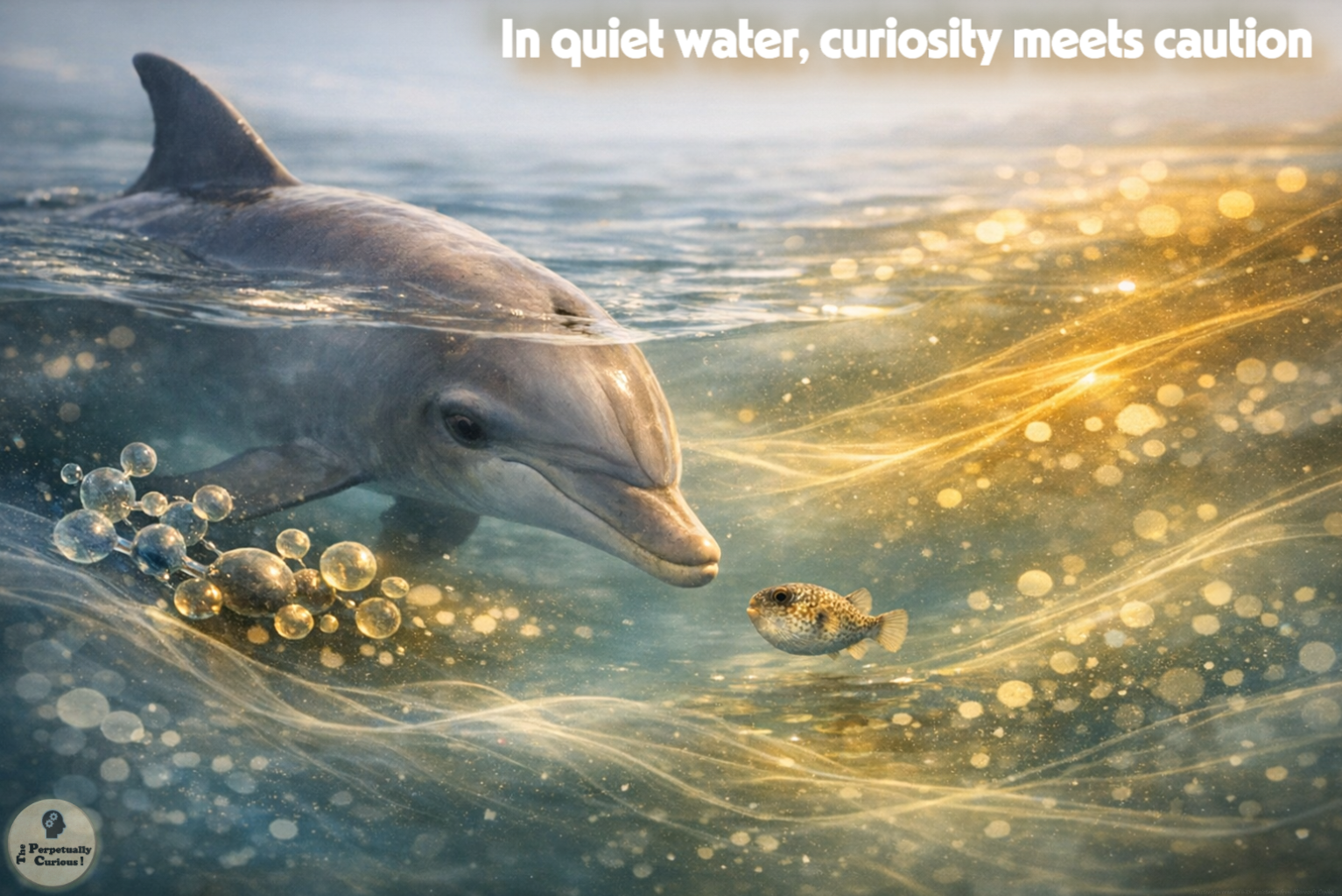
In coastal waters, young bottlenose dolphins have been observed approaching pufferfish with a gentleness that differs from ordinary hunting. They nudge the fish, hold it lightly in their mouths, and sometimes pass it between individuals. The pufferfish inflates as a defensive response, and in the wildlife observational footage available, the dolphins appear to handle it without causing obvious injury. Instead, the dolphins treat the fish as an object of shared interest, returning to it with a curiosity that seems deliberate.
After these interactions, observers have described a shift in the dolphins’ behavior. The animals may float just below the surface or move more slowly than usual, and these descriptions come from naturalistic footage rather than controlled studies. Some viewers have interpreted the dolphins’ stillness or surface-focused behavior as unusual, but these impressions remain observational rather than experimentally verified.
Dolphins are known for their fascination with objects that respond dramatically to touch. They play with seaweed, shells, and even bubbles, exploring how these objects move or change shape. A pufferfish that inflates when nudged offers a particularly striking response, which may help explain why dolphins return to it with such interest. This exploratory instinct is not unique to dolphins; similar curiosity-driven interactions appear across many marine mammals.
To understand why this interaction might influence behavior, the narrative turns next to the molecule at the center of the encounter.
🧪 Tetrodotoxin: A potent molecule with many hosts
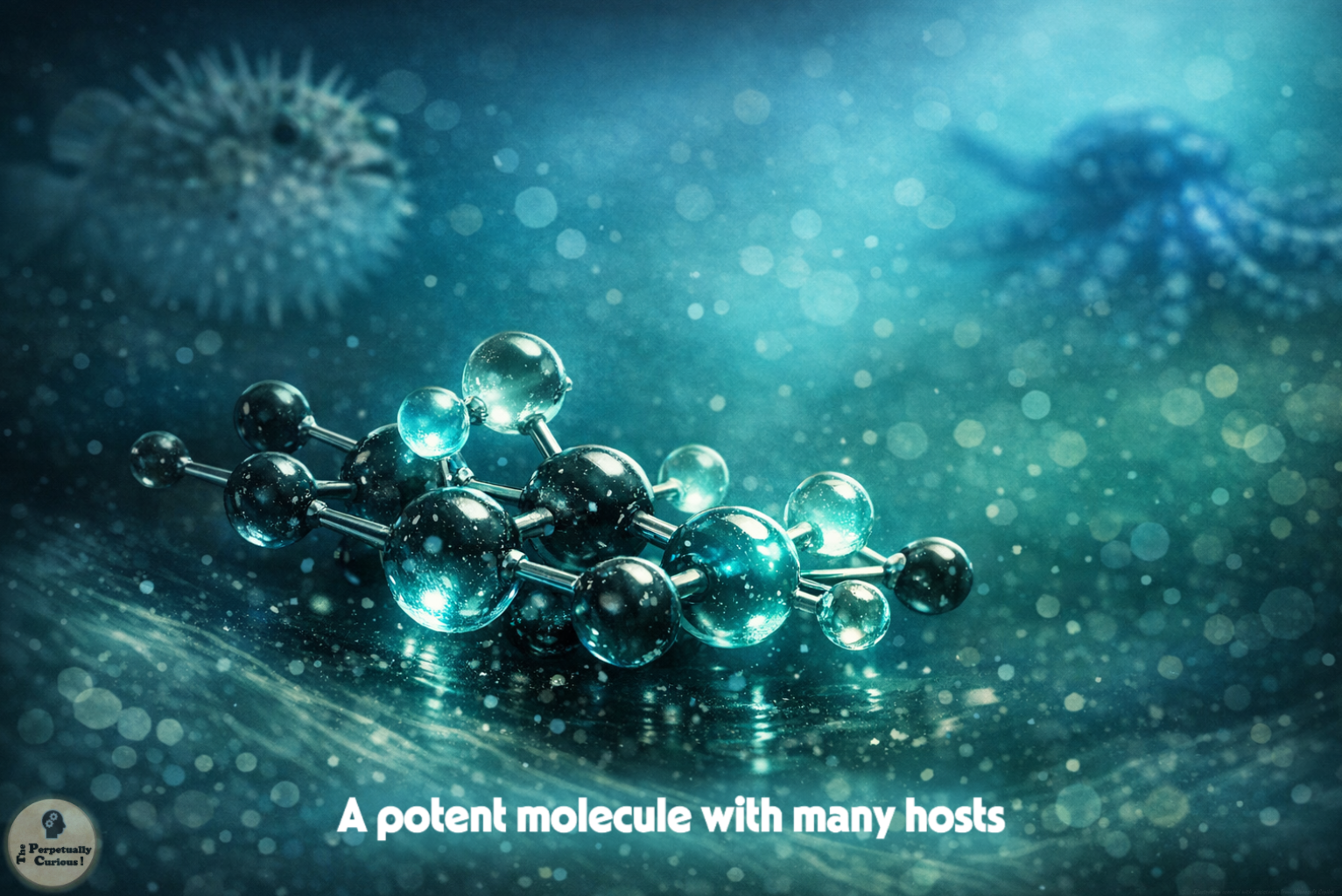
Pufferfish carry a powerful neurotoxin known as tetrodotoxin, often abbreviated as TTX. This compound is widely thought to originate from bacteria associated with the fish and to accumulate through the food web, and it is concentrated in the skin, liver, and reproductive organs. Tetrodotoxin blocks voltage‑gated sodium channels in nerve and muscle cells, which prevents the electrical signals that allow muscles to contract and nerves to fire.
In high doses, tetrodotoxin can cause paralysis and respiratory failure. In humans, very small amounts may cause numbness, tingling, or slowed responses, and some researchers have suggested that, if trace amounts were absorbed through oral mucosa, similar mild effects could help account for the slow, trance‑like behavior observers have described in dolphins after brief contact with pufferfish, although this mechanism has not been directly confirmed.
Tetrodotoxin is not unique to pufferfish. Several other organisms carry it, including some species of octopus and certain amphibians. The blue‑ringed octopus, for example, uses tetrodotoxin in its saliva to immobilize prey. Many toxin‑bearing species evolve resistance to their own chemicals, which allows them to use these molecules safely for defense or predation. A deeper look at octopus intelligence reveals how these animals integrate chemical tools into their predatory strategies.
However, the way octopuses deliver tetrodotoxin differs sharply from pufferfish. Octopuses inject the toxin through a bite, delivering a concentrated dose designed to subdue prey quickly. Dolphins cannot safely interact with octopuses in the gentle, exploratory way they interact with pufferfish. A bite from a venomous octopus would be dangerous rather than mildly altering, and there is no evidence that dolphins seek such contact.
This contrast highlights an important ecological truth. The same molecule can play very different roles depending on how it is delivered and how animals encounter it.
🐾 Beyond dolphins: Other animals and natural intoxicants
Across ecosystems, several species have been documented interacting with natural chemicals that influence their behavior. These examples vary in how intentional they appear, yet together they reveal a pattern in which animals meet environmental chemistry in ways that shape their actions.
Reindeer in northern regions have been described in anecdotal and ethnographic accounts as consuming fly agaric mushrooms, which contain psychoactive compounds such as muscimol. After such encounters, changes in movement and responsiveness have been reported, although the degree of deliberate seeking and the frequency of this behavior remain uncertain.
Chimpanzees in parts of West Africa have been documented drinking naturally fermented palm sap with measurable alcohol content, returning to these sources across multiple seasons. This behavior reflects the social intelligence and observational learning explored more broadly in studies of great ape social learning.
Birds such as cedar waxwings sometimes feed on berries that have begun to ferment on the branch. After such meals, they may appear disoriented or clumsy, especially when large quantities are consumed.
Wallabies in some agricultural regions have been reported in anecdotal accounts entering poppy fields and showing looping or erratic hopping patterns after feeding on the plants, although these reports have not been systematically studied.
Domestic cats and several wild felids respond strongly to catnip and related plants such as silvervine, rolling, rubbing, and displaying behaviors that appear to be pleasurable and are highly repeatable across individuals. The active compounds in these plants, including nepetalactone in catnip and nepetalactol in silvervine, are known to activate mu‑opioid receptors in cats, making this one of the better characterized plant–animal chemical interactions.
Fruit bats can encounter ethanol in fermenting fruit and nectar.
These encounters show that animals meet environmental chemistry in many ways, from incidental exposure to learned exploration. This diversity of interactions echoes the chemical communication seen in pollinator ecology.
With this comparative foundation in place, the narrative can turn toward how scientists interpret such behaviors and why caution remains essential.
🧠 Interpreting behavior: Curiosity, play, or altered states
When scientists study animal behavior, they distinguish between what is directly observed and what is inferred about internal states such as pleasure, curiosity, or euphoria. In the case of dolphins and pufferfish, two broad interpretations are commonly discussed.
One interpretation suggests that dolphins may have learned to handle pufferfish in a way that elicits a small, controlled release of tetrodotoxin. In this view, the gentle manipulation, the passing of the fish between individuals, and the subsequent slow behavior could indicate that the dolphins are seeking a mild alteration of sensation. This remains a hypothesis, and in the widely circulated footage there were no direct measurements of toxin exposure in the dolphins, so any chemical influence is speculative.
A second interpretation emphasizes play and object exploration. Dolphins interact with floating seaweed, shells, and a variety of objects in ways that appear playful and inventive, and the inflation response of a pufferfish provides a dramatic and repeatable stimulus. From this perspective, the behavior may reflect the dolphins’ interest in objects that change shape or resist manipulation, rather than any chemical effect. Play in dolphins often involves social exchange, experimentation, and repeated handling of unusual items, and the pufferfish fits naturally into this broader pattern of exploratory engagement.
Studying internal states in nonhuman animals is inherently challenging. Researchers rely on behavior, context, and physiology rather than direct reports. Long‑term observation, rather than direct measurement of chemical exposure, often forms the basis for interpretation, which naturally limits certainty. Dolphins are known for cultural transmission of behaviors, which means that learned interactions can spread through social groups and may change over time.
These interpretive challenges lead naturally into a broader reflection on how animals navigate the chemical landscapes of their environments and what these encounters reveal about their minds.
🌊 Minds in a chemical world
The stories of dolphins, reindeer, chimpanzees, birds, wallabies, cats, bats, and toxin‑bearing octopuses all point toward a shared reality. Animals inhabit worlds shaped by molecules that defend, attract, confuse, or gently shift perception. Some interactions are clearly adaptive, such as the use of plant or microbial toxins as defenses. Others may be side effects of foraging or curiosity. A few may hint at more complex relationships between sensation, learning, and social behavior.
From an ecological perspective, pufferfish use tetrodotoxin as a powerful deterrent against predators. Some observers have suggested that dolphins may occasionally engage with this defense in a way that results in trace exposure, although there is no direct evidence that they do so deliberately or with any consistent outcome.
These encounters remind us that animals navigate not only landscapes of land and water, but also landscapes of molecules. The invisible currents introduced at the beginning of this story become visible again here, shaping behavior in ways that reveal how deeply animals are connected to the chemistry of their environments. This interconnectedness mirrors the chemical artistry seen in firefly bioluminescence. As research continues to illuminate how animals sense and respond to chemical cues, these stories may offer new insights into the diversity of cognition across species. Each new layer of precision uncovered may reveal dimensions of animal perception and learning that current methods have only begun to approach.
In that recognition, there is room for both scientific inquiry and a quiet sense of wonder.
Pass this article along to someone curious and let the learning travel.
💡 Did You Know
🐬 Dolphins learn through cultural transmission Young dolphins often learn complex behaviors by watching older individuals and practicing with peers.
🐙 Some octopuses carry tetrodotoxin Species such as the blue‑ringed octopus use tetrodotoxin to immobilize prey.
🐸 Certain amphibians also carry tetrodotoxin Some newts and other amphibians possess tetrodotoxin in their skin.
🍇 Fermentation occurs naturally in many ecosystems Fruits can ferment on the branch or on the ground.
🦇 Fruit bats regularly encounter ethanol in fermenting fruit and nectar Research suggests that some species tolerate these naturally occurring concentrations without measurable changes in flight or echolocation.
🐦 Birds can encounter natural alcohol Cedar waxwings occasionally consume fermented berries.
🐱 Catnip and silvervine trigger a known chemical pathway Compounds such as nepetalactone in catnip and nepetalactol in silvervine activate mu‑opioid receptors in cats, making this one of the best‑characterized plant–animal chemical interactions.
🦎 Rough‑skinned newts carry exceptionally high levels of tetrodotoxin Their potent chemical defenses illustrate how some species evolve extreme biochemical strategies for survival.
Do dolphins really get altered states from pufferfish toxins?
Scientists have documented dolphins gently handling pufferfish and then showing unusually slow or still behavior, but there is no definitive proof that they seek intoxication in the human sense. These observations come from wildlife footage rather than controlled studies, and any chemical influence remains speculative.
Are pufferfish harmed during these interactions?
In the available observational footage, pufferfish inflate defensively and then swim away afterward. The dolphins appear to handle them without causing obvious injury, although the long‑term effects on the fish are not fully understood.
Could dolphins experience altered states from octopus toxins?
It is unlikely. Octopus toxins such as tetrodotoxin are delivered through a bite, which provides a concentrated dose designed to immobilize prey. Dolphins cannot safely interact with octopuses in the gentle way they interact with pufferfish, and there is no evidence that they seek such contact.
Do dolphins interact with other toxin‑bearing species in similar ways?
There is no strong evidence that dolphins handle other toxin‑bearing species in the same gentle, exploratory manner seen with pufferfish. Interactions with such animals are typically predatory or defensive rather than playful.
Are dolphins the only animals that encounter natural intoxicants?
No. Several species, including chimpanzees, cats, bats, and cedar waxwings, have been documented interacting with naturally occurring chemicals that influence their behavior. Other cases, such as reindeer consuming fly agaric mushrooms or wallabies entering poppy fields, come from reported anecdotal or ethnographic accounts. The strength of evidence varies by species and context.
Are there risks when animals encounter natural intoxicants?
There can be risks, especially when exposure is accidental or when animals consume large quantities. Disorientation, impaired movement, or increased vulnerability to predators may occur. Many species have evolved strategies to navigate these risks, just as they have adapted to other environmental challenges.
Is tetrodotoxin always lethal?
Tetrodotoxin can be lethal at relatively low doses, but very small exposures may cause only numbness or slowed responses. The effects depend on dose, route of exposure, and species sensitivity.
Why do some animals evolve resistance to their own toxins?
Species that produce defensive or predatory toxins often evolve physiological resistance to avoid self‑harm. This resistance allows them to store or deploy potent molecules safely, as seen in certain octopuses and amphibians.
How certain are scientists about the reasons behind these behaviors?
Certainty varies by species and context. For some behaviors, such as the response of cats to catnip, the mechanisms are relatively well understood. For others, including dolphins and pufferfish, researchers emphasize that motivations and subjective experiences are difficult to measure, so interpretations remain tentative.
How do scientists distinguish between play and chemical influence in animal behavior?
Researchers look at context, repetition, and timing. They compare behavior before and after exposure, examine whether similar actions occur without chemical cues, and consider whether the behavior appears in multiple individuals or groups. Even with these tools, interpretations remain cautious.
Do animals ever use chemical cues intentionally during foraging or navigation?
Many species rely on chemical gradients to locate food, avoid predators, or find mates. These cues may be subtle, such as the faint scent trails used by insects, or more pronounced, such as the chemical plumes that guide marine animals through shifting currents. This broader chemical awareness parallels the sensory strategies explored in studies of shark sensory systems.
Do any animals use chemical cues to communicate across long distances?
Several species release airborne or waterborne molecules that travel far beyond their immediate surroundings. These signals may guide migration, mark territory, or synchronize breeding cycles. This long‑distance communication echoes the luminous signaling seen in firefly bioluminescence.
Are there examples of animals using chemical defenses in social contexts?
Yes. Some insects, amphibians, and marine organisms use chemical signals to warn group members, deter rivals, or coordinate reproductive behavior. These interactions reveal how chemistry can shape social dynamics.
Do marine mammals besides dolphins interact with toxin‑bearing species?
Most interactions between marine mammals and toxin‑bearing species are predatory or defensive rather than exploratory. While some marine mammals may consume prey that contain toxins, there is no evidence that they handle such animals in a way that would allow controlled exposure.
Can environmental chemistry influence migration or seasonal behavior?
Yes. Chemical cues in water, soil, and air can signal seasonal changes, food availability, or breeding conditions. These cues may guide animals across long distances, shaping migrations that unfold with remarkable precision.
🤝 Sharing quiet wonders of the natural world
We kindly invite you to share and spread the word. By passing this article along to friends, colleagues, or fellow nature enthusiasts, you help more readers encounter these quiet intersections between behavior and chemistry. Your support in allowing this story to travel a little farther across the human world is deeply appreciated.
“Tides of Chemical Worlds: How Animals Meet the Molecules Around Them.” The Perpetually Curious!, May 2026.
https://www.theperpetuallycurious.org/articles/animal-chemical-encounter/Continue Exploring
For the curious mind: want to explore this theme through a few questions? Visit the Classic Quiz Studio, nestled under Explorations opens in a new tab ,and see where a few well-placed questions lead: Wilderness & Homestead Creatures Quizzesopens in a new tab
For what comes next
Site Updates gathers occasional notes, new additions, and ways to keep in touch. RSS brings new publications to your feed reader in chronological order.
Choose the path that speaks to you, and let the next curiosity find you wherever your wondering takes you.