
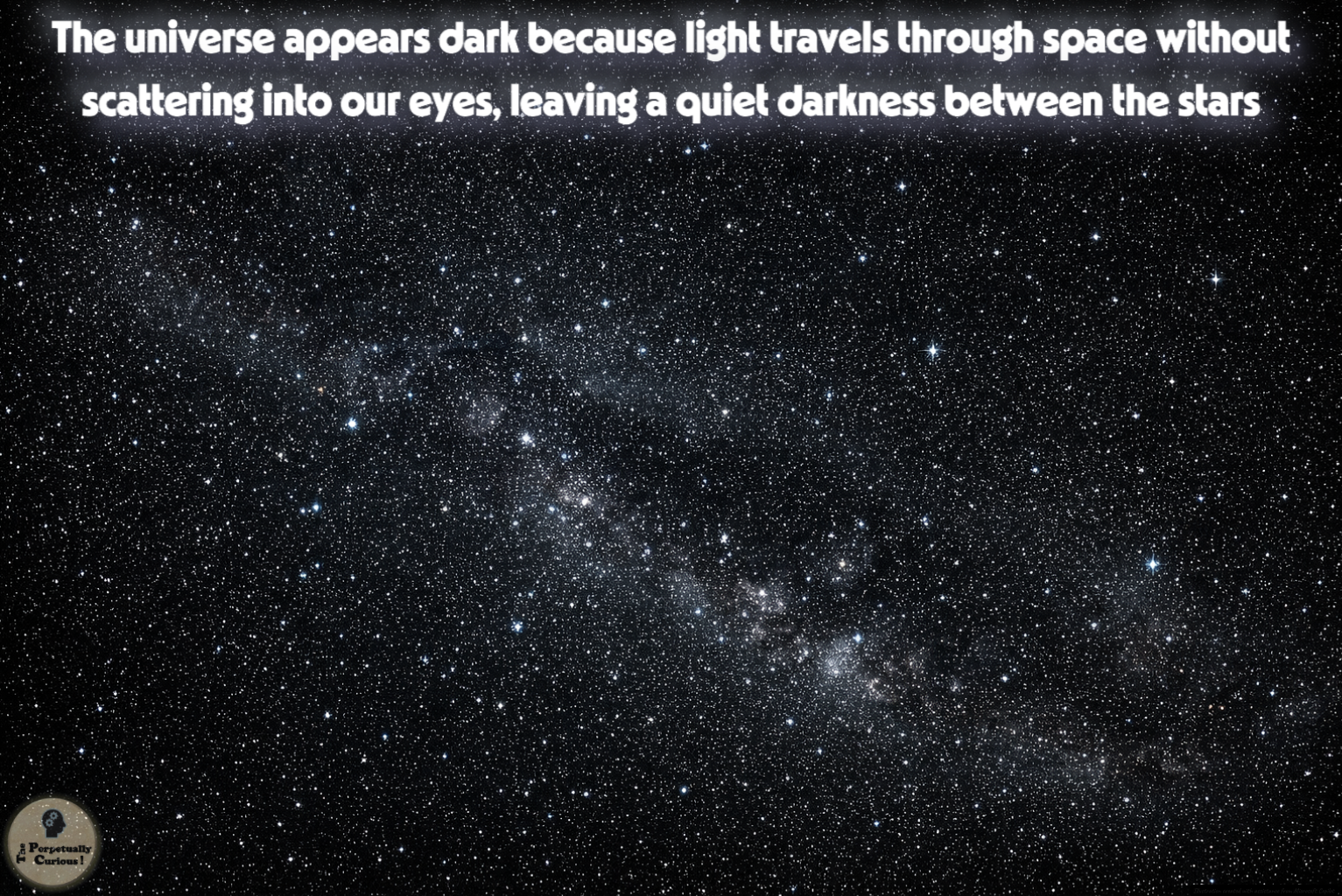
On a clear night, the sky stretches overhead as a vast field of darkness, interrupted only by scattered stars and the faint glow of the Milky Way. This darkness feels puzzling when one considers that the universe contains an extraordinary number of stars, each emitting light in all directions. During the day, sunlight floods Earth and turns the sky bright, yet photographs taken from orbit show a black sky even when the Sun shines intensely. This contrast raises a natural question: if light travels freely and stars fill the cosmos, why does space appear so dark? This question invites a journey that begins with familiar experiences of light and gradually expands toward the structure and history of the universe itself. The first step is to understand how light becomes visible in the environments we know best. What follows is a layered exploration of how scattering, distance, cosmic structure, and the universe’s own history shape the darkness we see.
✨ How light becomes visible
When a flashlight shines in a dark room, the beam often appears as a visible cone. Dust, smoke, and tiny particles in the air scatter some of the light toward the observer, making the path of the beam visible. The same light that illuminates a wall or a book also becomes visible in the air because it interacts with matter along the way.
In space, the situation is very different. Between planets and stars, there is no thick atmosphere and very few particles. Light still travels through these regions, but it usually does not scatter sideways into an observer’s eyes. Unless an observer looks directly at a luminous object or at something that reflects or emits light, the path of the light remains invisible. Space can therefore be filled with light while still appearing black.
This contrast between a room filled with air and a region of near vacuum is the first clue. It hints that the darkness of space is not an absence of light, but the beginning of a deeper story about what, if anything, occupies the vast stretches between the stars.
🌫️ A universe that is not empty, yet profoundly sparse
The space between stars in a galaxy is called the interstellar medium. It contains gas, dust, and more complex structures such as molecular clouds and nebulae. However, the density of this material is extremely low by everyday standards. A typical region of interstellar space may contain about one atom per cubic centimeter, while the air at sea level contains on the order of 2.7 × 10¹⁹ molecules per cubic centimeter, roughly twenty‑seven quintillion. Even in relatively dense nebulae, the number of particles per unit volume remains extraordinarily low by everyday standards, far below anything encountered in ordinary air.
Because the material is so sparse, most light passes through without interacting. Only in special regions, such as bright emission nebulae near hot young stars, does gas glow strongly enough to be easily visible. Many nebulae that appear colorful in astronomical images would look faint or gray to the unaided human eye. Telescopes collect light for minutes or hours, allowing them to reveal structures that ordinary vision cannot detect.
This extreme sparsity explains why the interstellar medium does not create a bright background. However, it does not fully resolve the deeper puzzle. Even if the space between stars is mostly transparent, one might still expect that every line of sight would eventually end on the surface of a star. To understand why this does not happen, it is helpful to consider distance and how brightness changes with it.
🌟 Distance and the thinning of starlight
A star emits light in all directions. As that light travels outward, it spreads over larger and larger spheres. The surface area of a sphere increases with the square of the radius, so the intensity of light from a point source decreases in proportion to one divided by the distance squared. If a star is twice as far away, it appears four times dimmer. If it is ten times farther away, it appears one hundred times dimmer.
This inverse square relationship means that even very luminous stars can appear faint when they are far away. A star similar to the Sun, placed at the distance of the nearest stars, roughly four light years away, would appear about seventy billion times dimmer than the Sun appears from Earth. It may still be visible as a point, but it does not significantly brighten the space around it. Because each star’s light arrives as a narrow, unscattered beam, its contribution remains isolated rather than blending into a general glow, a principle examined in why starlight does not mix and observed across the full breadth of the night sky.
However, this raises a deeper question. If the universe contains so many stars, why does their combined light not fill the sky? This question leads directly to a historical puzzle that shaped modern cosmology.
🌀 Olbers’ paradox and the limits of the visible universe
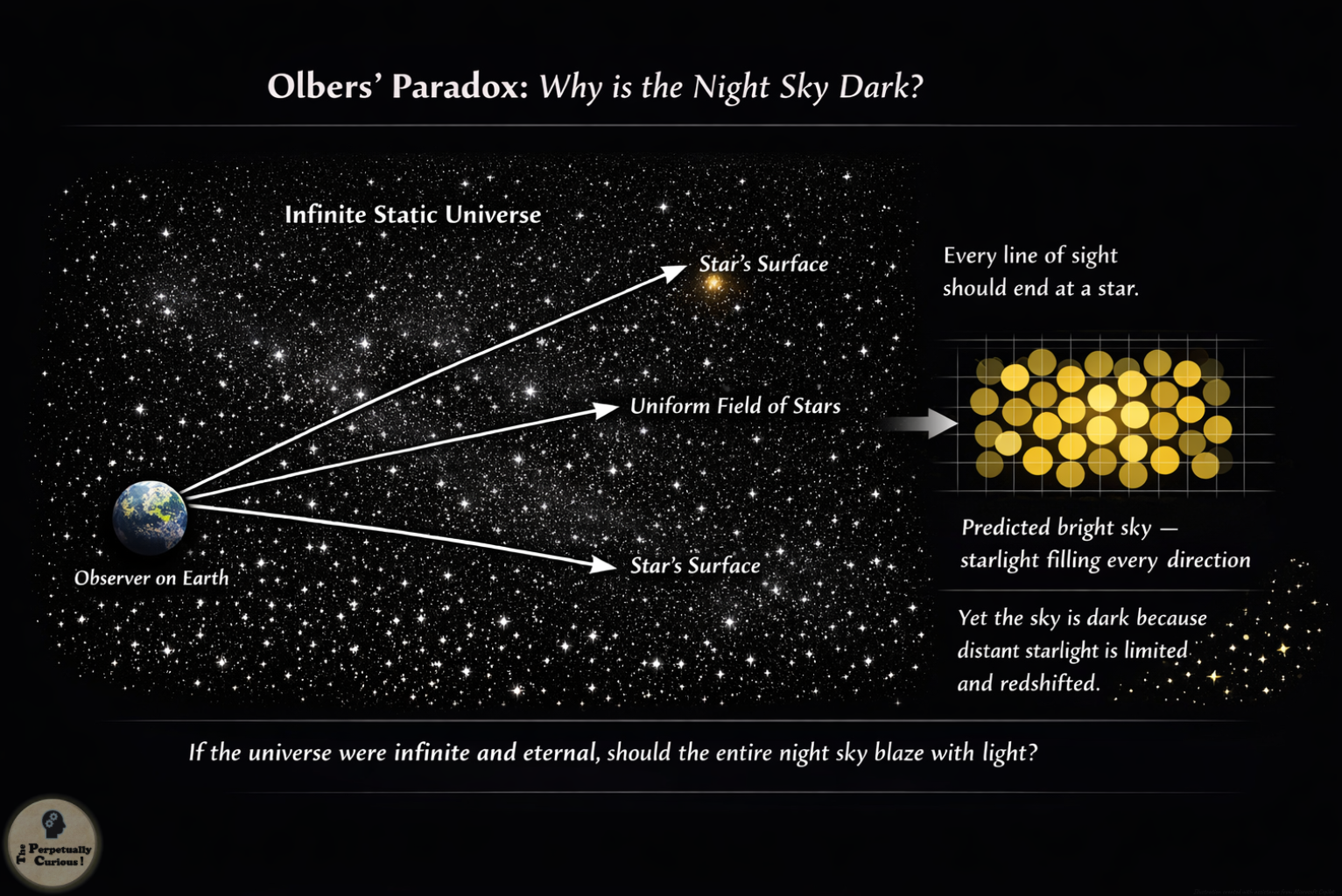
The question of why the night sky is dark, despite the presence of countless stars, is often referred to as Olbers’ paradox. In the early nineteenth century, Heinrich Wilhelm Olbers and others considered a simple thought experiment. If the universe were infinitely old, infinitely large, and uniformly filled with stars, then every line of sight should eventually intersect the surface of a star. Under those assumptions, the entire sky would appear as bright as the surface of an average star. Even if dust were present in such a universe, it would not solve the paradox, because any absorbed starlight would eventually be reradiated and the sky would still become bright.
The observed darkness of the night sky suggests that at least one of those assumptions is not correct. Modern cosmology indicates that the universe has a finite age of about 13.8 billion years, according to current cosmological models. Light travels at a finite speed, so there is a limit to how far light can have traveled since the beginning of the universe. There are regions of space so distant that their light has not yet had time to reach Earth. These regions do not contribute to the brightness of the sky.
In addition, the universe is expanding. As space expands, light traveling through it is stretched to longer wavelengths, a process known as redshift. Light that may have started in the visible range can be shifted into infrared or microwave wavelengths that human eyes cannot detect. The cosmic microwave background is a faint glow that fills all of space at a temperature of about 2.7 kelvin (about minus 454 degrees Fahrenheit). It is a relic of an earlier, hotter universe, now stretched into microwave wavelengths.
These cosmological factors mean that the sky is not filled with overlapping stellar surfaces in every direction. Instead, there are large regions of sky where no bright star lies directly along the line of sight, and the accumulated light from distant galaxies is too faint and too redshifted to be visible without instruments.
🚀 Sunlight, astronauts, and a black sky
Images from spacecraft and from the surface of the Moon often show a striking combination: intensely bright sunlight on surfaces and a deep black sky above. This visual contrast can feel surprising, because on Earth, a bright sky usually accompanies bright sunlight. The difference arises from the presence or absence of an atmosphere.
On Earth, sunlight enters the atmosphere and interacts with molecules of nitrogen, oxygen, and other gases. Shorter wavelengths of light are scattered more efficiently, which gives the sky its blue color. During the day, this scattered light is so strong that it overwhelms the light from most stars, and the sky appears bright even when one is not looking directly at the Sun.
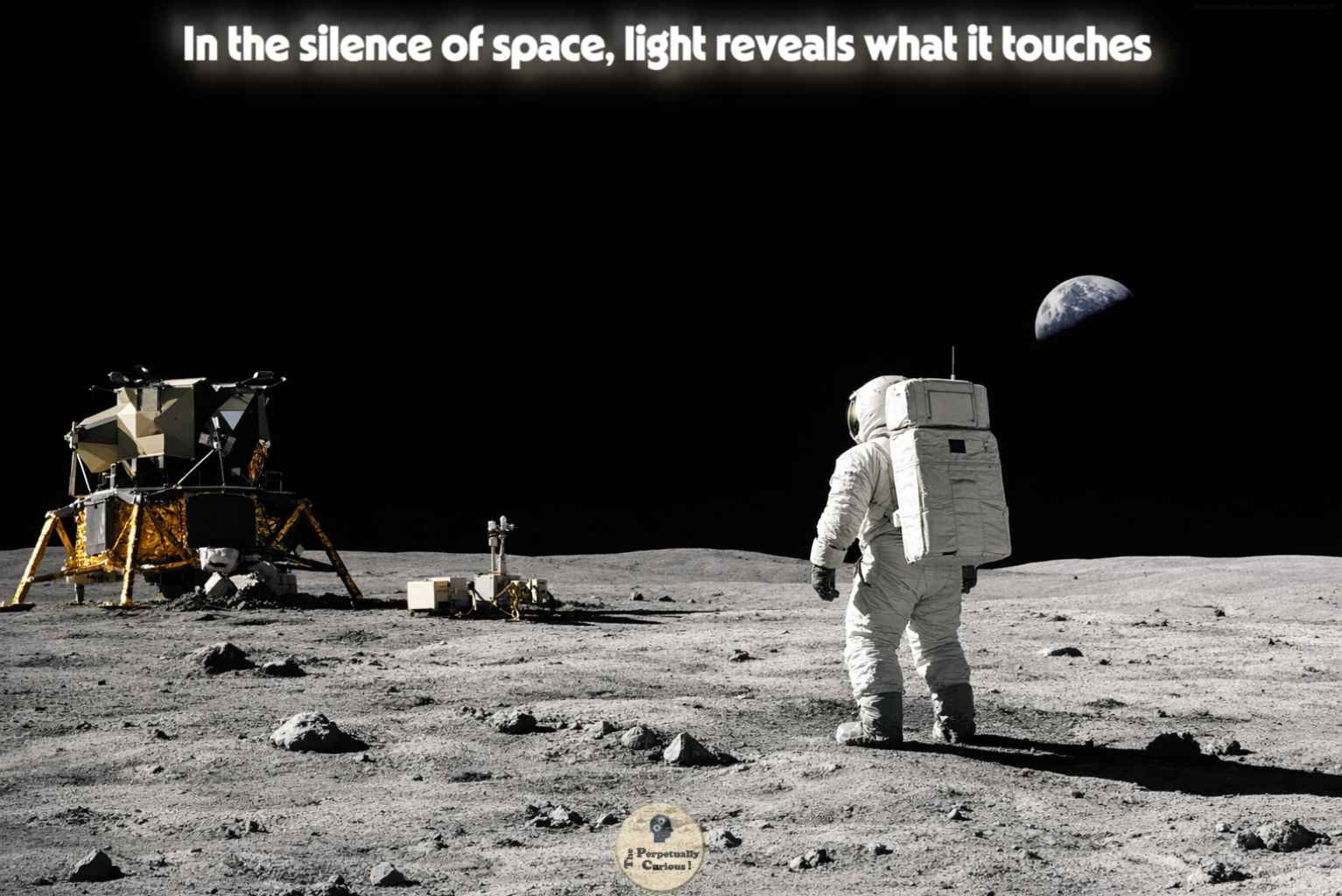
In space, or on the surface of the Moon, there is no thick atmosphere to scatter sunlight. The Sun appears extremely bright, and surfaces directly illuminated by it can be dazzling. However, the sky itself remains black because there is no medium to redirect sunlight into the observer’s eyes from other directions. Stars may still be present, but they can be difficult to see when the Sun is in view, because the human eye adapts to the intense brightness of the illuminated surfaces. Cameras often adjust exposure to capture bright objects, which can cause stars to disappear from photographs even when they are present. The same physics that hides stars near a brilliant Sun also shapes how planetary brightness is perceived from Earth, where a planet’s reflectivity, distance, and position relative to the Sun determine how bright it appears in the night sky.
This contrast between bright objects and a dark background illustrates the central idea that light must interact with matter in order to create a visible glow. Each of the examples so far, from scattering in Earth’s atmosphere to the emptiness of space and the behavior of starlight, is a piece of the same explanation for why the universe appears dark despite being filled with light. It also prepares the ground for a more reflective view of what a dark universe filled with light might mean.
🌙 A quiet universe filled with hidden light
Taken together, these pieces form a coherent picture. Space appears dark not because light is absent, but because light usually travels in straight lines through regions that are almost empty. The interstellar and intergalactic media contain gas and dust, but at densities that are far too low to create a bright background. Stars and galaxies are separated by immense distances, so their light arrives at Earth as narrow beams that appear as points rather than as a continuous luminous surface. The finite age and expansion of the universe limit how much light can reach us and shift much of that light into wavelengths that human eyes cannot see.
There is a quiet, contemplative quality to this picture. The universe is filled with radiation across many wavelengths, from radio waves to gamma rays. Much of this radiation passes by unnoticed, because human senses are tuned to a narrow band of visible light. This hidden activity connects to a vast network of cosmic radio emission that fills the universe beyond the reach of human sight. What appears as darkness is often a limitation of perception rather than an absence of activity. The dark sky above is, in a sense, a veil over a universe that is continuously shining.
🌠 Seeing darkness with new understanding
The next time a night sky appears as a field of scattered stars on a dark background, it may carry a different meaning. Each point of light represents a distant source whose photons have traveled for years, centuries, or even billions of years before arriving. The darkness between those points is not a simple emptiness. It is a sign of vast distances, of a universe with a finite age, and of the remarkable transparency of space. These immense timescales find a different kind of measure in the concept of a galactic year, which describes how long it takes the solar system to complete one orbit around the Milky Way and highlights the scale of cosmic motion.
This perspective can invite a sense of wonder that is grounded in careful physics. The dark sky is not a failure of the universe to shine. It is the visible trace of how light, matter, and time are arranged on the largest scales. Understanding this does not remove the mystery. Instead, it deepens it in a way that respects both scientific knowledge and the quiet awe that many people feel when they look up.
Pass this article along to someone curious and let the learning travel.
💡 Did You Know
🌡️ The cosmic microwave background The cosmic microwave background that fills all of space has a temperature of about 2.7 kelvin (about minus 454 degrees Fahrenheit). It is a remnant of an early, hot phase of the universe, now stretched into microwave wavelengths that human eyes cannot see.
🌈 Nebula colors and human vision Many nebulae that appear vividly colored in astronomical images would look very faint to an observer using only unaided vision. Telescopes often collect light for many minutes or hours and use sensitive detectors, which allows them to reveal structures that would otherwise remain hidden.
🌌 The Andromeda galaxy The Andromeda galaxy, which is about 2.5 million light years away, is one of the few galaxies visible to the unaided eye from dark locations. Even so, it appears as a faint, diffuse patch rather than a bright object, because its light is spread over a relatively large area of the sky.
☄️ The zodiacal light The zodiacal light, a faint triangular glow visible just after sunset or before sunrise in very dark locations, is caused by sunlight scattering off dust particles in the inner solar system. It is one of the few examples of interplanetary dust creating a visible glow.
✴️ The universe glows intensely in X‑rays Many regions of the universe, such as the surroundings of black holes and neutron stars, emit powerful X‑ray radiation. Human eyes cannot detect these wavelengths, but X‑ray telescopes reveal a sky filled with energetic structures that remain invisible in visible light.
📡 The universe is bright in radio waves Many cosmic structures, including supernova remnants and active galaxies, emit strong radio signals. Human eyes cannot detect these wavelengths, but radio telescopes reveal vast structures that remain invisible in visible light. This hidden activity is part of the broader landscape of radio emission that fills the cosmos.
🌠 Surface brightness and galaxies In ordinary telescopic images of nearby galaxies, a galaxy does not appear dramatically brighter simply because it occupies a larger apparent area in the sky. Its surface brightness remains nearly constant because both its apparent size and its total brightness change together. This counterintuitive property helps explain why galaxies can be visible yet still appear faint.
Why does space look black even when the Sun is shining nearby?
Space looks black because there is no thick atmosphere to scatter sunlight into all directions. Sunlight travels in straight lines, and unless it strikes an object or a cloud of particles, it does not create a visible glow. Near Earth, the Sun can illuminate planets, spacecraft, and the Moon very strongly, while the surrounding sky remains dark.
Why does a sunlit surface look bright on the Moon while the sky stays black, but on Earth the sky becomes bright too?
Sunlight reveals the lunar surface because it strikes solid matter, while the surrounding sky stays dark because there is no atmosphere to scatter that light. On Earth, the atmosphere scatters sunlight in all directions, so the sky becomes bright even when the ground is illuminated by the same Sun.
If space contains dust and gas, why do these not make the sky bright?
The dust and gas in space are extremely sparse compared with air on Earth. In many regions, there may be about one atom per cubic centimeter. This density is far too low to scatter enough light to create a bright background. Only in relatively dense or strongly illuminated regions, such as certain nebulae, does gas or dust glow visibly, and even then it often appears faint to the unaided eye.
What is Olbers’ paradox in simple terms?
Olbers’ paradox is the question of why the night sky is dark if the universe contains a very large number of stars. In a universe that is infinitely old, infinitely large, and uniformly filled with stars, every line of sight should eventually end on a star, and the sky should be bright everywhere. The observed darkness of the night sky suggests that these assumptions are not all correct.
How does the age of the universe affect how bright the sky appears?
Because the universe has a finite age of about 13.8 billion years, light has had only a limited time to travel. There are regions of space so distant that their light has not yet had time to reach Earth in the universe’s current age. These regions do not contribute to the brightness of the sky. This finite age is one of the key reasons that the sky is not uniformly bright.
What role does the expansion of the universe play in the darkness of space?
As the universe expands, light traveling through space is stretched to longer wavelengths. Some light that was once in the visible range has been shifted into infrared or microwave wavelengths that human eyes cannot detect. This redshift reduces the amount of visible light that contributes to the brightness of the sky and helps explain why the universe appears dark in visible light.
Why do stars appear as points rather than as small disks that cover more of the sky?
Stars are extremely far away compared with their sizes. Even very large stars subtend extremely small angles on the sky when viewed from Earth. As a result, they appear as points of light rather than extended disks. Their combined apparent areas cover only a tiny fraction of the sky, so they do not create a continuous bright surface. This is also related to the behavior of largest stars, which can be immense in physical size yet still appear as tiny points because of their great distances.
Why do telescopes reveal a bright universe while human eyes see darkness?
Telescopes collect light over long periods of time and use sensitive detectors that can record faint signals. Human eyes gather light over very short intervals and have limited sensitivity. As a result, telescopes can reveal structures and distant galaxies that would otherwise remain invisible.
Would the night sky look different from other planets or moons?
The appearance of the night sky depends on the presence or absence of an atmosphere. Worlds with thick atmospheres may have bright skies during the day, while airless bodies such as the Moon have black skies even in full sunlight. The distribution of stars would be similar, but the brightness of the sky itself would vary.
Would the universe appear brighter if human eyes could see more wavelengths?
The universe emits radiation across a wide range of wavelengths, including infrared, radio, ultraviolet, X‑ray, and gamma‑ray light. Human eyes detect only a narrow band of visible wavelengths. Instruments that detect other parts of the spectrum reveal a universe that is far more active and luminous than visible light alone suggests.
Why do some wavelengths travel through space more easily than others?
Different wavelengths of light interact with matter in different ways. Radio waves can pass through dust clouds that block visible light, while X‑rays can reveal energetic regions near black holes. The transparency of space depends on the wavelength, which is why instruments that detect multiple wavelengths reveal a far more complex and luminous universe than human eyes can perceive.
Does dark matter affect how bright the universe looks?
Dark matter does not emit, absorb, or scatter light, so it does not directly brighten or dim the sky. However, its gravity shapes the structure of galaxies and clusters, which influences where luminous matter forms. The universe’s large‑scale structure is therefore shaped by dark matter, even though it remains invisible.
Light moves through the quiet of space and waits for a surface to answer it.
The rest remains open and unlit, a depth that holds its silence.
Related articles
A wider collection of cosmic essays is available for readers who wish to continue exploring the larger patterns and questions that shape our universe.
If you would like to keep up with what unfolds here, the Updates page is the best place to begin.
📣 A gentle invitation to share
If this exploration of cosmic darkness and hidden light offered something meaningful, you are welcome to share it with others who might appreciate it. Passing the piece along helps more readers encounter the quiet beauty of a universe that appears dark yet is filled with light.