

The story of certain trees in South India is, at its core, a story about water. In dry and semi‑dry landscapes, water is not merely a resource. It is a presence that moves quietly through soil, stone, and air. Every shallow pond that holds on through summer, every aquifer that gathers the memory of monsoon rain, and every root that reaches downward becomes part of a delicate negotiation between land, life, and time.
When particular species arrive, especially those that grow quickly, spread widely, and draw deeply from the ground, that negotiation begins to shift. Some of these species are native to the Indian subcontinent, while others arrived through human introduction. One of the most discussed examples is Prosopis juliflora, known in Tamil as seemai karuvelam, which is not native to India. It is often mentioned alongside eucalyptus, certain introduced acacia species, and shrubs such as Lantana and Ipomoea. Together, they represent a group of fast‑growing, highly adaptable plants whose presence has become associated with both resilience and ecological caution, particularly in relation to water and landscape change.
This article follows that group, not to praise or criticize, but to understand how roots, leaves, and water are linked in the landscapes of South India. By beginning with the broader story of water and then moving into specific species, the narrative remains grounded in ecology rather than controversy. Each section builds on the previous one, guiding the reader through a quiet arc of hydrology, biodiversity, and human experience.
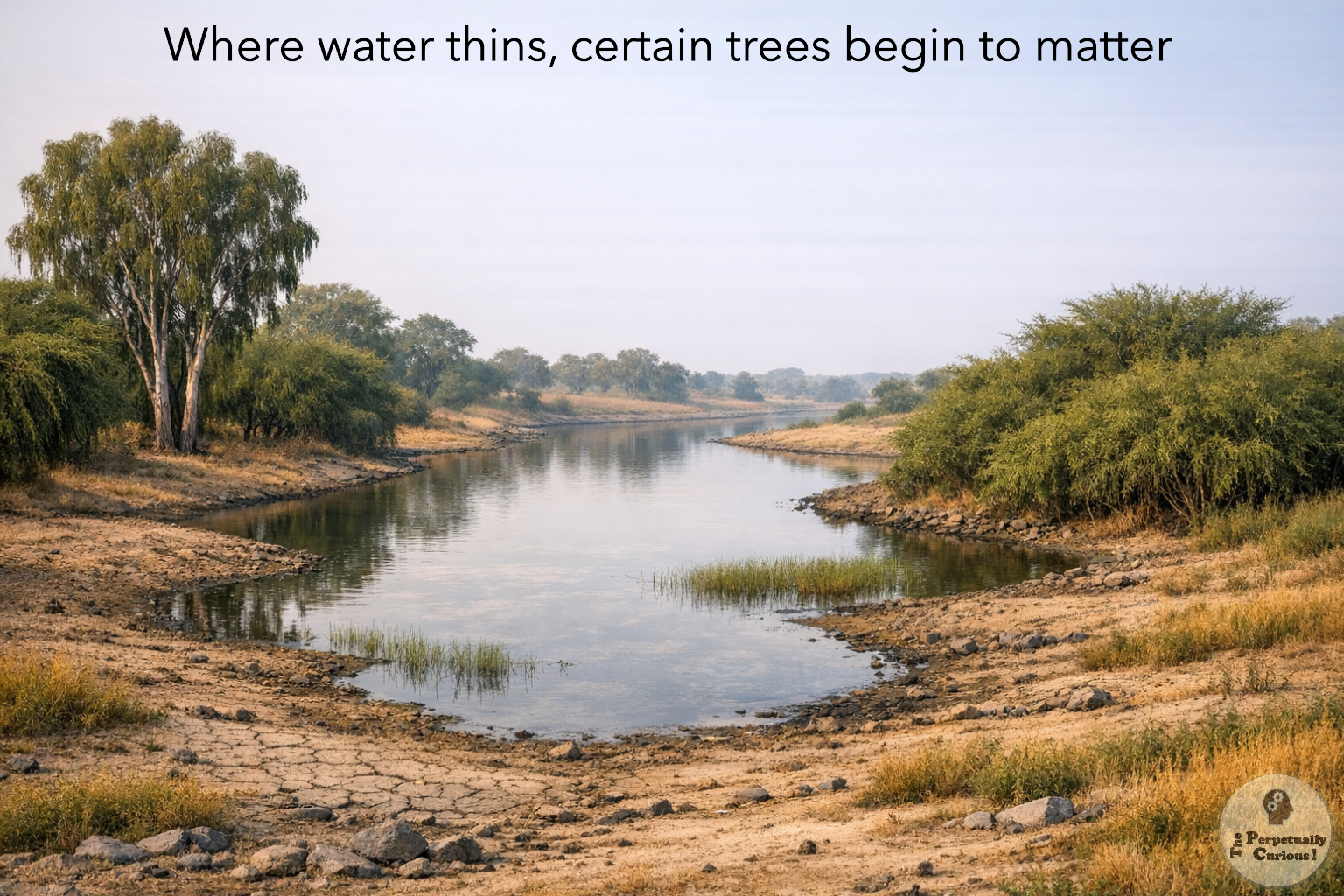
The land holds its quiet negotiations with water, shaping what endures and what yields.
In this stillness, every root and margin remembers the long rhythm of presence and loss.
🌏 A landscape written in water
Much of Tamil Nadu receives rainfall in brief, seasonal bursts. The rest of the year, the land depends on stored water in tanks, ponds, shallow aquifers, and the slow movement of moisture through soil. In such settings, vegetation is not simply background. It is part of the water cycle itself.
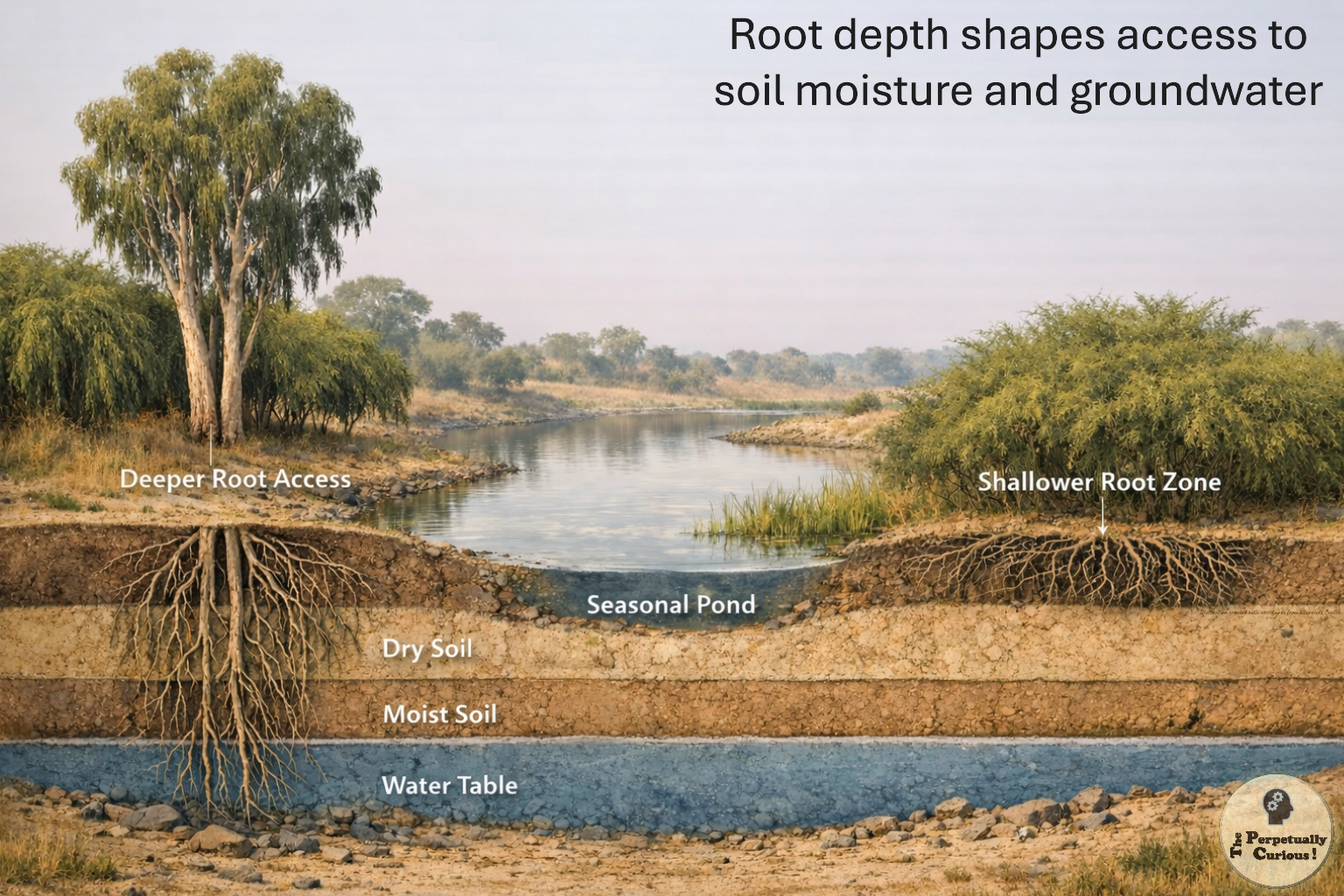
Some plants have shallow roots that rely on the upper layers of soil. Others develop deeper taproots that can extend to around 30 feet or more (about 9 meters) in many field settings, with exceptional depths reported under favorable geological conditions. These deeper-rooted species often remain green when surrounding vegetation has dried, which can be visually striking and ecologically significant.
Shallow aquifers in semi-arid regions recharge mainly during monsoon rains. They may rise quickly after heavy rainfall and decline steadily during the dry season. When deep-rooted species access these aquifers, they may influence how long water remains available for other plants and for human use.
The same relationship between roots and buried water appears in a far more extreme desert setting in the Tree of Ténéré, whose survival depended on deep roots reaching hidden groundwater far below the Sahara surface.
From that single-tree example, the view widens again to the living soil beneath many landscapes. The quiet movement of water below the surface is part of a larger subsurface network of interactions that links roots, mycorrhizal fungi, and soil organisms, and this interconnected system is explored in greater depth in discussions of the wood wide web.
Understanding how particular species interact with water is therefore a natural next step. Once the landscape is seen as a shared reservoir, it becomes easier to ask which plants simply participate in this cycle and which may alter it in ways that matter for people, wildlife, and long-term ecological balance.
🌳 Prosopis juliflora: An introduced survivor
Prosopis juliflora, called seemai karuvelam in Tamil, is not native to India. It originated in arid and semi‑arid regions of the Americas and was introduced to the Indian subcontinent during the latter part of the nineteenth century, with wider planting encouraged during post‑independence afforestation programs for fuelwood, soil stabilization, and the greening of dry lands.
The species adapted with remarkable success. Prosopis can tolerate high temperatures, low rainfall, and nutrient‑poor soils. It often forms dense thickets supported by a combination of deep taproots and lateral roots that allow it to access water from multiple depths. In many field settings, its roots can extend to around 30 feet or more (about 9 meters), with exceptional depths reported under favorable geological conditions.
Some studies suggest that Prosopis may exhibit allelopathic properties, releasing chemicals that could suppress the growth of nearby plants, although evidence from field settings remains mixed. Its seeds are dispersed by livestock, birds, and flowing water, which helps explain its wide distribution across drylands and tank margins.
The resilience of Prosopis invites comparison with other drought‑adapted species, including the baobab tree, which stores water within its trunk and survives in some of the driest landscapes on Earth.
These characteristics do not make Prosopis inherently harmful. Instead, they highlight how a species with strong survival traits may reshape ecosystems when introduced into new environments. Once Prosopis is understood in this ecological frame, it becomes natural to ask how other fast‑growing species behave in similar landscapes.
🌲 Eucalyptus: fast growth and water use
Eucalyptus species are not native to India. They originated in Australia and nearby regions and were introduced to India for timber, pulpwood, and plantation forestry.
Eucalyptus trees often have extensive root systems and relatively high transpiration rates. Their leaves contain volatile oils, and the trees regulate moisture loss primarily through stomatal control. Even with these adaptations, eucalyptus plantations may use substantial amounts of water because of their rapid growth and large cumulative leaf area. In some documented cases, eucalyptus plantations have been associated with reduced stream flow or lower shallow water tables, although researchers emphasize that such effects are highly site specific and depend on rainfall, soil depth, plantation age, and local hydrogeology.
These hydrological outcomes vary with planting density, soil characteristics, rainfall patterns, and the presence of nearby water bodies. Scientific reviews consistently note that eucalyptus water use per unit of biomass is comparable to other fast‑growing species, although stand‑level water consumption can still be substantial because these trees accumulate biomass rapidly. This is why eucalyptus is best understood not as a universal cause of water stress, but as a species whose influence depends on local conditions.
The contrast with native species is illustrated by the peepal tree, whose ecological relationships with insects, birds, and soil organisms developed over millennia within the Indian subcontinent and reflect long‑standing interactions with local climates and soils.
By placing eucalyptus alongside Prosopis, the narrative shows that concerns about water use are not limited to a single species. Instead, they form part of a broader question about how fast‑growing trees interact with already stressed water systems.
🌾 Acacia and other introduced trees: subtle shifts in soil and water
Acacia is a broad group that includes both native and introduced species in India. Some species, such as Vachellia nilotica and other members of the Vachellia and Senegalia genera, are native to the subcontinent. Others, including Australian species such as Acacia auriculiformis and Acacia mangium, were introduced for fuelwood, timber, or soil stabilization.
Many acacias can fix atmospheric nitrogen, which may alter soil nutrient dynamics over time. In some landscapes, dense stands of introduced Australian acacia species have been associated with changes in understorey vegetation and soil properties. In certain settings, these species produce dry, fine‑textured litter that may increase fire intensity or frequency, potentially affecting how native vegetation regenerates after burns. These changes may not always be visually dramatic, but they can gradually shift how soil holds moisture and how native grasses and herbs reestablish.
The ecological role of acacia species can be contrasted with the stabilizing presence of the arjuna tree, which is native to India and known for its relationship with riverbanks and flowing water.
Certain introduced acacia species therefore contribute to the broader ecological mosaic by influencing soil chemistry, habitat structure, and water movement. As soon as trees are examined in this way, shrubs enter the picture as part of the same ecological story.
🌺 Lantana, Ipomoea, and the quiet spread of invasive shrubs
Lantana camara is not native to India. It originated in Central and South America and was introduced as an ornamental plant before spreading widely across the subcontinent.
Ipomoea carnea is also not native to India. It is believed to have originated in tropical America and has naturalized across South Asia, Southeast Asia, parts of Africa, and other tropical regions, especially near water bodies.
Lantana often forms dense thickets in forest edges, scrublands, and degraded areas. It produces hardy seeds and can resprout after cutting, which contributes to its persistence. While visually appealing, it may suppress native understorey plants and influence local fire behavior in areas where it accumulates as dry, fine fuel.
Ipomoea carnea, often found along canals, tank margins, and moist edges, can form dense stands that interfere with water flow and access. Some parts of the plant may be toxic to livestock, which adds another layer of complexity to its presence in agricultural landscapes.
The spread of these shrubs can be understood as part of a larger pattern of ecological adaptation. Like carnivorous flora, which evolved unusual strategies to thrive in nutrient‑poor environments, these shrubs demonstrate how certain plants exploit ecological niches that others cannot easily occupy.
These shrubs may not draw deeply from groundwater in the same way as Prosopis or eucalyptus, but they influence how water moves across the surface and how other plants access light and space. Together, trees and shrubs form a mosaic of influences that shape both the visible and hidden parts of the environment.
💧 How roots, leaves, and water interact
Once these species are seen together, a pattern begins to emerge. Each plant interacts with water in its own way, yet several common themes can be identified.
Deep‑rooted trees such as Prosopis and some eucalyptus species may access water from deeper soil layers and shallow aquifers. In regions where groundwater is already under stress, this may contribute to concerns about declining water levels, especially when large areas are covered by such species. Their shade and leaf litter may reduce evaporation from the soil surface, which introduces complexity to any simple narrative.
Shrubs such as Lantana and Ipomoea may influence how water flows across the surface and how other plants access light and space. In wetlands and tank margins, dense vegetation may slow water movement or complicate maintenance, which affects how long water remains available for human use and wildlife.
These interactions depend on rainfall, soil type, land management, and the presence of other vegetation. Scientific studies emphasize that hydrological impacts are context dependent and that careful, site‑specific observation is essential. The seasonal and ecological rhythms that shape these interactions are part of a broader set of biological cycles explored in discussions of plant timekeeping.
With these hydrological patterns in mind, the next question is how they intersect with human lives.
🌿 Biodiversity, livelihoods, and the human dimension
In many parts of Tamil Nadu and South India, people have long depended on a mix of native trees, grasses, and shrubs for grazing, fuel, fodder, and cultural practices. When introduced species such as Prosopis, eucalyptus, or Lantana become dominant, they may displace some of this diversity.
Dense Prosopis thickets may reduce the availability of open grazing lands and native grasses. At the same time, Prosopis wood has become an important source of fuel and charcoal in some regions, which means that communities may derive economic benefits from it. Local knowledge systems often reflect this duality, viewing the species as both resource and challenge.
Eucalyptus plantations may provide income and raw material for industry, while also raising questions about long‑term water availability in certain settings. Lantana and Ipomoea may interfere with access to water bodies or agricultural fields, yet they also become part of the visual and ecological fabric of the landscape.
The presence of native species such as the neem tree offers a contrast, since these trees have long been part of local ecological and cultural systems and have coexisted with regional climates, soils, and disturbance patterns over extended periods.
By acknowledging both benefits and concerns, the article maintains a neutral, educational tone that respects the complexity of real‑world situations. This naturally leads to a broader reflection on how societies respond to such species.
📚 Science, policy, and careful language
In recent years, invasive and high‑impact species have received increasing attention from scientists, planners, and courts in India. Reports and studies have examined how Prosopis juliflora affects water, soil, and livelihoods in Tamil Nadu and other states. Some policy documents describe it as an invasive alien species that may alter ecosystem services such as water supply and grazing potential.
Eucalyptus and certain introduced acacia species have also been studied for their hydrological and ecological effects, with findings that highlight the importance of local context. Lantana and Ipomoea are widely recognized as invasive in many regions, particularly in relation to biodiversity and habitat structure.
Invasive species are typically defined as non‑native organisms that spread rapidly and may cause ecological or economic impacts. However, classification varies by region because ecological effects depend on local conditions, disturbance history, and land use patterns.
Scientific and public discussions increasingly use terms such as “may contribute,” “is associated with,” or “has been observed to” rather than absolute claims. This hedging reflects the complexity of ecological systems and helps avoid overgeneralization.
With this foundation, the narrative can draw together the threads of water, roots, biodiversity, and human experience into a reflective conclusion.
🌌 A quiet reflection on shared landscapes
When one looks across a dry tank bed where Prosopis has taken root, or along a roadside lined with eucalyptus, or through a forest edge threaded with Lantana, it is possible to see only the immediate plant in front of the eye. Yet beneath the surface, roots are tracing paths through soil, water is moving in slow currents, and seeds are waiting for the next season.
The presence of Prosopis juliflora, eucalyptus, acacia, Lantana, and Ipomoea in South Indian landscapes is part of a larger story about how species travel, adapt, and sometimes dominate. It is also a story about how communities respond, how science observes, and how policy attempts to balance different needs.
To view these species only as threats would be to overlook the ways in which people have used them and adapted to them. To view them only as resources would be to ignore the pressures they may place on water, soil, and native biodiversity. Between these two perspectives lies a space of careful observation and nuanced understanding.
The quiet endurance of native giants such as the banyan tree offers a reminder that landscapes hold many forms of resilience.
Seasonal shifts in vegetation, including the transformations described in seasonal color change, offer a reminder that landscapes are shaped by cycles rather than fixed states, and that ecological patterns must be interpreted within these changing rhythms.
In that space, the landscape becomes a shared text, written in roots and rainfall, in ponds and aquifers, and in the quiet persistence of native grasses and the steady spread of introduced trees. Reading that text with patience and humility may be one of the most meaningful ways to understand how water, life, and land remain connected in a changing world.
Pass this article along to someone curious and let the learning travel.
💡 Did You Know
🌱 Prosopis and nitrogen Prosopis juliflora belongs to the legume family and can fix atmospheric nitrogen. This trait may help it establish in poor soils while also influencing soil chemistry for other plants.
🌿 Deep roots and aquifers Some deep‑rooted trees may access water from shallow aquifers during dry months. This interaction depends on soil depth, geology, and seasonal recharge patterns.
🔥 Lantana and fire Lantana camara can alter fire behavior by producing dry, fine fuels. After fires, it often resprouts more vigorously than many native species, which may allow it to expand its presence in affected areas.
🌸 Ipomoea and water edges Ipomoea carnea often grows near canals and tank margins. Its dense growth may slow water flow and restrict access along wet edges, especially in agricultural landscapes.
🌲 Eucalyptus height Some Eucalyptus species can reach heights of more than 150 feet (about 45 meters). Their rapid growth and large leaf area contribute to high stand‑level water use in certain plantation settings.
🍃 Bamboo and speed The rapid growth of asian bamboo offers another example of how certain plants can transform landscapes in surprisingly short periods of time.
🐝 Pollinators and plant networks The plant communities that take root in these landscapes also depend on pollinators for reproduction, linking the hidden hydrology of roots to the visible work of bees, butterflies, and other flower visitors.
What is Prosopis juliflora, and where did it come from?
Prosopis juliflora is a tree originally from arid regions of the Americas. It was introduced to India for purposes such as fuelwood production and land rehabilitation.
Does Prosopis juliflora always deplete groundwater wherever it grows?
Prosopis juliflora is often associated with deep roots and significant water use, and in some regions it has been linked to concerns about groundwater and soil moisture. However, the extent of its impact varies with local conditions such as rainfall, soil type, and planting density.
Are eucalyptus trees always harmful to water resources?
Eucalyptus trees are known for relatively high water use and have been associated in some studies with reduced stream flow or lower shallow water tables, especially in dry regions. Their actual impact depends on site‑specific factors.
How do shrubs like Lantana and Ipomoea affect the environment?
Lantana camara and Ipomoea carnea can spread rapidly in disturbed or moist areas. They may alter habitat structure, compete with native plants, and in some cases interfere with access or water flow.
Why do some species become invasive while others do not?
Species become invasive when they possess traits that allow rapid spread, such as fast growth, high seed production, or tolerance of poor soils. Disturbance, land use history, and the absence of natural predators also play important roles in determining whether a species becomes invasive in a particular landscape.
How do shallow aquifers respond to deep‑rooted species?
Shallow aquifers recharge mainly during monsoon rains. Deep‑rooted species may access this water during dry months, although the extent of this interaction depends on soil depth, geology, and planting density.
Are there native species that play similar ecological roles?
Some native trees and shrubs may also be deep‑rooted or fast‑growing, but their ecological roles reflect long periods of coexistence with local climates, soils, and disturbance regimes. Their interactions with soil, water, and other species are shaped by these long‑standing relationships.
Is this article suggesting that these species should be removed or banned?
This article is written as an educational and descriptive overview. Questions of management, restoration, or policy are complex and depend on local conditions, community needs, and ecological assessment.
Why is hedged language such as “may” or “often” used so frequently here?
Ecological systems are complex, and the effects of a species can vary widely across different landscapes. Hedged language reflects this complexity and helps avoid overgeneralization.
🌤️ A gentle invitation to share
If this article has offered a useful lens on how water, roots, and introduced species interact across South Indian landscapes, it may be worth sharing with others who care about ecology and living systems. By passing it along to friends, colleagues, or community groups, you help widen the circle of understanding.
Every reader who shares this work contributes to a broader conversation about how landscapes change and how people interpret those changes.
“Trees That Drink the Sky: How Certain Species Shape Water and Land in South India.” The Perpetually Curious!, May 2026.
https://www.theperpetuallycurious.org/articles/roots-and-water-seasonal-ponds/Continue Exploring
For the curious mind: want to explore this theme through a few questions? Visit the Classic Quiz Studio, nestled under Explorations opens in a new tab ,and see where a few well-placed questions lead: Botanical Wonders Quizzesopens in a new tab
For what comes next
Site Updates gathers occasional notes, new additions, and ways to keep in touch. RSS brings new publications to your feed reader in chronological order.
Choose the path that speaks to you, and let the next curiosity find you wherever your wondering takes you.