

The first light of day often arrives with a quiet patience. Before the sun appears, the world begins to shift in gradients of color and in shapes that slowly emerge from darkness. Dawn is not only a moment on the clock. It is a gradual unveiling in which the landscape moves from unreadable shadow to full visibility, and in that transition the eye, the ear, and the mind all learn to perceive again.
What follows is the unfolding of that transformation: how early light gathers, how forms return, and how the atmosphere shapes the experience of seeing. For a brief span of time, dawn builds a geometry that exists only in this interval between night and day, a temporary architecture of tone and contrast that dissolves as the sun climbs higher.
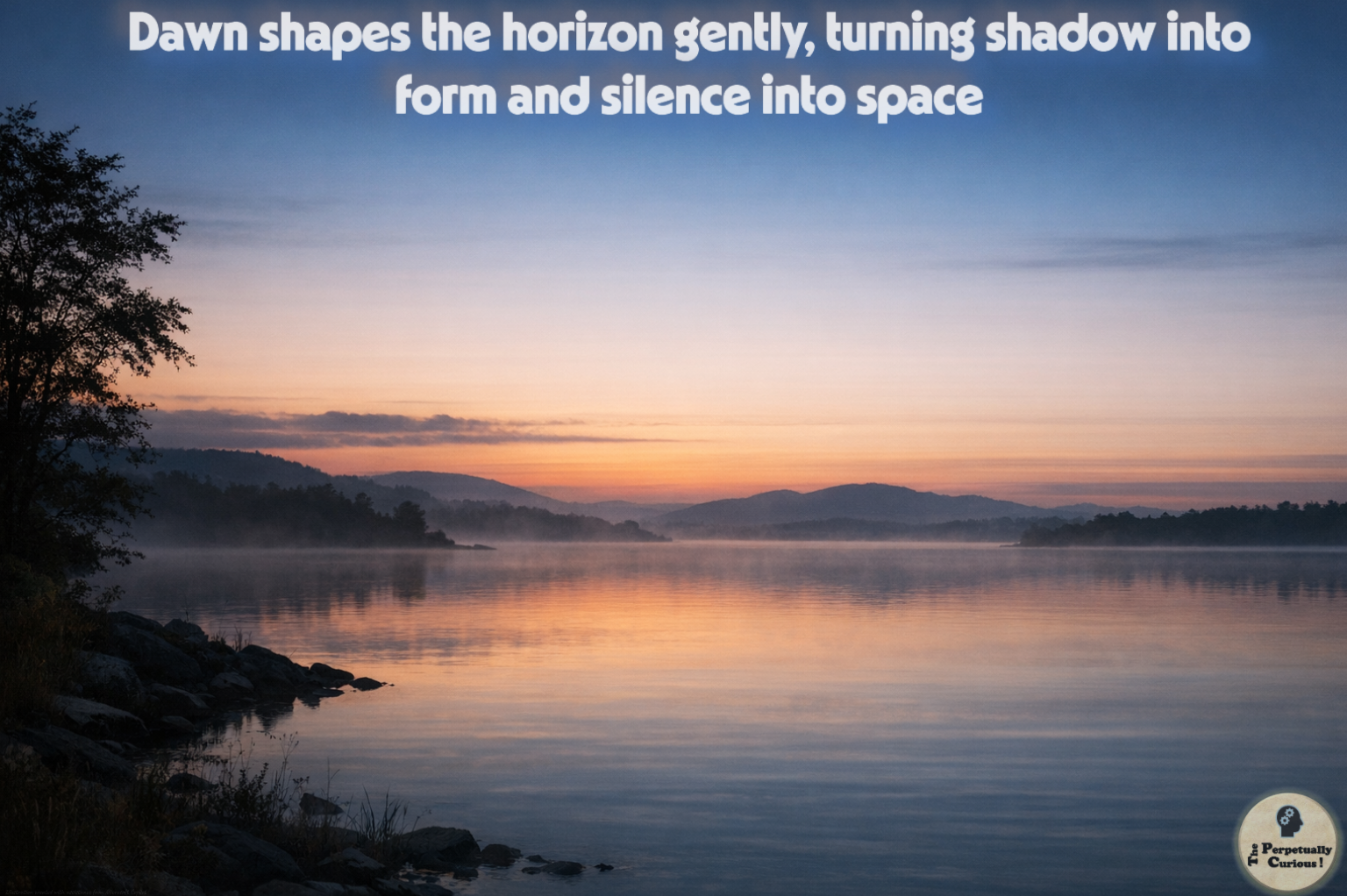
Dawn lifts the darkness gently, allowing the familiar to appear as if seen for the first time.
Shapes gather, colors wait, and the air holds a quiet clarity that feels both fragile and complete.
It is a moment that asks nothing and offers everything.
🌑 Before the light: the world held in shadow
Before dawn, the landscape is present but difficult to interpret. Hills, trees, and buildings remain in place, yet they blend into a near uniform darkness. At this stage, the sun lies well below the horizon, and only a faint amount of scattered light reaches the lower atmosphere. In these conditions, the human eye has limited contrast to work with, and distance becomes difficult to judge reliably, as depth cues such as tonal contrast and texture gradient are largely absent.
Edges soften in this interval. The boundary between field and forest becomes a suggestion rather than a line, and the shoreline of a lake or river may appear as a single dark band. The mind fills in what the eye cannot fully see, which can make familiar places feel slightly unfamiliar.
Beyond the visual softening caused by low light, early morning atmospheric layers can also shape the way sound carries. Overnight cooling can create layers of air with different temperatures and densities, and these layers may refract sound toward the ground, making distant noises seem clearer or more noticeable than they would be later in the day.
This stage feels like a room that has not yet been furnished with detail. The structure is present, but the finer elements are withheld. As the darkness begins to lift, the first subtle gradients of light begin to loosen the uniformity of shadow and prepare the landscape for the shapes that will soon emerge.
🌅 The first gradients of light: shapes returning to the eye
Long before the sun becomes visible, the sky begins to change. Astronomers describe several stages of twilight, defined by how many degrees the sun lies below the horizon. During these stages, sunlight scatters in the upper atmosphere and gradually brightens the sky.
To an observer on the ground, this appears first as a subtle shift in color temperature. The sky becomes a gradient rather than a flat surface, often moving from deep blue overhead to a paler band near the horizon. In very dark locations, this change may be almost imperceptible at first, then suddenly clear once the eye adapts.
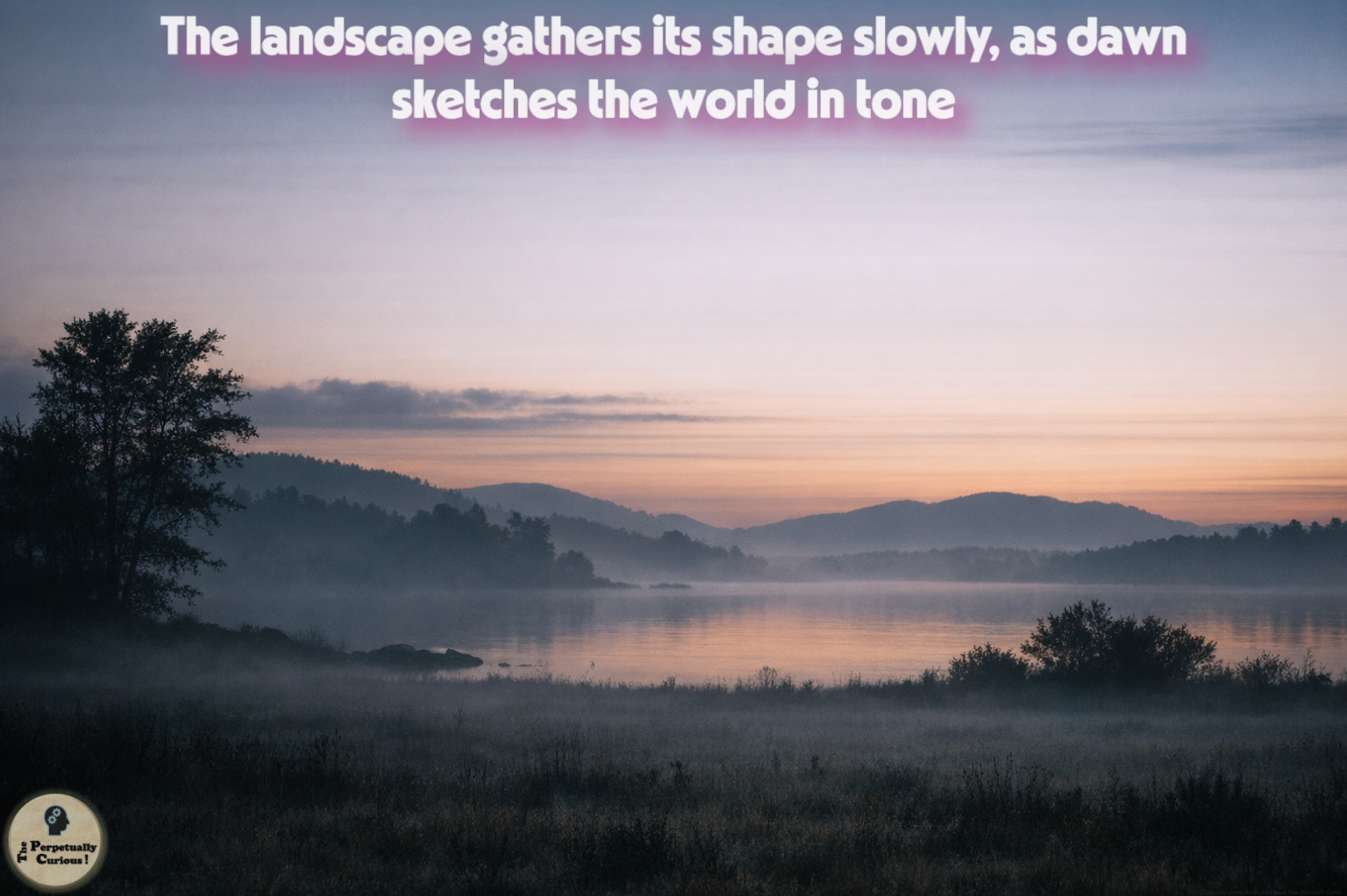
The land begins to show faint geometry. Ridges separate from valleys, and distant silhouettes detach from the foreground. A tree becomes recognizable again, but its leaves remain indistinct. A barn or house reappears as a block of tone rather than a fully textured object.
This is the stage in which shapes return before details do. The world feels as if it has been sketched in charcoal, with broad strokes defining the main structures while finer lines are still withheld. The behavior of light scattering across surfaces helps explain why some materials appear soft and diffuse, while the gleam of smoother or wetter surfaces arises from more direct reflection. These principles extend well beyond the dawn sky and help clarify the subtle tonal shifts that emerge in this early light.
As light continues to increase, the outlines that first emerged in the half‑dark begin to gather texture and depth, preparing the landscape for the more articulated forms that appear as the growing light strengthens.
🌄 How light reveals form: the landscape as a drawing
As dawn progresses, the increase in light is not only a matter of brightness. It is also a matter of how surfaces respond to that light. Different elements of the landscape gain definition at different rates. Smooth water may begin to reflect the brightening sky while nearby rocks remain relatively dark. A large inland water body often catches the first gradients of light before the surrounding land becomes fully visible, a phenomenon apparent even on the scale of north america’s great lakes, where the expanse of open water creates an early contrast between water and terrain.
In the final moments before sunrise, the growing but still diffuse light begins to show the first hints of shadow‑like directionality. These early forms remain soft, yet they suggest the long, shallow‑angle shadows soon to appear when the sun clears the horizon. Even small irregularities in the terrain are poised to project long, thin patterns across the ground, and a fence line will soon cast a repeating rhythm of light and dark that turns a simple boundary into a striking visual pattern.
Surfaces reveal their character in this stage. Rough bark on a tree trunk may show strong contrast between illuminated ridges and shaded grooves, while matte surfaces scatter light in many directions and appear soft. Glossy or wet surfaces reflect more directly and appear sharper, creating a varied interplay of texture across the landscape.
The landscape becomes a drawing before it becomes a photograph. Lines and tonal blocks emerge before full color saturation arrives, and the strengthening twilight begins to suggest the finer details that were hidden in the half‑light.
🌫️ The atmosphere of early morning: cool air and softened edges
While light shapes what is seen, the atmosphere shapes how that seeing feels. The air near dawn is often cooler than it will be later in the day because the ground has been radiating heat into space throughout the night. This cooling can bring surfaces and the air immediately above them toward the dew point, allowing dew, mist, or shallow fog to form under clear skies, calm conditions, and sufficiently moist near‑surface air. A broader understanding of these processes emerges from the study of earth’s atmosphere, which governs how temperature, humidity, and pressure interact.
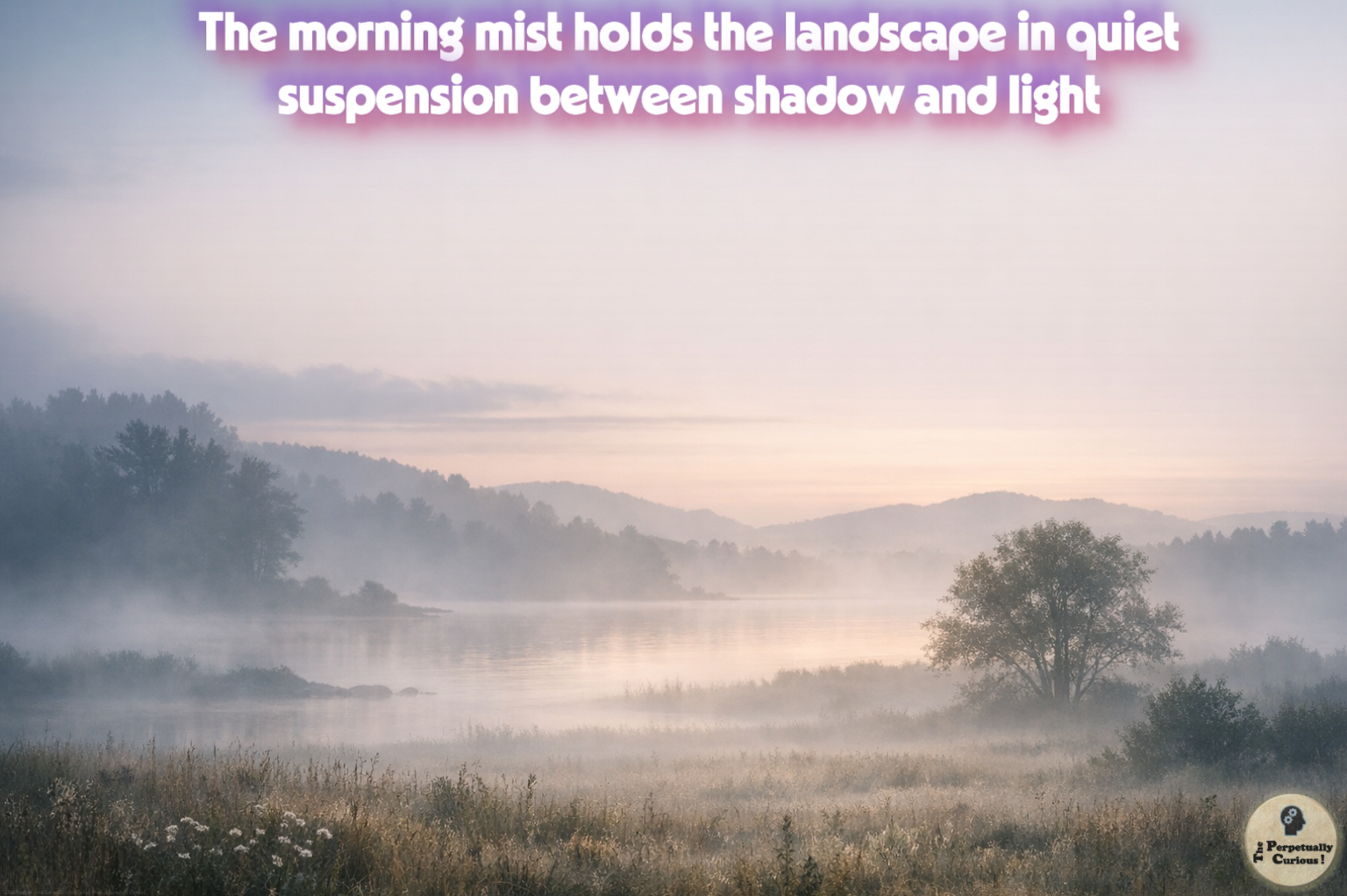
Dew forms when surfaces cool to a temperature at or below the dew point of the surrounding air, causing water vapor to condense into droplets. Grass, leaves, and even metal railings can become coated with a fine layer of moisture. Mist or shallow fog may gather in low‑lying areas where cooler air pools, softening the outlines of trees and buildings.
Wind is often minimal at this time, especially in sheltered terrain on calm nights, though regional weather patterns may produce exceptions. With fewer moving leaves, fewer passing vehicles, and fewer human activities, sound levels remain low. This quietness can make the world feel closer and more intimate. A single bird beginning its dawn song or the distant sound of water can seem to occupy a larger share of attention than it would later in the day.
The emotional quality of this early light is frequently described as calm, anticipatory, and spacious. The combination of cool air, soft light, and subdued sound creates a setting in which perception feels heightened, and this atmospheric stillness sets the stage for the moment when direct sunlight begins to enter the scene.
🌇 The moment the sun breaks the horizon: light with direction
When the upper edge of the sun touches the horizon, the entire scene undergoes a rapid transformation. Up to this point, much of the light has been scattered through the atmosphere, producing gentle gradients and soft illumination. With the sun now visible, light gains a clear source and direction.
Colors often warm noticeably at this moment. Because sunlight travels through a longer path in the atmosphere near the horizon, shorter wavelengths such as blue are scattered more strongly, and longer wavelengths such as red and orange may dominate the direct light. Clouds, if present, can catch this warm illumination and reflect it across the sky.
Shadows sharpen as the sun rises above the horizon. Edges that were previously blurred become crisp, and the contrast between lit and unlit areas increases. A row of trees can cast bold stripes across a field, and the texture of soil, rock, or pavement becomes more evident.
In this brief interval, the landscape transitions from quiet geometry to full detail. The underlying forms that were so evident in the half-light begin to share attention with color, texture, and fine structure, and the first minutes of direct sunlight start to dissolve the temporary simplicity of dawn into the complexity of day.
🌤️ The world after dawn: the landscape fully revealed
Once the sun rises well above the horizon, the landscape becomes fully legible. Objects that were once silhouettes now display their colors and textures. The eye no longer has to infer shapes from minimal information. Instead, it receives an abundance of detail.
With this abundance comes a change in perception. The quiet geometry of dawn, in which large forms and simple contrasts dominated, dissolves into the complexity of daytime. The same field that looked like a single plane of tone at first light now reveals individual blades of grass, insects moving through the stems, and subtle variations in soil. A faint warmth begins to gather on sunlit surfaces, marking the moment when the day fully asserts itself.
Although the moment of dawn has passed, it often leaves an imprint on the observer. Having watched the world assemble itself from darkness to full visibility, the viewer may carry a heightened awareness of structure throughout the day. Dawn becomes a reminder that perception is shaped by light, atmosphere, and attention.
Pass this article along to someone curious and let the learning travel.
💡 Did You Know
🌍 Twilight behaves differently depending on latitude
Near the poles, twilight can last for many hours, and in some seasons the sun may never rise fully above the horizon, creating extended periods of dawn‑like light. This effect is especially visible in regions shaped by arctic twilight.
🐦 Many animals respond to dawn before the sun appears
Birds often begin their dawn chorus during early twilight, using changes in light intensity as a primary external cue that helps synchronize internal rhythms guiding their daily behavior.
🌫️ Mist forms more readily in valleys
Cool air tends to settle in low‑lying areas, which can bring the air closer to saturation and make mist more likely to form around dawn.
🌅 A soft arc of color can appear opposite the rising sun
During morning twilight, observers facing away from the sunrise may notice a pink‑to‑purple band resting above the horizon. A darker band along the horizon marks Earth’s shadow rising into the atmosphere, and immediately above it the Belt of Venus appears as a soft pink or mauve arc created by warm backscattered light from the sunlit air above that shadowed boundary.
🧭 Dawn light helps regulate human circadian rhythms
Early morning light, especially its blue‑wavelength component, plays a measurable role in synchronizing the human circadian clock by providing a primary environmental time cue that helps reset the body’s daily biological rhythm in alignment with the solar day.
❄️ Polar regions experience unusually long, low‑angle dawn light
In high‑latitude environments, the sun can linger just below or near the horizon for extended periods, producing twilight‑like illumination and unusually soft gradients of color. This effect is particularly notable in Antarctica, where such conditions can persist for many hours or even days depending on the season.
What is the scientific definition of dawn?
Dawn is commonly defined as the period of morning twilight that begins when the sun is a certain number of degrees below the horizon and ends at sunrise. Astronomers often distinguish between astronomical dawn, nautical dawn, and civil dawn, which occur when the center of the sun is about 18, 12, and 6 degrees below the horizon, respectively.
Why do colors at dawn often appear warmer near the horizon?
Near the horizon, sunlight travels through a longer path in the atmosphere. Shorter wavelengths such as blue are scattered more strongly, so longer wavelengths such as red and orange may dominate the direct light that reaches the observer.
Why does the landscape look flatter before dawn?
Before dawn, light levels are low and contrast is limited. The human eye has difficulty distinguishing fine detail and subtle differences in tone under such conditions. As light increases, contrast improves and depth cues become clearer.
Why does sound sometimes seem clearer early in the morning?
In the early morning, the air near the ground is often cooler and more stable than it is later in the day. This stability can reduce atmospheric mixing, while lower background noise can make distant sounds seem more noticeable.
Why do some animals begin their dawn chorus before sunrise?
Many species respond to changes in light intensity that help synchronize internal circadian rhythms guiding their daily behavior. Early twilight provides a reliable cue for these rhythms to begin.
Why are shadows so long near sunrise?
When the sun is low on the horizon, its light arrives at a very shallow angle. Even small features on the ground cast elongated shadows because the light must travel across the surface rather than down onto it. As the sun rises higher, the angle steepens and shadows shorten.
What is the Belt of Venus?
The Belt of Venus is a pink or mauve arc that appears near the horizon opposite the rising sun during twilight. A darker band along the horizon marks Earth’s shadow being cast into the atmosphere, and the Belt itself forms as a distinct pink arch immediately above that shadowed layer, tinted by warm scattered light from the sunlit air above.
Why does dawn feel different in winter versus summer?
Seasonal differences in temperature, humidity, and the angle of sunlight can influence how dawn appears and feels. Winter dawns may be cooler and clearer, while summer dawns may be warmer and more humid.
🌱 A gentle invitation to share
We kindly invite you to share and spread the word. Under this quiet sky of early light, every thoughtful reader becomes part of the landscape of understanding. If this exploration of dawn has resonated with you, we encourage you to help us reach a wider audience by sharing this piece with your friends and colleagues. Your support in spreading the message is deeply appreciated and helps this quiet geometry of observation find new horizons.
“The Quiet Geometry of Dawn: How Early Morning Light Shapes the Landscape.” The Perpetually Curious!, May 2026.
https://www.theperpetuallycurious.org/articles/quiet-geometry-of-dawn/Continue Exploring
For what comes next
Site Updates gathers occasional notes, new additions, and ways to keep in touch. RSS brings new publications to your feed reader in chronological order.
Choose the path that speaks to you, and let the next curiosity find you wherever your wondering takes you.