

Toothpaste is often seen only in passing, a small ribbon of color pressed onto a brush before the day begins or ends. Yet behind this familiar gesture lies a carefully engineered material shaped by chemistry, physics, and sensory design. Each tube represents a quiet collaboration between ingredients that must remain stable, gentle, and effective, all while feeling pleasant in the mouth. Understanding how toothpaste is made reveals the intricate craft behind an object that most people use without a second thought, and this hidden craft mirrors the transformations seen in pencil making, where simple materials are shaped into a tool that quietly supports daily life.
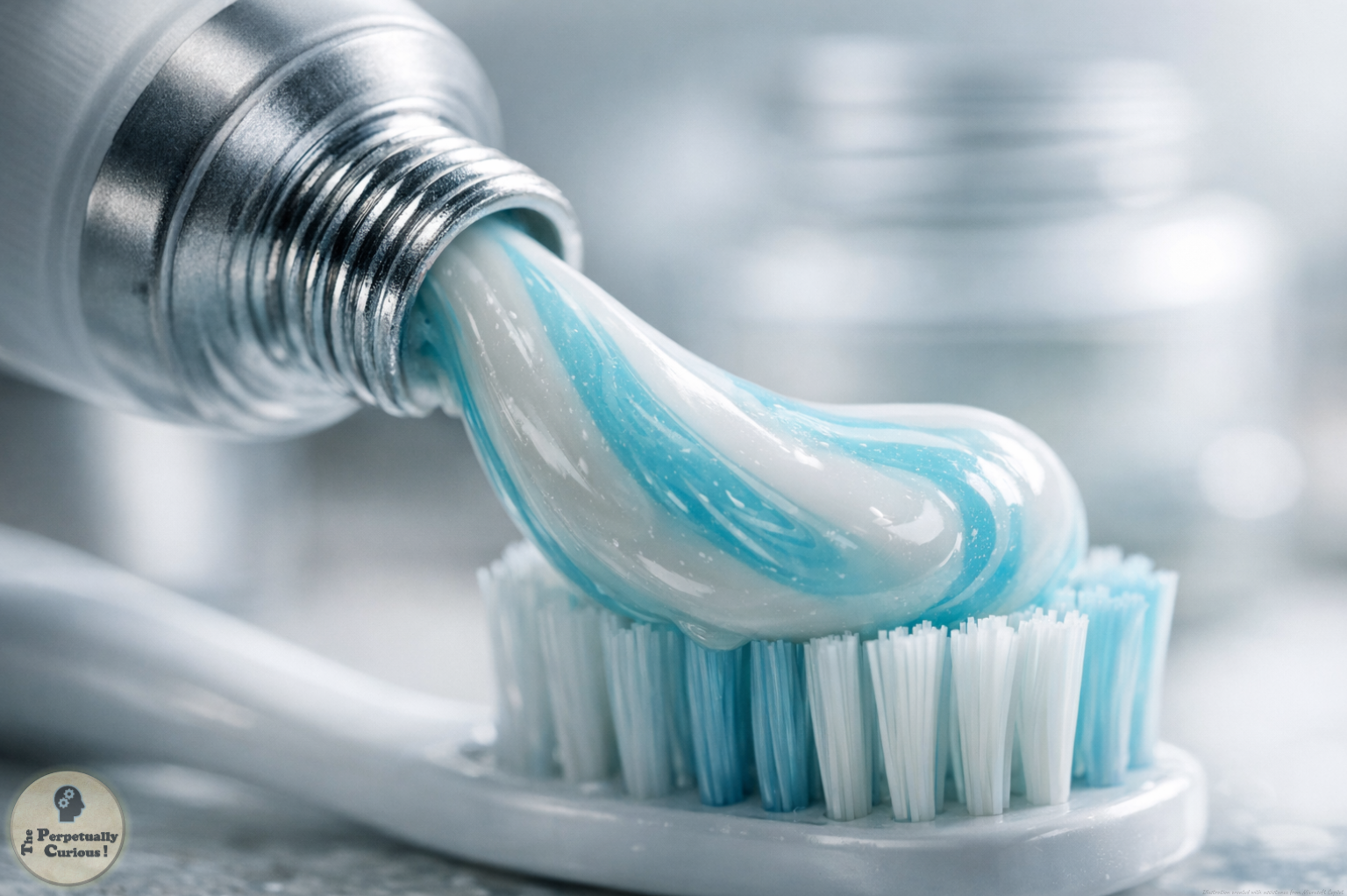
The material moves through quiet stages of change, shaped by forces that work with steady intention.
It gathers itself into structure and motion, carrying its purpose with a calm intelligence that rarely calls attention to itself.
Even its vessel holds a layered story, a reminder that the simplest objects often carry the deepest design.
📜 How early powders gradually became the pastes we know today
Before exploring stainless steel mixers and vacuum systems, it is helpful to understand that toothpaste began as something far simpler. Evidence commonly cited in historical overviews places early Egyptian tooth‑cleaning powders around 3000–5000 BCE, and early dentifrices in several ancient cultures were dry powders made from crushed minerals, charcoals, or plant materials. These powders were often coarse, and their cleaning action depended largely on abrasion.
In several regions, traditional oral‑care preparations developed in parallel. Some Ayurvedic formulations, for example, used herbal powders or plant extracts that reflected local knowledge systems and cultural practices. These preparations were part of broader traditions of oral hygiene long before modern toothpaste manufacturing emerged, and they echo broader traditional medicine systems that shaped approaches to health and daily care across cultures.
As knowledge of oral hygiene expanded, these powders slowly evolved into moist pastes. The introduction of collapsible metal tubes in the late nineteenth century allowed semi‑solid formulations to be stored more hygienically and used more conveniently. This shift from loose powders to stable pastes created the foundation for modern manufacturing, where consistency, safety, and predictable performance are essential. This evolution from early powders to modern pastes also parallels the long material journey seen in paper making, where simple raw matter becomes an essential part of daily routines.
🧪 What lives inside the tube and why each ingredient matters
Once the historical context is in place, the next step is to look inside the tube itself. Modern toothpaste is a structured mixture in which each ingredient type has a specific role. Although formulations vary, many toothpastes share a similar set of functional groups.
Abrasives form a significant portion of the paste. Hydrated silica, calcium carbonate, or dicalcium phosphate are commonly used. These particles are processed so that they are hard enough to help remove surface deposits, yet fine enough to be compatible with enamel when used as directed. Abrasives typically make up around 20 to 40 percent of the paste by weight, depending on the product formulation. Their abrasive potential is often assessed using the Relative Dentin Abrasivity scale, a standardized dentin‑based measure used in product development and quality control to help balance cleaning performance with acceptable abrasivity.
Humectants such as sorbitol or glycerin help the paste retain moisture and maintain a smooth texture. Water is also present and acts as a solvent and dispersion medium. Thickeners and binders, which may include cellulose derivatives or other gums, help control viscosity so that the paste holds its shape on a brush yet flows when squeezed.
Surfactants assist in dispersing the paste in the mouth and help lift debris from surfaces. Active ingredients such as fluoride compounds are added in carefully controlled amounts, commonly in the range of about 1,000 to 1,500 parts per million in many consumer toothpastes, although permitted concentrations and fluoride compounds vary by jurisdiction and formulation. These concentrations reflect guidance for general adult use; formulations designed for younger children may follow different specifications. These compounds support enamel remineralization and help reduce the risk of tooth decay.
Flavor systems and colorants shape the sensory experience. Mint flavors are widely used because they are often associated with freshness in many cultures and can help mask the taste of other ingredients. Cooling sensations, which may be produced by specific compounds, can enhance this perception. Colorants may be used to create white pastes or colored gels, and preservatives help maintain microbiological stability. The way toothpaste relies on stable pigments and controlled dispersion has a quiet parallel in the formulation of printing ink, which also depends on finely balanced mixtures that must remain uniform under varying flow conditions.
Each ingredient is selected not only for its individual function, but also for how it behaves in combination with the others. This interplay is what the manufacturing process must carefully manage.
⚙️ How manufacturing begins with a liquid base that sets the stage
The order in which these ingredients are combined matters as much as the ingredients themselves, and manufacturing begins not with powders but with the liquid base that will carry them. Water, humectants, and other liquid components are measured and added to a mixing vessel, with precise weighing systems and controlled transfer lines maintaining consistency from batch to batch.
The liquid base is mixed until it becomes uniform. Some manufacturers pre‑disperse thickeners in a portion of the humectant to help prevent clumping when the thickener later encounters water. Others may dry blend thickeners with powders before introducing them into the main vessel.
This early phase sets the foundation for the entire batch. If the liquid base is not homogeneous, later additions of abrasives and actives may not distribute evenly. Manufacturers therefore monitor parameters such as temperature and mixing speed to ensure that the base is ready to receive solid ingredients. The transition from this step to the next marks a shift from preparing a smooth liquid environment to gradually building the paste structure.
🌀 How abrasives and actives transform the base into a structured paste
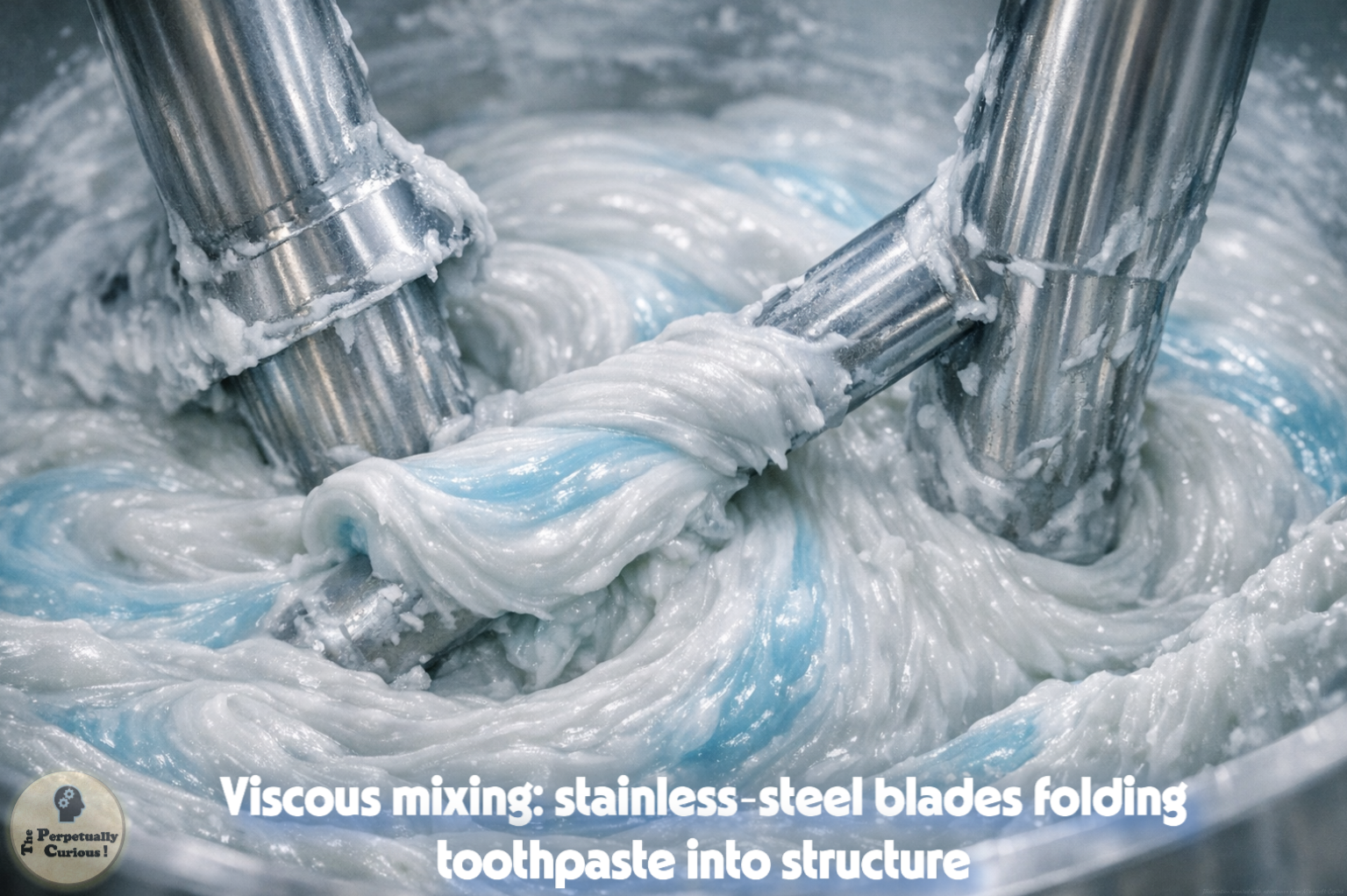
Once the base is prepared, abrasives and other solid ingredients are introduced. In many industrial systems, powders are added under controlled conditions, sometimes with the vessel under partial vacuum. The goal is to draw powders into the liquid without trapping excessive air and without forming lumps.
Abrasives are dispersed until they are evenly distributed throughout the mixture. This step is crucial for both performance and mouthfeel. If abrasive particles are not well dispersed, the paste may feel gritty or may not clean uniformly. Mixing equipment in some facilities uses high‑shear zones or specialized impellers to help break up agglomerates and create a smooth texture.
Active ingredients such as fluoride compounds and sweeteners are incorporated in carefully measured quantities. Quality control checks may be performed on intermediate samples to confirm that the desired levels have been reached.
As the solids are incorporated, the mixture thickens and begins to resemble the familiar paste. The transition from a relatively thin liquid to a structured material marks the point where rheology, or flow behavior, becomes especially important.
🌊 How rheology shapes the feel, flow, and performance of toothpaste
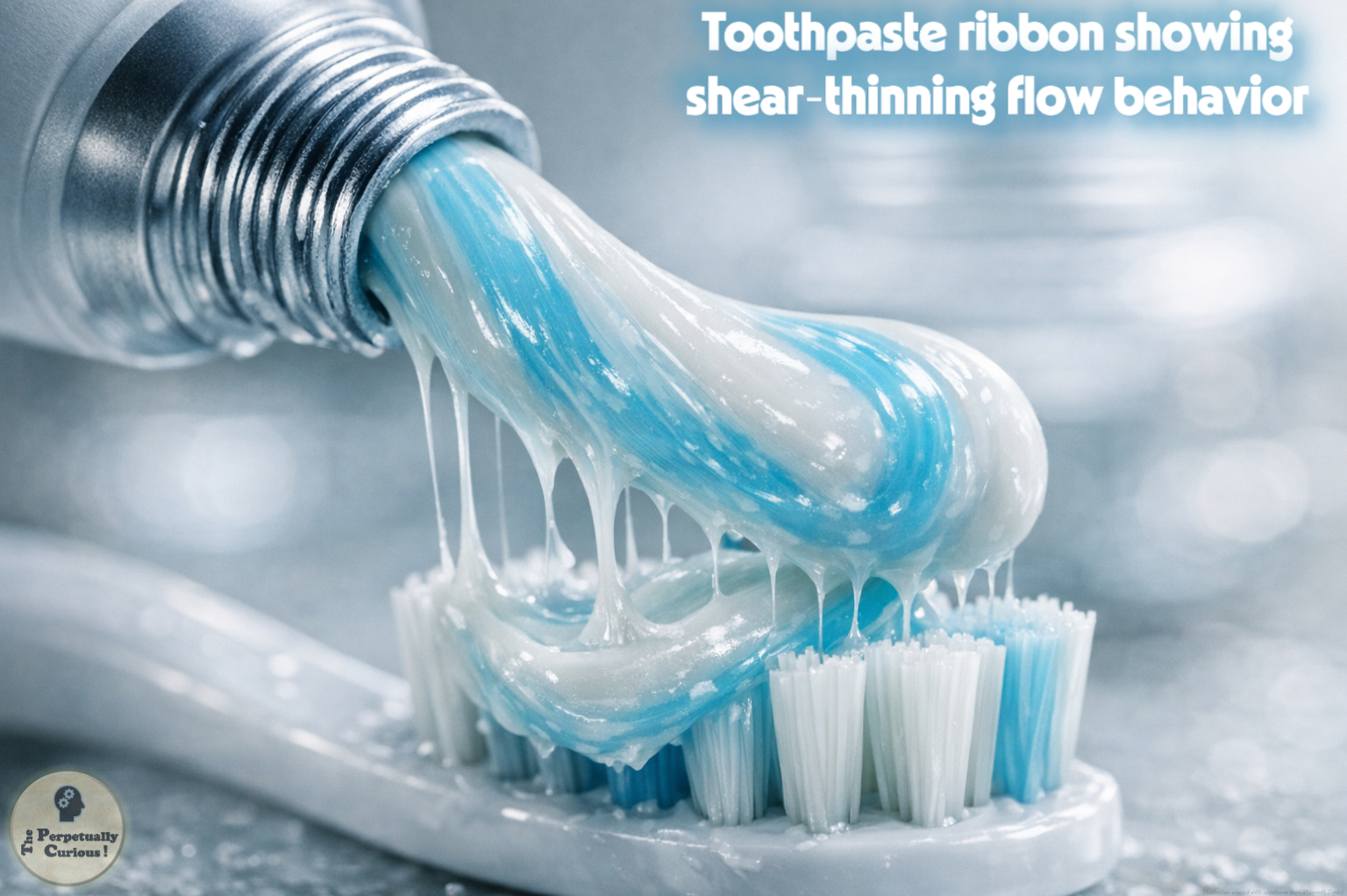
Toothpaste must satisfy several requirements. It must be thick enough to sit on a toothbrush without running off, yet it must also flow smoothly out of a tube when squeezed. It should feel smooth in the mouth, spread easily over surfaces, and rinse away without leaving unwanted residue. These properties are governed by rheology.
Many toothpaste formulations exhibit shear‑thinning behavior. This means that the paste becomes less viscous when it is subjected to higher shear, such as when it is squeezed through a narrow opening or brushed across teeth. When the shear is removed, the viscosity increases again, and the paste holds its shape. Thickeners, humectants, and the distribution of abrasives all contribute to this behavior. The study of how toothpaste flows under pressure has conceptual similarities to the way asphalt materials are evaluated for their behavior under varying shear conditions.
Manufacturers adjust mixing times, ingredient ratios, and sometimes temperature to fine‑tune rheology. Vacuum mixers are often used to blend and deaerate the paste. Removing entrained air helps prevent visible bubbles, improves density control, and supports a smooth appearance. Vacuum levels are carefully controlled because too little vacuum may leave air pockets.
This focus on texture and flow influences how evenly active ingredients are delivered during brushing and how comfortable the product feels in use. Once the desired rheological profile is achieved, the paste is ready to move from mixing vessels to storage tanks and then to filling lines.
🧴 How bulk paste becomes individual tubes ready for daily use
After mixing and rheology adjustment, the toothpaste is transferred to holding tanks that feed the filling machines. These tanks are designed to maintain gentle agitation and preserve the deaerated state of the paste. The goal is to deliver a consistent, bubble‑free stream to the filling nozzles.
Tube filling machines portion the paste into individual tubes, which may be made from laminated materials, plastics, or other suitable packaging structures. In many facilities, tubes are filled from the open bottom end rather than through the cap. Once the correct volume of paste is dispensed, the bottom is sealed by crimping or heat‑sealing, which is why the lower end of a tube is flat while the cap and nozzle are preformed.
Quality control checks may include monitoring fill weights, checking seals, and inspecting the appearance of the paste at the nozzle. These checks help ensure that the product that reaches store shelves matches the intended specifications.
🌿 How flavor, color, and culture shape the sensory experience
While the core of toothpaste manufacturing is technical, the sensory layer is also carefully considered. Flavor systems are developed to complement the base formulation. Mint flavors occupy a central place in toothpaste’s sensory identity, and the cooling effect they produce, a response driven by specific aromatic compounds rather than any actual change in temperature, adds a sensory dimension that extends well beyond taste alone. The design of toothpaste flavors shares conceptual ground with perfume chemistry, since both rely on carefully selected aromatic molecules that shape how a product is experienced.
Color choices reflect both aesthetic and functional considerations. White pastes may use opacifying agents, while clear or colored gels rely on colorants that are suitable for oral use. Striped toothpastes require additional process steps to co‑fill different formulations into a single tube in a controlled pattern.
Cultural preferences influence both flavor and appearance. In some markets, herbal or regionally familiar flavors may be preferred. Manufacturers adapt formulations to local expectations while working within regulatory frameworks and safety standards.
🌍 How materials and packaging connect toothpaste to the wider world
Toothpaste manufacturing intersects with questions about materials and environmental impact. The paste itself is formulated to be safe for everyday use, while packaging presents additional challenges.
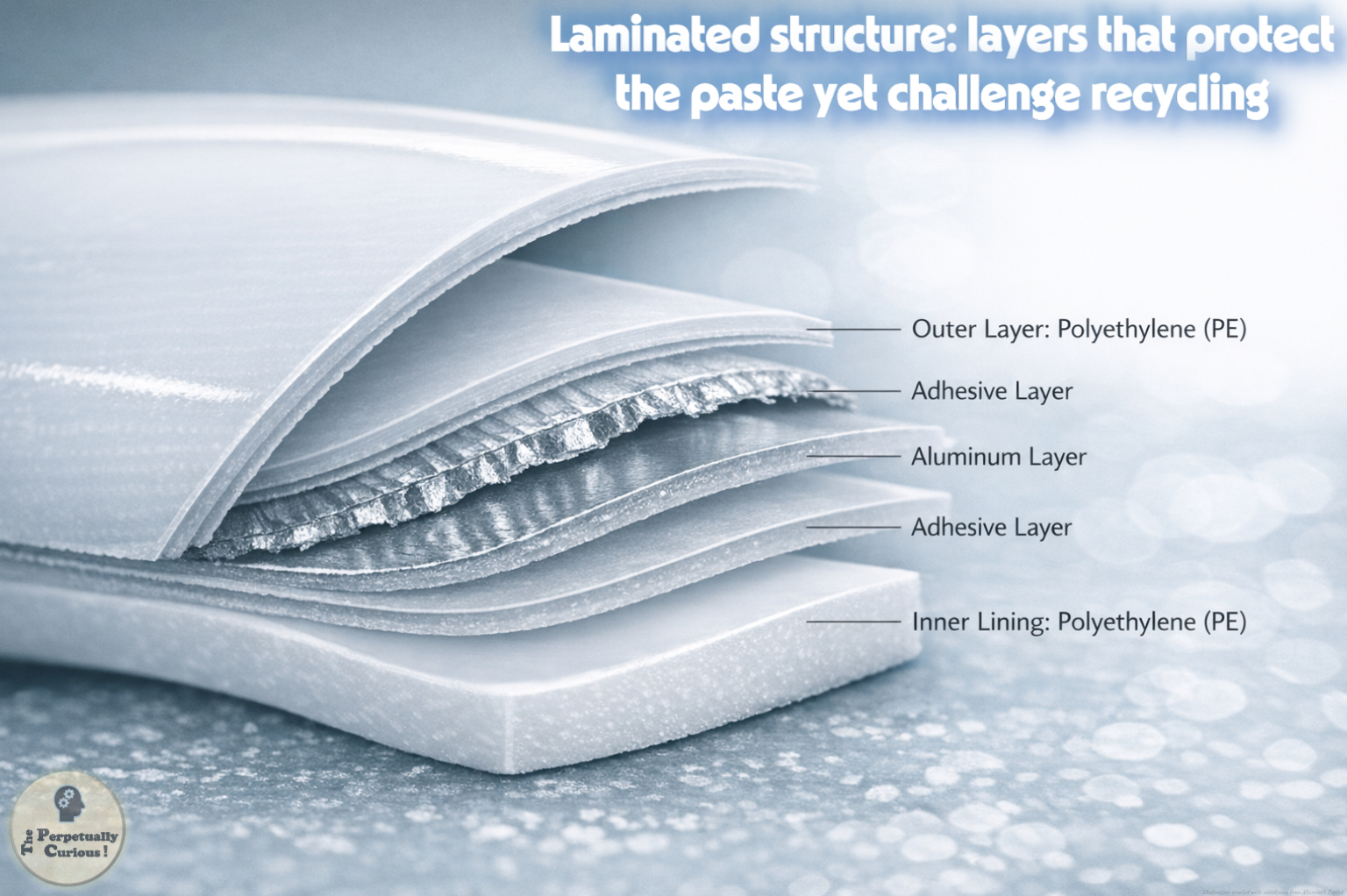
Many toothpaste tubes combine plastic layers with an aluminum barrier in a laminated structure that is difficult to separate in standard municipal recycling streams. In response, some producers explore alternative tube constructions or different formats such as pumps or solid forms. These developments aim to balance product protection, usability, and potential recyclability. Some of the plastics used in modern packaging originate from processes such as petroleum refining, which convert raw hydrocarbons into materials with specific performance characteristics.
From a manufacturing perspective, efficient use of raw materials, careful control of waste streams, and energy‑conscious process design all contribute to a more responsible production system. The underlying theme is that toothpaste manufacturing is not only about the paste itself, but also about the broader system that brings it to the sink.
📚 How all these elements come together in a daily ritual
When viewed as a whole, toothpaste manufacturing is a sequence of linked decisions and processes. Formulation defines the roles of abrasives, humectants, thickeners, surfactants, actives, flavors, and colorants. Mixing and dispersion transform these ingredients into a smooth, structured paste. Rheology control ensures that the material behaves as expected in both tube and mouth. Filling and packaging convert bulk paste into familiar tubes that fit easily into daily routines.
This quiet engineering effort supports a simple ritual that many people perform without much thought. Yet behind each small ribbon of paste there is a carefully balanced combination of chemistry, physics, and design. Recognizing this complexity can add a sense of appreciation to an object that usually disappears down the drain in a matter of seconds, revealing how much unseen craft supports even the most ordinary moments of daily life.
Pass this article along to someone curious and let the learning travel.
💡 Did You Know
💈 Toothpaste stripes are stabilized by viscosity and tube geometry Striped toothpastes rely on high viscosity and precise tube design. Each colored formulation is thick enough to resist mixing, and the tube’s inner nozzle structure directs the colored gel to the surface of the paste as the tube is compressed.
🐚 Early toothpastes sometimes used chalk or crushed shells Before modern abrasives were developed, some formulations used finely ground chalk or crushed oyster shells to help clean teeth.
🧵 Tube geometry influences how toothpaste flows The shape of the tube and the diameter of the opening influence how the paste moves under pressure, which affects both dispensing and the appearance of the ribbon on the brush.
🔬 Abrasive particles are often micrometer‑scale Many abrasives are milled so that their typical dimensions are measured in micrometers, which is a small fraction of the width of a human hair.
🧊 The cooling sensation in mint toothpaste is a sensory effect The cool feeling associated with many mint toothpastes is not a drop in temperature. Certain aromatic compounds activate cold‑sensing receptors in mouth tissues, creating the perception of coolness even at room temperature.
🏭 Toothpaste tubes are filled from the bottom, not the top The cap and nozzle are preformed. The open flat end is used for filling, then sealed by crimping or heat‑sealing, which is why the bottom of most tubes is folded and flat.
What are the main ingredients in most toothpastes?
Most toothpastes contain a combination of abrasives, humectants, water, thickeners, surfactants, active ingredients such as fluoride compounds, flavor systems, colorants, and preservatives. Each group has a specific function, from cleaning and texture control to stability and sensory experience.
Why do many toothpastes use mint flavors?
Mint flavors are widely used because they are often associated with freshness and cleanliness in many cultures. They can also help mask the taste of other ingredients. The way toothpaste flavor blends are constructed shares underlying principles with perfume chemistry, where aromatic components are selected and balanced to create a coherent sensory profile.
How is the texture of toothpaste controlled during manufacturing?
Texture is influenced by the ratio of liquids to solids, the type and amount of thickeners, the size and distribution of abrasive particles, and the mixing process itself. Manufacturers adjust these factors and often use vacuum mixers to achieve a smooth, stable, and shear‑thinning paste. The study of how toothpaste flows under pressure has conceptual similarities to the way asphalt materials are evaluated for their behavior under varying shear conditions.
Why is fluoride often included in toothpaste?
Fluoride compounds are frequently included at controlled levels because they support enamel remineralization and help reduce the risk of tooth decay. The exact concentration and type of fluoride depend on regulatory guidelines and product design.
How do manufacturers ensure that each tube contains the same product quality?
Manufacturers typically use precise weighing systems, controlled mixing conditions, and standardized procedures. Quality control tests may include checks on viscosity, pH, appearance, microbial limits, and active ingredient levels. Filling lines are calibrated to deliver consistent volumes and maintain hygienic conditions.
What determines whether a toothpaste is opaque or transparent?
Opacity can arise from opacifying agents or dispersed solids within the formulation. Transparent gels depend on refractive‑index matching and careful composition design so that the ingredients allow light to pass through uniformly.
How is toothpaste safety evaluated?
Safety evaluations may include assessments of ingredient compatibility, microbiological stability, and compliance with regulatory guidelines. Manufacturers also conduct tests to ensure that the product remains stable over its intended shelf life.
Are all toothpastes equally abrasive?
No. Abrasivity varies depending on the type and amount of abrasive used, as well as how the particles are processed. The Relative Dentin Abrasivity scale provides a standardized way to compare abrasive potential across formulations.
Why are some toothpastes gels while others are opaque pastes?
Gels rely on transparent or translucent bases in which the refractive indices of the ingredients are closely matched. Opaque pastes contain opacifiers or dispersed solids that scatter light. The choice depends on aesthetic goals and formulation design.
Why do some toothpastes foam more than others?
Foaming depends on the type and concentration of surfactants in the formulation. Some products use higher‑foaming surfactants to enhance the perception of cleaning, while others use milder systems that produce less foam.
How are toothpaste tubes actually filled during manufacturing?
Tubes are filled from their open bottom end rather than through the cap. Once the correct volume of paste is dispensed, the bottom is sealed by crimping or heat‑sealing. This method allows the cap and nozzle to be preformed, ensuring a clean and consistent opening.
How does the cooling sensation in many toothpastes relate to flavor design?
The perception of coolness in many toothpaste products is not a change in temperature. Certain aromatic compounds activate cold‑sensing receptors in mouth tissues, creating a cooling sensation that complements the flavor profile.
Did traditional oral‑care practices influence early toothpaste formulations?
Some early herbal powders reflect broader traditional medicine systems that developed distinct approaches to oral care long before contemporary formulations emerged.
Why is fluoride sometimes discussed in public debates?
Fluoride has been studied for many decades, and its use in toothpaste is guided by regulatory limits that define how much may be included in consumer products. Research has examined both its benefits for enamel remineralization and the importance of using appropriate concentrations, especially for younger children. Public discussions sometimes arise because different regions and communities take varying approaches to fluoride use in water or oral‑care products. Toothpastes are available in both fluoride‑containing and fluoride‑free formulations to accommodate different preferences and regulatory contexts.
How did traditional systems such as Ayurveda approach oral‑care materials?
Several traditional knowledge systems developed their own oral‑care practices long before contemporary toothpaste formulations emerged. In some Ayurvedic traditions, herbal powders or plant‑based mixtures were used to clean teeth and freshen the mouth. These preparations reflected local materials, cultural preferences, and broader traditional medicine systems that shaped approaches to daily care. While their ingredients and methods differ from modern formulations, they illustrate how communities have long explored ways to maintain oral hygiene using the resources available to them. This description is offered in an educational spirit and does not represent a recommendation for any specific practice or product.
🌱 A gentle invitation to share
We kindly invite you to share and spread the word. Under this gentle and poetic reflection, we encourage you to help this story of everyday materials reach a wider audience by sharing it with friends, colleagues, or anyone who may enjoy seeing familiar objects in a new light. Your support in spreading the message is deeply appreciated and helps keep curiosity about the material world very much alive.
“The Making of Toothpaste: The Subtle Science Behind a Daily Ritual.” The Perpetually Curious!, May 2026.
https://www.theperpetuallycurious.org/articles/how-toothpaste-is-made/Continue Exploring
For what comes next
Site Updates gathers occasional notes, new additions, and ways to keep in touch. RSS brings new publications to your feed reader in chronological order.
Choose the path that speaks to you, and let the next curiosity find you wherever your wondering takes you.