

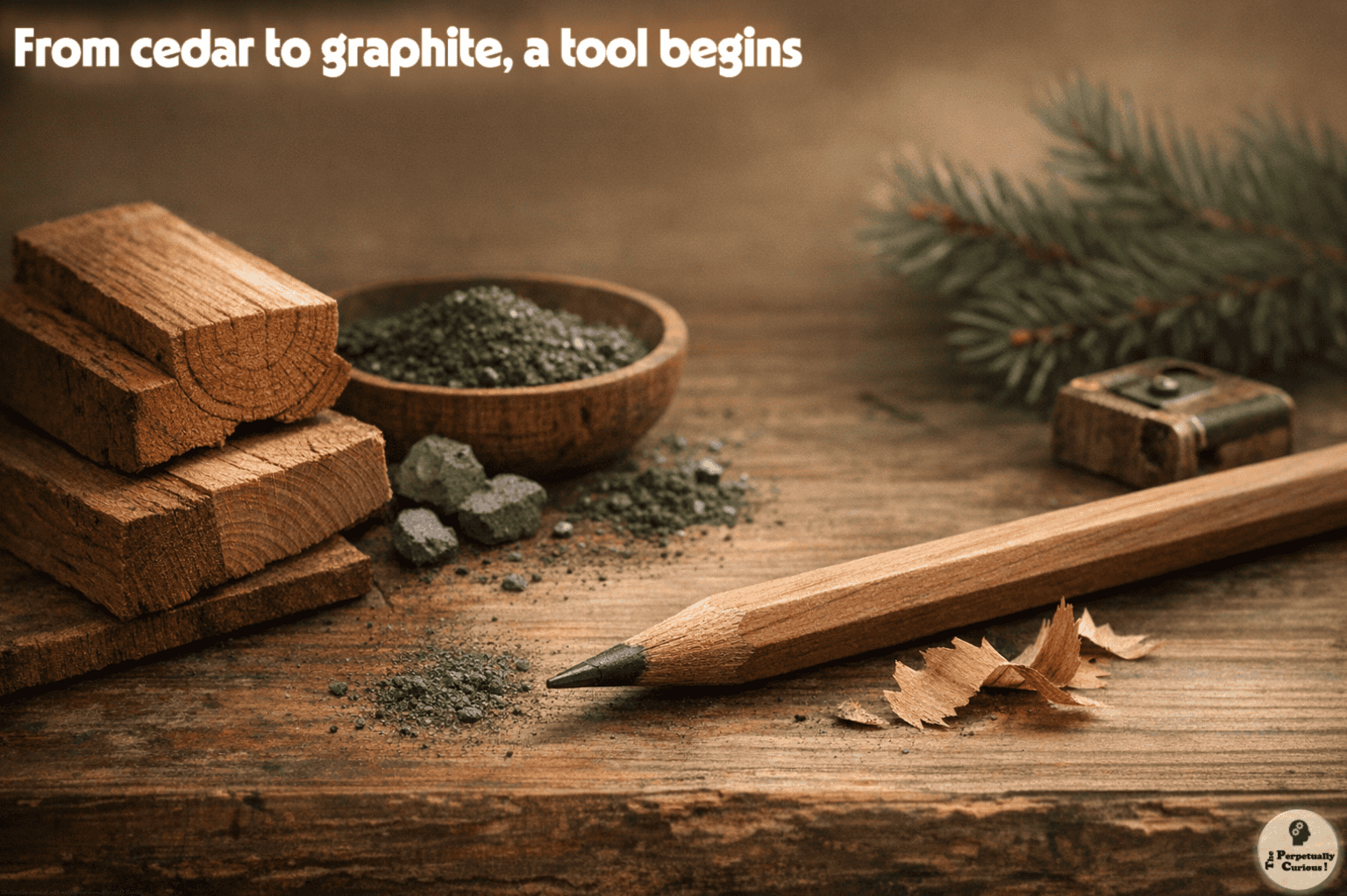
A pencil rests so lightly in the hand that it can be easy to forget the long journey that brought it into existence. It begins in forests where softwoods grow in patient rings, and in geological seams where carbon has settled into crystalline layers. Through a sequence of careful transformations, these materials are shaped into a tool that carries ideas, sketches, calculations, and quiet moments of thought. This article follows that journey in a continuous narrative, so that each stage feels like a natural step in the unfolding life of the pencil.
As we move from raw materials to finished object, the pencil reveals itself as a meeting point of geology, forestry, chemistry, and engineering. The goal is to illuminate this process with clarity and accuracy, while preserving a sense of wonder for an object that has accompanied human creativity for generations.
✏️ The pencil as an object before its story begins
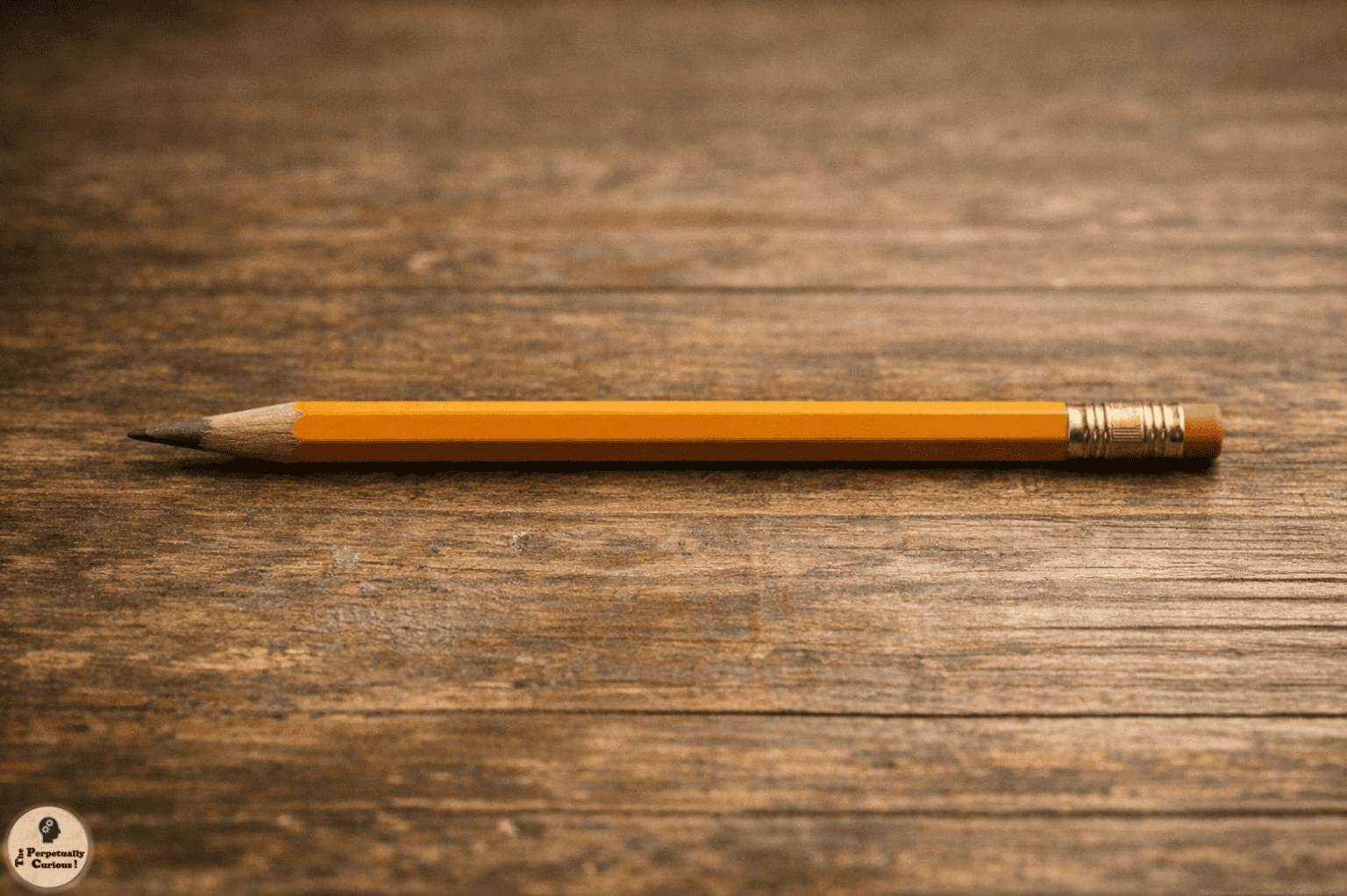
Before tracing the pencil’s origins, it is helpful to look closely at the familiar form that emerges at the end of the manufacturing process. A typical wooden pencil is between 7 and 7.5 inches long (about 17.5 to 19 centimeters), with a hexagonal or round wooden body, a dark core that leaves marks on paper, and, in many cases, a small eraser held by a metal band at one end.
This simple structure contains four essential components that guide the narrative ahead: the graphite and clay core, the wooden casing, the ferrule, and the eraser. Each of these elements has its own origin and its own transformation. Understanding them individually allows the manufacturing process to unfold as a coherent story rather than a list of steps.
To follow this story, we begin where the materials themselves begin, in forests and geological deposits, before moving into the factory where they are shaped and assembled.
🌍 Gathering the materials that will become a pencil
The life of a pencil begins long before any machine is engaged. It begins in forests where softwoods such as cedar or similar species grow with straight, workable grain. These woods are valued because they are relatively light, easy to sharpen, and capable of producing smooth shavings rather than splintering. Logs are cut into long pieces known as pencil stock, then kiln‑dried to a controlled moisture content so that the wood will remain stable and resist warping or cracking during later stages of manufacture.
The core of the pencil begins in geological deposits where graphite, a crystalline form of carbon, is mined and purified. On its own, graphite is too soft and fragile to form a durable writing core, so it is blended with clay and water to create a workable mixture. The ratio of graphite to clay influences how dark or hard the finished pencil will feel. Small amounts of waxes or oils may later be added to adjust smoothness.
A reader who is interested in how other forest-based materials are transformed into everyday tools may appreciate a deeper look at the journey of paper, since both pencils and paper begin in the quiet work of trees and continue through careful industrial shaping.
By understanding these materials at the outset, the later steps in the factory can be seen as a series of transformations that respect and refine the properties of wood and graphite rather than obscuring them.
🧪 Forming the core: Where graphite and clay become a writing line
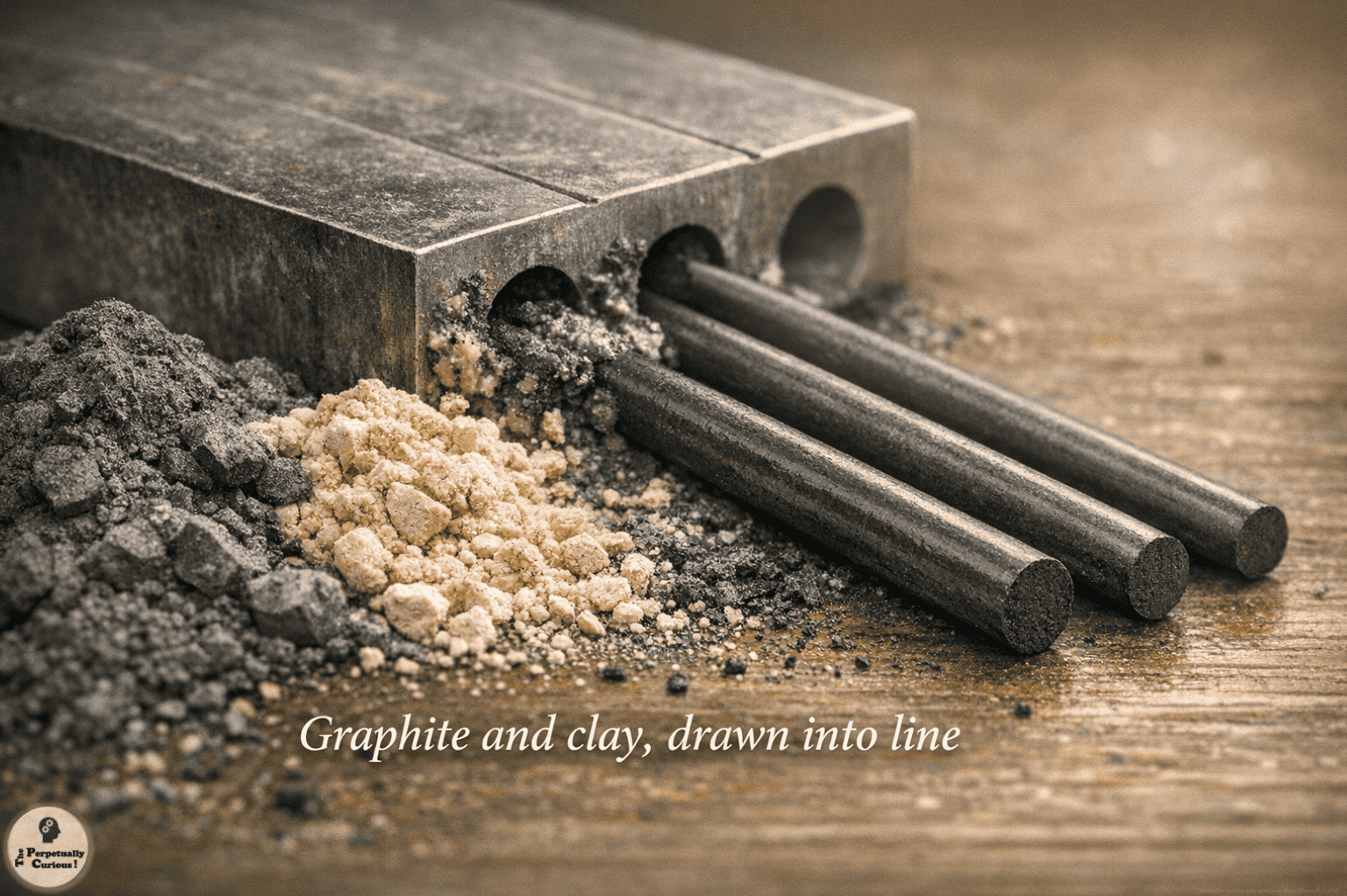
Once graphite and clay have been prepared, they are combined with water to form a smooth, uniform paste. This mixture is kneaded until it reaches a consistent texture. The proportions are adjusted with care, because more clay generally produces a harder, lighter line, while more graphite tends to produce a softer, darker line. This balance forms the basis for familiar hardness grades such as H, HB, or B.
The paste is extruded through fine dies to form long, thin rods. These rods are cut into lengths slightly shorter than the final pencil, then dried to remove excess moisture. After drying, they are fired at high temperatures, commonly around 1,800 degrees Fahrenheit (about 1,000 degrees Celsius), though formulations and processes vary. This firing step strengthens the cores and helps lock in their mechanical properties.
After firing, the cores may be impregnated with oils or waxes to improve smoothness and reduce brittleness. At this stage, the pencil exists only as a fragile thread of dark material. While these cores gain strength in the kiln, the wood that will protect them undergoes its own transformation.
🌲 Preparing the wooden body: From log to slat
The wooden part of the pencil begins as dried pencil stock that is cut into blocks and then into thin boards known as slats. Each slat is slightly longer and wider than the final pencil, which allows for trimming and shaping later. The slats are inspected for knots, cracks, or irregular grain. Pieces that meet quality standards may be treated with wax to improve machining and sharpening characteristics, and sometimes stained for a more uniform appearance.
Moisture equilibrium is important at this stage. If the wood is too dry, it may crack during shaping; if it is too moist, it may warp later. Manufacturers therefore aim for a stable moisture content that supports clean machining and long term durability.
The way natural materials are conditioned and stabilized before they are shaped into useful forms is explored further in the study of rubber production, where latex undergoes its own transformation from a raw biological substance into a durable engineered material.
The slats, now prepared and stabilized, are ready to meet the graphite cores. The narrative moves from separate material streams to their first point of contact.
🧩 Bringing core and casing together: The pencil sandwich
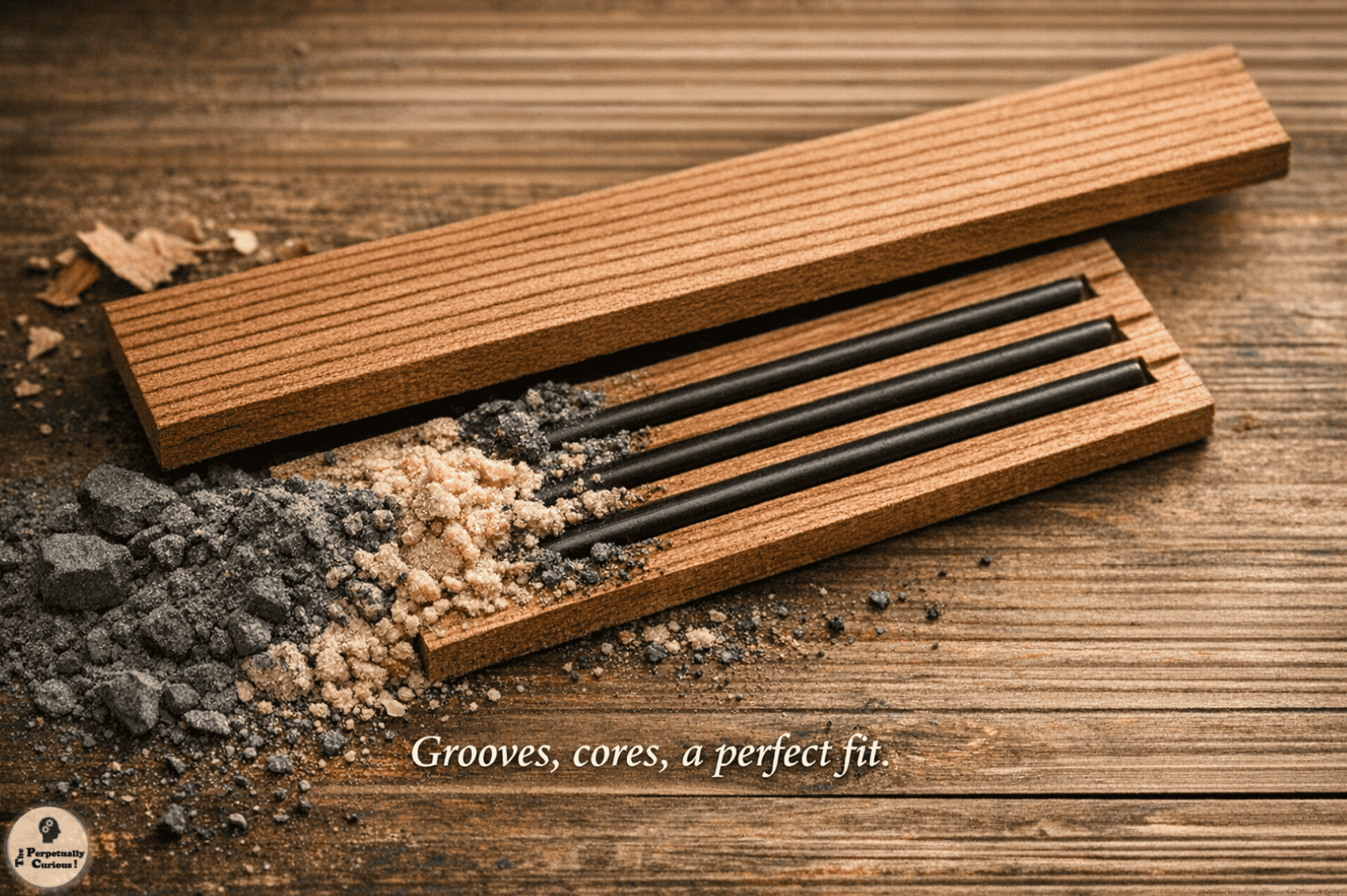
To house the graphite cores, each wooden slat passes through a grooving machine that cuts a series of parallel channels along its length. These grooves are just deep and wide enough to cradle the cores securely. The spacing of the grooves determines how many pencils will be produced from each slat.
Graphite cores are then laid into the grooves, either by hand in smaller operations or by automated systems in larger factories. A second grooved slat, coated with adhesive, is placed on top so that the grooves align and the cores are enclosed between the two boards. This assembly is often called a pencil sandwich.
The sandwiches are clamped under pressure while the adhesive cures. During this time, the wood and core become a single composite piece. Once the glue has set, the sandwiches are ready to be shaped into the familiar form that fits comfortably between fingers.
📐 Carving form and feel: Shaping individual pencils
The glued sandwiches are fed into shaping machines that first trim the edges to ensure that the block is square and that all cores are properly aligned. The block then passes through cutting heads that carve the cross section of each pencil. Common shapes include hexagonal, round, and triangular profiles. The hexagonal shape is widely used because it provides a comfortable grip and prevents the pencil from rolling easily on flat surfaces.
As the shaping heads cut along the length of the sandwich, individual pencils emerge, still joined in rows until they are fully separated. Typical pencils have a diameter of about 0.3 inch (about 7 to 8 millimeters), although this can vary slightly depending on design and intended use.
At this stage, quality control is important. Pencils with off center cores, chipped wood, or other visible defects are removed. The remaining pencils now look familiar, but they are still bare wood with exposed cores. The next part of the story explains how color, protection, and identity are added.
🎨 Finishing the surface: Color, protection, and identity
Bare wooden pencils are vulnerable to moisture and wear, so they are usually coated with multiple layers of lacquer or similar finishes. Pencils are mounted on racks or fed through automated systems that apply thin coats of paint, which are then dried between applications. High quality pencils may receive between four and ten coats, which build up a smooth, durable surface.
Color choices can be aesthetic or functional. The finish also provides a surface for printing. Once the lacquer has cured, pencils are stamped or printed with information such as hardness designation or manufacturer name. This step turns each pencil from a generic object into a clearly identified tool.
With the surface protected and labeled, the pencil is almost complete. For many designs, one final set of components remains to be added at the top.
🧷 The final touch: Ferrule and eraser
Many pencils include an eraser at one end, held in place by a small metal band known as a ferrule. The ferrule is typically made from a metal such as aluminum or brass, formed into a short cylinder with a crimpable section. Erasers are often made from synthetic rubber or similar polymers that can lift graphite from paper through gentle abrasion.
The eraser plug is inserted into the ferrule, and the combined piece is pressed onto the blunt end of the wooden body. Crimping tools then deform the ferrule slightly so that it grips both the wood and the eraser securely.
Not all pencils include erasers. Some drawing and technical pencils are sold without them to allow for different erasing tools or to maintain a simpler design. Regardless of design choice, the pencil is now ready to be used.
🌱 Considering the wider picture: Environment and efficiency
Before the pencil reaches any hand or desk, it carries a quiet record of the resources drawn upon to bring it into being, a record that becomes more significant as production scales to billions of units each year.
Although each pencil is small, the number of pencils produced worldwide is very large, so questions of resource use and environmental impact are important. Many manufacturers source wood from managed forests where harvesting is balanced with replanting. Cedar and similar woods are valued for their straight grain and working properties, which make them well suited to pencil manufacture.
In the factory, thin saw blades and careful cutting patterns are used to minimize waste in the form of sawdust and offcuts. Some of this wood waste may be repurposed or used as fuel in controlled systems. Graphite and clay processing also generates byproducts, and modern facilities often include filtration and treatment systems to reduce environmental impact.
Pencils themselves are largely composed of wood and mineral based materials. When separated from metal ferrules and erasers, the wooden and graphite portions may be compatible with certain recycling or energy recovery processes, but the feasibility depends entirely on local waste management rules, coatings, adhesives, and facility capabilities, so broad statements are made with care.
🌌 A quiet companion to thought
When all of these stages are viewed together, the pencil appears less as a trivial object and more as a quiet companion to human thought. Wood that once formed part of a living tree now carries a core of carbon that once lay deep in the earth. Through careful drying, mixing, firing, cutting, shaping, and finishing, these materials are invited into a new role: to trace ideas, sketches, calculations, and notes.
The manufacturing process is therefore not only a sequence of technical steps, but also a kind of choreography that allows natural materials to participate in everyday acts of learning and creativity. Each time a pencil is sharpened and a fresh length of core is revealed, that long journey from forest and rock to page is renewed.
Pass this article along to someone curious and let the learning travel.
💡 Did You Know
✨ Pencils write because graphite shears into thin layers Graphite is composed of carbon atoms arranged in flat sheets. These sheets slide easily over one another, which allows tiny layers to transfer to paper when writing.
🌕 Pencils can make marks in microgravity Because pencils do not rely on liquid ink or atmospheric pressure, they can leave marks in low pressure or microgravity environments. Early spaceflight programs, however, raised concerns about loose, electrically conductive graphite particles in sealed cabin atmospheres, which helped drive the adoption of specialized pressurized pens for spacecraft.
📏 The standard pencil length reflects long established convention Most unsharpened wooden pencils are between 7 and 7.5 inches long (about 17.5 to 19 centimeters), a range shaped by long standing manufacturing practice and comfortable handling rather than a strict design rule.
🌲 Pencil wood is chosen for how it breaks Cedar and similar woods are selected not only for their straight grain but also for the way they fracture. When sharpened, they tend to peel in long, even ribbons rather than splintering, which protects the core and improves control.
✏️ Graphite cores are not actually “lead” The term “lead pencil” is a historical holdover from early writing tools that used metallic lead. Modern pencils contain no lead at all, only graphite and clay, yet the old name persists in many languages.
🎨 Hardness grades form a broad spectrum Artists and technical drafters sometimes use sets that range from very hard to very soft, all based on subtle changes in the graphite to clay ratio.
Why do some pencils feel harder or softer than others?
The perceived hardness or softness usually depends on the ratio of graphite to clay in the core. More clay tends to produce a harder, lighter line, while more graphite tends to produce a softer, darker line.
Why do pencil marks sometimes appear shiny?
Graphite has a layered structure that can reflect light when compressed onto paper, creating a subtle sheen.
Why do some pencils break more easily when sharpened?
Breakage can occur if the core is off center, if the wood grain is irregular, or if the pencil has been dropped and the core has fractured internally.
Why do many pencils have hexagonal shapes?
Hexagonal shapes provide a comfortable grip and help prevent pencils from rolling on flat surfaces.
Are wooden pencils recyclable?
Wooden pencils are composed mainly of wood and mineral based materials, with small amounts of metal and polymer in the ferrule and eraser. In some contexts, the wooden and graphite portions may be compatible with certain recycling or energy recovery processes, but feasibility depends entirely on local waste management rules, coatings, adhesives, and facility capabilities.
Why do some pencils sharpen more smoothly than others?
Sharpening quality depends on the interaction between the wood and the core. Woods with straight, even grain tend to peel cleanly, while irregular grain can cause chipping. Core alignment, moisture content, and the sharpness of the sharpener blade also influence how smoothly a pencil sharpens.
Why do some pencils leave darker marks even when they have the same grade?
Variations in graphite purity, clay formulation, firing temperature, and added waxes or oils can all influence how dark a pencil feels. Even within the same grade, different manufacturers use slightly different mixtures and processing methods, which can produce noticeable differences on paper.
Shaped by centuries of careful craft, the pencil remains a quiet companion to human thought.
It carries our ideas forward with a steadiness that honors the simple materials from which it is made.
🤝 A gentle invitation to share
We kindly invite you to share and spread the word. If you found this exploration of pencil making illuminating or quietly inspiring, you may consider passing it along to friends, students, or colleagues who enjoy understanding how familiar objects come into being. Your support in sharing this piece helps thoughtful, carefully researched stories reach a wider circle of readers. Every shared link is a small gesture of curiosity that keeps the story of this humble tool alive in new hands and new minds.
“The Quiet Alchemy of Pencil Making: How an Everyday Tool Comes into Being.” The Perpetually Curious!, May 2026.
https://www.theperpetuallycurious.org/articles/pencil-making/Continue Exploring
For what comes next
Site Updates gathers occasional notes, new additions, and ways to keep in touch. RSS brings new publications to your feed reader in chronological order.
Choose the path that speaks to you, and let the next curiosity find you wherever your wondering takes you.