

There is a moment on Earth when daylight softens, shadows stretch across familiar ground, and the Sun’s brilliance dims as if the world is holding its breath. Although this article is not about Earth’s eclipses, that moment offers a useful anchor. It reminds us that eclipses are not merely alignments of celestial bodies. They are experiences shaped by light, distance, atmosphere, and the quiet geometry that governs the Solar System.
Across the planets and their moons, eclipses unfold in ways that are both familiar and profoundly different. Some are swift, sharp, and fleeting. Others are slow, muted, and tinted by alien atmospheres. Some occur on worlds where the Sun appears small and distant. Others occur on moons where shadows sweep across icy plains or drift across cloud tops.
This article explores both solar and lunar eclipses beyond Earth, giving each equal strength. It follows a dual‑path structure that mirrors the symmetry of the events themselves, revealing how the same celestial geometry creates diverse and sometimes surprising shadow phenomena across the Solar System.
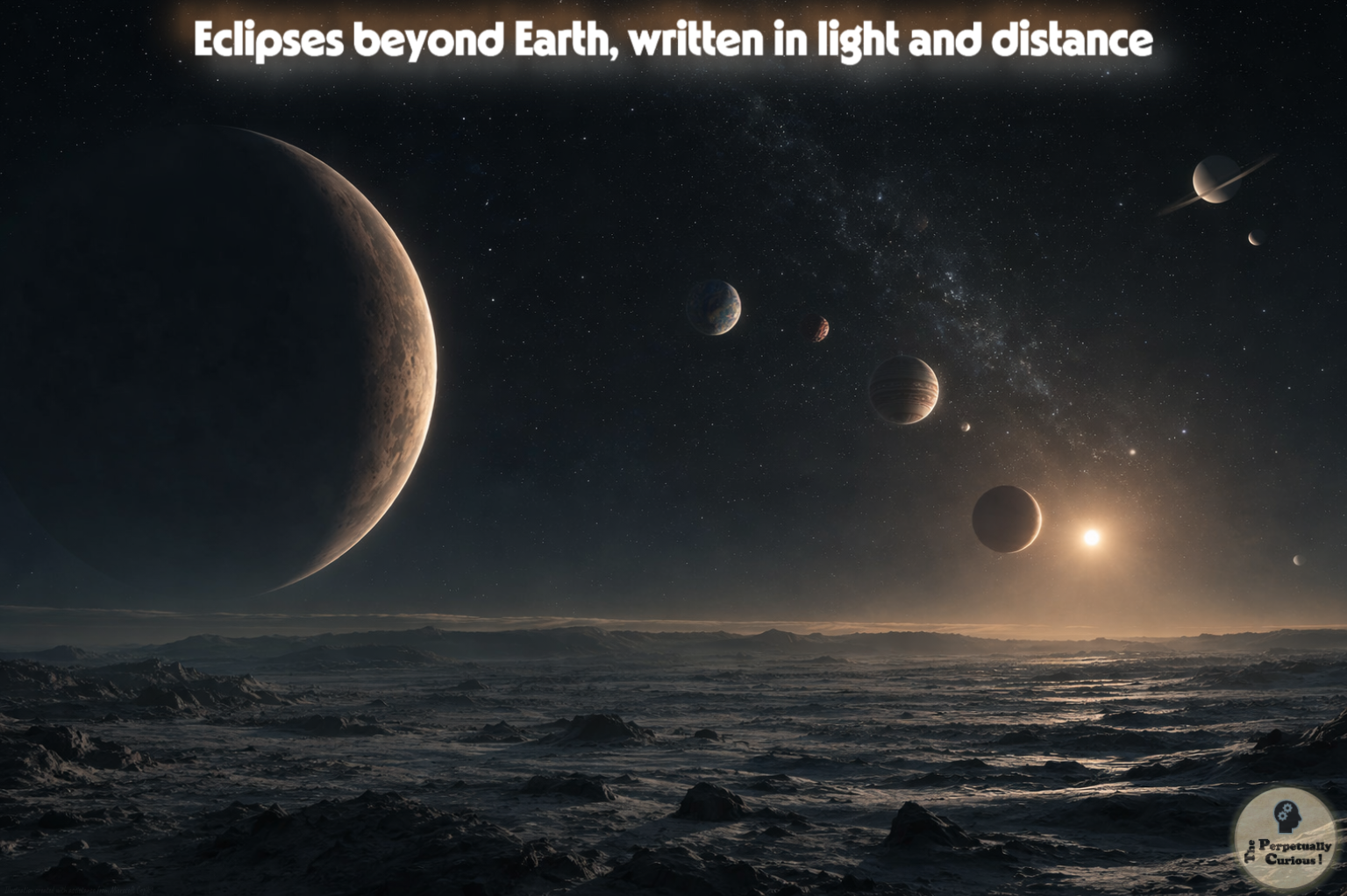
Shadows move across distant worlds with a patience that belongs to the cosmos.
Light bends, fades, and gathers again, shaping moments that unfold in silence.
Across the Solar System, every eclipse becomes a brief reminder of how gently the universe turns.
🔭 The geometry that shapes every eclipse
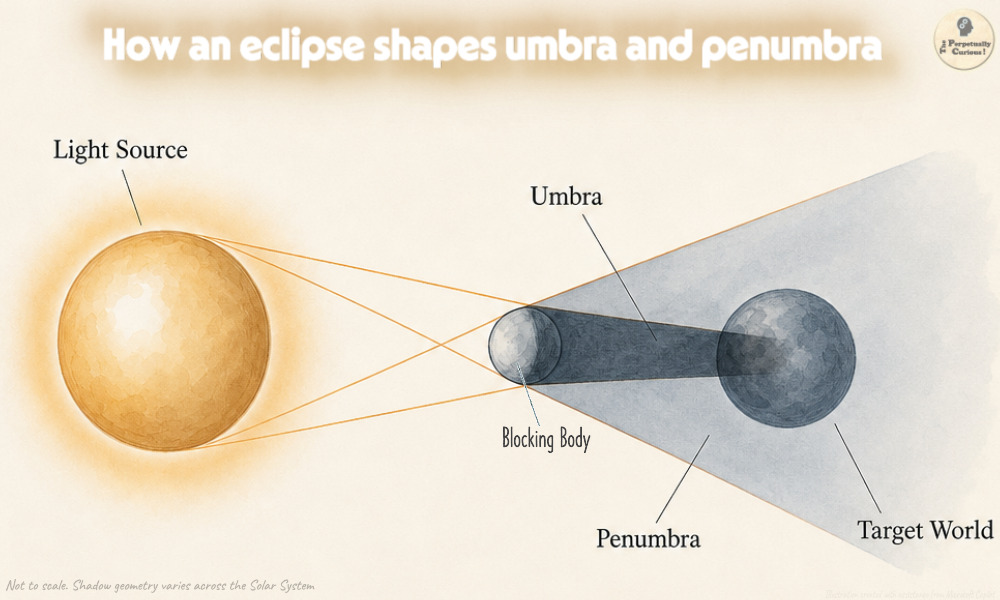
Every eclipse begins with a simple arrangement: a light source, an object that blocks the light, and a surface where the shadow falls. In our Solar System, the Sun is the light source, planets and moons are the objects that cast shadows, and the surfaces range from rocky ground to swirling clouds.
Two main types of eclipses occur:
- Solar eclipses: a moon passes between its planet and the Sun.
- Lunar eclipses: a moon enters the shadow cast by its planet.
These events depend on the structure of the shadows themselves. The umbra is the region of full shadow where the Sun is completely blocked. The penumbra is the region of partial shadow where only part of the Sun is obscured. When a moon is too small or too distant to cover the Sun’s disk, the result is a transit, a small silhouette crossing the Sun. When an object fully hides another from view, the event is an occultation. Across the Solar System, eclipses shift among these forms depending on size, distance, and alignment.
The appearance of an eclipse depends on apparent size, which is determined by an object’s actual diameter and its distance from the observer. Because distances and moon sizes vary widely across the Solar System, eclipses take on many forms. Some worlds experience total eclipses. Others experience only transits. Some moons plunge into deep planetary shadows. Others skim the edges of faint penumbras.
The balance between orbital distance and gravitational pull is explored further in the study of planetary gravity, which helps clarify why some worlds experience frequent eclipses while others do not.
The Sun’s influence on eclipse geometry becomes clearer when considering its solar mass, which governs the structure of planetary orbits. Its radiance during an eclipse is shaped by its solar luminosity, which determines how strongly its light reaches distant worlds.
With this foundation in place, the journey can move outward to the worlds where these alignments unfold, beginning with Mars, where two small and irregular moons create swift, delicate transits.
🌞 Solar eclipses across the Solar System
Solar eclipses occur when a moon passes between its planet and the Sun. The appearance of the event depends on the moon’s size, its distance from the planet, and the apparent size of the Sun at that distance.
Below is a tour of solar eclipses beyond Earth, enriched with atmospheric nuance, shadow geometry, and observational perspective.
🔴 Mars: swift transits beneath a smaller Sun
Mars has two small moons, Phobos and Deimos. Phobos spans roughly 17 miles (27 kilometers) at its widest, and Deimos reaches about 10 miles (15 kilometers) across. Both are too small to cover the Sun completely. Instead, they create swift transits.
Phobos moves quickly across the Sun, causing a noticeable but brief drop in brightness. The event lasts roughly 30 seconds as seen from the Martian surface, while the shadow of Phobos sweeps across the ground in approximately 50 seconds. Deimos creates a more delicate transit, barely dimming the Sun at all.
From the Martian surface, the Sun appears smaller than it does from Earth, yet still larger than either moon. The result is a fleeting, almost delicate interruption of sunlight. Robotic missions have captured these events, showing the moons as dark shapes gliding across the solar disk.
The scale of Martian eclipses becomes easier to appreciate when compared with the dimensions of the largest moons in the Solar System.
Mars’s small moons fit naturally into the broader family of lesser-known moons that shape subtle shadow events across the planets.
🌀 Jupiter: a moving theatre of shadows
Jupiter’s four large moons, Io, Europa, Ganymede, and Callisto, are large enough to cover the Sun’s disk from certain vantage points. Jupiter orbits the Sun at about 484 million miles (about 778 million kilometers), so the Sun appears smaller in its sky.
Spacecraft have observed the shadows of these moons as dark circular spots drifting across Jupiter’s cloud tops. These shadows can be crisp and sharply defined, especially when the Sun is high above the horizon. Multiple shadows can appear at once, creating a dynamic and visually striking scene. Double shadow transits occur roughly once or twice per month, and single shadow transits from individual moons are visible at least once a week. Triple transits are rare, with only a handful occurring each decade.
These eclipses are common because the Galilean moons follow near coplanar orbits and Jupiter casts a large, deep shadow. From the surface of a Galilean moon, a solar eclipse would be dramatic. Jupiter itself would pass in front of the Sun, and the surrounding landscape would dim in a slow, sweeping motion. Mutual events between moons can also occur, but these are separate from the primary solar eclipses created by Jupiter.
Jupiter’s volcanic moon Io provides a vivid example of how dynamic moon systems can influence eclipse behavior.
The way Jupiter’s cloud tops respond to drifting shadows relates to broader patterns of planetary brightness across the Solar System.
Many of the most detailed eclipse observations come from modern space telescopes, which reveal shadow patterns invisible from Earth.
💫 Saturn: rings, moons, and layered light
Saturn’s moons, including Titan and Rhea, can cover the Sun’s disk from certain locations. Titan’s thick, hazy atmosphere softens the light, creating a muted eclipse. The Sun appears as a small, filtered disk, and the eclipse unfolds through layers of muted amber rather than bright color.
Saturn’s rings also cast broad shadows across the planet’s atmosphere. These shadows shift with the seasons as the angle of sunlight changes, creating a layered interplay of light and darkness. The rings can create partial eclipse like events, where sunlight is interrupted, reflected, and partly blocked by icy ring particles, producing gentle variations in brightness rather than true atmospheric scattering.
From the surface of Titan, a solar eclipse would feel subdued and atmospheric, with the Sun dimming behind a veil of haze.
The muted quality of light during a Titan eclipse reflects the behavior of a thick atmosphere that scatters sunlight in complex ways.
The interplay between ring shadows and reflected light creates a layered visual effect on the planet’s cloud tops.
The way Titan’s atmosphere filters sunlight parallels the behavior of an atmosphere on Earth, although the resulting colors differ.
🌌 Uranus and Neptune: eclipses beneath a distant Sun
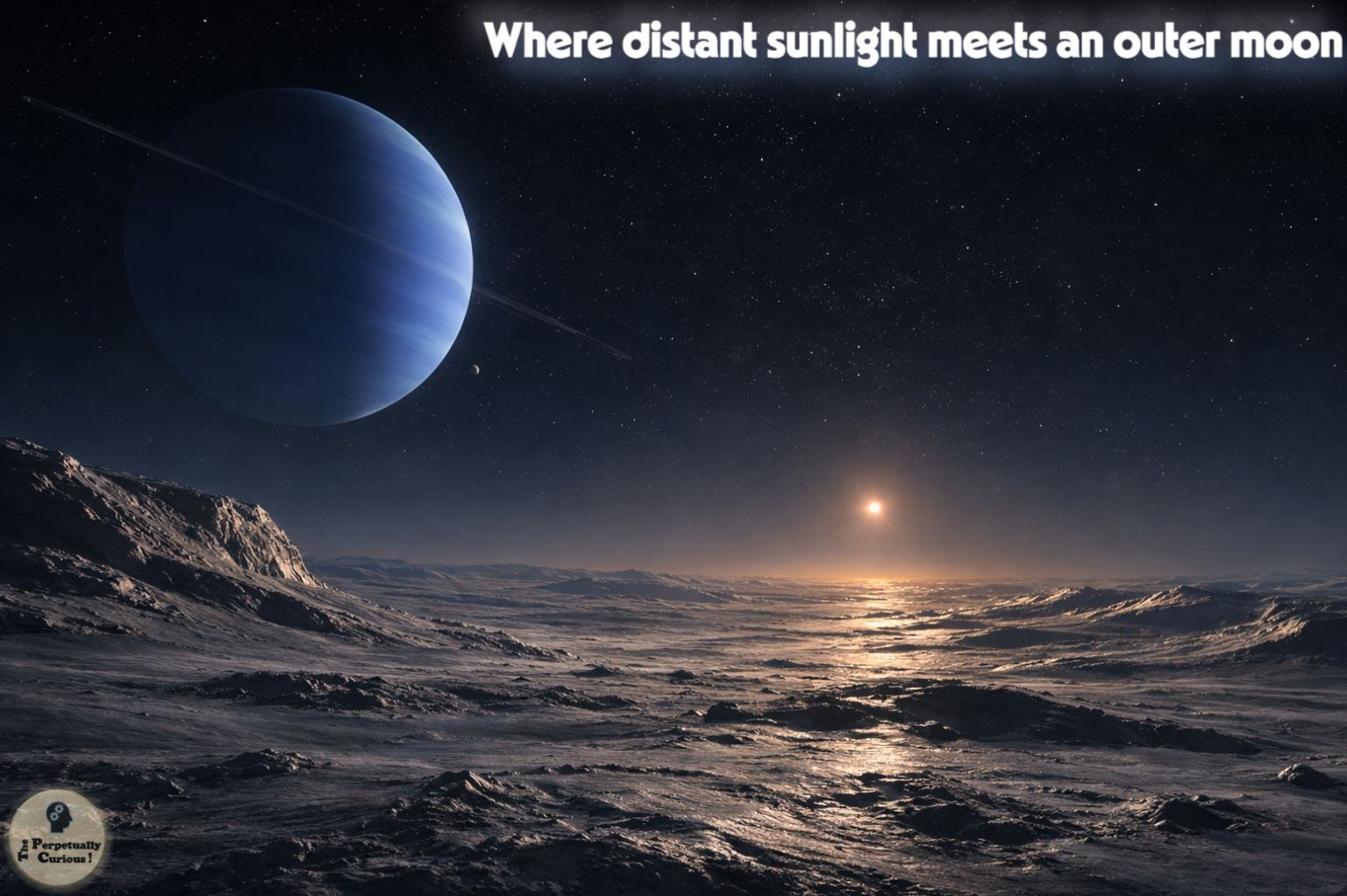
At the distances of Uranus and Neptune, the Sun appears as an extremely small but still defined disk, so reduced in apparent size that, without optical aid, it would resemble a brilliant star rather than the broad daylight source familiar from Earth. Their moons can still create solar eclipses, though many such events are subtle and require precise alignment.
Uranus has an extreme axial tilt, and its eclipse seasons occur when the Sun aligns with the planet’s equatorial plane. These seasons cluster around Uranian equinoxes, when the geometry briefly allows moons to cast shadows across the planet. Neptune’s moon Triton can eclipse the Sun with considerable depth, since Triton’s disk appears far larger than the Sun in Neptune’s sky. However, such eclipses are rare because Triton’s orbit is steeply inclined to Neptune’s equatorial plane, making precise alignments infrequent.
From the surface of Triton, the Sun would disappear behind an oversized silhouette, and the icy landscape would fall into a deep, total eclipse. Triton’s thin nitrogen atmosphere scatters very little sunlight, so the dimming would be stark rather than tinted.
Subtle changes in light during distant eclipses can be influenced by the thin atmospheres present on some outer moons, including Triton, Neptune’s largest moon, whose tenuous nitrogen atmosphere scatters sunlight only weakly at these distances.
The dimness of the Sun in these regions reflects the natural reduction of sunlight across the outer Solar System, where illumination becomes increasingly faint with distance.
🧊 Pluto and Charon: a slow dance in shared shadow
Pluto and Charon are tidally locked, always showing the same face to each other. When one passes between the other and the Sun, the event unfolds slowly. The Sun appears as a very small disk, barely distinguishable from a brilliant star at this distance, so the eclipse is subtle.
Mutual eclipse seasons occur only twice during Pluto’s long orbit, and each season lasts roughly five to six years. These seasons recur approximately every 124 years, creating rare and intimate shadow events. One such season, from 1985 to 1990, was observed from Earth and provided precise measurements of the Pluto–Charon system. The light dims gently, and the icy terrain reflects the faint glow of a distant Sun.
The location of Pluto and Charon within the Kuiper belt shapes the slow and delicate nature of their mutual eclipses.
The remoteness of this region leads into the stillness of deep space, where sunlight becomes little more than a memory.
🌔 When moons enter shadow: lunar eclipses across the Solar System
Lunar eclipses occur when a moon enters the shadow cast by its planet. In contrast to solar eclipses, where a moon blocks sunlight, these events reverse the geometry. The planet becomes the object that casts the shadow, and the moon becomes the surface where that shadow falls.
This reversal highlights how planetary atmospheres, distances, and orbital alignments shape the appearance of shadowed moons. Some moons slip into deep umbra, where the Sun is fully blocked. Others pass through broad penumbras, where only part of the Sun is obscured. The results range from copper toned dimming to sharp, icy darkness.
Below is a tour of lunar eclipses beyond Earth, enriched with atmospheric color, shadow sharpness, and observational perspective.
🔴 Mars: Phobos and Deimos in planetary shadow
Phobos can enter Mars’s shadow for up to roughly an hour, depending on the exact alignment of its orbit. During this time, it darkens as sunlight is fully blocked. Deimos can also enter the shadow, though the event is more subtle because of its greater distance and smaller size.
These lunar eclipses are not visually dramatic from the Martian surface, but they are scientifically valuable for studying the moons’ orbits and surface properties.
🌀 Jupiter: giant shadows sweeping across moons
Jupiter casts a vast shadow. When one of its large moons enters this shadow, the event resembles a lunar eclipse.
From the surface of Europa or Ganymede, the Sun would fade as Jupiter blocks the light. The darkness would last for hours, creating a deep and extended eclipse. The icy surface might reflect a faint glow from Jupiter’s upper atmosphere, although the effect would depend on viewing angle and atmospheric scattering and may be subtle.
💫 Saturn: atmospheric tint and ring shadows
Saturn’s shadow can envelop its moons, creating lunar eclipses. Titan’s thick atmosphere would tint the light, producing a muted, amber eclipse. Moons without atmospheres, such as Rhea or Tethys, would experience sharp and crisp shadow boundaries. The transition from light to darkness would be sudden and striking.
The color of a lunar eclipse depends on the filtering effect of a living atmosphere, which can tint the shadow in subtle ways.
🌌 Uranus and Neptune: subtle and rare lunar eclipses
Because sunlight is already faint at these distances, lunar eclipses are less luminous than similar events closer to the Sun. Moons still enter real planetary shadows, and the local transition from weak sunlight to darkness can be distinct.
Triton’s thin nitrogen atmosphere means its shadow falls with a crisp, well‑defined boundary during rare eclipse alignments. The icy surface might reflect a faint glow from Neptune’s upper atmosphere, although the effect would depend on viewing angle and scattering and may be slight.
🧊 Pluto and Charon: mutual shadowing in a binary system
Pluto and Charon can eclipse each other when their orbital plane aligns with the Sun. These events unfold slowly and create subtle changes in brightness. Because both bodies are tidally locked, the eclipses occur over the same hemispheres, producing long term patterns of light and shadow.
The duration of a lunar eclipse in this system is shaped by orbital speed and geometry, including the size of each body and their distance from the Sun, which together determine how long one world remains within the shadow of the other.
🌍 Earth’s place in a family of shadows
Earth’s eclipses are distinctive because the apparent sizes of the Sun and Moon are closely matched. This allows dramatic solar eclipses and richly colored lunar eclipses. However, Earth is not unique. Other worlds experience their own forms of eclipse, shaped by distance, atmosphere, and orbital geometry. Together, these events reveal the diversity of shadow and light across the Solar System.
The long term evolution of eclipse patterns reflects the slow recession of the Moon and the gradual changes in orbital geometry over millions of years. These processes remind us that even familiar celestial alignments evolve over time.
Pass this article along to someone curious and let the learning travel.
💡 Did You Know
🌑 Mutual events in binary systems
Some pairs of moons or dwarf planets experience mutual eclipses that allow scientists to measure their sizes and orbits with precision.
🔭 Exoplanet transits mirror Solar System geometry
Astronomers detect planets around distant stars by observing tiny dips in starlight caused by transits.
💍 Saturn’s ring shadows change with the seasons
As Saturn moves along its orbit, the angle of sunlight shifts, altering the appearance of ring shadows.
🌒 Phobos is slowly spiraling inward
Phobos’s orbit is decaying, and it may break apart or collide with Mars in the distant future.
🌫️ Titan’s atmosphere softens eclipse light
Titan’s thick haze scatters sunlight, creating a muted, amber eclipse.
❄️ Triton creates deep, total solar eclipses on Neptune
Neptune’s moon Triton appears far larger than the Sun in Neptune’s sky, producing a complete and dramatic eclipse when the geometry aligns. Triton’s thin atmosphere also ensures the shadow boundary falls with crisp definition.
🌞 The Sun will eventually appear too small for total eclipses on Earth
Because the Moon is receding at roughly 1.5 inches (3.8 centimeters) per year, total solar eclipses will cease in about 600 million years.
🪐 Three shadows at once on Jupiter
In January 2015, the Hubble Space Telescope captured three of Jupiter’s large moons, Io, Europa, and Callisto, casting their shadows simultaneously on the planet’s cloud tops, an event often cited in studies of space telescopes and their ability to reveal shadow patterns that cannot be observed from Earth. Triple shadow transits are rare, with only a handful occurring each decade.
Do other planets experience total solar eclipses?
Yes. Large moons around Jupiter and Saturn can cover the Sun’s disk, and their role in shaping eclipse geometry becomes clearer when compared with the largest moons.
Do moons experience lunar eclipses?
Yes. Moons can enter the shadow cast by their planet, creating lunar eclipses.
Why are eclipses rare on some planets?
The rarity of eclipses depends on orbital tilt and gravitational alignment, which are explored further in discussions of planetary gravity.
How long can an eclipse last on a distant moon?
The duration of an eclipse is influenced by the size of a planet’s shadow and the distance from the Sun.
Can moons eclipse each other?
Mutual eclipses between moons are more common in systems with many satellites, such as those described in studies of lesser-known moons.
Can eclipses occur on dwarf planets beyond Pluto?
If a dwarf planet has a moon and the geometry aligns, eclipses can occur.
Do atmospheres change the color of eclipses?
Yes. Thick atmospheres scatter sunlight, creating tinted eclipses.
What does a lunar eclipse look like from a moon with an atmosphere?
The scattering of sunlight during an eclipse is shaped by the behavior of a living atmosphere, which can tint the shadow in distinctive ways.
Do ring systems create eclipse like events?
The filtering of sunlight through icy particles creates gentle variations in brightness, but the effect differs from the scattering produced by thick planetary atmospheres.
Do eclipses help scientists study planetary atmospheres?
Yes. Changes in light during an eclipse can reveal atmospheric composition.
Do exoplanets experience eclipses?
The detection of exoplanets often relies on eclipse like alignments that cause small dips in starlight.
Have we observed eclipses that resemble exoplanet transits?
Yes. Some Solar System eclipses closely mimic the brightness dips used to detect exoplanets. These events provide calibration data for transit detection methods and help scientists interpret distant starlight variations.
How many eclipses occur in our Solar System?
Eclipses occur throughout the Solar System, but there is no single total count because each planet moon system produces its own repeating cycle of solar and lunar eclipses. Giant planets generate the most frequent events because their large moons regularly cross into planetary shadow or pass in front of the Sun, while distant systems such as Pluto and Charon experience slow and infrequent mutual eclipses shaped by the stillness of the Kuiper belt.
Have we observed eclipses on other planets or moons through our space telescopes?
Yes. Spacecraft and space based observatories have recorded many eclipses across the Solar System, including the shadows of Jupiter’s moons drifting across its cloud tops and the muted dimming of sunlight on Saturn’s hazy moon Titan. These observations are often made with space telescopes, which reveal shadow patterns and atmospheric effects that cannot be seen from Earth.
Have spacecraft ever recorded an eclipse from the surface of another world?
Yes. Several landers and rovers have captured eclipses from the surfaces of other planets and moons, including the swift transits of Phobos across the Sun as seen from Mars. These observations complement the broader view provided by orbiters and space based observatories.
Have we ever seen multiple eclipses happening at the same time on another planet?
Yes. Jupiter frequently experiences overlapping eclipses when two or more of its large moons cast shadows on its cloud tops at once. These multi shadow events have been recorded by orbiters and space based observatories, which track the motion of each moon with high precision.
Have we observed lunar eclipses on other moons directly?
Yes. Spacecraft have documented moons entering the shadows of their parent planets, including the long eclipses experienced by Europa and Ganymede when they pass into Jupiter’s shadow. These observations help refine models of gravitational interaction and surface cooling.
Have we observed ring shadow eclipses on Saturn?
Yes. Orbiters have recorded the broad, shifting shadows cast by Saturn’s rings as they sweep across the planet’s atmosphere. These events resemble partial eclipses and reveal how sunlight interacts with icy particles.
Have we observed eclipses in the outer Solar System?
Yes. Although the Sun appears small at great distances, observatories have recorded subtle shadow and occultation events involving outer Solar System worlds. Charon’s mutual events were observed from Earth during the 1985 to 1990 season, and Triton’s shadow has been tracked during stellar occultation observations. These observations help clarify orbital motion in remote regions.
Have we observed mutual eclipses between moons?
Yes. Mutual eclipses between moons have been recorded in systems with many satellites, especially around Jupiter. These events occur when one moon passes into the shadow of another, and they relate to the broader family of lesser-known moons that participate in subtle shadow interactions.
Have we observed eclipses that reveal atmospheric composition?
Yes. When a moon enters a planetary shadow, the dimming and color shift of sunlight can reveal details about atmospheric structure. Titan’s amber eclipse light, for example, has been studied through both orbiters and space based observatories.
Have we observed eclipses that help measure surface temperature?
Yes. When a moon enters shadow, its surface cools rapidly, and spacecraft instruments can measure this temperature drop. These observations help scientists understand thermal inertia and surface composition, especially on icy worlds.
Have we observed eclipses that help refine moon orbits?
Yes. Eclipse timing is one of the most precise tools for measuring orbital motion. By tracking when a moon enters or exits shadow, scientists refine models of gravitational interaction, which connects naturally to the study of planetary gravity.
🤝 Sharing the wonder, one sky at a time
If this journey through eclipses across the Solar System has sparked curiosity or offered a new perspective, your decision to share it may help others discover the same sense of quiet awe. Each shared link becomes a small reflection of the larger cosmic alignments that inspired these words.
“Shadows Across the Solar System: How Eclipses Unfold Beyond Earth.” The Perpetually Curious!, June 2026.
https://www.theperpetuallycurious.org/articles/eclipses-across-the-solar-system/Continue Exploring
For the curious mind: want to explore this theme through a few questions? Visit the Classic Quiz Studio, nestled under Explorations opens in a new tab ,and see where a few well-placed questions lead: Cosmic Exploration Quizzesopens in a new tab
For what comes next
Site Updates gathers occasional notes, new additions, and ways to keep in touch. RSS brings new publications to your feed reader in chronological order.
Choose the path that speaks to you, and let the next curiosity find you wherever your wondering takes you.