

Elephants often move with a quiet deliberation that invites a second look. Their steps are steady, their pauses intentional, and their low rumbles carry through the air with a quiet resonance that suggests a mind continuously weighing memories, relationships, and the shifting conditions of the landscape. Across African savannas and Asian forests, decades of research have revealed that elephant intelligence is not a single trait. It is a layered constellation of memory, sensory perception, social understanding, problem solving, emotional sensitivity, and ecological awareness, all shaped by long lives and complex family structures. This article follows that constellation from the architecture of the elephant brain to the lived experiences that give it meaning. Each section builds upon the last, tracing how elephants think, remember, sense, and respond to the world around them. Their intelligence is not abstract. It is woven into daily life, expressed in the way they care for calves, navigate vast territories, and interact with the environment that sustains them.
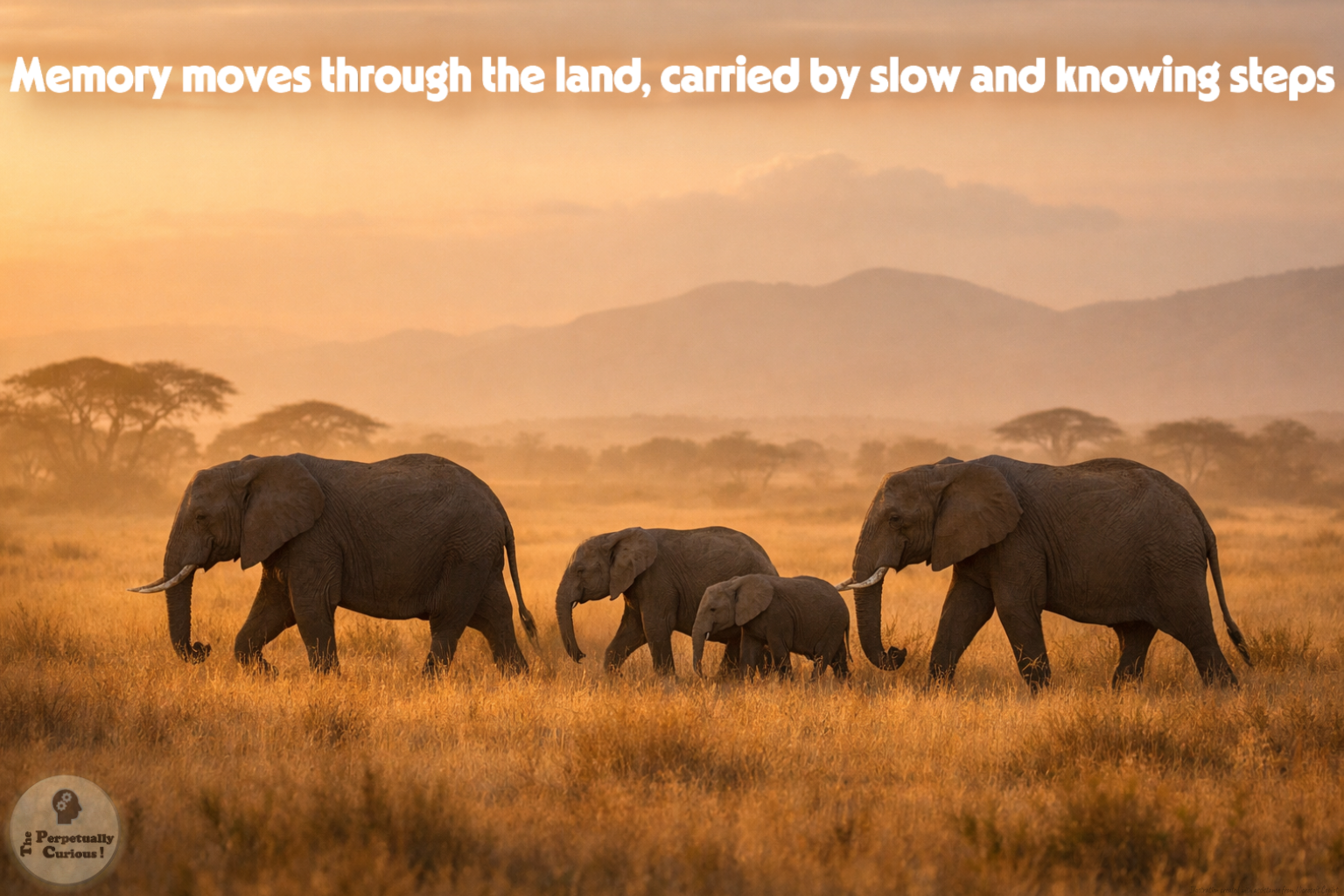
The minds of elephants move like slow rivers, carrying memory through the quiet distances of their world.
Their steps trace old knowledge across shifting light and open space, guided by bonds that endure beyond a single lifetime.
In their presence, the landscape itself seems to remember.
🧠 A brain built for long lives and complex worlds
Elephant intelligence begins with a remarkable brain. Adult elephants have among the largest brains of any living land mammal, with weights varying by species and typically ranging from approximately 10 to 12 pounds (about 4.5 to 5.5 kilograms). The neocortex is highly folded and extensive, and the temporal lobes are deeply developed with intricate folding. The hippocampus, a region associated with memory and spatial navigation, is large and intricately structured. These features support the processing of social information, environmental cues, and long-term memory.
Elephants also have the longest gestation period of any living mammal, lasting about 22 months. While gestation itself does not cause intelligence, it allows the developing brain to form extensive neural connections before birth. Calves enter the world with a brain prepared for rapid learning, social bonding, and environmental awareness. Their long childhood, which can extend for more than a decade, provides time to refine these abilities through observation and experience.
As we move from anatomy to behavior, memory becomes the natural bridge. A large, well-connected brain offers the capacity to store and update information across years and even decades, and elephants use this capacity in ways that shape their survival.
🌍 How Elephant Memory Maps Space and Time
The idea that elephants “never forget” is a familiar phrase, yet scientific studies suggest a more nuanced truth. Elephants often show strong long term memory for places, individuals, and events, although the exact limits of these abilities continue to be studied.
In dry years, experienced matriarchs may lead their families along established routes that connect distant water sources, drawing on memories of places used in earlier years. These journeys are not random. They are shaped by terrain, water availability, and past experience, suggesting that elephants maintain internal maps of their home ranges that extend over tens of miles. Such spatial memory can influence survival during droughts, when the difference between remembering a hidden spring and forgetting it may be significant.
Social memory appears in more intimate ways. Elephants recognize individuals by sight, sound, and scent, and they respond differently to familiar and unfamiliar calls. Some studies suggest that elephants can distinguish between human voices associated with different groups, reacting more cautiously to those historically linked with conflict. These examples indicate that memory in elephants is not limited to simple associations. It often involves tracking relationships, risks, and resources across long spans of time.
Memory forms only one layer of elephant intelligence. How elephants perceive the world through sound, scent, and vibration shapes how these memories are used, creating the next dimension of their cognitive lives.
👣 Sensory minds: Hearing, touch, scent, and vibration
Elephants live in a sensory world that is both subtle and expansive. Their intelligence is closely tied to how they perceive their surroundings.
Elephants communicate using low frequency rumbles that can travel over several miles. These infrasonic calls move through air and ground, and elephants detect them not only through their ears but also through sensitive receptors in their feet and trunk pads. This seismic communication allows groups that are far apart to coordinate movement and maintain contact. Their attention to vibration and low frequency sound reflects a way of reading the environment that extends beyond what humans can easily perceive.
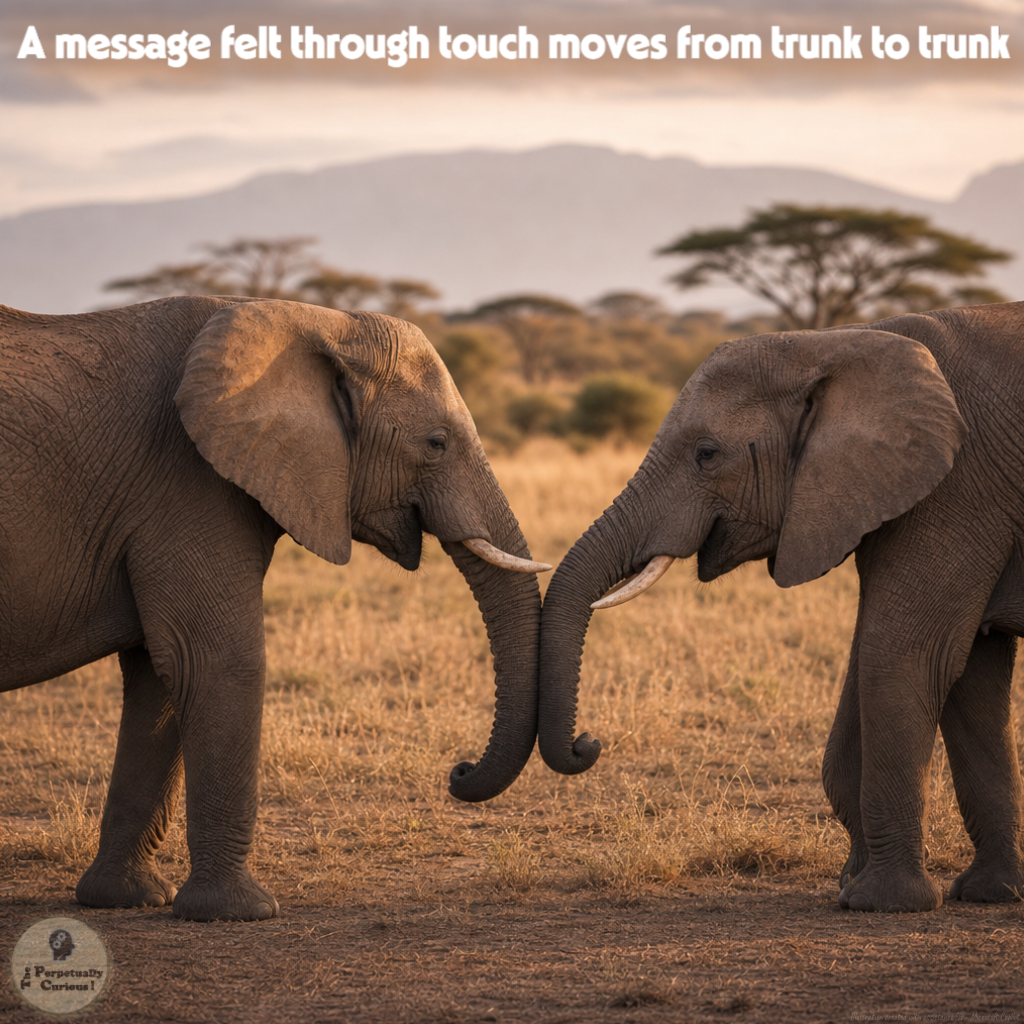
Scent plays a central role in social life. Elephants can identify individuals, reproductive states, and physiological conditions through chemical cues. They often explore scents with the trunk tip, which contains a rich concentration of sensory receptors. Touch is equally important. Elephants use their trunks to reassure calves, greet companions, and investigate unfamiliar objects. The importance of fine-grained perception appears across many species, each interpreting environmental cues in ways that support survival and social connection.
This sensory richness shapes how elephants understand their environment. It also supports the social and emotional behaviors that define their lives.
🤝 Social minds in layered families
Elephants live in multi layered societies built around family groups, often led by older females. These families include mothers, calves, older siblings, and aunts, and they may join with other related groups to form larger clans. Within these networks, individuals interact through touch, vocalizations, and coordinated movement, creating a social environment that is both supportive and demanding.
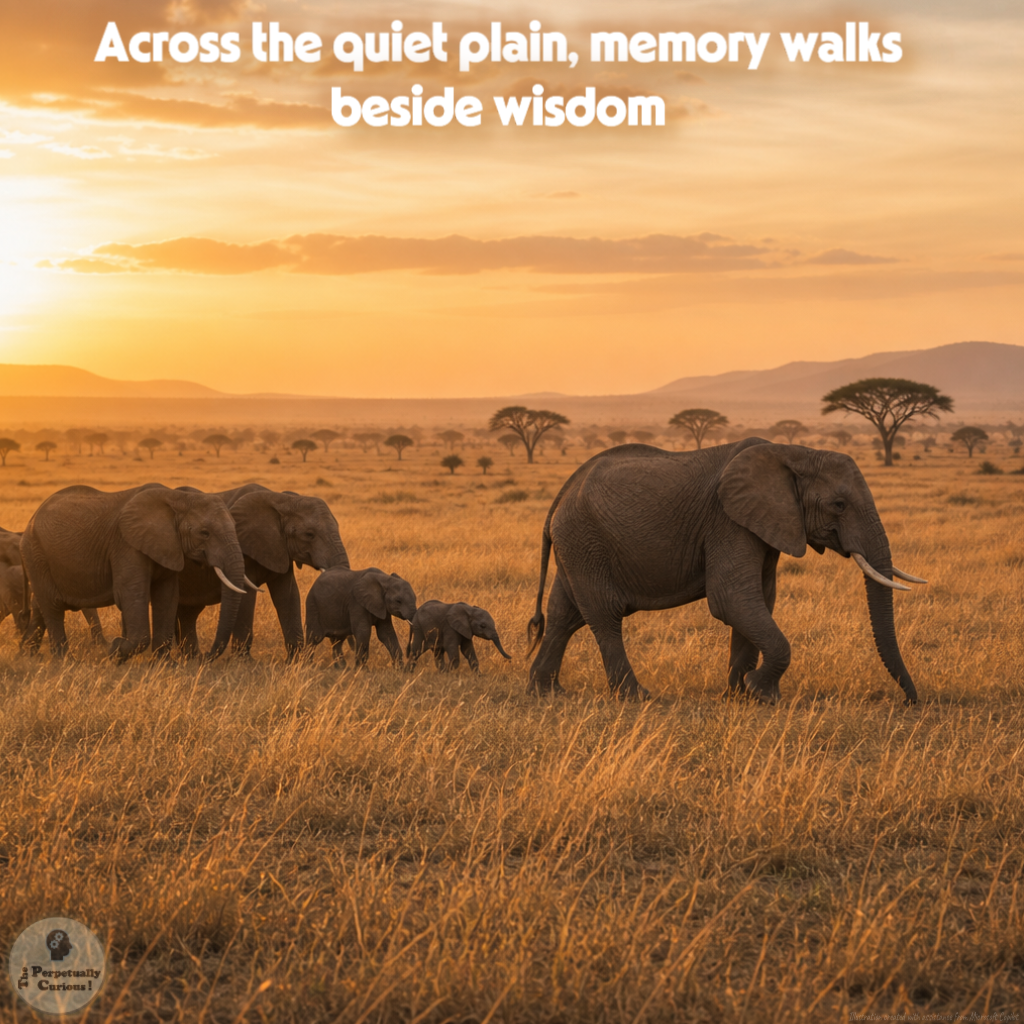
One of the most striking examples of coordinated social intelligence appears when elephants travel with calves. Adults often position themselves around young elephants, forming protective sandwiching formations. Calves walk between larger individuals, shielded from potential threats and guided across uneven terrain. This behavior suggests flexible social awareness, cooperative movement, and sensitivity to the vulnerability of younger members. Rather than being a fixed pattern, it can shift with terrain, herd composition, and perceived risk. The layered cooperation within elephant families finds a clear parallel in hyena social structure, where group coordination and shared responsibilities also shape survival.
Allomothering, where non maternal females help care for calves, is common. Young elephants receive guidance from older siblings and cousins, who may assist in shepherding them away from danger or back toward the safety of the group. This shared care requires an understanding of relationships and responsibilities that extends beyond simple parental instinct. Coordinated movement in elephant families reflects a form of teamwork that supports the growth and safety of younger members.
Communication weaves these social threads together. Elephants use a wide range of vocalizations, including low frequency rumbles that coordinate group movement, signal reproductive status, or convey alarm. Body posture, ear position, and trunk gestures add further layers of meaning, creating a rich, multimodal communication system.
Intelligence within these family networks does not end at social coordination. It also shapes how elephants interact with the physical world around them.
🛠️ Problem solving, tools, and ecological intelligence
Elephants often encounter challenges that require more than strength. They may need to access food that is out of reach, cross barriers, or manage water in ways that benefit the group. In these situations, they sometimes show flexible problem solving and limited tool use.
In experimental settings, at least one Asian elephant has moved a cube beneath suspended food, then stepped onto it to reach the reward. This behavior suggests an understanding of how objects can be used to extend physical reach. In the wild, elephants have been observed using branches to swat flies, stripping leaves to create more effective swatters, and manipulating logs or rocks to modify access to waterholes.
Their trunks function as highly versatile instruments. The trunk contains an extraordinary density of muscle units. Researchers have documented more than 40,000 muscle fascicles, and finer anatomical analyses suggest the number may be considerably higher. With this structure, the trunk can pick up small items such as a single peanut or blade of grass, yet it can also lift heavy logs and move large stones. Elephants often adjust grip and pressure with fine control, which allows them to explore objects, test surfaces, and perform delicate tasks such as removing thorns.
Ecological intelligence also appears in behaviors such as mud and dust bathing. Elephants often choose specific soils, return to preferred wallows, and sometimes help younger elephants coat hard to reach areas. These choices reflect memory, social learning, and cooperation. Mud cools the skin, protects against sun exposure, and deters insects, while dust helps seal the layer and prolong its benefits. The ecological dimension of this behavior becomes clearer when viewed alongside the role of mud and dust baths in regulating temperature, protecting skin, and supporting social learning.
As we consider these abilities, another dimension of elephant intelligence comes into focus. Their actions are not only practical. They often carry emotional weight, especially in moments of distress, reunion, or loss.
💬 Emotion, empathy, and the texture of experience
Elephants frequently display behaviors that suggest emotional complexity. These responses point to an internal social awareness that goes beyond reflex or habit, weaving emotional sensitivity into the fabric of everyday elephant life. When a calf is distressed, several adults may gather around, touching the calf with trunks and emitting low rumbles that appear to soothe. During reunions after separation, elephants often engage in prolonged greeting ceremonies, with intertwined trunks, ear flapping, and excited vocalizations.
Maternal bonding is especially strong. Calves remain dependent for several years, and calves learn social rules, movement routes, and foraging skills from mothers and other experienced herd members. Allomothers participate in raising calves, forming a network of caregiving that extends beyond the mother. Calves show distress when separated, and mothers respond with coordinated group support. This extended, multi layered caregiving system is closely tied to elephant intelligence, long childhood, and social learning. Extended caregiving in elephants shares a quiet kinship with great ape family life, where long childhoods and layered relationships also shape emotional development.
Responses to death and injury have drawn particular attention. In some cases, elephants have been observed pausing at the remains of deceased individuals, gently touching bones with their trunks and feet. While it is difficult to interpret these actions with certainty, they indicate that elephants may recognize the significance of a body that once belonged to a familiar individual.
These emotional and social capacities do not exist in isolation. They are intertwined with memory, communication, and problem solving, forming a cohesive picture of elephant intelligence that is deeply embedded in ecological and social contexts.
🧸 Play as a window into learning
Play is a powerful indicator of cognitive flexibility, and young elephants engage in a wide range of playful behaviors. Calves often chase birds, splash in water, and practice mock charges. They explore objects with their trunks, sometimes lifting sticks or rolling logs in ways that resemble early tool use.
Trunk control itself requires months of practice. Calves frequently trip over their own trunks or struggle to grasp objects, and older siblings sometimes intervene to help. These playful interactions support motor development, social bonding, and emotional regulation. They also provide opportunities for learning through trial and error.
Play connects directly to intergenerational knowledge transfer, which forms another layer of elephant intelligence. It creates early experiences that prepare calves to absorb the guidance, traditions, and social cues passed down by older members of the family.
🧭 Knowledge passed across generations
Elephants do not only remember. Younger elephants learn from older ones through repeated travel, observation, and social experience. Matriarchs guide their families along migration routes, drawing on decades of experience. They lead the group to water sources, safe resting places, and foraging areas, and younger elephants learn these routes through repeated journeys.
Older siblings often teach calves how to use their trunks, how to navigate obstacles, and how to interpret social cues. These lessons are not formal, but they are consistent and influential. Knowledge accumulates across generations, shaping how families respond to environmental challenges. Research has found that wild African elephants produce calls that appear to function like names, identifying specific recipients by acoustic structure, a capacity linked to their complex social demands.
This intergenerational learning reinforces the idea that elephant intelligence is cumulative. It is built not only on individual experience but also on the shared memory of the group.
🌱 Ecological engineers of the landscape
Elephants shape their environments in ways that reflect ecological intelligence. Their movements, feeding habits, and interactions with water can influence entire ecosystems.
Repeated digging at dry riverbeds can create small waterholes that benefit other species. Breaking branches and pushing over trees can open pathways and maintain grassland areas. Wallowing sites may become microhabitats for frogs, insects, and birds.
These landscape level effects are not intentional engineering, but they reveal how elephant behavior interacts with ecological processes. Intelligence in this context is not an abstract measure. It is a practical set of abilities that allows elephants to navigate changing landscapes, maintain social bonds, and respond to new challenges. It also shows how their daily actions ripple outward, shaping the ecological communities that depend on the spaces elephants help create.
🌍 Intelligence shaped by landscape and time
Elephant intelligence is inseparable from the landscapes they inhabit. Their decisions about movement, foraging, and social coordination are shaped by seasonal rhythms, water availability, and the long distances that define their home ranges. These movements unfold within the broader patterns of African and Asian ecosystems, where distance, seasonality, and terrain shape the decisions animals make across generations. Elephant intelligence, viewed this way, is woven into the ecosystems and temporal rhythms that have shaped it across time.
🌌 Parallel minds: What elephant intelligence suggests
Elephants do not think in the same way humans do, yet their behavior suggests a form of intelligence that is both familiar and distinct. They remember, communicate, cooperate, and respond to the needs of others, all within the framework of their own sensory world and ecological pressures.
Recognizing this parallel does not require assigning human emotions or motives to elephants. Instead, it invites a careful appreciation of how cognition can evolve in species that rely on long lives, strong social bonds, and detailed knowledge of their surroundings. Their minds may be seen as quiet rivers, carrying memories and relationships forward through time. Research on mirror self-recognition adds another dimension to this picture. In a landmark study, at least one Asian elephant demonstrated the ability to recognize her own reflection, a capacity associated with self-awareness and observed in only a small number of non-human species.
Much remains to be studied, and researchers continue to refine our understanding of elephant cognition, memory, and emotion. These questions about emotional behavior and social awareness connect naturally to broader themes explored in human emotions and neurons, where the biological foundations of feeling are examined from a different perspective. What is clear, however, is that elephants offer a compelling example of how intelligence can be expressed in large brained, socially complex mammals.
Pass this article along to someone curious and let the learning travel.
💡 Did You Know?
🐘 Elephants can communicate using low frequency sounds that travel over several miles, allowing groups that are far apart to coordinate movement and maintain contact.
🛡️ Protective formations around calves are not random. Adults adjust their positions based on terrain, herd composition, and perceived risks.
🌿 Mud and dust bathing reflects ecological intelligence. Elephants often return to specific wallows and may help younger individuals coat hard to reach areas.
👶 Maternal bonding is strengthened by long childhoods. Calves remain dependent for years, learning social rules and environmental knowledge from mothers and allomothers.
🌩️ Elephants may detect distant thunderstorms through low frequency sound or vibration, although rainfall, wind, and local environmental cues also influence their movements.
🖐️ Elephants sometimes use stones or logs to scratch themselves. This is a subtle example of tool assisted self care.
🗣️ Elephants can distinguish human voices by sex, age, and human ethnic group or language linked cues, and they respond differently to voices associated with varying levels of risk.
🐾 Calves take months to learn trunk control. They often trip over their own trunks during early development.
🌱 Wallowing sites can become microhabitats. Repeated use by elephants may create small ecosystems for other species.
🔊 Elephants produce name-like calls that address specific individuals, a finding supported by recent machine learning studies.
🧠 Adult elephants have among the largest brains of any living land mammal, with weights varying by species and typically ranging from approximately 10 to 12 pounds (about 4.5 to 5.5 kilograms).
👶 Elephant calves are born with a brain that has already undergone substantial prenatal development, and it continues to grow significantly throughout their long childhood.
FAQ: Elephant Intelligence
The questions below span many dimensions of elephant intelligence, from memory and social life to communication, sensory perception, ecological awareness, comparative cognition, cultural meaning, and human interactions. They appear as a single running list, yet they reflect these deeper classifications and offer a broad view of how elephants understand and move through their world.
Why do elephants sometimes protect calves by surrounding them?
This behavior suggests flexible social awareness, cooperative movement, and sensitivity to the vulnerability of younger members. Adults position themselves around calves to shield them from potential threats and guide them across challenging terrain. A similar emphasis on coordinated care appears in great ape family life, where extended caregiving shapes development.
How do elephants remember things?
Elephants form long-term memories through repeated experience, social learning, and sensory recognition. They can remember individuals, migration routes, water sources, and changing environmental conditions. Older elephants, especially matriarchs, help pass practical route knowledge across generations.
Is the mother and calf bond unique among mammals?
Many mammals show strong maternal bonds, but elephants extend caregiving across multiple years and involve allomothers. This multi layered system is closely tied to their intelligence and long childhood.
How do elephants respond to injured or distressed individuals?
Elephants often gather around injured or distressed individuals, offering physical support, vocal reassurance, and protective positioning. These responses vary across situations and appear to reflect social awareness and sensitivity to the needs of group members.
Do elephants mourn their dead?
Elephants sometimes show interest in the remains of deceased individuals, touching bones or pausing at carcasses. While it is difficult to interpret these behaviors with certainty, they suggest recognition and possibly emotional response.
How do elephants make decisions as a group?
Group decisions often emerge through a combination of matriarch leadership, vocal signals, and subtle body cues, with individuals responding to the movements and choices of experienced members. These processes reflect social awareness and shared attention rather than formal hierarchy.
How do elephants communicate through the ground?
Elephants detect seismic vibrations through sensitive receptors in their feet and trunk pads. These vibrations may convey information about movement, calls, or distant disturbances.
Do elephants use names or individual calls?
Elephants produce individualized contact calls that appear to function like names, allowing them to identify and address specific individuals within their social groups. A 2024 study using machine learning confirmed that these calls contain acoustic features that identify the intended recipient, and that elephants responded more actively when they heard a call directed at them.
How do elephants use their sense of smell in social life?
Scent is central to recognition, bonding, and reproductive behavior. Elephants often explore scents with the trunk tip, which contains numerous sensory receptors.
How do elephants use their trunks to communicate?
Elephants use their trunks to touch, guide, reassure, and investigate, and these tactile signals play a central role in bonding and coordination. Trunk gestures often accompany vocalizations, creating layered forms of communication that support social cohesion.
Do elephants have dialects or regional communication differences?
Some studies suggest that elephant vocalizations vary across regions, possibly reflecting differences in habitat, social structure, or learned communication patterns. Research continues to explore how these variations arise and how they influence social interactions.
Why do some people play music to elephants?
Some caregivers and researchers use music as a form of enrichment because elephants respond to low frequency sound, rhythm, and vibration, although their reactions reflect sensory curiosity rather than an understanding of music in the human sense. These interactions can create calm or exploratory behavior, but they do not indicate musical appreciation as humans experience it.
Do elephants use tools?
Elephants occasionally use simple tools, such as branches for swatting insects or objects for reaching food. Tool use is less frequent than in some primates or birds but demonstrates flexible problem solving and an ability to manipulate objects with fine control. In experimental settings, at least one Asian elephant has moved a cube beneath suspended food and then stepped onto it to reach the reward, demonstrating an ability to modify the environment to solve a task.
How do elephants learn to use their trunks?
Calves require months to develop trunk control. They often practice through play and observation, and older siblings may assist in guiding early movements.
Is mud and dust bathing a sign of intelligence?
Mud and dust bathing is primarily a biological behavior, but the way elephants perform it reflects memory, social learning, and cooperation. These behaviors connect naturally to the broader ecological patterns explored in mud and dust baths.
How do elephants learn migration routes?
Young elephants learn migration routes by traveling with older family members, especially matriarchs, who draw on decades of experience with water sources, safe paths, and seasonal patterns. This knowledge is passed across generations through repeated journeys rather than through formal teaching.
Do elephants cooperate with other species?
Elephants do not typically engage in deliberate cooperation with other species, although their movements and behaviors can create opportunities for many animals by opening pathways, digging waterholes, and shaping vegetation. These effects arise from ecological interactions rather than intentional collaboration.
Do elephants play differently in different environments?
Play behavior varies with age, social context, and habitat, with calves in resource rich environments often engaging in more frequent and energetic play. These variations reflect differences in safety, space, and social opportunity rather than differences in cognitive capacity.
How do elephants respond to unfamiliar objects or changes in their environment?
Elephants often approach unfamiliar objects cautiously, using their trunks, ears, and posture to gather information before deciding how to interact. Their responses reflect a balance of curiosity, caution, and social awareness, and they vary across individuals and situations.
What is musth?
Musth is a physiological state in adult male elephants characterized by elevated hormone levels. It may lead to increased aggression or unpredictability, although behavior varies among individuals.
Are there differences in intelligence between African and Asian elephants?
Both African and Asian elephants show complex cognition, social learning, and problem solving, although their abilities may be expressed differently due to ecological pressures, social structures, and physical traits. Current research suggests variation in emphasis rather than overall capacity, and studies continue to explore these differences with caution and nuance.
How does elephant intelligence compare with the intelligence of whales and primates?
Elephants, whales, and great apes all show complex cognition, long memories, social learning, and flexible problem solving, although each group expresses these abilities in ways shaped by its own sensory world and ecological pressures. Whales rely heavily on acoustic communication across long distances, great apes use hands and vision to navigate social and physical challenges, and elephants integrate touch, vibration, scent, and social coordination. Current research suggests that these forms of intelligence are different in emphasis rather than higher or lower in any comparative sense. These comparisons also connect with great ape family life, where long childhoods and layered relationships shape social learning.
How does elephant intelligence compare with human intelligence?
Elephants and humans both show complex social learning, long memories, and flexible problem solving, although each species expresses these abilities in ways shaped by its own sensory world and evolutionary history. Human cognition relies heavily on language, symbolic reasoning, and tool based problem solving, while elephants integrate touch, vibration, scent, and social coordination to navigate their environments. These forms of intelligence differ in emphasis rather than forming a simple hierarchy. This comparison also connects with human emotions and neurons, where cognition and feeling emerge through complex neural networks rather than from a single isolated source.
Do elephants have culture?
Some researchers suggest that elephants may have culturally transmitted behaviors, such as migration routes or foraging strategies, although this remains an area of active study. Evidence is still limited, and researchers emphasize caution when interpreting these patterns.
Why are elephants considered sacred in some cultures?
In several cultures, elephants hold symbolic significance due to their strength, longevity, social cohesion, and presence in religious narratives, and these qualities have contributed to their association with wisdom, protection, and good fortune. Their cultural importance arises from historical and spiritual traditions rather than from any single biological trait.
Why do elephants sometimes show aggression toward mahouts?
Aggression can arise from several factors, including musth, stress, miscommunication, or poor living conditions. Musth is a natural hormonal phase in adult males and can increase irritability.
What are kumki elephants?
Kumki elephants are trained elephants used in some regions of India to help forest teams guide, calm, or redirect wild elephants during human-elephant conflict situations. The term kumki is believed to derive from the Persian word kumak, meaning “aid.”
Do elephants create artwork because they are intelligent?
Elephants can be trained to hold brushes and follow guided motor patterns, and these behaviors show fine control of the trunk and an ability to learn complex sequences. However, the resulting drawings do not reflect symbolic representation or creative intention, and they arise from training rather than spontaneous artistic expression.
Are elephants used to study human neurological disorders?
Elephants are not used as biomedical models for human neurological disorders, and current evidence does not show that they naturally develop neurodegenerative diseases that closely parallel those seen in humans. Their long lifespans, complex care requirements, and ethical considerations make them unsuitable for laboratory research. Elephants can show age related cognitive changes, but these differ from the progressive neurological conditions documented in humans, and researchers emphasize that the available evidence remains limited.
🌺 A gentle invitation to share
We kindly invite you to share and spread the word. We encourage you to help this piece reach a wider audience by sharing it with your friends and colleagues. Your support is deeply appreciated and helps more readers discover the quiet richness of elephant minds.
“Minds Like Quiet Rivers: The Intelligence of Elephants.” The Perpetually Curious!, June 2026.
https://www.theperpetuallycurious.org/articles/elephant-intelligence/Continue Exploring
For the curious mind: want to explore this theme through a few questions? Visit the Classic Quiz Studio, nestled under Explorations opens in a new tab ,and see where a few well-placed questions lead: Wilderness & Homestead Creatures Quizzesopens in a new tab
For what comes next
Site Updates gathers occasional notes, new additions, and ways to keep in touch. RSS brings new publications to your feed reader in chronological order.
Choose the path that speaks to you, and let the next curiosity find you wherever your wondering takes you.
🔎 Related exploration
For readers who want to continue exploring how elephant intelligence begins in early life, this related video offers a gentle look at baby elephants, their behavior, and the family bonds that shape their development.