
A Quiet Descent into the Reflection
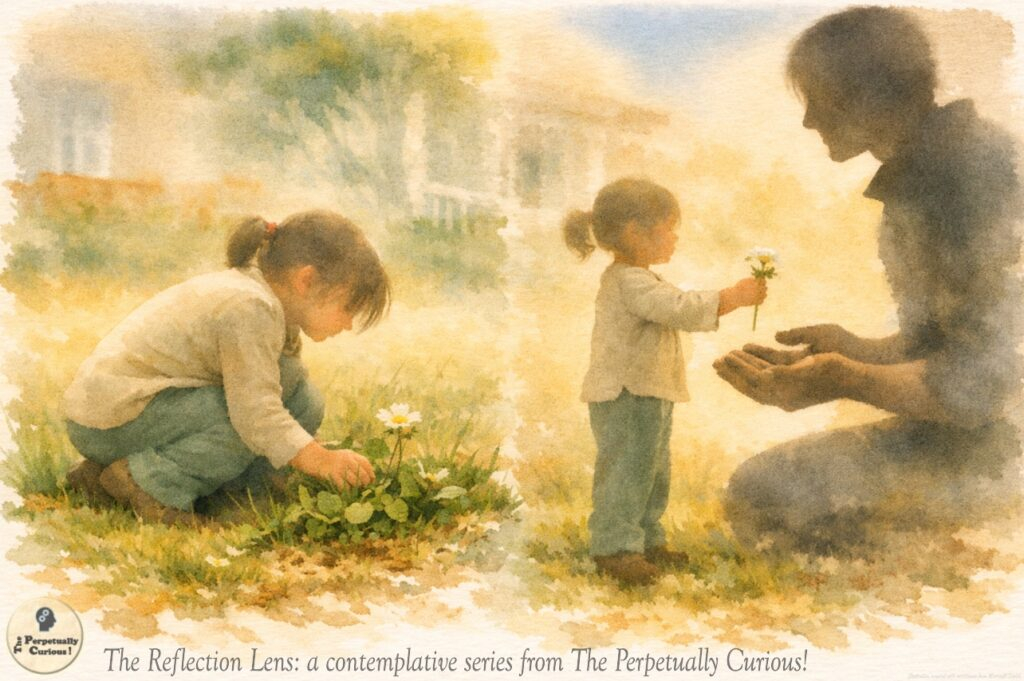
Young children often meet the world at ground level, where a modest uncultivated bloom can become the center of an entire moment. Their gaze lingers where adult attention has already thinned, on details that lie below the usual line of sight. In that early field of seeing, the world has not yet been sorted into what matters and what does not. The grass, the small stone, and the bloom that no one planted all share the same quiet claim on awareness.
This reflection begins with that simple scene and remains close to it. A child’s early, innocent way of seeing reveals a mode of perception that adults still carry beneath layers of naming and comparison. The child does not seem to assign value before seeing. The child sees first, and value arises from the meeting. In that meeting, the uncultivated bloom is not a lesser version of something cultivated. It is simply present, and fully received.
From this observation, the movement turns gently toward the structure of adult perception. Categories help adults navigate the world. They support memory, decision, and protection. They allow a person to distinguish signal from distraction and to move through the day with efficiency. Yet the same categories that support understanding can also narrow the field of what is noticed. When the mind moves too quickly to classify, it can pass by what is quietly offered at the edges of attention.
The reflection does not argue against knowledge or the use of categories. Instead, it suggests that there is a cost when categorization becomes the only mode of seeing. When comparison falls away, even briefly, the overlooked begins to return. The familiar object, seen without the usual labels, regains depth. The ordinary scene, viewed without haste, becomes visible again in a way that feels both simple and quietly new.
The movement remains observational at every step. It does not rush toward a lesson. It stays with the image of the child and the uncultivated bloom, then slowly widens the frame to include the reader. The philosophical invitation is gentle rather than prescriptive. It opens a space in which the reader may notice how often perception is guided by habit rather than by direct encounter.
In its closing movement, the reflection returns to the first field of seeing that the child reveals. It suggests that this field is not lost with age, but covered by layers of sorting and naming. To glimpse it again does not require a rejection of knowledge. It requires a brief pause in the rush to classify. The loop closes where it began, at ground level. The reader is left with a quiet suggestion to look again at something that usually escapes notice. In that small act, the world before categories becomes faintly visible again, and the first field of seeing becomes a present possibility.