

The first rain after a long dry spell often feels like a quiet turning point. Warm ground cools, dust settles, and a familiar, earthy scent rises from the soil. Many people recognize this aroma instantly, even if they only learn the scientific term for it much later in life. That scent is called petrichor, and it is one of the most widely recognized sensory experiences following the arrival of rain on dry ground. To understand why this scent feels both familiar and extraordinary, it helps to follow the chain from soil chemistry to human memory, and then outward to the ways different cultures and even other worlds frame the arrival of rain. This article traces how soil, microbes, plants, and the atmosphere together create the smell of rain, and how this scientific story gently overlaps with cultural expressions across continents. In Tamil, the scent is often described as manvaasanai. In Hindi, it may be described as mitti ki khushboo. In Spanish, people speak of olor a tierra mojada. In Portuguese, cheiro de chuva conveys a similar idea. In Arabic, it may be described as ra’ihat al-turab ba’d al-matar. In Japanese, it is often expressed as tsuchi no nioi. These vernacular expressions reveal how deeply the scent of rain is woven into memory, language, and place, even as meanings shift across regions and dialects.
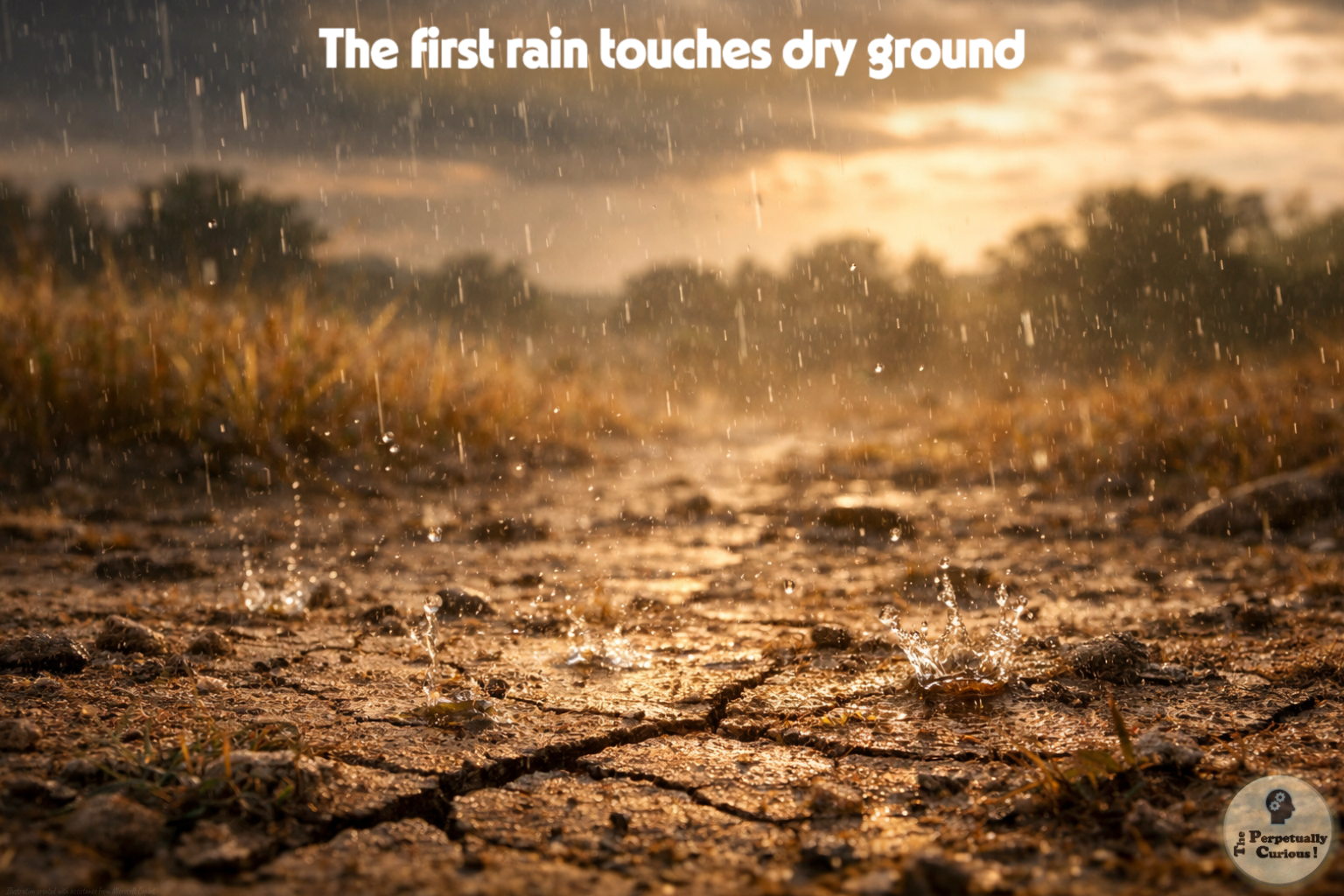
The first rain settles into the waiting Earth, and the scent rises with a quiet patience.
What was held in the soil drifts upward as a gentle reminder of the world beneath our feet.
In this brief meeting of water and dust, the land finds its voice again.
🌍 A name for the smell of rain
The word “petrichor” was introduced in 1964 by Australian researchers Isabel Joy Bear and Richard G. Thomas. They were studying the scent released when rain falls on dry soil, particularly in landscapes shaped by long dry seasons. The term combines two Greek roots: petra (stone) and ichor (the mythological fluid that flowed in the veins of the gods).
Bear and Thomas reported that certain plant‑derived compounds can be absorbed by clay and rock surfaces during dry periods and then released when moisture returns, a process that contributes to the characteristic aroma associated with the first rain.
Long before this scientific name existed, people around the world had already described the scent in their own languages. These expressions show that the experience is widespread, even if the scientific term arrived only recently. The naming of petrichor prompted scientists to investigate its chemical origins, revealing that the smell is not simply “wetness,” but a complex blend of compounds shaped by soil, life, and atmosphere.
🧪 The quiet chemistry beneath the first raindrops
The smell of rain arises from a mixture of chemical compounds released when raindrops strike dry, porous surfaces. Three major contributors are often highlighted: plant‑derived oils, microbial compounds such as geosmin, and atmospheric ozone. In practice, many additional compounds contribute to the aroma, but these three are a useful starting point for understanding the scent that accompanies the arrival of rain.
🌿 Plant oils waiting for rain
During extended dry periods, some plants release small amounts of oily, volatile compounds that accumulate on soil and rock surfaces. Bear and Thomas reported that certain petrichor‑related oils could retard seed germination and early growth under dry conditions, although this effect is species‑specific and not the primary function of plant oils in general. These compounds may also serve protective or signaling roles in some plants. Because many of these molecules are hydrophobic, they remain on the surface until rain arrives.
When the first raindrops fall, the impact disturbs these accumulated oils and lifts them into the air. The exact mixture varies by region, which is why the scent of rain in a forest, a savanna, or a city may feel slightly different while still being recognizably “rain‑like.”
🧫 Geosmin and the work of soil microbes
One of the most distinctive contributors to the smell of rain is geosmin, a compound produced by soil‑dwelling microorganisms such as Streptomyces and other Actinobacteria. These microbes play essential roles in decomposing organic matter and maintaining soil health.
Geosmin has a strong earthy aroma, and humans are remarkably sensitive to it. Some studies suggest that people can detect it in the parts‑per‑trillion to sub‑parts‑per‑billion range, although thresholds vary by medium and individual sensitivity. Research published in Nature Microbiology has shown that certain Streptomyces bacteria produce geosmin during sporulation, a signal that attracts springtails that help disperse their spores to new locations. This mechanism has been confirmed in Streptomyces, although it is not necessarily universal across all soil microbes.
A deeper look at the quiet transformations within soil reveals how its shifting chemistry shapes the compounds that rise into the air when rain arrives.
⚡ Ozone and the sharp scent before a storm
In some storms, especially those involving lightning, another component may be noticeable: ozone. Ozone is a form of oxygen made up of three atoms rather than the usual two. It has a sharp, clean scent that some people detect even before the rain begins.
Lightning and storm electrical activity can create ozone directly and can also produce nitrogen oxides that influence ozone chemistry. Strong downdrafts can then carry ozone‑rich air downward toward the ground. Because the human nose can detect ozone at very low concentrations, its scent may be noticeable before the earthy aroma of petrichor rises from the soil. Ozone is most strongly associated with thunderstorms, and its presence near the surface varies with storm structure and atmospheric conditions.
Readers interested in how Earth maintains the oxygen and nitrogen balance that allows ozone to form may appreciate a broader view of our planet’s living atmosphere.
💧 How raindrops release the scent
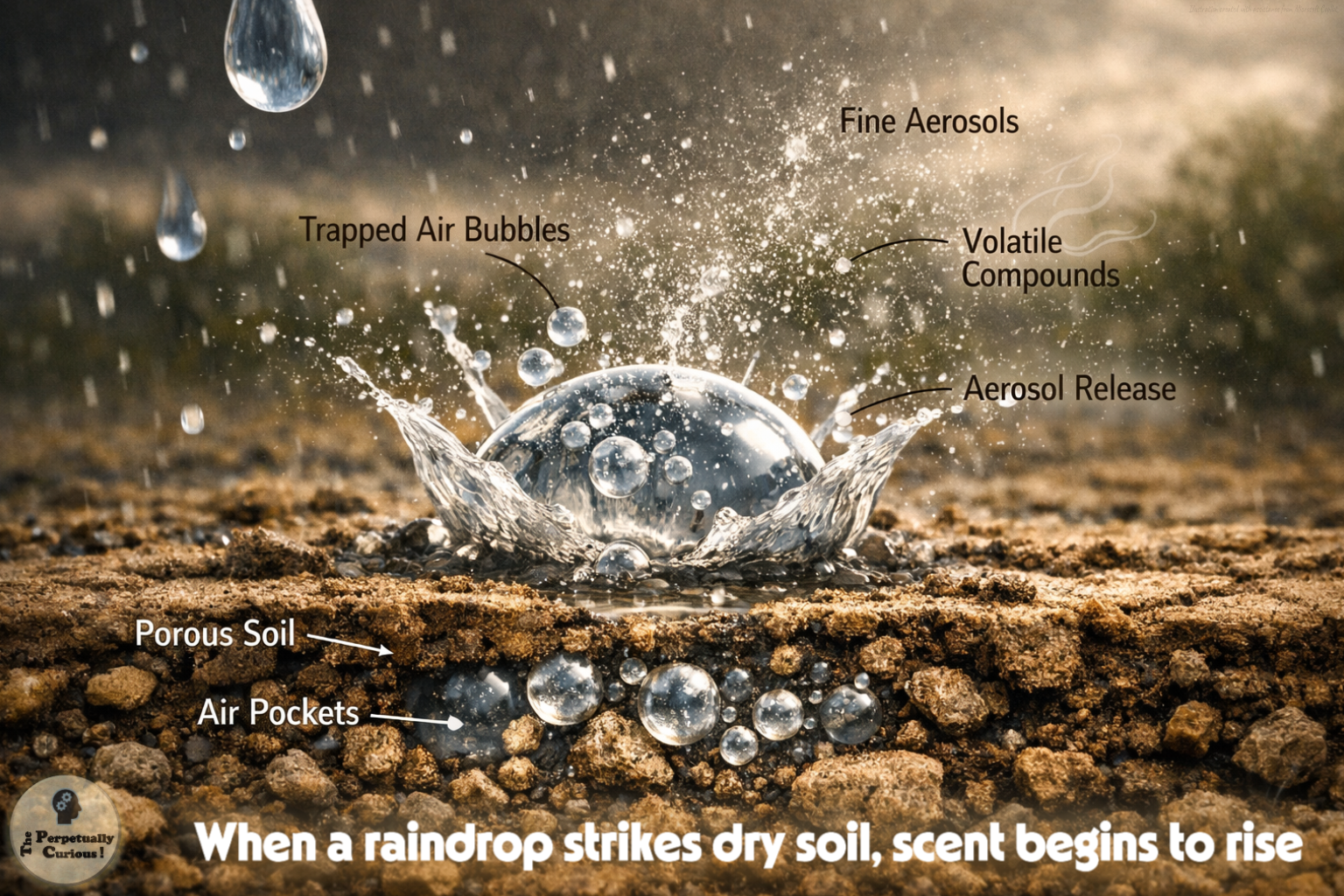
Understanding what produces the smell of rain is only part of the story. It is also important to understand how these compounds move from soil and other surfaces into the air. Before a drop reaches the ground, it has already emerged through the cloud processes that produce rain. High-speed imaging has shown that when a raindrop strikes a porous surface, it can trap tiny pockets of air that form bubbles inside the droplet.
As these bubbles rise and burst, they release extremely fine aerosols into the surrounding air. These aerosols carry plant oils, geosmin, and other volatile compounds upward, where wind can disperse them and humans and other animals may inhale them.
Light to moderate rain tends to produce more aerosols than heavy rain because the impact conditions better support bubble formation and bursting. Warm surfaces can also intensify volatilization, which is why the scent of rain may seem stronger after a period of heat.
This physical explanation naturally leads to the cultural dimension of the experience. The broad mechanism is shared across many rainy landscapes, yet the meaning attached to the scent varies widely among regions and communities.
🌾 How cultures describe the smell of rain
In many parts of South India, the smell of the first rain on dry soil is often described as manvaasanai, a vernacular Tamil expression that conveys the fragrance of earth when touched by water. The term carries associations with monsoon rhythms, agricultural cycles, and the relief that arrives after long stretches of heat.
Across the world, cultures have given their own names to this familiar experience. In Hindi, the scent is often described as mitti ki khushboo, a phrase that evokes the aroma of soil awakening after dryness. Spanish speakers refer to it as olor a tierra mojada, a description that highlights the sensory immediacy of wet earth. In Portuguese, cheiro de chuva captures the scent of rain as it moves through the air and across the ground. In Arabic, it may be described as ra’ihat al-turab ba’d al-matar, a phrase that reflects the meeting of water and soil. In Japanese, tsuchi no nioi refers to the smell of earth after rain and is often associated with seasonal transitions and the quiet marking of nature’s rhythms.
These expressions show that the scent of rain is not only a chemical phenomenon but also a cultural and emotional one. Each term reflects the landscapes, climates, and lived experiences of the communities that use it, and many of these phrases vary across regions and dialects. Although the broad chemistry of petrichor is widely shared, the meanings attached to it are shaped by language, memory, and place.
🧠 Why the smell of rain feels so emotional
The smell of rain often feels more than merely interesting. For many people, it is deeply comforting, nostalgic, or even moving. This response is partly rooted in the way the human brain processes scent.
The olfactory system has direct pathways to regions of the brain involved in emotion and memory, including structures such as the amygdala and hippocampus. Unlike many other sensory routes, olfactory signals bypass the thalamus, which helps explain why scent‑linked memories can feel immediate and vivid.
From an evolutionary perspective, there may also be practical reasons for this strong response. The arrival of rain has long been associated with the availability of water, the growth of plants, and the survival of communities. A positive association with the smell of rain may have helped humans pay attention to environmental changes that mattered for food, shelter, and safety, which may help explain why many people experience the scent as emotionally resonant.
🌎 A planet-wide phenomenon with local variations
Although the basic mechanisms behind petrichor are similar across the globe, the exact scent can vary from place to place. Soil mineralogy, organic matter, vegetation types, climate patterns, and land use all influence which compounds accumulate on surfaces and how they are released when rain arrives.
Clay‑rich soils can trap volatile compounds more effectively than sandy soils. Iron‑rich laterite, common in some tropical regions, and soils influenced by volcanic ash can differ in texture and mineral composition, which can subtly shape how scent compounds are held and released from the surface. These differences contribute to the overall scent profile of each landscape.
In arid regions, the smell may be particularly intense when the first rain follows a long dry season. In forested areas, the scent may blend with the aromas of leaves, wood, and organic matter. In cities, the smell of rain can mix with pavement, dust, and other urban materials, creating a slightly different profile while still retaining an earthy core.
Comparing Earth soils with extraterrestrial materials highlights why petrichor is unique to our planet, and this contrast becomes clearer when examining lunar regolith. The movement of water across landscapes also shapes the character of local soils, and this relationship becomes evident when considering how differences in soil composition influence mud color across environments.
🪐 Petrichor across planets and moons
Petrichor is an Earth‑specific phenomenon because it depends on three ingredients that other worlds lack in combination: liquid water at the surface, soil rich in microbial life, and plant‑derived oils that accumulate during dry periods. Based on current evidence, no other planetary body hosts this full set of conditions.
On Mars, dust storms dominate the landscape, but there is no confirmed evidence of microbial communities that produce geosmin or similar compounds. Venus has a dense atmosphere and extreme surface temperatures that prevent liquid water from reaching the ground (and although Venus experiences sulfuric‑acid precipitation at high altitudes, it evaporates before reaching the surface). Titan has methane rain, supported by both observations and atmospheric modeling, but its hydrocarbon lakes and organic sands would release entirely different compounds.
The diversity of extraterrestrial precipitation across the solar system highlights how unusual Earth’s rain truly is. Each world has its own form of rainfall, but none produce the familiar scent that rises from Earth’s living soil.
Pass this article along to someone curious and let the learning travel.
💡 Did You Know
🌱 Some plants release oils during drought that can remain on soil and rock surfaces until rain arrives, contributing to part of the petrichor signature in certain species.
🌬️ Aerosols released by raindrops can be carried by wind beyond the immediate impact area, which is why the scent of rain may be noticeable before rain reaches your exact location.
🧫 Streptomyces bacteria produce geosmin during sporulation, a signal that attracts springtails that help disperse their spores to new locations; this mechanism is specific to certain systems and is not universal across all microbes.
🧱 Clay‑rich soils can hold volatile compounds more effectively than sandy soils, which can influence how strongly petrichor is perceived in different regions.
🌡️ Warm ground can intensify the release of volatile compounds when rain arrives, which can make the scent of rain feel stronger after a period of heat.
🌏 The intensity of petrichor can vary with soil composition, organic matter, moisture, and vegetation, including soils influenced by laterite, chalk, or volcanic ash.
🐟 Some freshwater fish and invertebrates can detect geosmin and related compounds at very low concentrations, which may help them locate certain habitats.
🏙️ In some cities, the smell many people notice during rain includes contributions from asphalt, concrete, and urban dust, layered over the underlying earthy petrichor.
🪐 Some moons and planets experience methane, sulfuric acid, or hydrocarbon rain, but none have the biological and chemical conditions needed to produce Earth’s familiar scent.
Is petrichor the smell of rain itself or the smell of wet soil?
Petrichor refers primarily to the smell that arises when rain falls on dry ground. The scent comes from compounds released from soil, rocks, and plant materials, rather than from the water alone.
What is the main chemical responsible for the earthy smell of rain?
One of the main contributors is geosmin, a compound produced by certain soil-dwelling microorganisms. Plant-derived oils and other volatile compounds also play important roles.
Why does the smell of rain sometimes appear before the first drops fall?
Atmospheric ozone formed during storms can be carried downward by downdrafts. Ozone has a sharp scent that some people notice before the rain begins.
Is manvaasanai scientifically different from petrichor?
Manvaasanai describes the experience of the smell of rain on dry earth in a Tamil cultural context. Scientifically, the underlying mechanisms are closely related to those of petrichor. Similar expressions exist in many languages, reflecting a shared human experience.
Why does the smell of rain vary between regions?
Soil composition, vegetation, dryness before rainfall, and atmospheric conditions influence how strong and distinctive the smell becomes in a particular region. Regional differences in soil minerals help explain why the scent of rain feels distinct from one landscape to another.
Can animals detect petrichor more strongly than humans?
Some animals appear to be highly sensitive to geosmin and related compounds. Research suggests that certain species may respond to these cues when locating water, food, or suitable habitats, even though the exact behaviors vary by species.
Can petrichor be artificially recreated?
Some perfumers attempt to mimic petrichor using synthetic geosmin and plant-derived compounds. However, the complexity of natural soil chemistry makes full replication challenging.
Does petrichor occur on other planets?
Mars has soil rich in iron oxides, but without liquid water and Earth-like microbial life, the scent would not resemble petrichor. The diversity of extraterrestrial precipitation across the solar system provides a useful perspective on why Earth’s rain produces a scent that other planets cannot replicate.
Why is petrichor often strongest after a dry spell?
During long dry periods, plant-derived oils and microbial compounds can accumulate on soil and rock surfaces. When rain finally arrives, these concentrated materials are released at once, creating a stronger scent.
Does heavy rain make petrichor stronger?
Light to moderate rain often produces more scent than heavy rain because the impact conditions favor the formation and bursting of tiny bubbles that release aerosols. Heavy rain can suppress this effect by saturating surfaces too quickly.
Is petrichor always a pleasant smell?
Many people find petrichor deeply pleasant, while others may experience it as neutral or slightly sharp. Individual differences in smell perception and memory shape these responses.
Does rain in polluted areas smell different?
In regions with higher air pollution, the smell of rain can include additional compounds from dust, soot, and airborne particles. The underlying earthy notes from soil and plants are still present but can be partially masked by these additional elements.
🌦️ Sharing the scent of stories
If this exploration of the smell of rain has resonated with you, you are welcome to share it with others who may appreciate the quiet science woven into everyday experiences. Sharing helps more readers discover how familiar moments, such as the scent of rain on dry earth, connect to the subtle interactions between soil, life, and atmosphere.
“When Earth Begins to Breathe: Why Rain Smells the Way It Does.” The Perpetually Curious!, June 2026.
https://www.theperpetuallycurious.org/articles/why-does-rain-smell/Continue Exploring
For what comes next
Site Updates gathers occasional notes, new additions, and ways to keep in touch. RSS brings new publications to your feed reader in chronological order.
Choose the path that speaks to you, and let the next curiosity find you wherever your wondering takes you.