

Far beneath the surface, where sunlight softens into blue and currents move with patient intention, some fishing nets slip away from the vessels that once guided them. They drift without purpose, yet they continue to behave as if they still serve one. These are ghost nets, abandoned or lost fishing nets that remain in the water and continue to interact with marine life long after their intended use has ended.
Ghost nets belong to a broader category often described as ghost fishing gear, which includes lines, ropes, traps, and other equipment that remains in the ocean after it has been lost. Although these objects may appear inert, they can continue to catch and entangle organisms. Their presence is subtle, persistent, and woven into the ocean’s memory.
The story begins with a quiet contradiction: a net can be lost to people while still functioning in the sea. To understand why, we first have to look at the materials that allow fishing nets to linger beyond their purpose.
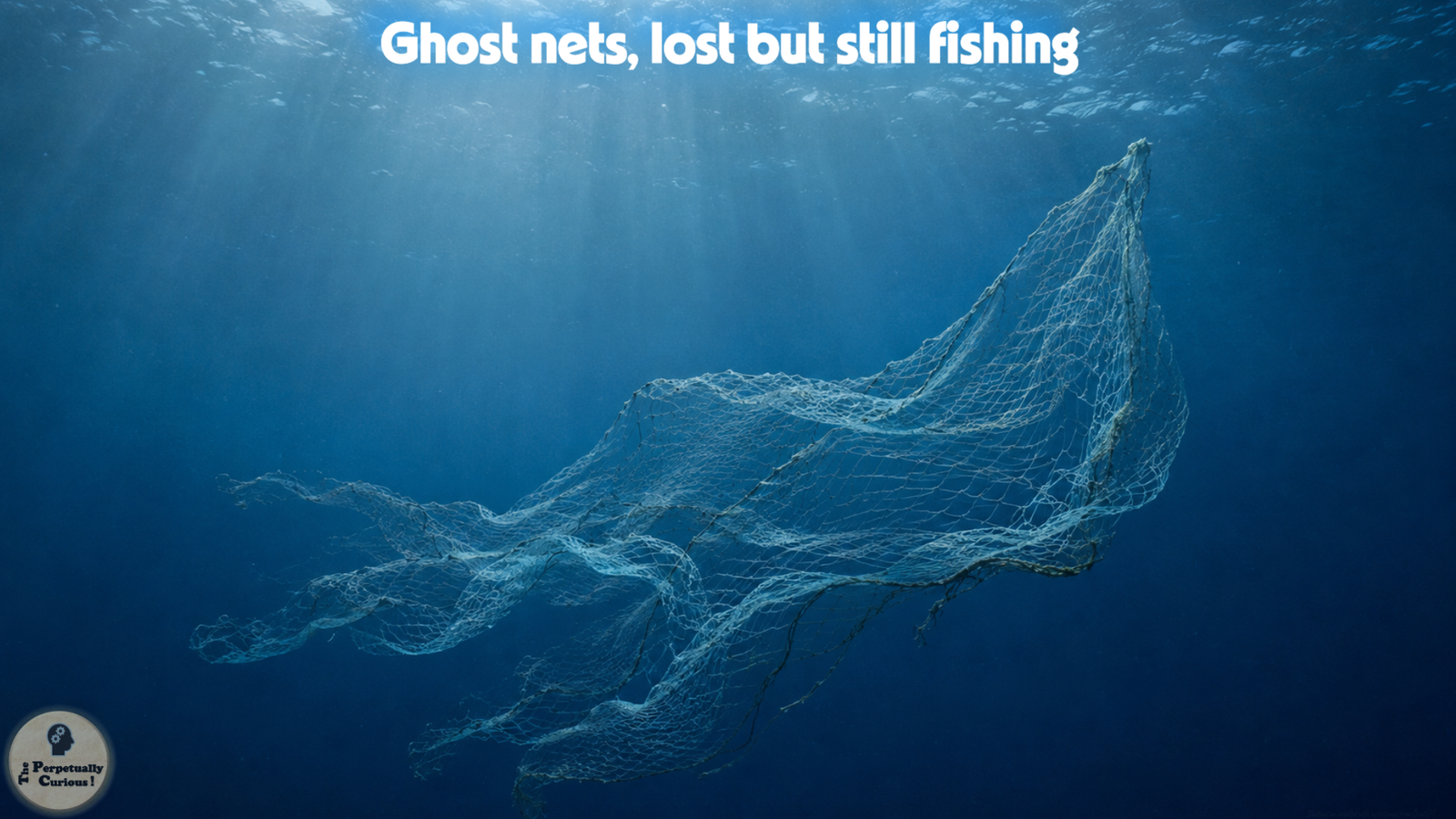
The ocean carries what we leave behind, folding each forgotten net into its long, patient motion.
In the quiet between currents, these drifting shapes become part of the sea’s memory, moving through blue water with a purpose no longer their own.
Even untethered, they remind us that the ocean keeps every story, holding them gently in its restless light.
🎣 When fishing nets linger beyond their purpose
Modern fishing nets are often made from synthetic materials such as nylon, polyethylene, or polypropylene. Older nets were often made from natural fibers such as hemp, cotton, jute, or coir, which could break down more readily than many modern synthetic materials, although they could still harm marine life while intact. Today’s synthetic fibers are valued for strength, flexibility, and resistance to decay, although sunlight, saltwater, abrasion, and wave action can gradually weaken them over time. A typical net may remain structurally intact for many years, which is useful during fishing but consequential once the net is lost.
Nets may become ghost nets for many reasons. Storms can sweep gear away. Strong currents can carry nets far from their original location. Mechanical failures or accidental entanglement with the seabed can lead to gear being cut loose. In some cases, damaged nets are abandoned because retrieval is difficult or unsafe. Once a net is no longer under human control, it may still retain the mesh structure and drifting shape that allow it to behave like a fishing device.
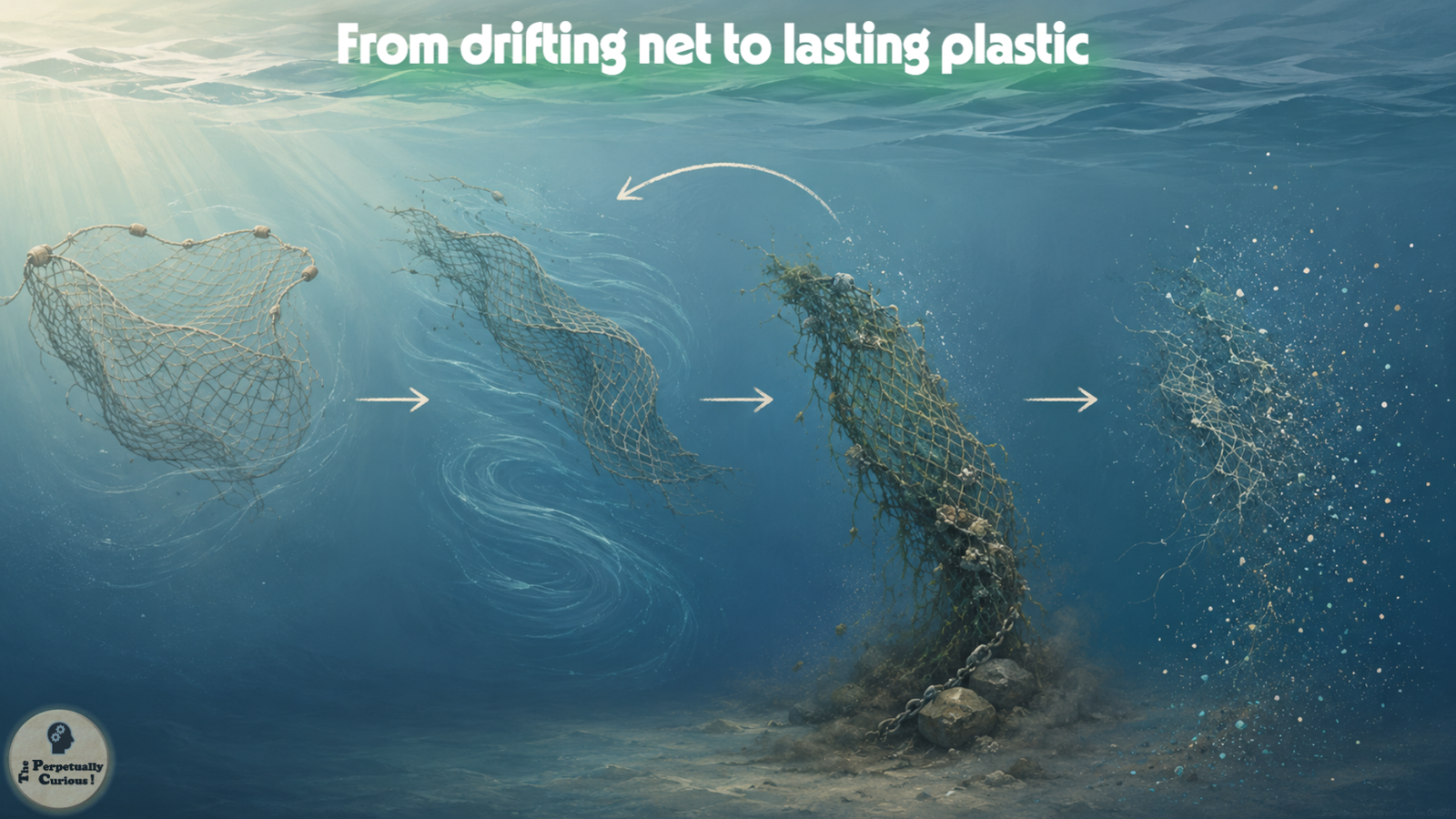
Ocean currents can transport ghost nets across long distances. Some drift through open water, carried by ocean gyres or seasonal flows. Others sink as biofouling, the growth of algae, barnacles, and other organisms, adds weight. Some settle on reefs or rocky bottoms, while others shift again when storms or breakage return sections to circulation. Whether floating, sinking, or tangled in place, the net can continue to intercept movement. The very durability that makes it useful at sea is what allows it to linger beyond its purpose, leading directly into the phenomenon known as ghost fishing.
🐢 Ghost fishing: how lost gear continues to catch life
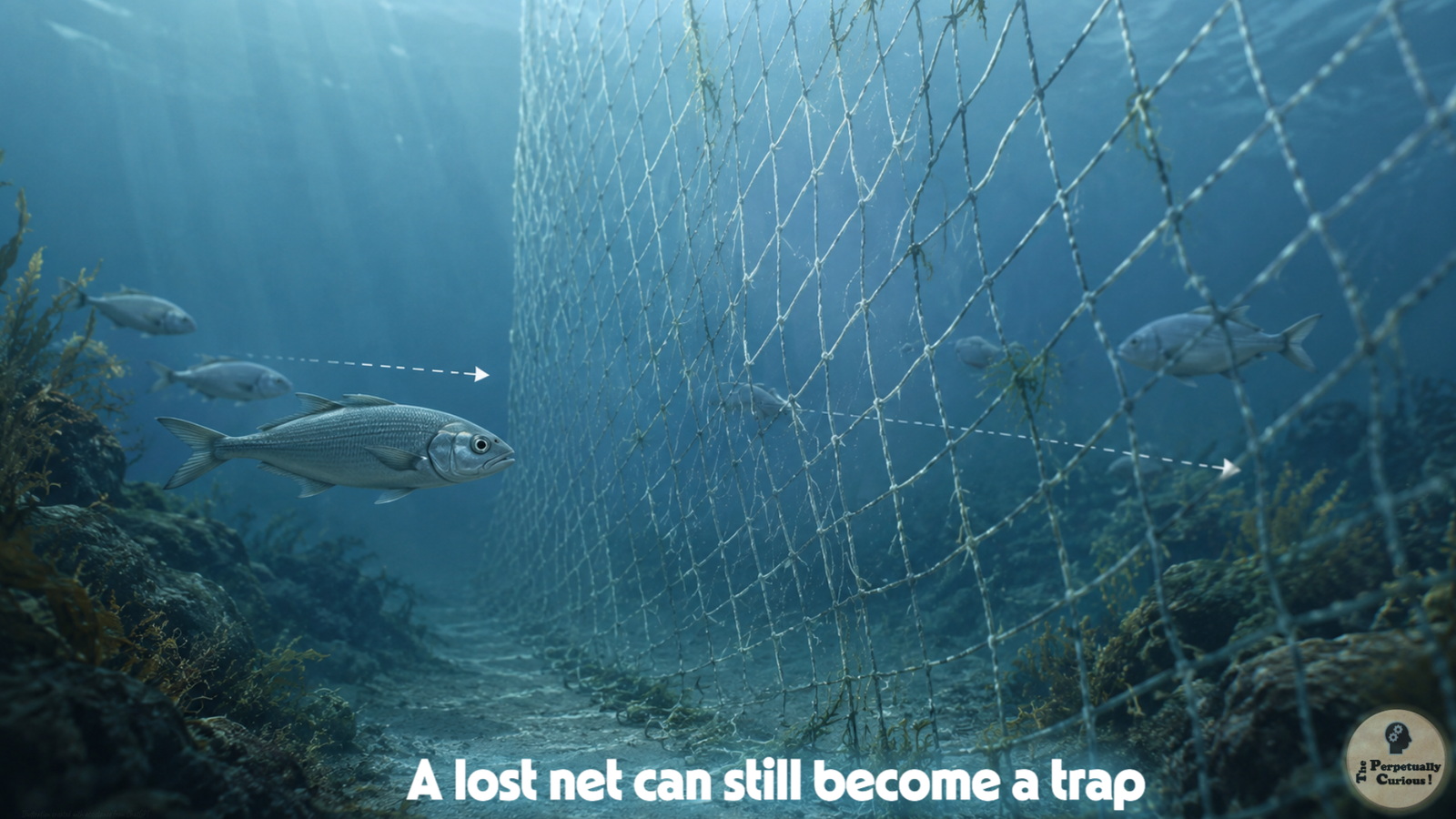
Ghost fishing describes the process by which lost or abandoned gear continues to capture organisms. Nets are designed to intercept movement, and they can keep doing so even when no one is present to retrieve them. Fish may swim into the mesh and become entangled. Crustaceans may be caught in smaller openings. Larger animals such as sea turtles, seals, dolphins, and seabirds may encounter nets while foraging, surfacing, or migrating.
A drifting net may appear harmless from a distance, yet in blue or broken light it can register only as a faint grid in the water, difficult to detect until escape becomes hard. A turtle rising toward the surface may become caught in a panel of mesh. A dolphin chasing prey may collide with a nearly invisible curtain of nylon. These encounters can restrict movement, feeding, or breathing.
Ghost nets may also create feedback loops. When animals die in a net, their bodies can attract scavengers, which may themselves become entangled. Over time, the net can accumulate organic material, broken lines, floats, and additional debris, forming dense tangles sometimes described by cleanup crews as gear balls. These clusters can be difficult to remove and may continue to interact with the surrounding environment.
The same durability that allows a net to linger beyond its purpose also allows ghost fishing to continue. Once a lost net keeps its shape in the water, persistence becomes more than a material problem. It becomes a biological one.
🐠 Ecosystems under strain: habitats, species, and subtle shifts
Ghost nets do not only affect individual animals. They can also influence the habitats those animals depend on. When a net settles on a coral reef, it may abrade the coral surface, break fragile branches, or block sunlight from reaching living tissue. Currents can move the net back and forth, turning soft mesh into a dragging surface against living coral. Over time, this can weaken reef structure and add to other stressors already acting on the habitat. In seagrass meadows, nets may shade the blades and reduce photosynthesis, which can affect growth and the smaller organisms that shelter among them.
In open water, drifting nets may intersect with migratory routes. Species such as turtles, sharks, and marine mammals often travel long distances, following temperature gradients, breeding routes, or prey distributions. A ghost net in such a pathway can become an unintentional barrier. Because many of these animals mature slowly or reproduce at modest rates, additional mortality from entanglement can contribute to cumulative strain, especially in populations already facing other pressures.
Ghost nets may also influence local food webs. When fish and invertebrates are removed through ghost fishing, predators may have fewer prey available in that area. In some regions, lost gear may also add to fishing pressure outside managed catch systems by continuing to remove organisms after the gear has left human control. The scale of these effects varies by gear type, habitat, species, and region, but the pattern is clear: a lost net can become part of the ocean’s ecological structure, not merely an object passing through it.
🌍 Ghost nets and the story of ocean plastics
Ghost nets are closely linked to the wider issue of plastic in the ocean. Many modern nets are made from synthetic polymers such as nylon, polyethylene, and polypropylene. These materials are valued for strength and durability, and although sunlight, saltwater, and abrasion can gradually weaken them, they often remain in the marine environment for years. As they weather, fray, and weaken, pieces may gradually break away, adding smaller fragments to the ocean rather than disappearing entirely.
Large-scale surveys of floating debris have found that fishing gear can make up a substantial share of plastic mass in some parts of the ocean. In the Great Pacific Garbage Patch, one study estimated that fishing nets alone account for about 46 percent of the plastic mass by weight. Broader analyses have suggested that abandoned, lost, or discarded fishing gear as a whole, including nets, lines, ropes, buoys, and other equipment, may account for around 70 to 86 percent of floating macroplastics by weight in ocean gyre estimates, with North Pacific analyses of larger floating debris tending toward the higher end of that range. These proportions vary by region, debris type, and sampling method, but they consistently indicate that ghost gear is a major component of ocean plastics. Nets also tend to contribute heavily to plastic mass because they are large, durable, and often buoyant enough to remain in circulation for long periods.
As nets fray and fragment, they can also contribute to microplastic pollution. These smaller particles may be ingested by fish, invertebrates, and other organisms. Research suggests that microplastics can carry chemical additives or adsorbed pollutants, and ingestion may have physiological effects, although the scale and significance of those effects can vary and are still being studied.
In this way, ghost nets connect the earlier story of durability and persistence to a broader material problem in the sea. The same properties that make nets effective fishing tools also allow them to remain in the ocean as long-lasting plastic debris.
🌐 Human stories at sea: livelihoods, navigation, and daily realities
Ghost nets are part of human stories as well as ecological ones. Fishing communities rely on gear to support livelihoods, and losing nets can represent a material and economic cost. For fishers, a lost net can mean replacement expenses, reduced working gear, and the added risk that derelict equipment may foul active lines, traps, or nets. In some regions, habitat damage and ongoing ghost fishing may also add pressure to local fish stocks, although these relationships are complex and influenced by many environmental and economic factors.
Navigationally, ghost nets can pose challenges. Large tangles of gear may drift into shipping lanes or become entangled with active fishing equipment. Vessels may encounter floating nets that are difficult to see, especially in rough seas or low light, where lines can foul propellers, rudders, or other working parts. In documented cases, coordinated efforts have been undertaken to locate and remove large accumulations of ghost gear, sometimes weighing many thousands of pounds.
These human realities follow naturally from the ecological ones. Ghost nets are not separate from human activity. They are remnants of it, and their presence reflects the practical, economic, and navigational contexts in which fishing and maritime operations take place.
🔍 Seeing the unseen: why ghost nets can be hard to track
Ghost nets often operate out of sight. Much of the activity of ghost fishing occurs below the surface, far from shore and beyond the range of casual observation. Nets may drift in deep water, settle on the seabed, or become entangled in complex structures such as reefs, wrecks, or rocky ledges.
Researchers use a variety of methods to study ghost nets. These may include underwater surveys, diver and fisher reports, remotely operated vehicle observations, drift modeling based on known gear loss rates and ocean currents, and acoustic imaging tools, including SONAR, in some seafloor or deep-water survey contexts. Some nets are discovered only during deep-water expeditions or seafloor surveys, where a faint shape on the bottom may reveal a net that was invisible from the surface.
Estimating the total amount of lost gear is difficult because fishing methods, reporting systems, ocean conditions, and retrieval practices vary widely. Recent global analyses have estimated that nearly 2 percent of fishing gear may be lost to the ocean each year, depending on gear type and fishery, but those losses are often measured by net area, line length, hooks, pots, or traps rather than by one simple global weight. For that reason, no single figure fully captures the scope of ghost nets. A growing body of regional case studies, fisher reports, and field observations instead forms a picture of a persistent, distributed phenomenon.
Because ghost nets are both measurable and elusive, they lead naturally from description into reflection. To understand them, researchers must follow objects that drift, sink, tangle, fragment, and sometimes reappear, carrying traces of human activity into places most people never see.
🌌 A quiet reflection: ghost nets as part of the ocean’s memory
When we imagine the ocean, we may picture waves, shorelines, and the play of light on the surface. Ghost nets remind us that another kind of memory can also be carried beneath that surface, formed by the tools, materials, and traces of human presence. A net that drifts beyond its intended use does not simply leave a vessel behind. It enters the motion of the sea.
From a scientific perspective, ghost nets are a form of marine debris with specific, measurable characteristics. They can drift with currents, settle on reefs, tangle with other debris, fragment into smaller pieces, and interact with living communities in ways that are sometimes visible and sometimes hidden. From a more contemplative perspective, they show how human activity can continue beyond the moment a tool is lost, carried forward by durable materials and the restless dynamics of water.
The story returns, finally, to the quiet image with which it began: a net moving through blue water, no longer guided by human hands, yet still shaping the lives around it. The ocean holds motion, life, and memory together, and ghost nets drift uneasily among all three.
Pass this article along to someone curious and let the learning travel.
💡 Did You Know?
🌊 Ghost nets can behave differently depending on water temperature and local conditions. In warmer waters, biofouling organisms may grow more quickly on the net, adding weight and sometimes causing sections to sink. In colder or less productive waters, biofouling may accumulate more slowly, allowing some nets to drift for longer periods.
🐚 Some ghost nets become floating habitats. Over time, barnacles, algae, and small invertebrates may colonize the net, creating small traveling communities that move with the currents. In some cases, drifting gear may also carry attached organisms beyond their usual range.
🧭 Ocean gyres can transport ghost nets across vast distances. A net lost near one coastline may drift hundreds or even thousands of miles, carried by circular currents that move slowly but persistently.
🧫 Microorganisms can form biofilms on ghost nets. These thin living layers may change how other organisms colonize the net’s surface, creating tiny biological microenvironments on a piece of plastic debris.
🌪️ Ghost nets may move vertically through the ocean over time. Biofouling can add weight and pull sections downward, while storms, breakage, attached floats, or buoyant pieces can sometimes return sections to circulation near the surface.
🧬 Studies of plastic-decomposing organisms show that biological breakdown can occur under specific material and environmental conditions, but these processes are often slow, partial, and context-dependent. They do not mean ghost nets simply disappear once they enter the ocean.
What is a ghost net?
A ghost net is a fishing net that has been abandoned, lost, or otherwise discarded in the ocean but continues to exist and interact with marine life. It may drift freely, become caught on the seabed, or form tangles with lines, floats, and other debris.
Are ghost nets the same as ghost gear?
Ghost nets are one type of ghost gear. The broader term ghost gear can include lost or abandoned nets, lines, ropes, traps, pots, floats, and other fishing equipment that remains in the marine environment.
How do ghost nets affect marine animals?
Ghost nets can entangle fish, invertebrates, sea turtles, seabirds, and marine mammals. Animals may become trapped in the mesh or lines and may be unable to move, feed, surface, or escape from predators.
Do ghost nets damage habitats such as coral reefs?
Ghost nets may damage habitats when they settle on or move across them. On coral reefs, nets can break fragile branches, abrade surfaces, or block sunlight. Similar effects may occur in seagrass meadows, rocky bottoms, and other shallow habitats.
Are ghost nets a significant part of ocean plastic pollution?
Yes, in some regions and debris surveys, fishing gear represents a substantial share of floating plastic mass. In the Great Pacific Garbage Patch, one study estimated that fishing nets alone account for about 46 percent of the plastic mass by weight, although figures vary by region, debris type, and sampling method.
How are ghost nets connected to microplastics?
As synthetic nets age, sunlight, saltwater, abrasion, and wave action can weaken them into smaller fragments. Those fragments can contribute to microplastic pollution and may be ingested by fish, invertebrates, and other organisms.
How long can ghost nets remain in the ocean?
The longevity of ghost nets depends on the material, gear design, sunlight exposure, abrasion, biofouling, and local ocean conditions. Synthetic fibers such as nylon, polyethylene, and polypropylene can remain intact for years, even as sections gradually weaken or fragment.
How do scientists estimate ghost gear quantities?
Scientists use field surveys, fisher reports, diver observations, remote sensing, drift models, and known gear-loss rates. Because fisheries, gear types, reporting systems, and ocean conditions vary widely, estimates often use ranges rather than a single global number.
Why do ghost gear estimates vary so much?
Estimates vary because researchers may measure different kinds of gear, such as net area, line length, hooks, traps, or total mass. Some studies focus on one region or fishery, while others use broader global models, so the numbers are not always directly comparable.
Do ghost nets behave differently in coastal versus open-ocean environments?
Yes. In coastal areas, ghost nets may become entangled with reefs, rocks, vegetation, wrecks, or seabed structures. In open water, they may drift for long distances with currents and gyres. These differences affect how nets interact with animals, habitats, and cleanup efforts.
Do ghost nets change as they age?
Yes. Ghost nets may become heavier as biofouling accumulates, then shift, sink, tear, or fragment as conditions change. Over time, the mesh may weaken or become tangled with other debris, creating complex structures that behave differently from intact nets.
Can ghost nets be removed from the ocean?
Some ghost nets can be removed through coordinated recovery efforts involving divers, vessels, remotely operated equipment, or shoreline cleanup teams. Removal can be difficult when nets are deep, heavy, tangled with habitat, or spread across large areas.
🌱 Sharing quiet stories of the sea
If this reflection resonates with you, we invite you to share it with friends, colleagues, or fellow ocean-curious readers. Each shared link becomes one small thread in a wider tapestry of curiosity about the sea and the lives it holds.
🎥 A visual companion to the drifting story
This companion video offers a visual path through the story of ghost nets, showing how lost fishing gear can continue to affect marine life, coral reefs, and ocean communities.
“Ghost Nets, Silent Drifters: How Lost Fishing Gear Haunts the Ocean.” The Perpetually Curious!, June 2026.
https://www.theperpetuallycurious.org/articles/ghost-nets/Continue Exploring
For what comes next
Site Updates gathers occasional notes, new additions, and ways to keep in touch. RSS brings new publications to your feed reader in chronological order.
Choose the path that speaks to you, and let the next curiosity find you wherever your wondering takes you.