

Every morning, many people stand before a mirror and watch light return to them as a familiar face. The experience feels effortless, as though the glass simply agrees to show what is already there. Yet behind that calm surface lies a precise exchange between light and matter. A mirror does not merely return brightness. It preserves direction, shape, and distance well enough for the eye and brain to rebuild a scene from reflected light.
A mirror is therefore not just a reflective object. It is a carefully crafted stage where light arrives, meets a smooth material surface, and departs in a way that preserves the geometry of the world. Its quiet clarity depends on physics at a scale far smaller than ordinary sight, on materials shaped with remarkable smoothness, and on perception that turns returning light into recognition. Understanding how mirrors work invites us to follow light on that journey, and from that journey, the story of reflection unfolds into physics, materials science, perception, technology, and culture.
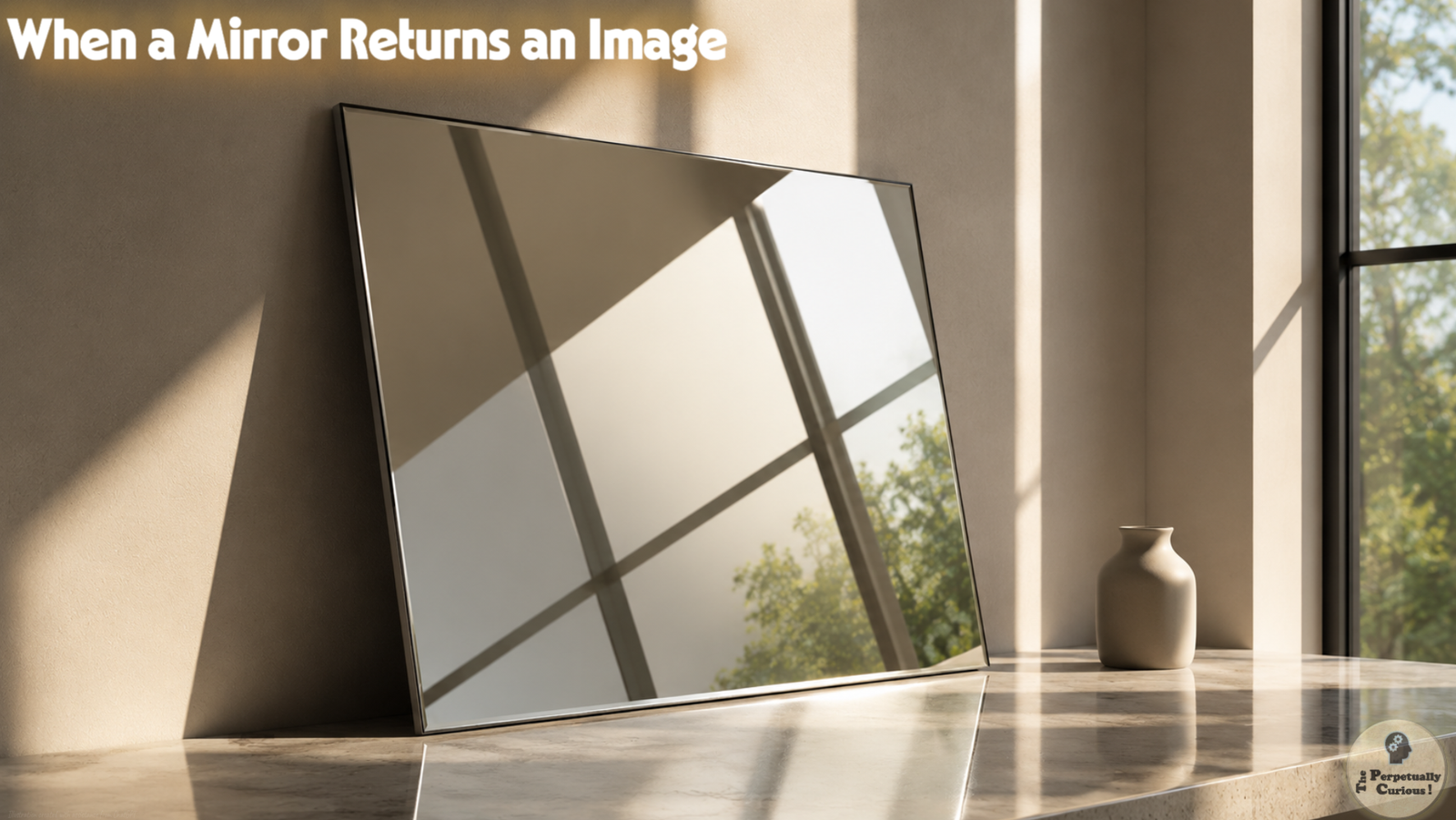
A mirror waits with patient clarity, holding light just long enough for meaning to appear.
In its calm return, the world gathers itself again, shaped by the quiet order of reflection.
Even the smallest glimmer reminds us that light remembers the path home.
🔍 Light, surfaces, and the law of reflection
To understand mirrors, it helps to begin with the behavior of light itself. When light reaches a surface, it may be absorbed, transmitted, or reflected. The way a surface manages this incoming light determines whether it behaves like a mirror, a window, a colored object, or a surface that simply looks bright. These outcomes are part of the broader story of light-matter interaction: before anything becomes visible as brightness, color, shadow, or reflection, light has to meet matter in a particular way.
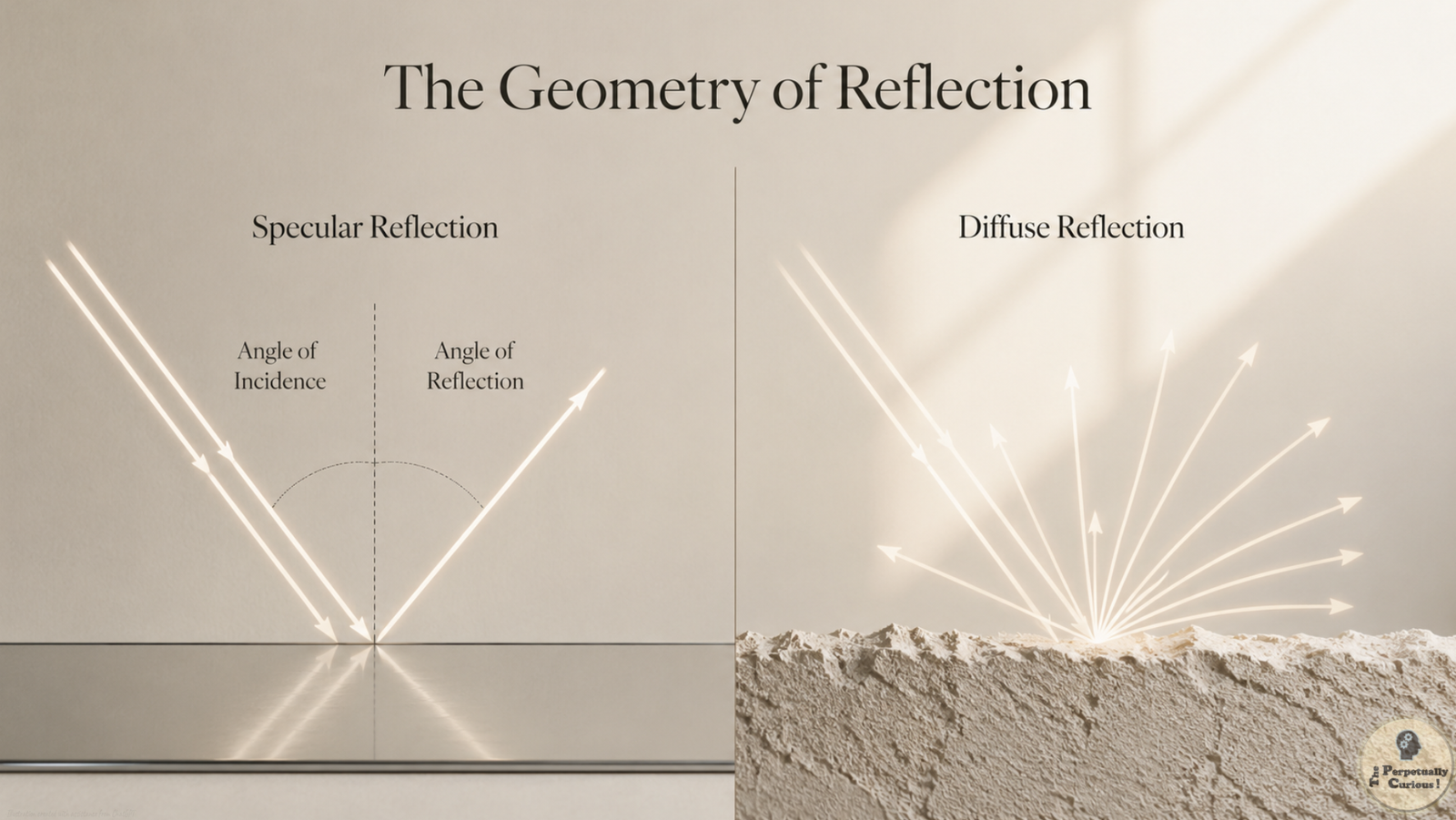
Reflection follows a simple geometric rule known as the law of reflection. The angle at which light arrives, measured from a line perpendicular to the surface, equals the angle at which it leaves. When many rays of light obey this rule together on a very smooth surface, the geometry of the scene is preserved. The eye and brain can then reconstruct a coherent image.
This leads to a useful distinction between specular and diffuse reflection. Specular reflection occurs when a surface is smooth enough that its height variations are small compared with the wavelength of visible light, which is about 0.000016 inches to 0.000028 inches (about 400 to 700 nanometers). Diffuse reflection occurs when a surface is rough at that scale, scattering light in many directions. A painted wall reflects light diffusely, so it appears bright but does not show a clear image of the world around it. A mirror reflects light specularly, so the arrangement of the scene is carried back with clarity.
There is something quietly astonishing about this requirement. A mirror does not need to look microscopically perfect to the human eye, but its reflective surface must be smooth enough for visible wavelengths to leave in an orderly pattern. The mirror’s ability to return the world depends on precision far beyond everyday perception. From that hidden smoothness, the story naturally turns toward the materials capable of holding such a surface.
🧪 Why mirrors are usually made of glass and metal
Once light’s behavior at a surface is clear, the next question is how to build a surface smooth and responsive enough to preserve that light with precision. Many everyday mirrors are made from glass backed by a thin layer of metal. Glass itself is not highly reflective. A clean pane of window glass reflects only a small fraction of the light that strikes it, while most of the light passes through. However, glass has two important advantages. It can be manufactured in large, flat sheets with very low surface roughness, and it is mechanically rigid and chemically stable.
The reflective power of a modern mirror comes mainly from the metal layer attached to the back of the glass. Metals such as silver and aluminum contain conduction electrons that respond strongly to incoming electromagnetic fields. When light reaches the metal, those electrons move collectively at the surface, creating a reflected wave that sends much of the incoming light back toward the viewer. For visible wavelengths, well-prepared silver coatings often reflect roughly ninety-five percent or more of incoming light, with specialized optical-grade protected silver coatings sometimes reaching higher values. Aluminum coatings commonly reflect around ninety percent, depending on wavelength, surface preparation, and protective treatment.
This electron response is central to the mirror’s function. In metals, many electrons are not bound tightly to individual atoms. They can move through the material, allowing the surface to respond as a coordinated electrical system rather than as a set of isolated particles. That collective response preserves much of the structure of the incoming wavefront, which is why polished metals shine and why they serve as the reflective heart of many mirrors.
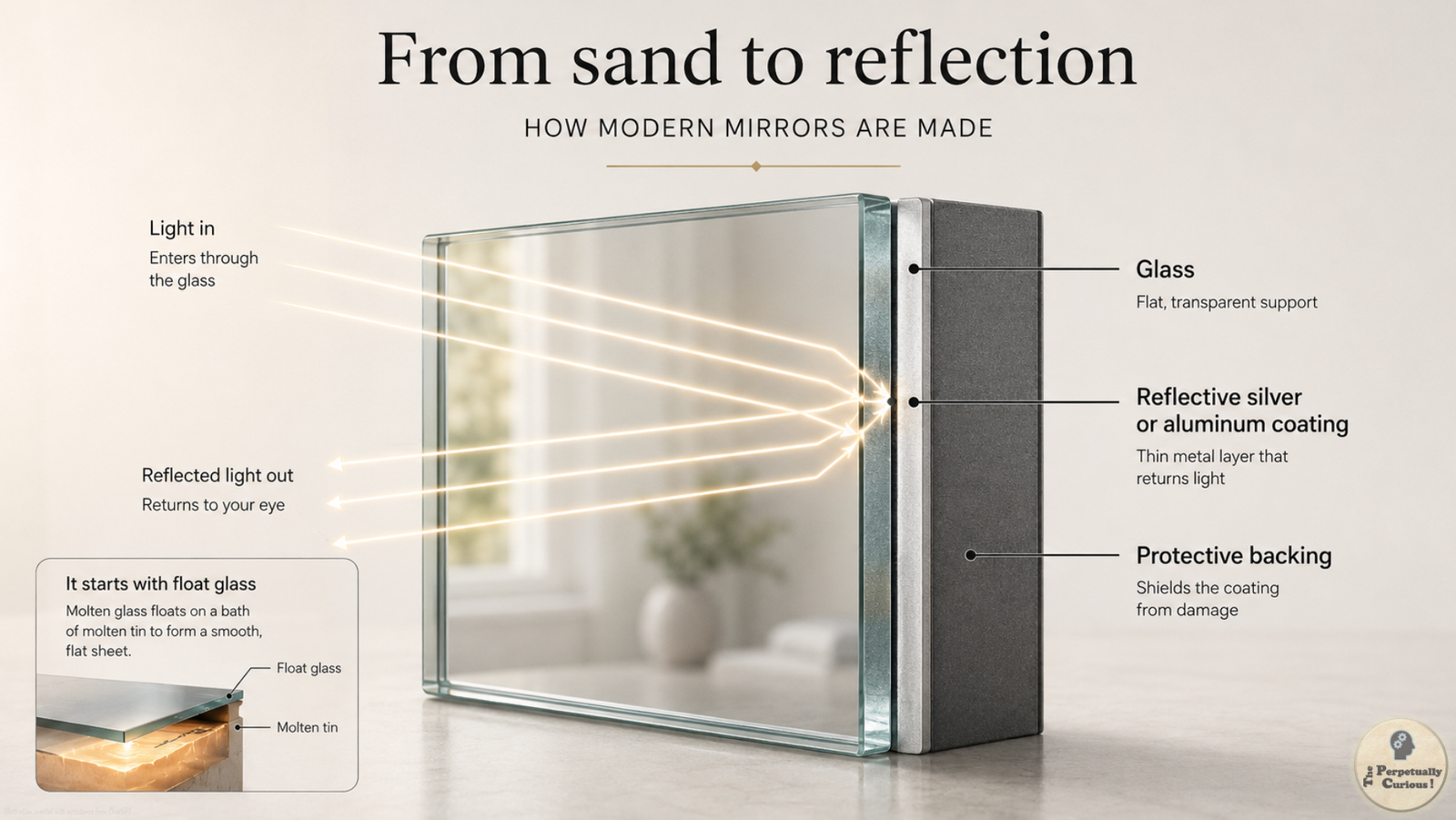
In a typical household mirror, the glass serves as a smooth, protective window, while the metal layer is the true reflective surface. Light enters through the glass, reaches the metal, reflects from it, and then passes back through the glass to the observer. The glass protects the delicate metal film from scratches and chemical damage while also providing structural support so that the mirror remains flat over time.
This combination of glass and metal did not appear suddenly. Early mirrors were polished pieces of stone or metal, such as obsidian, bronze, or copper. These surfaces could be made reasonably smooth, but they were prone to tarnish, dimming, and distortion. The development of high-quality glassmaking and controlled metal coating allowed mirrors to become clearer, larger, and more durable. The modern mirror is therefore a product of both ancient curiosity and contemporary materials science.
⚙️ From sand to reflection: how modern mirrors are made
With glass and metal working together, the next question is how a sheet of sand-derived glass becomes a precise reflective instrument. The process typically begins with flat glass. Many modern mirrors use float glass, which is made by floating molten glass on a bed of molten tin. As the molten glass spreads, gravity and surface tension help level it into a flat sheet with uniform thickness, often in the range of about 0.08 inches to 0.24 inches (about 2 to 6 millimeters). This stage of glass manufacturing gives the future mirror a smooth, stable substrate before the sheet is cooled and cut.
After the glass substrate is prepared and thoroughly cleaned, the reflective metal layer is applied. Many ordinary household mirrors use chemical silvering, in which a solution containing silver ions is reduced on the glass surface, depositing a thin film of metallic silver. Precision optical mirrors, including many scientific and technical mirrors, may instead use vacuum deposition. In these methods, aluminum, silver, or another coating material is deposited in a low-pressure chamber so that it forms a controlled reflective film. The resulting metal layer may be only a few millionths of an inch thick, often on the order of about 100 nanometers, yet it can still be continuous enough to reflect most incoming light.
The choice of coating method depends on the mirror’s purpose. Chemical silvering is well suited to many everyday glass-backed mirrors, where clarity, durability, and cost all matter. Vacuum deposition gives optical manufacturers more precise control over coating thickness, purity, adhesion, and wavelength performance. For specialized instruments, those details can affect how much light is reflected and how accurately the reflected wavefront is preserved.
Once the metal layer is in place, additional coatings are added to protect it. A thin dielectric layer may be used to enhance reflectivity or provide a barrier against chemical attack. On the back side of many household mirrors, paints or other protective layers shield the metal from moisture and mechanical damage. The final product is a layered structure: glass on the front, a reflective metal film behind it, and protective coatings on the back.
Quality control is essential throughout this process. Any waviness in the glass or unevenness in the metal layer can introduce distortions in the reflected image. For everyday mirrors, small imperfections may be acceptable, but for scientific instruments such as telescopes, the tolerances are much tighter. Large astronomical mirrors may be polished and tested repeatedly to achieve surface deviations smaller than a fraction of a wavelength of light. In those cases, the mirror becomes a precision scientific tool capable of gathering light from distant galaxies.
🧭 Why mirrors seem to flip left and right
Once the mirror has been built, another question emerges: why does its image feel so intuitively strange? Many people notice that a mirror appears to reverse left and right, but not up and down. Words written on paper appear reversed when seen in a mirror, and the hand that appears on the left side of the reflection is actually the right hand of the person standing in front of the mirror.
A mirror does not choose left and right as special directions. Instead, it reverses the front-back relationship between the observer and the reflected image. The direction pointing toward the mirror is exchanged with the direction that appears to extend behind it, while the side-to-side and up-and-down directions remain aligned with the mirror’s surface. The confusion begins when people imagine themselves turning around to face the same direction as the reflection. That mental rotation swaps left and right in the imagined body, making the mirror seem as though it has performed a sideways reversal.
This subtlety illustrates how mirrors sit at the intersection of physics and human experience. The mirror obeys a simple physical rule, yet the way humans interpret the resulting image can lead to intuitive puzzles that have inspired scientific explanations and philosophical reflections.
🔭 Mirrors in science and technology
Once mirrors are understood as tools that preserve geometry, their role in scientific instruments becomes clearer. Mirrors are central components in telescopes, microscopes, lasers, scanners, and many optical devices.
In reflecting telescopes, large concave mirrors collect light from distant stars and galaxies and focus it to a point. The shape of the mirror determines how the light is brought together, and the quality of the surface determines how sharp the resulting image can be. Unlike large lenses, telescope mirrors can gather light without ordinary chromatic aberration, and they can often be supported more practically at large sizes. Some of the largest telescope mirrors in the world span many feet in diameter, with surfaces polished to extraordinary precision.
In lasers, mirrors are used to trap light between them, encouraging photons to stimulate the emission of more photons in the same direction and phase. This process creates a beam of highly coherent light that can be used for communication, measurement, medicine, manufacturing, and many other applications.
In advanced astronomical instruments, adaptive mirrors can change shape in real time. These mirrors are supported by arrays of actuators that adjust their surface to correct for atmospheric turbulence. This allows telescopes to produce images with remarkable clarity, even when observing through Earth’s atmosphere.
In everyday devices, smaller mirrors guide light within optical instruments, redirect beams in scanners, and help align systems. Fiber optic networks rely on a related but distinct principle: light is guided through glass fibers by total internal reflection and waveguiding, not by reflection from a metal surface.
These examples show that mirrors are not only passive observers of the world. They are active participants in technologies that measure, align, focus, and reveal. From there, the story of mirrors naturally widens from scientific instruments to human meaning, because reflective surfaces have shaped not only what people can observe, but also how they imagine seeing themselves.
🌍 Mirrors, culture, and the idea of seeing oneself
As the scientific story of mirrors unfolds, it naturally touches the cultural and symbolic roles that reflective surfaces have played. Long before modern glass-backed mirrors became common, people saw themselves in still water, polished stone, bronze, copper, and other carefully worked surfaces. Many cultures have used mirrors as objects of beauty, introspection, ceremony, and storytelling. The ability to see oneself has often been associated with identity, wisdom, illusion, and contemplation.
Mirrors have also influenced scientific thought. Renaissance scholars and artists used mirrors to explore perspective, symmetry, light, and proportion, helping connect visual experience with geometry. Artists studied reflections to understand composition and depth, while optical experiments used mirrors to test how light travels, changes direction, and forms images. In architecture, mirrors have been used to expand spaces, redirect illumination, and alter the felt scale of a room.
Traditional mirror-making also preserves distinctive regional knowledge. In Kerala, for instance, the Aranmula Kannadi, literally “Aranmula mirror” in Malayalam, is a traditional handmade metal-alloy mirror known for its front-surface reflection. Across time, mirrors have also carried the marks of care and repair, from polished stone and metal surfaces to later practices of cleaning, re-backing, and re-silvering old glass so that a fading reflective surface could return to use.
In this way, mirrors occupy a quiet but meaningful place at the intersection of physics and human experience. They reveal the world while also inviting people to consider the act of seeing itself. A mirror can be a tool, an instrument, an ornament, a restored object, or a symbol, but in each role it depends on the same physical act: light returning with enough order for meaning to appear.
Pass this article along to someone curious and let the learning travel.
💡 Did You Know
✨ Some insects have highly reflective microstructures in their exoskeletons. Microscopic layers can reflect selected wavelengths of light, creating iridescent colors that shift with viewing angle. This is one expression of structural coloration, where tiny physical architecture helps shape visible color.
🌈 Many ordinary glass-backed mirrors can show a faint green tint, especially when light reflects back and forth through the glass many times. The effect is often linked to the slight greenish cast of standard iron-bearing glass rather than to perfect color balance in the reflective coating.
🐚 Some seashells create natural mirror effects. The inner surfaces of certain shells contain microscopic layers of calcium carbonate that shape reflected light through wave effects, producing pearly iridescence and bright glints.
🔭 Adaptive mirrors can change shape. In advanced telescopes, deformable mirror surfaces are supported by arrays of actuators that adjust their shape in real time, correcting for atmospheric turbulence.
🧊 Ice can act as a natural mirror. Smooth ice surfaces reflect light specularly, especially when freshly formed, contributing to the shimmering appearance of frozen lakes.
🪐 Venus is not mirror-like in the ordinary glass-and-metal sense, but its dense cloud layers reflect sunlight strongly. That high reflectivity helps explain planetary brightness, where cloud cover, distance, and viewing geometry affect how bright a world appears.
📡 Retroreflectors, which send light back toward its source, are used on the Moon. They allow scientists to measure the distance between Earth and the lunar surface with remarkable precision.
🔎 Mirrors do not have to be flat. Curved mirrors can spread light outward or bring it together, which is why convex mirrors widen views while concave mirrors can focus light in telescopes and other optical instruments.
How does a mirror differ from a regular shiny object?
A mirror differs from a regular shiny object in the way it reflects light. A mirror reflects light specularly, preserving the geometry of the scene. Many shiny objects reflect light more diffusely, scattering light in many directions and preventing the formation of a clear image.
Why is glass used in most household mirrors?
Glass is used because it can be manufactured as flat, smooth sheets that provide an excellent substrate for a reflective metal coating. It is rigid, stable, and transparent, allowing light to reach the metal layer and return to the viewer. The precision of glass manufacturing helps explain why a mirror can remain flat and clear while the thin metal layer behind the glass does most of the reflecting.
Which metals are commonly used for mirror coatings?
Silver and aluminum are commonly used. Silver reflects visible light very efficiently, while aluminum provides good reflectivity across a broad range of wavelengths and is widely used in many optical and industrial mirrors.
Do mirrors reflect all colors of light equally well?
Mirrors do not always reflect all colors equally well. The reflectivity of a coating can vary with wavelength, and the glass, metal layer, and protective coatings can each introduce subtle color differences.
Why do some mirrors seem slightly tinted?
Some mirrors appear tinted because of the properties of the glass and coatings used. In many ordinary glass-backed mirrors, the glass itself can contribute a faint greenish cast, especially when light passes through it repeatedly during multiple reflections.
What is a first-surface mirror and when is it used?
A first-surface mirror has the reflective coating on the front side of the substrate rather than behind a layer of glass. It is used in optical instruments where even small distortions from passing through glass must be minimized. The reflective surface is more exposed and requires careful handling.
What is a virtual image in a mirror?
A virtual image is an image that appears to come from behind the mirror, even though light does not actually pass through that apparent location. The reflected rays enter the eye as if they had traveled from a point behind the glass, so the brain interprets the image as occupying that space.
Does a flat mirror show a life-size image?
A flat mirror forms an upright virtual image that appears the same size as the object. The image also appears to sit as far behind the mirror as the object is in front of it, which is why a plane mirror can feel like an extension of the room.
Can mirrors reflect infrared or ultraviolet light?
Mirrors can reflect infrared or ultraviolet light, but the efficiency depends on the coating. Specialized mirrors are designed to optimize reflection for particular wavelength ranges.
Why do mirrors appear slightly darker than the world they reflect?
Mirrors appear slightly darker because even highly reflective coatings absorb, scatter, or transmit a small fraction of incoming light. This small loss reduces the brightness of the reflected image.
Why are mirrors not perfectly lossless?
A perfect mirror is an idealization. Real mirrors lose a small amount of light because their materials absorb, scatter, or transmit part of the incoming energy. Protective coatings, surface roughness, glass absorption, and microscopic imperfections can all contribute to these losses.
Can mirrors be made without metal?
Mirrors can be made without metal by using dielectric coatings. These coatings consist of multiple thin layers of transparent materials that reflect light through interference effects. They are used in lasers and scientific instruments where precise wavelength control is required.
Do mirrors behave differently in space?
Mirrors in space must withstand extreme temperatures, radiation, and vacuum conditions. Their coatings are carefully engineered to remain stable, and their surfaces are often polished to extraordinary precision for astronomical observations.
🌱 Sharing reflections, spreading light
If this exploration of mirrors has sparked a sense of quiet wonder, we warmly invite you to share it with friends, colleagues, and fellow curious minds. A single shared reflection can carry the story farther, helping another reader look more closely at the light that answers back from the glass.
“When Light Learns to Answer Back: The Quiet Science of Mirrors.” The Perpetually Curious!, July 2026.
https://www.theperpetuallycurious.org/articles/how-do-mirrors-work/Continue Exploring
For the curious mind: want to explore this theme through a few questions? Visit the Classic Quiz Studio, nestled under Explorations opens in a new tab ,and see where a few well-placed questions lead: Physics Quizzesopens in a new tab
For what comes next
Site Updates gathers occasional notes, new additions, and ways to keep in touch. RSS brings new publications to your feed reader in chronological order.
Choose the path that speaks to you, and let the next curiosity find you wherever your wondering takes you.