

Earth’s story begins in a quiet arm of the Milky Way, where a drifting cloud of gas and dust moved through darkness. Over time, gravity drew part of this cloud inward, creating a rotating structure that grew denser and hotter as it contracted. At the center, heat and pressure rose until a star ignited. Around that newborn Sun, a glowing disk of material stretched outward, carrying the raw ingredients of future worlds. One of those worlds would become Earth, a planet that would one day hold oceans, continents, and living beings capable of wondering how it all began.
This story unfolds through a continuous chain. The birth of the Sun shaped the disk. The disk gave rise to planetesimals. Their collisions built protoplanets. Heat reorganized their interiors. A giant impact helped create the Moon and changed Earth’s spin history. Cooling allowed crust and oceans to emerge. Over time, stability created the conditions for habitability. Each chapter follows from the one before it, forming a story that is both scientific and quietly poetic.
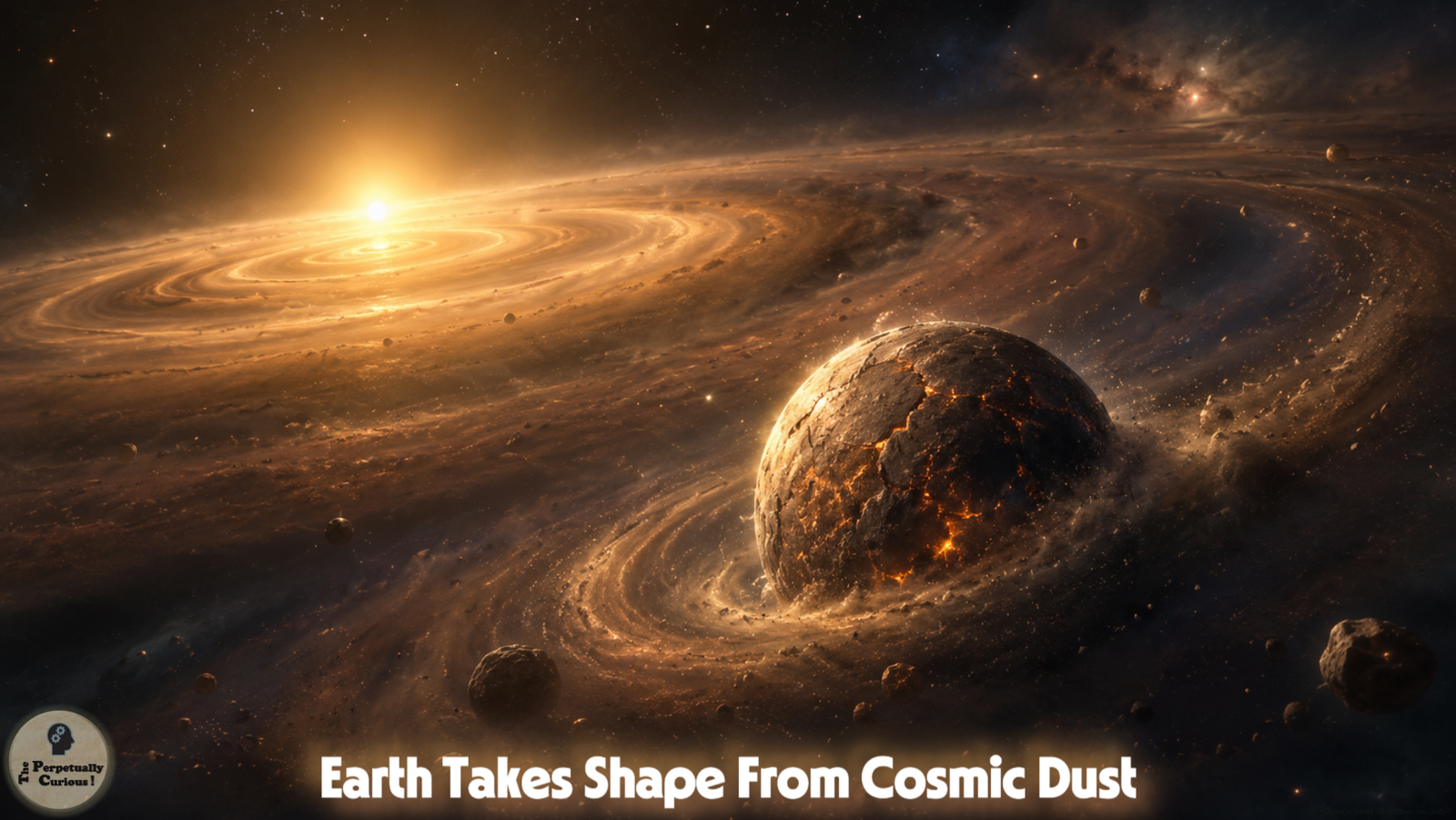
In the long calm after fire and falling dust, Earth began to hold its shape.
A young world turned slowly beneath the sky, carrying the memory of its earliest light.
Its ancient beginnings still rest in every tide, every shadow, every quiet motion of the planet.
🌟 The Sun’s age and Earth’s place in the Solar System
The Sun formed at the center of the collapsing solar nebula before the planets completed their growth. It is about 4.57 billion years old, while Earth formed slightly later, about 4.54 billion years ago. This places Earth close to the beginning of the Solar System’s story, but not at the very first moment of that story.
Some of the earliest dated solid materials in the Solar System are found in certain meteorites known as calcium-aluminum-rich inclusions. These inclusions are about 4.567 billion years old and serve as important time markers because they formed near the beginning of solid material formation around the young Sun. They help scientists anchor the chronology of the early Solar System.
Earth’s age marks a broad formation window rather than a single instant. The planet assembled through accretion, continued to heat and differentiate, experienced the Moon-forming impact, and kept changing as its surface cooled. This is why the dates for the earliest solids, Earth’s formation, and the Moon’s origin sit close together without describing the same event.
Jupiter likely began assembling very early, while gas remained abundant in the protoplanetary disk. That early start mattered because giant planets needed enough time to gather hydrogen and helium before the disk’s gas dispersed. Saturn also formed early in this gas-rich environment, while Uranus and Neptune developed farther out under conditions that remain more complex and model-dependent. The terrestrial planets, including Mercury, Venus, Earth, and Mars, grew more gradually in the warmer inner disk, where rock and metal could accumulate but lighter gases were harder to retain.
Earth therefore belongs near the opening chapter of the Solar System, but it emerged within an already unfolding sequence. The Sun, the earliest solids, and the early growth of the giant planets all help frame Earth’s birth as part of a larger architecture, shaped by temperature, timing, gravity, and the changing material available in the young disk.
🌌 Earth’s formation mapped across galactic years
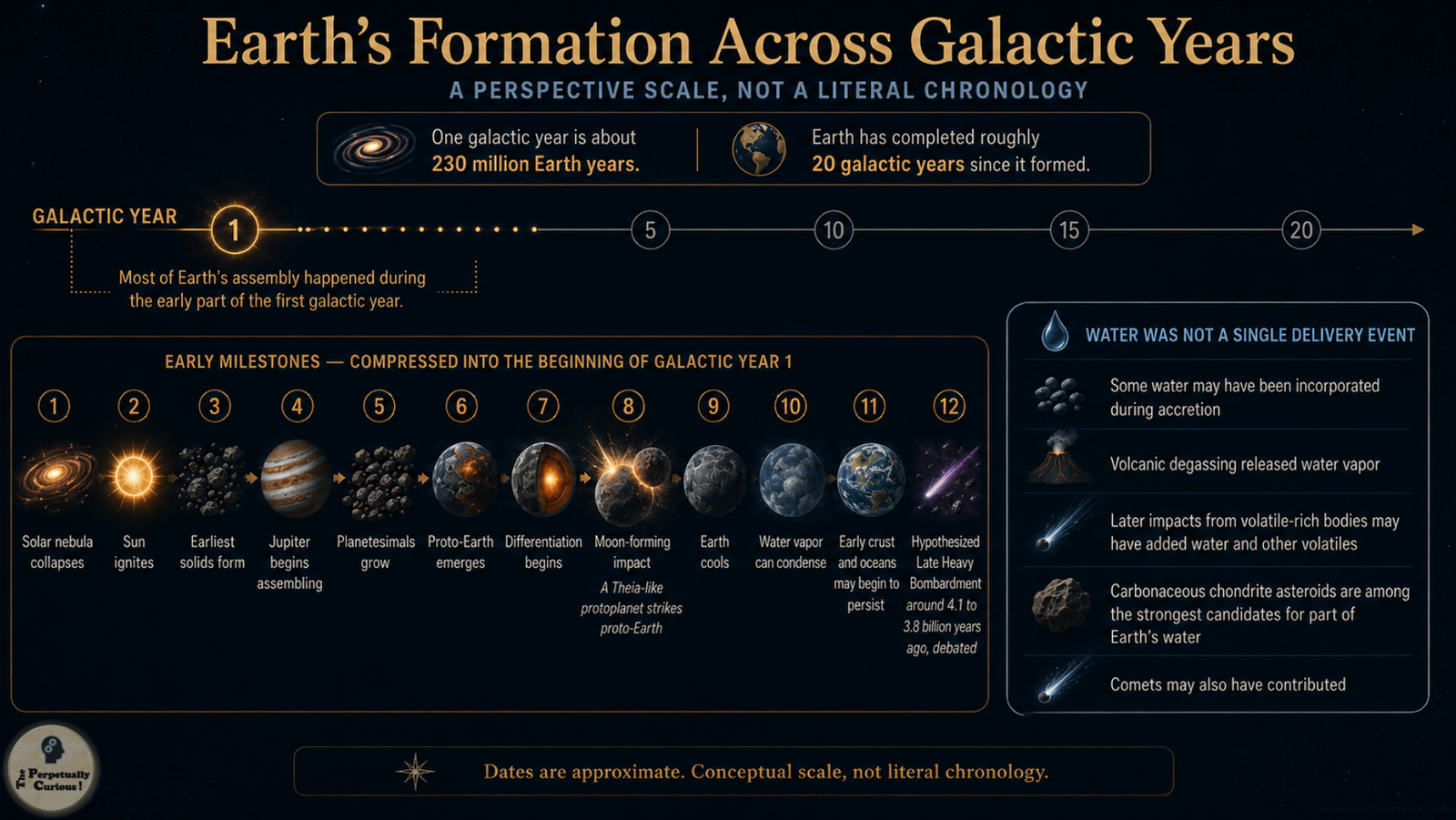
The Solar System orbits the center of the Milky Way once every galactic year, a period of about 230 million Earth years. Since Earth formed about 4.54 billion years ago, it has completed roughly twenty of these vast circuits. In this article, the galactic year is used as a perspective tool rather than a literal chronology for specific events. Mapping Earth’s formation against this larger rhythm does not replace the planetary timeline, but it gives that timeline a wider cosmic scale.
For scale, Earth’s first galactic year covers only the first roughly 230 million years after the planet formed, while even events hundreds of millions of years later still belong to the earliest few orbits of Earth’s journey around the galaxy.
The first galactic year was the most compressed and transformative. Within its opening portion, the solar nebula collapsed, the Sun ignited, the earliest solids formed, Jupiter likely began assembling, and planetesimals grew through repeated collisions. Proto-Earth also emerged during this early interval, while impact heating and radioactive decay helped drive the first stages of differentiation. The Moon-forming impact likely occurred within the early part of this same first galactic year, not several galactic years later.
Across the remainder of the first galactic year and the galactic years that followed, Earth continued to cool, its surface began to stabilize, and water vapor could condense as temperatures fell. Early crust may have formed and been destroyed many times before more persistent surface records appeared. A hypothesized interval of increased impacts, often called the Late Heavy Bombardment, is commonly placed around 4.1 to 3.8 billion years ago, although its timing, duration, sharpness, and even whether it occurred as a single discrete event remain debated.
Seen this way, Earth’s birth was not evenly spread across twenty galactic years. Most of the planet’s assembly happened quickly, during the early part of its first orbit around the Milky Way. The later galactic years carried the consequences of that beginning: cooling, crustal change, oceans, atmosphere, and the long movement toward a more stable world.
🌞 A star is born: The young solar nebula
Earth’s origin traces back to the solar nebula, the cloud of gas and dust from which the Sun and planets formed. This material was mostly hydrogen and helium, but it also carried heavier elements such as oxygen, silicon, iron, and carbon. Those heavier elements had been forged by earlier generations of stars and released into space through processes such as stellar winds, supernova explosions, and other violent stellar endings long before the Solar System took shape.
Over time, gravity drew part of this material inward. One region became dense enough to collapse, forming a rotating structure with a growing central mass. As that central mass contracted, pressure and temperature increased until nuclear fusion began. The Sun emerged from this process of star formation, lighting the disk of material that still surrounded it.
Around the young Sun, the remaining gas and dust formed a rotating protoplanetary disk. This disk was not uniform. Its inner regions were warm enough for rock and metal to remain stable, while its outer regions were cool enough for ices to survive. Earth’s story unfolded in the warmer inner zone, where solid materials could accumulate but lighter gases were harder to hold.
This transition from a diffuse nebula to a structured disk set the stage for planetary formation. The disk provided both the raw materials and the physical environment needed for the next chapter, where dust grains began to collect, collide, and grow into larger bodies.
🌌 From dust to worlds: Accretion and the rise of proto-Earth
Within the protoplanetary disk, tiny grains of dust collided and stuck together. At first, these grains formed small aggregates, but repeated collisions gradually produced larger clumps. Over time, some of these clumps grew into kilometer-scale bodies known as planetesimals. They orbited the young Sun in a crowded disk, interacting through gravity, collision, and scattering. Some merged and grew, while others were broken apart or pushed into different paths.
In the region that would become Earth’s orbit, many planetesimals gathered into larger bodies called protoplanets. One of these growing bodies, often described as proto-Earth, gained mass by accreting surrounding material. Each impact added material and released energy, helping to heat the young planet. As proto-Earth became larger, its gravity strengthened, allowing it to draw in more planetesimals and smaller protoplanets from nearby regions.
The early Solar System was not a calm arrangement of finished planets. It was a dense and changing environment where many growing worlds crossed paths. Over tens of millions of years, repeated impacts and gravitational encounters reduced the number of large bodies in Earth’s orbital region. Proto-Earth emerged from this process as a substantial young world, no longer a small rocky fragment but a planet-sized body with enough mass and heat to begin reorganizing its interior.
This growth mattered because size changed what the young planet could become. Accretion did not simply make Earth larger. It supplied heat, pressure, and gravity, setting up the next stage in which dense metals and lighter rocky materials began to separate inside the growing world.
🌋 Fire within: Differentiation and the shaping of Earth’s interior
As proto-Earth grew, impact energy and heat from radioactive decay made its interior extremely hot. Large portions of the young planet may have been molten or partially molten. In this heated state, dense metals such as iron and nickel tended to sink toward the center, while lighter silicate materials remained closer to the outer layers. This separation, known as differentiation and sometimes described as the iron catastrophe in some models, helped produce Earth’s layered structure: a dense metallic core, a silicate mantle, and a developing crust.
Differentiation was not instantaneous. It unfolded over time as heat, impacts, and radioactive decay continued to reshape the young planet. The formation of Earth’s core had lasting consequences. A metallic core helped make it possible for Earth to eventually generate a magnetic field, which would later shield the planet from some charged particles from the Sun. Above the core, the mantle began the long, slow movement of convection, a process that would later help drive volcanic and tectonic activity. The crust, although thin, unstable, and repeatedly altered in the beginning, would eventually become the foundation for continents and ocean basins.
Differentiation also influenced the planet’s surface environment. Volcanic activity released gases from the interior, contributing to an early atmosphere that was very different from the air surrounding Earth today. This atmosphere likely contained water vapor, carbon dioxide, nitrogen, and other gases, though its exact composition remains uncertain. At this stage, Earth was a hot, changing world shaped by magma oceans, frequent impacts, and constant interior heat. Yet these same processes set the physical and chemical conditions that would later allow oceans and a more stable surface to form.
The next major chapter follows from this restless beginning. Earth had grown large enough to reorganize itself from within, but it still moved through a crowded young Solar System. Another large body, traveling through the same region of space, would collide with proto-Earth and change the planet’s future.
🌗 A world reshaped: The giant impact and the birth of the Moon
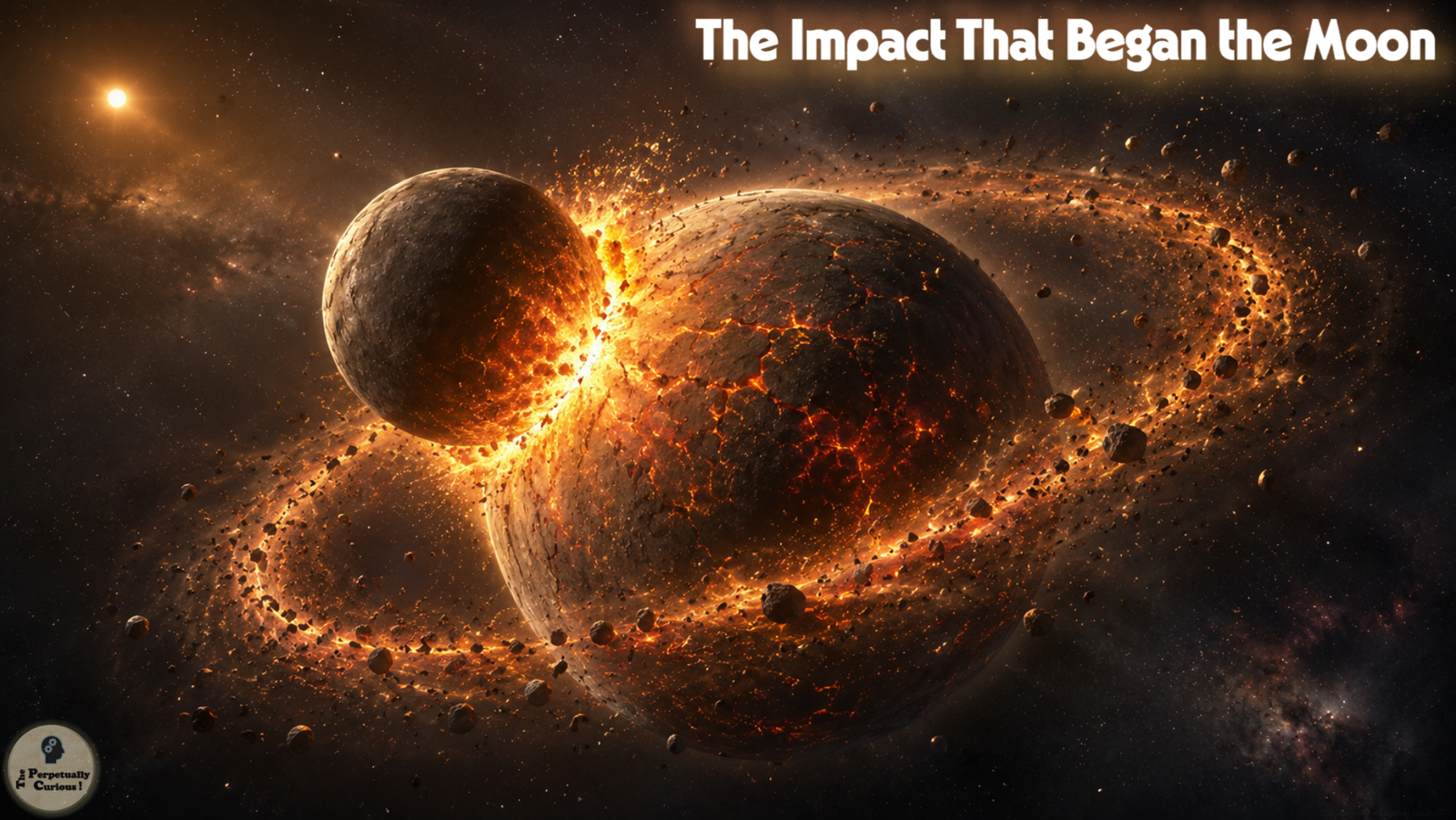
The leading scientific explanation for the Moon’s origin is the giant impact hypothesis. According to this model, a large protoplanet collided with the early Earth roughly 4.5 billion years ago, within the opening tens of millions of years of Earth’s history. This hypothetical impactor is conventionally called Theia.
In the classic version of the hypothesis, Theia was roughly Mars-sized. It approached Earth on a trajectory that led to a high-energy collision. The impact released enormous amounts of heat, melted large portions of both bodies, and ejected material into orbit around Earth. Over time, this debris coalesced into a single large satellite, the Moon. Some modern variants of the model also consider higher-energy collisions between bodies of more comparable mass, which may help explain why lunar samples and Earth’s mantle share very similar isotopic signatures.
The Moon’s later surface record also preserves a stark contrast between lunar regolith and Earth soil, because the Moon lacks the same atmosphere, water cycle, and biological weathering that continually reshape Earth’s surface. Regardless of the exact size and trajectory of the impactor, the consequences for Earth were profound. The collision likely altered Earth’s rotation rate and strongly influenced its later spin-axis history. The tilt Earth has today, about 23.5 degrees, plays a major role in producing seasons, but the Earth-Moon system later helped stabilize this obliquity over long timescales. The impact also contributed to the angular momentum of the Earth-Moon system. Today, the Moon orbits at an average distance of about 238,855 miles (384,400 kilometers), and its gravitational pull affects tides and the long-term stability of Earth’s rotation.
This giant impact connects directly to the earlier stages of Earth’s formation. Accretion produced a world large enough to experience such a collision, and differentiation had already begun to separate dense and lighter materials inside it. The Moon’s birth, in turn, shaped the later evolution of Earth’s surface environment, tides, and long-term planetary stability.
🌊 From fire to water: Cooling, oceans, and early atmosphere
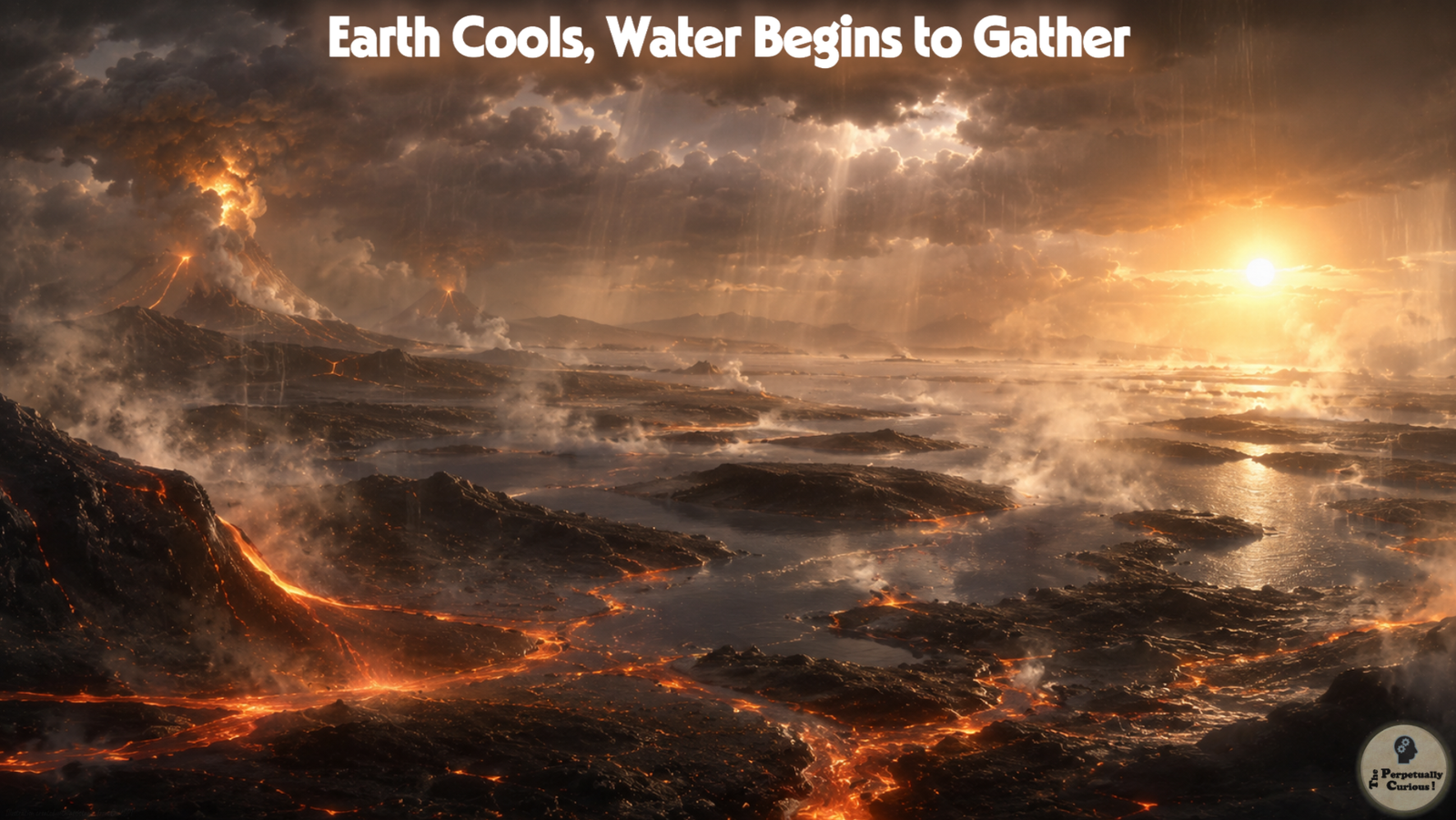
After the giant impact, Earth remained extremely hot. Models suggest large regions of the surface may have been covered by magma oceans, while the young planet slowly radiated heat into space. As temperatures fell, portions of the surface began to solidify into crust. Volcanic activity continued to release gases, including water vapor, carbon dioxide, nitrogen, and other compounds, into the atmosphere. This early atmosphere was likely rich in greenhouse gases, although its exact composition remains uncertain.
As the surface cooled further, water vapor could begin to condense. Rain may have fallen for long periods, collecting in low-lying regions and gradually forming extensive bodies of liquid water. Some of Earth’s water may have been present in the materials that built the planet, while additional water and other volatiles may have arrived through later impacts from primitive, volatile-bearing Solar System bodies. The result was not a single simple event, but a long transition from heat, vapor, and impact-shaped rock toward a world where liquid water could persist.
The presence of liquid water was a major turning point. It allowed chemical reactions to unfold in solution and began shaping Earth’s geology through erosion, sedimentation, mineral formation, and interaction with the crust. Early Earth may have hosted a global or near-global ocean, although the timing, extent, and stability of those first oceans remain active areas of research.
The early atmosphere and oceans were never separate systems. They interacted with the crust and mantle through volcanic degassing, weathering, mineral reactions, and the exchange of gases between air and water. Over time, these interactions helped shift Earth away from a surface dominated by molten rock and toward one where solid crust, atmosphere, and persistent liquid water could coexist.
This cooling and condensation phase follows naturally from the energy released during accretion and the giant impact. Once the most intense heat began to fade, Earth could move from a hostile, molten state toward the more stable planetary framework needed for oceans, climate, and later habitability.
🌍 A planet settles: Early stability and the path toward habitability
As Earth’s crust thickened and oceans spread, the planet moved toward a more stable phase. Large impacts became less frequent, although they did not disappear. The interior continued to convect, helping drive volcanic activity and, over longer timescales, tectonic change. Portions of the crust may have grown into early continental fragments, although their extent, persistence, and stability remain debated. Much of Earth’s earliest surface record was later erased, altered, or recycled by impacts, melting, erosion, and tectonic activity. These early crustal pieces interacted with oceans and atmosphere, influencing climate, chemistry, and the cycling of materials.
The Moon also contributed to Earth’s long-term stability. The gravitational interaction between Earth and the Moon helped moderate changes in Earth’s axial tilt over long timescales, supporting more stable seasonal patterns than Earth might otherwise have experienced. The Moon also affects tides, which help move and mix ocean waters and shape coastal environments.
This was not yet the familiar Earth of blue skies, oxygen-rich air, stable continents, and living landscapes. It was a younger world still being shaped by heat, water, rock, atmosphere, and impact history. Even so, Earth was becoming increasingly suitable for complex chemistry. The emergence of life is a separate and intricate story, but it is closely tied to the physical and chemical environment that Earth’s formation created. Liquid water, a solid surface, long-term atmospheric retention, and a favorable distance from the Sun all helped shape a planet where habitability could develop gradually rather than appear all at once.
This stage of relative stability does not mark the end of Earth’s evolution. Instead, it marks the point at which the planet had the basic physical framework needed to support the long, unfolding history of geology, climate, and life, even as the details of early surface evolution remain active areas of research.
🌌 Looking back at a quiet beginning: A reflective closing
When we trace Earth’s story from cosmic dust to a living world, we see a sequence of events that was both violent and orderly. A collapsing nebula gave rise to a star and a disk. Within that disk, collisions built growing worlds. Heat and gravity reshaped their interiors. A single immense impact helped create the Moon and changed Earth’s spin history. Cooling and condensation allowed water to begin gathering in low-lying regions. Over time, a once-molten world became a place where oceans could reflect starlight and continents could begin rising above the waves.
This narrative is grounded in careful measurements and observations, even though much of Earth’s earliest surface was later erased or transformed. Radiometric dating places Earth’s formation at about 4.54 billion years ago. Meteorites preserve records from the earliest solids of the Solar System. Lunar samples point to a shared history between Earth and its satellite. Ancient zircons offer rare but limited clues from Earth’s earliest crust. Computer models of planetary dynamics indicate how accretion, differentiation, and giant impacts can produce the structures we observe today. Together, these indirect witnesses help scientists reconstruct a beginning that no observer was present to see. These methods provide a coherent but still evolving picture of early Earth.
At the same time, there is room for humility. Details of the giant impact, the timing of the earliest oceans, the nature of the first atmosphere, and the survival of Earth’s oldest records remain subjects of ongoing research. To look up at the night sky and see the Moon is to glimpse one chapter of Earth’s origin story. To stand on solid ground and feel the pull of gravity is to experience the outcome of accretion and differentiation. The planet beneath our feet is the product of ancient processes that unfolded long before any observer existed to record them. Through science, we can reconstruct this story and appreciate the quiet grandeur of a world that once was only dust.
Pass this article along to someone curious and let the learning travel.
💡 Did You Know
🌌 The earliest dated solids in the Solar System, known as calcium-aluminum-rich inclusions, are about 4.567 billion years old and help anchor the timeline of early solid material formation around the young Sun.
🌟 Jupiter likely began assembling very early in Solar System history, while gas was still abundant in the protoplanetary disk. Earth grew later through the slower accumulation of rock and metal in the warmer inner Solar System.
🪐 Carbonaceous chondrite asteroids, rich in hydrated minerals, are among the strongest candidates for delivering part of Earth’s water, based partly on isotopic similarities. Their deuterium-to-hydrogen ratios are close to those of Earth’s oceans, although Earth’s water likely had more than one source.
🌠 Earth’s water history was probably not a single delivery event. Some water may have been incorporated during accretion, while later impacts may have added additional water and other volatiles. A hypothesized interval of increased impacts, often called the Late Heavy Bombardment, is commonly placed around 4.1 to 3.8 billion years ago, though its timing, duration, sharpness, and even whether it occurred as a single discrete event remain debated.
🔥 Models suggest magma oceans may once have covered large regions of Earth’s surface and reached hundreds to thousands of miles (hundreds to thousands of kilometers) deep, influencing how the young planet cooled and differentiated.
🧲 During differentiation, dense iron and nickel sank toward Earth’s center while lighter silicate material remained closer to the surface. This dramatic separation is sometimes called the iron catastrophe in some models, and it helped Earth develop a metallic core.
🌬️ The early atmosphere may have lost large amounts of hydrogen to space through interactions with the young Sun’s solar wind, shaping the composition of the atmosphere that followed.
🌫️ The faint young Sun paradox connects early oceans with changing solar luminosity, because the young Sun was dimmer than it is today while geological evidence still points to liquid water on early Earth.
🌊 Early oceans may have been slightly acidic because of dissolved carbon dioxide and other gases, influencing mineral formation, chemical reactions, and the long interaction between water, rock, and atmosphere.
💎 Tiny zircon crystals found in ancient rocks provide some of the oldest direct evidence of Earth’s early crust. Some zircons are about 4.4 billion years old, suggesting that solid crust and possibly liquid water existed relatively soon after Earth formed.
🌎 Earth’s earliest continental fragments may have formed through repeated melting, solidification, and recycling of crustal material, gradually creating buoyant rocks that could persist above surrounding oceanic crust, although their extent and stability remain debated.
🌕 The Moon is slowly moving away from Earth at about 1.5 inches (3.8 centimeters) per year, a change measured by laser ranging using retroreflectors placed on the lunar surface.
🌀 Some models suggest early Earth may have rotated much faster after the Moon-forming impact, with a day perhaps only about five to six hours long before lengthening over time.
🌌 Computer simulations of planetary formation suggest that giant impacts were common in the early Solar System, helping scientists understand how collisions could create moons, alter planetary spin, and reshape young worlds.
🌍 Earth’s name has older language roots tied to ground and soil, while the planet itself formed through accretion, differentiation, impact, cooling, and long-term stabilization.
Which planet likely began forming first in the Solar System?
Jupiter likely began assembling very early, while the protoplanetary disk was still rich in gas. Its early growth helped shape the later architecture of the Solar System.
Why did Jupiter likely begin forming before Earth completed its growth?
Jupiter needed abundant hydrogen and helium, which were available only during the early life of the disk. Earth grew more gradually in the warmer inner Solar System, where rock and metal could accumulate but lighter gases were harder to retain.
How much older is Jupiter than Earth?
Jupiter probably began forming tens of millions of years before Earth completed much of its growth. The exact difference depends on how scientists define the beginning and completion of planetary formation, and the timing remains model-dependent.
Did Earth finish forming at one exact moment?
No. Earth’s formation was a process rather than a single event. The planet gained most of its mass early, but impacts, differentiation, cooling, atmosphere formation, ocean development, and later material delivery continued to shape it over time.
Which asteroids may have contributed to Earth’s water?
Carbonaceous chondrite asteroids are among the strongest candidates for contributing part of Earth’s water because their hydrogen isotope ratios are close to those of Earth’s oceans. Earth’s water history likely involved more than one source and remains an active area of research.
When did Earth receive its water?
Some water may have been incorporated during Earth’s accretion, while additional water and other volatiles may have arrived through later impacts. The timing was not a single clean moment, but a long process tied to planet formation, cooling, and impact delivery across different stages of Earth’s early history.
Did later impacts add anything important after Earth formed?
Yes. Later impacts may have added some material after Earth’s main phase of accretion and core formation was underway, including certain metals and volatiles. This late-arriving material was important, although its extent, composition, and role in Earth’s water and atmosphere remain debated.
When did major asteroid bombardments affect early Earth?
The Late Heavy Bombardment is often described as a hypothesized interval of increased impacts around 4.1 to 3.8 billion years ago. Its timing, duration, sharpness, and even whether it occurred as a single discrete event remain debated.
Why did Earth keep its water while Venus and Mars did not?
Earth’s distance from the Sun, planetary gravity, atmospheric chemistry, geologic cycling, and long-term atmospheric retention all helped it keep liquid water more successfully than Venus or Mars. Venus lost much of its water through extreme greenhouse heating, while Mars lost much of its atmosphere after its magnetic field weakened.
Did Earth ever almost become a gas giant?
No. Earth did not have the mass, location, or early gas-capturing conditions needed to become a gas giant. It formed in the inner Solar System, where temperatures favored rock and metal rather than large envelopes of hydrogen and helium.
Why did Earth not form rings like Saturn?
Earth’s environment did not favor long-term ring stability. Nearby material was more likely to collide, fall back, disperse, or become incorporated into larger bodies, while Saturn’s mass, distance from the Sun, and satellite system allowed rings to persist.
When did Earth get its axial tilt of about 23.5 degrees?
The Moon-forming impact likely influenced Earth’s spin and tilt, but the present tilt did not settle in one simple moment. Over long timescales, Earth-Moon interactions helped moderate changes in Earth’s obliquity.
When did the Moon form?
The Moon formed roughly 4.5 billion years ago, within the opening tens of millions of years of Earth’s history. According to leading models, it emerged from a debris disk produced by a high-energy collision between proto-Earth and a large protoplanet conventionally called Theia. Today, lunar regolith helps preserve a surface-material record that evolved without Earth’s atmosphere, water cycle, or biological weathering.
What was Theia?
Theia is the conventional name for the hypothetical protoplanet that struck early Earth in the leading Moon-formation model. It remains an inferred body, reconstructed from modeling and evidence from Earth and lunar samples, rather than a directly observed object.
How do scientists know Earth once had magma oceans?
Geochemical evidence, computer models, and the behavior of elements during differentiation all support the idea that large portions of early Earth were molten or partially molten, although the extent and duration of these magma oceans remain under study.
What evidence suggests early atmosphere escaped into space?
The loss of lighter elements such as hydrogen suggests that atmospheric escape occurred, likely influenced by the young Sun’s solar wind and by conditions on the hot young planet.
How do scientists know the Moon is moving away?
Laser ranging measurements using retroreflectors placed on the lunar surface show that the Moon is slowly receding from Earth at about 1.5 inches (3.8 centimeters) per year.
Why does Earth have only one large Moon?
According to current models, the giant impact likely produced a dominant debris disk that coalesced into one large satellite. Smaller fragments either fell back to Earth, joined the growing Moon, or were ejected from the system.
Why did Earth not form multiple moons like Jupiter?
Earth is much less massive than Jupiter and has a smaller gravitational sphere of influence. Jupiter’s large mass allowed it to capture or retain many satellites, while Earth’s environment favored one dominant Moon.
Why is so little direct evidence from early Earth preserved?
Much of Earth’s earliest surface was erased, altered, or recycled by impacts, melting, erosion, and tectonic activity. That loss limits direct reconstruction of the earliest surface conditions, which is why scientists rely on meteorites, lunar samples, ancient minerals such as zircons, and computer models to reconstruct Earth’s first chapters.
How do scientists know the order in which Solar System bodies formed?
Scientists use radiometric dating of meteorites, lunar samples, and ancient minerals, along with computer simulations and observations of protoplanetary disks around other stars, to reconstruct the sequence of Solar System formation. These methods provide a coherent but still evolving picture of how the early Solar System took shape.
🌱 Let This Wonder Travel Further
If this reflection helped you see Earth with renewed curiosity, we kindly invite you to share it with friends, family, or colleagues who may enjoy the story of how our planet first took shape. Every shared reading helps this quiet journey reach another curious mind.
“When Earth First Took Shape: A Planet Born from Cosmic Dust.” The Perpetually Curious!, July 2026.
https://www.theperpetuallycurious.org/articles/how-earth-formed/Continue Exploring
For the curious mind: want to explore this theme through a few questions? Visit the Classic Quiz Studio, nestled under Explorations opens in a new tab ,and see where a few well-placed questions lead: Cosmic Exploration Quizzesopens in a new tab
For what comes next
Site Updates gathers occasional notes, new additions, and ways to keep in touch. RSS brings new publications to your feed reader in chronological order.
Choose the path that speaks to you, and let the next curiosity find you wherever your wondering takes you.