

Across continents and epochs, trees have shaped Earth’s story in ways both visible and hidden. Some living lineages trace their ancestry to worlds where dinosaurs walked, some tree-like forest-builders first rose in Devonian landscapes and later vanished into stone, and a few have been carried forward in human memory through ritual, protection, and story. When we ask which tree is the oldest, we are really asking several questions at once: which living lineage has the deepest evolutionary roots, which ancient tree-like organisms built the first forests, which individual trees have stood alive the longest, and which trees have remained sacred or culturally revered across the longest span of human history. Each answer depends on a different kind of evidence, from fossils and growth rings to inscriptions, traditions, and living forms. Together, those timelines reveal how trees endure in biological time, geological time, individual time, and human time.
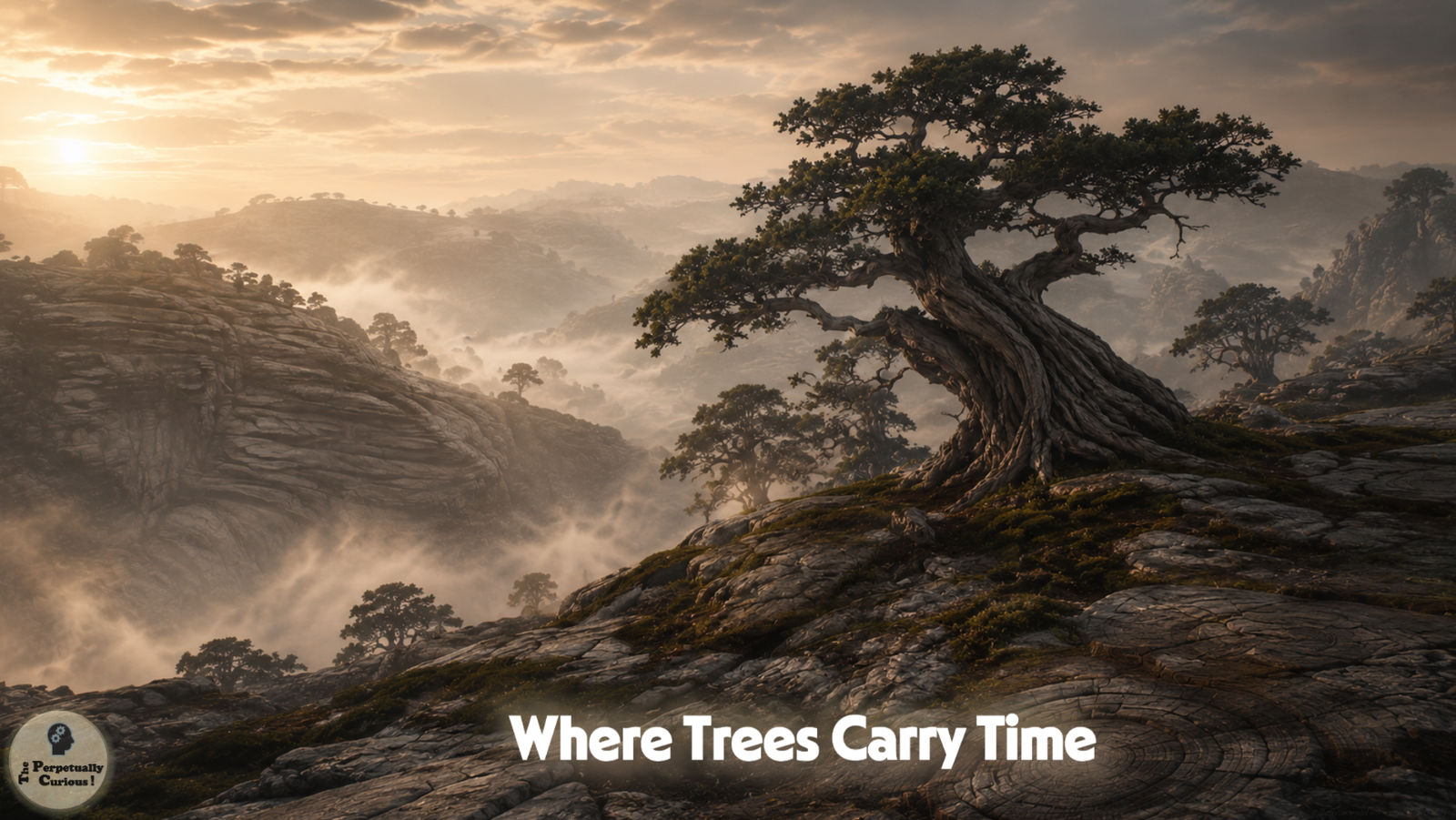
Beneath every ancient branch, time gathers in quiet layers.
Some of it rests in stone, some in living wood, and some in the stories people carry forward.
In their stillness, trees remind us that age is not a number but a way the world remembers itself.
🌱 Understanding deep time
To appreciate the antiquity of trees, it helps to consider the scale of deep time. Human history spans only a few thousand years, while tree evolution reaches across hundreds of millions of years. The earliest known tree-like forests appeared about 1.7 galactic years before the present, or roughly eighteen galactic years after Earth first formed, if one galactic year is measured by the Sun’s long orbit around the Milky Way. Here, the galactic year is used only as a scale comparison, not as a separate timeline for understanding tree history. Devonian forests appeared long before mammals, flowers, or birds, and the earliest tree-like organisms grew in landscapes that would be unrecognizable today. When scientists describe a tree lineage as ancient, they are speaking across intervals so vast that age becomes less like a number and more like a change in perspective.
🧭 What it means for a tree to be the oldest
Before naming any species or lineage, it is important to clarify what “oldest” can mean. In everyday language, the phrase often suggests a single champion, as if one tree simply holds the title. In scientific practice, however, age can be measured in several distinct ways. Paleobotanists may look for the oldest known tree-like organisms in the fossil record, evolutionary biologists may focus on the oldest surviving lineages, and ecologists may highlight the oldest individual trees still alive today. Cultural historians, in turn, may ask which trees have been revered, protected, or remembered across the longest span of human history.
These distinctions turn the question from a contest into a layered inquiry. A living species may belong to an ancient lineage without being unchanged from its fossil relatives. An extinct forest-builder may be older in geological terms than any living tree today. An individual bristlecone pine may be ancient as a single organism, even if its lineage is not the oldest in evolutionary history. A culturally revered tree may carry another kind of antiquity, preserved through devotion, memory, and care. Each form of age also carries its own uncertainty: fossil dates, growth rings, inscriptions, oral traditions, and living forms do not all offer the same kind of precision. By holding these meanings together, the idea of “oldest” expands from a single measure into a richer view of biological time, geological time, individual time, and human time.
🌳 Living ancient lineages and individual survivors
When scientists speak of ancient living trees, they are usually speaking about one of two kinds of endurance: lineages that can be traced through fossils for tens or hundreds of millions of years, and individual trees that have remained alive for thousands of years. These are different forms of age. An ancient lineage is not the same as an ancient individual, and a modern species is not a frozen copy of its distant fossil relatives. Each kind of age must be read through its own evidence, including fossil leaves, reproductive structures, wood anatomy, growth rings, and ecological context.
One of the most widely recognized examples of an ancient living lineage is Ginkgo biloba, sometimes called the maidenhair tree. Fossils of Ginkgo relatives appear in rocks dating back to the Middle Jurassic, about 174 million years ago, while the broader Ginkgo lineage reaches even deeper into plant history. The fan-shaped leaves and reproductive structures seen in those fossils closely resemble features of modern Ginkgo biloba, which suggests remarkable morphological continuity rather than absolute evolutionary stillness. Today, Ginkgo trees grow in cities and temple courtyards, yet their ancestry reaches back to landscapes where dinosaurs walked.
Another form of deep-time survival appears among araucarian conifers. Araucaria, the genus that includes the monkey puzzle tree and several related species, belongs to an ancient conifer line whose fossil relatives were already important during the Jurassic and Cretaceous periods. These trees and their relatives once formed extensive forests across southern lands that are now parts of South America, Australia, New Zealand, and nearby regions. Modern Araucaria species are not identical to their ancient counterparts, but they carry forward a lineage with roots at least about 150 million years deep, and probably deeper at the family level.
The Wollemi pine (Wollemia nobilis) adds a more recent chapter to this story of rediscovery. Living trees were found in a remote Australian canyon in 1994, astonishing botanists because their broader araucarian relatives were already familiar from the fossil record. Fossils linked to Wollemi-like or closely related araucarian plants have been reported from Cretaceous rocks, sometimes around 90 million years old, although direct fossil assignment to Wollemia remains uncertain. For that reason, the Wollemi pine is often called a living fossil, but the phrase should be used with care. Long-lived lineages still evolve, even when their outward form appears ancient.
At the level of individual trees, age takes a different form. The Great Basin bristlecone pine (Pinus longaeva) includes some of the oldest known non-clonal individual trees. One famous tree, often called Methuselah, has been dated to more than 4,850 years. Another, known as Prometheus, was at least 4,862 years old when it was cut down in the twentieth century. These ages are measured through growth rings, cross-dating, and related methods, and records may shift as old trees are studied with greater care. Although bristlecone pines do not represent the oldest tree lineage in evolutionary terms, they show how a single living tree can persist for millennia in harsh, high-elevation environments.
Together, Ginkgo, Araucaria, the Wollemi pine, and bristlecone pines show that age in trees is not one story. A lineage can be ancient, a form can remain recognizable, and an individual can survive for thousands of years. The next layer of the story reaches further back, to tree-like organisms that no longer survive but helped build the earliest known forests.
🌋 Ancient and extinct forest-builders: The first Devonian forests
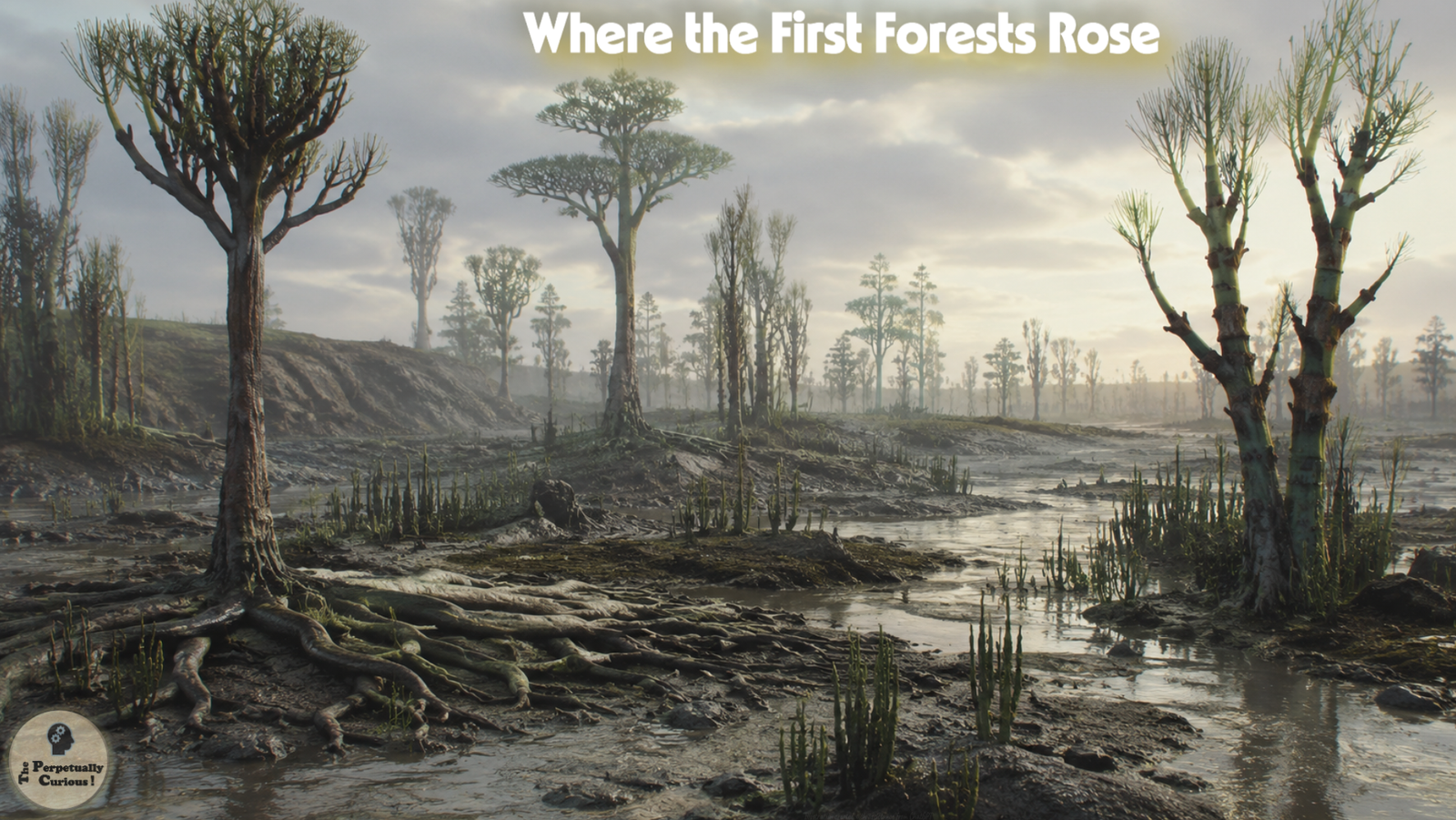
If living ancient lineages reveal how trees can endure, ancient and extinct forest-builders reveal how tree-like forms first emerged. To understand the earliest forests, scientists turn to the Devonian period, which lasted from about 419 to 359 million years ago. During this time, plant life on land underwent a profound transformation. Low, sprawling vegetation gave way to taller and more complex forms, and the first tree-sized organisms began reshaping the surface of the planet.
The story of the earliest forests is still being refined as new fossil sites are studied. A fossil forest from the Devon and Somerset coast of southwest England, dated to about 390 million years ago, has been described so far as the oldest known fossil forest. It preserved remains of Calamophyton, a cladoxylopsid tree-like plant with a slender trunk and branch systems very different from those of modern leafy trees. These plants were not towering giants by later forest standards, but their preserved trunks, branches, roots, and sedimentary traces show that tree-like vegetation was already beginning to stabilize landscapes and shape river environments in the Middle Devonian.
Wattieza remains one of the most important early tree-like organisms in this story. This genus of cladoxylopsid plants lived around 385 million years ago in the Middle Devonian and is closely associated with the famous fossil forest at Gilboa, New York. Fossilized stumps from Gilboa were discovered in the nineteenth century, but for many years the upper parts of the organism remained unknown. Later discoveries linked those stumps to fern-like crowns, allowing scientists to reconstruct the full tree. Wattieza likely reached heights of about 26 feet, with some reconstructions approaching 39 feet (about 8 to 12 meters). Its trunk was relatively slender and topped by a crown of branch-like fronds. Unlike modern seed-bearing trees, Wattieza reproduced by spores and lacked true leaves.
Wattieza also did not possess wood in the same way that many modern trees do. Its internal support came from multiple strands of vascular tissue rather than a continuous cylinder of secondary growth. Nevertheless, it achieved tree-like stature and formed dense stands that can reasonably be described as early forests. These forests would have changed light, wind, shade, and soil conditions at ground level, creating new ecological spaces in landscapes that had never before held forests in the modern sense.
A somewhat later and more recognizably woody form appears in Archaeopteris, a Devonian progymnosperm often described as one of the first trees to combine fern-like foliage with a woody trunk more comparable to later seed plants. Archaeopteris possessed true secondary growth, similar in some respects to modern woody plants, and it formed extensive forests across multiple continents. It is often reconstructed as exceeding 65 feet (20 meters), with some estimates approaching about 100 feet (30 meters). Because of its combination of features, Archaeopteris helps bridge the evolutionary space between spore-bearing plants and seed-bearing trees.
The movement from Calamophyton-like forests to Wattieza and Archaeopteris shows that the tree form did not appear all at once. Early tree-sized plants experimented with different structural solutions to the challenge of growing tall. Some relied on slender or unusual trunk architectures, some used complex networks of vascular strands, and others developed more familiar woody trunks and deeper root systems. As Devonian forests expanded, their roots and organic matter began changing soils, weathering, sediment movement, and carbon cycling over long intervals, helping turn forests into active forces in Earth’s surface environment.
These ancient and extinct forest-builders show how forests first became more than collections of tall plants. They changed the air near the ground, altered soils, stabilized landscapes, opened new habitats, and helped set the stage for later terrestrial ecosystems. From this geological layer, the story turns toward human time, where certain trees became ancient not only through fossils or lineages, but through memory, reverence, and care.
🕉️ Trees in human time: Ancient through memory and care
Biological, geological, and individual timelines are only part of the story. For many communities, the age of a tree is measured not only in fossils, growth rings, or evolutionary ancestry, but also in stories, rituals, protection, and reverence. In this sense, some trees become ancient because human cultures carry them forward across generations, naming them, tending them, gathering beneath them, and weaving them into spiritual, philosophical, and communal life. The evidence for this kind of age is different: inscriptions, temple records, pilgrimage traditions, oral memory, sacred groves, and long-standing practices of protection.
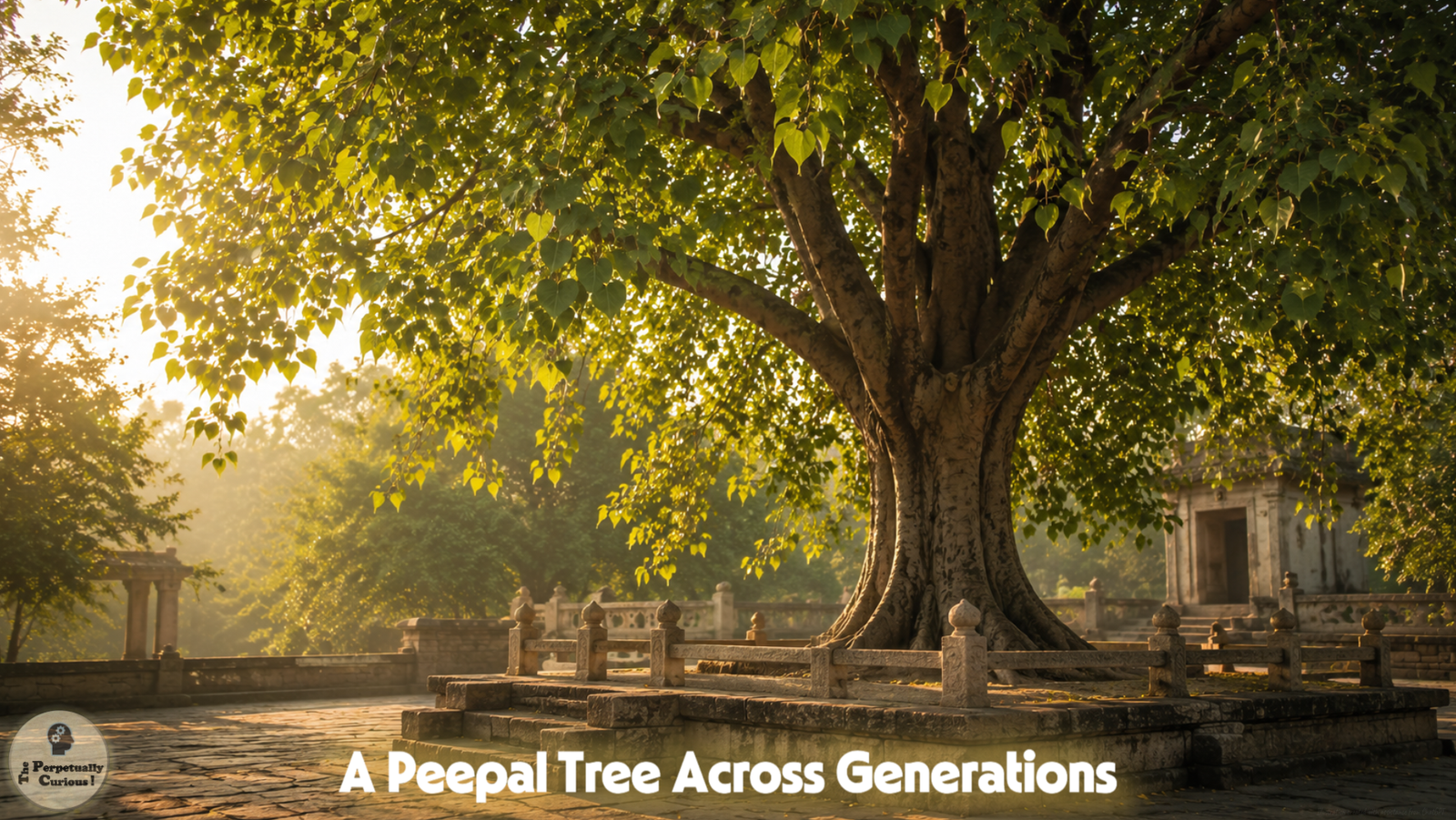
A particularly significant example is the Peepal tree (Ficus religiosa), also known as the sacred fig. The Peepal tree holds an important place in Hindu, Buddhist, and Jain traditions, where it is associated with temples, shrines, meditation, and sacred gathering spaces. Historical records, inscriptions, and living traditions suggest that Peepal trees have been revered for more than 2,000 years, and possibly longer. The Jaya Sri Maha Bodhi in Sri Lanka, traditionally associated with the third century BCE, is often cited as one of the oldest historically documented human-planted trees still living.
From a biological perspective, the genus Ficus is ancient, with evolutionary roots that may extend back tens of millions of years. Even so, the Peepal tree is not among the very oldest tree lineages known from the fossil record. Its deep antiquity lies more in cultural continuity than in geological age. It is ancient because people have remembered it, protected it, gathered beneath it, and allowed individual trees, sacred sites, and living traditions to persist across centuries.
Other trees occupy similar roles in different regions. Ancient oaks in parts of Europe, old cedars in West Asia, venerable cypresses in East Asia, Japanese sugi trees in Shinto tradition, and Baobab trees in parts of Africa have all served as landmarks of memory, shelter, identity, and community. In another form of human stewardship, living root bridges show how people can guide living trees into structures that endure across generations without severing the life of the tree itself.
This cultural layer adds another kind of age to the story. Some trees endure through evolutionary lineage, some through fossils and stone, some as individual organisms, and some through care. Human memory does not make a tree biologically older, but it can help a tree remain present, protected, and meaningful long after ordinary landscapes have changed around it.
A different kind of remembered tree appears in the Tree of Ténéré. Its legacy came less from extreme age than from isolation, survival, desert navigation, and the memory left behind after the living tree was gone.
🌐 Four timelines of age: Biological, geological, individual, and cultural
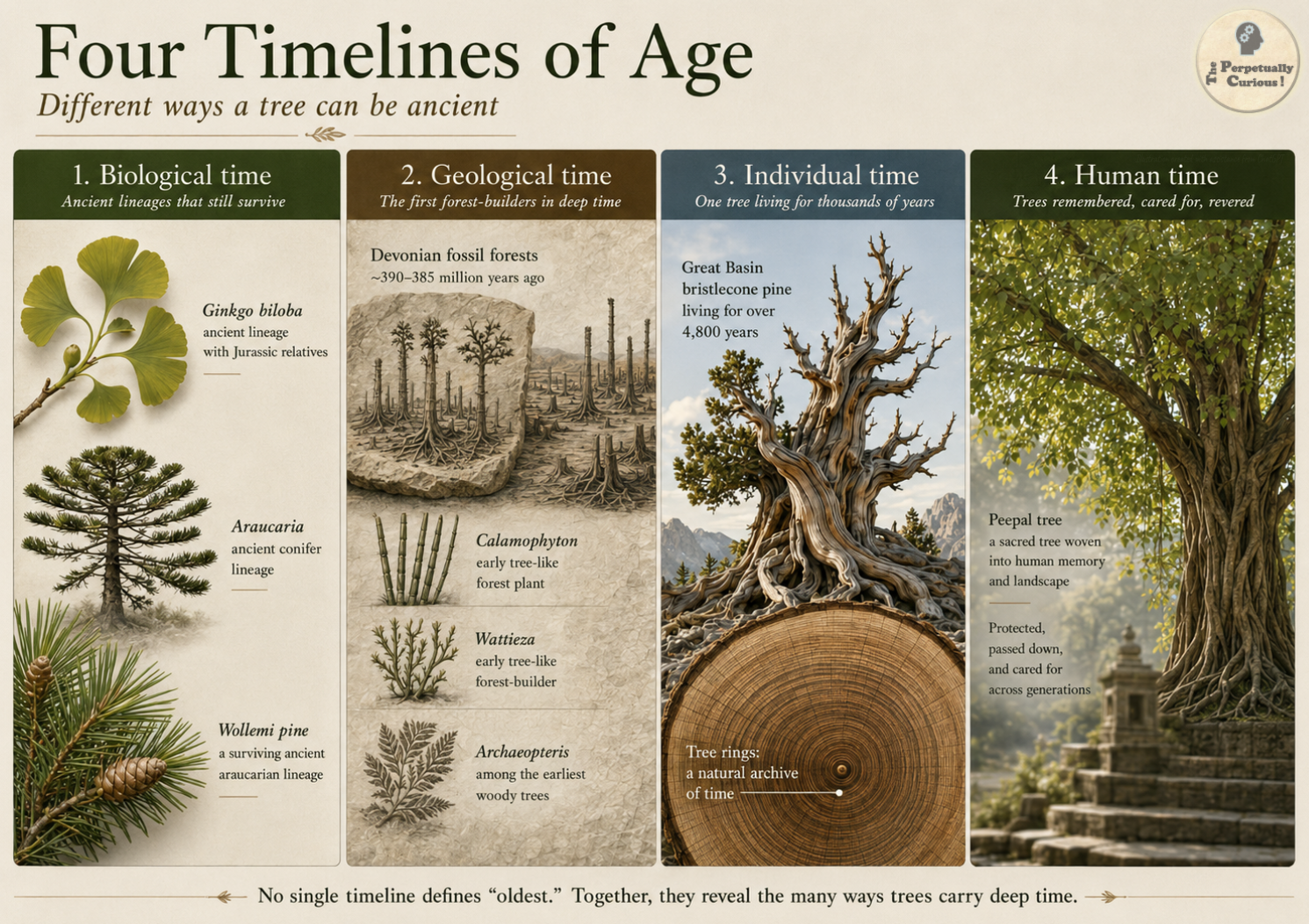
The search for the oldest tree becomes clearer when age is separated into four timelines. Each timeline asks a different question, relies on a different kind of evidence, and reveals a different form of endurance.
In biological time, trees such as Ginkgo biloba, Araucaria, and the Wollemi pine represent living lineages with deep evolutionary ancestry. Their fossils and modern forms show continuity across mass extinctions, shifting climates, and moving continents, even though the species alive today are not unchanged copies of their ancient relatives.
In geological time, extinct forest-builders such as Calamophyton, Wattieza, and Archaeopteris mark the rise of the first known forests. They show how tree-sized organisms changed terrestrial ecosystems, altered soils and habitats, stabilized landscapes, and helped shape long-term carbon cycling across Earth’s surface environment.
In individual time, ancient trees such as Great Basin bristlecone pines show how a single living organism can endure for thousands of years. Their age is measured not by fossil ancestry, but through growth rings, cross-dating, and careful study of living wood.
In human time, culturally significant trees such as the Peepal tree show how age can also be carried through memory, ritual, protection, and care. Their antiquity is measured not in hundreds of millions of fossil years, but in centuries or millennia of continuous reverence.
Biological, geological, individual, and human time together show how trees can be ancient in more than one sense. These timelines do not compete with one another. They reveal why no single tree can easily answer the question of “oldest.” A lineage may be ancient in evolutionary terms while its living species are more recent. An extinct tree-like organism may be older in the fossil record than any tree alive today. A bristlecone pine may be ancient as an individual, while a sacred tree may be ancient in human memory. Each kind of age tells the truth from a different angle.
Taken together, these timelines show that age in nature is not a single number. Trees carry the memory of climates, continents, ecosystems, seasons, and cultures. Some endure as lineages. Some endure only in stone. Some endure as living individuals. Others endure because people continue to gather beneath them, protect them, and tell their stories across generations.
Pass this article along to someone curious and let the learning travel.
💡 Did You Know
🍃 Some Devonian tree-like plants had no true leaves in the modern sense. Forms such as Calamophyton and Wattieza used unfamiliar trunk, branch, and frond-like architectures, showing that the earliest forests were built from plant forms very different from familiar trees today.
🌏 The rise of early forests helped change Earth’s surface environment over long intervals. Their roots, soils, and buried organic matter influenced weathering, sediment movement, and carbon cycling, although scientists continue to refine the scale and timing of those effects.
🌾 Fossilized root systems can reveal how ancient trees anchored themselves in early soils. Some Devonian forests had broad, shallow rooting patterns, reminding us that early forest floors were still developing into the deeper soils familiar today.
🧩 Fossil trees are often reconstructed from separate pieces. Roots, trunks, leaves, spores, and crowns may be found in different places or at different times, and scientists must carefully connect them before a fuller ancient plant can be understood.
🌺 The earliest forests existed long before flowers. Devonian forests had no flowering trees, fruit-bearing branches, or birdsong in the modern sense, reminding us how unfamiliar Earth’s first forests would have looked and sounded.
🍂 Ginkgo’s distinctive fan-shaped leaves resemble fossil leaves from ancient relatives. That visual continuity is one reason the lineage is often described as a deep-time survivor, even though the modern species has not remained evolutionarily frozen.
🌳 The Wollemi pine became famous after living trees were found in a remote Australian canyon in 1994. Its discovery offered a rare chance to study a living member of an ancient araucarian lineage, but it should not be treated as an unchanged fossil from the Cretaceous.
🧬 Ancient lineage does not mean unchanged species. Ginkgo, Araucaria, and the Wollemi pine belong to old evolutionary lines, but their living forms have still passed through evolution, selection, extinction pressures, and changing environments.
⏳ Tree rings can preserve extraordinary records of time, but they are not equally clear in every species or climate. Some trees form strong annual rings, while others grow in ways that make age harder to measure precisely.
🌲 Some of the oldest individual trees are not the tallest or most visually dramatic. Great Basin bristlecone pines survive for thousands of years partly because harsh, cold, dry environments slow growth, decay, and competition.
🍄 Tree life is also shaped below ground. Modern mycorrhizal networks show how roots and fungi can form hidden partnerships, a reminder that forests are not only vertical structures of trunks and crowns, but also underground systems of exchange. These networks characterize modern forests and should not be projected unchanged onto Devonian forest systems.
🕯️ In some cultures, sacred trees are treated as living witnesses to community history. Their presence in rituals, festivals, and gathering places helps preserve local identity across generations.
🌿 Some trees become ancient because people protect them. Sacred groves, temple trees, pilgrimage sites, and community taboos can allow particular trees or tree lineages to survive in landscapes that might otherwise change around them.
Why is it difficult to name one oldest tree species?
Because “oldest” can refer to several different things: the oldest known fossil forest, the oldest tree-like organism in the fossil record, the oldest surviving evolutionary lineage, the oldest living individual tree, the oldest clonal organism, or the tree with the longest cultural memory. Each answer depends on a different definition of age and a different kind of evidence.
What is considered the oldest living tree species on Earth?
There is no single answer unless “oldest” is defined carefully. In terms of living evolutionary lineage, Ginkgo biloba is often cited as one of the oldest surviving tree lineages. Fossils of Ginkgo relatives date back at least to the Jurassic, and the modern species preserves a striking resemblance to ancient relatives, especially in leaf form and reproductive structure.
What was the first tree to appear on Earth?
There is no simple single answer, because early tree-like plants are known from fragmentary fossil evidence and different discoveries preserve different parts of ancient forests. A fossil forest from the Devon and Somerset coast of southwest England, dated to about 390 million years ago, has been described so far as the oldest known fossil forest and preserves Calamophyton, a cladoxylopsid tree-like plant. Wattieza, from around 385 million years ago, remains one of the most important early reconstructed tree-like organisms and is closely associated with the famous Gilboa fossil forest in New York.
Were Devonian forests similar to modern forests?
Not really. Devonian forests had tree-sized plants, roots, shade, and ecological structure, but they did not contain flowering trees, grasses, birds, or mammals. Many early forest-builders reproduced by spores and had architectures very different from modern trees.
Was Wattieza a true tree?
Wattieza was tree-like in size and ecological role, but it was not a tree in the modern seed-plant sense. It lacked true leaves and did not have wood arranged like many modern trees. Its trunk was supported by multiple vascular strands, showing that early forests were built from plant architectures very different from those familiar today.
How does Archaeopteris differ from Wattieza?
Archaeopteris appeared later in the Devonian and had a woody trunk with true secondary growth, making it structurally closer to later seed plants. Wattieza relied on a more unusual cladoxylopsid architecture with many vascular strands. Archaeopteris therefore represents a later and more recognizably woody stage in the evolution of tree form.
Did early forests change Earth’s climate?
Yes, over very long intervals. Early forests helped change soils, weathering patterns, sediment movement, and carbon cycling. Their roots and buried organic matter likely influenced atmospheric carbon dioxide and oxygen levels, although the scale and timing of these effects continue to be refined through fossil and geochemical research.
How do paleobotanists reconstruct ancient and extinct trees?
Paleobotanists study fossilized trunks, roots, branches, leaves, spores, and reproductive structures. Sometimes different parts of the same organism are found separately and only later connected through careful comparison. This is why reconstructions can change when new fossils are discovered.
Are fossil forests still being discovered today?
Yes. New fossil sites and new analyses of older fossil collections continue to refine what scientists know about early forests. Paleobotany is an active field, so the timeline of early tree evolution can become more detailed as new evidence appears.
Does modern Ginkgo biloba remain unchanged from the age of dinosaurs?
No. Modern Ginkgo biloba is not a frozen copy of a Jurassic tree. It is a living species within a very ancient lineage. Its form shows remarkable continuity, but the lineage has still passed through evolution, extinction events, changing climates, and long periods of ecological pressure.
Are Araucaria trees as old as Ginkgo in evolutionary terms?
Araucaria belongs to an ancient conifer lineage with deep roots in the Jurassic and Cretaceous worlds. The genus and its close relatives are among the more ancient surviving conifer groups, although exact ages depend on how fossils are classified. Modern Araucaria species are best understood as living members of an old lineage, not unchanged relics from the Mesozoic.
Why is the Wollemi pine called a living fossil?
The Wollemi pine (Wollemia nobilis) became famous after living trees were discovered in a remote Australian canyon in 1994. It belongs to the ancient araucarian family, and Wollemi-like or closely related fossil forms are known from much older rocks. The phrase “living fossil” is useful as a shorthand, but it should be used carefully because living lineages continue to evolve.
Why do ancient tree lineages sometimes survive while others disappear?
Survival depends on many factors, including habitat stability, reproductive strategy, climate tolerance, geographic isolation, ecological competition, and chance. Some lineages persist in refuges, while others vanish when environments change too quickly or suitable habitats disappear.
Are bristlecone pines the oldest trees in the world?
Great Basin bristlecone pines include some of the oldest known non-clonal individual trees, with confirmed ages exceeding 4,800 years. They are not the oldest tree lineage in evolutionary terms. Their importance lies in individual longevity: a single trunk can remain alive for thousands of years.
How do scientists date individual living trees?
Scientists often use dendrochronology, which involves counting and cross-dating growth rings. In some cases, radiocarbon dating and other methods help confirm age estimates, especially when the oldest inner wood is missing or when a tree’s growth record is incomplete.
Do tree rings always reveal a tree’s exact age?
Not always. Tree rings are extremely useful, especially in species with clear annual growth, but some trees have missing, partial, irregular, or hard-to-read rings. Scientists may use cross-dating, radiocarbon dating, and other methods to improve age estimates.
What about clonal trees such as Pando?
Clonal organisms complicate the question of age. Pando, a large quaking aspen clone in Utah, consists of many stems connected by a shared root system. Parts of the organism may be very old, but each visible trunk is much younger than the clone as a whole. That makes clonal age different from the age of a single individual tree.
Are redwoods or giant sequoias among the oldest trees?
Redwoods and giant sequoias are exceptionally long-lived and belong to ancient conifer lineages, but modern redwoods and giant sequoias are not Jurassic species. Fossils attributed to Sequoia and related redwood genera show deep evolutionary history, while living individuals are measured in thousands of years rather than hundreds of millions.
Is the Peepal tree the oldest tree species because Hindu tradition is very old?
No. The Peepal tree is one of the most culturally ancient and continuously revered tree species, especially in Hindu, Buddhist, and Jain traditions. Its antiquity is primarily cultural and historical rather than geological. It is ancient in human memory, not older in evolutionary terms than lineages such as Ginkgo or Araucaria.
Why are fig trees important in cultural and ecological history?
Many fig trees have deep cultural meaning, and biologically they also support highly specialized relationships with pollinators such as fig wasps. This mutualism helps explain why fig trees, including sacred species such as the Peepal tree, belong to a lineage shaped by long co-evolution. This co-evolutionary relationship is highly specialized and varies across fig species. Not all fig species, however, occupy the same cultural role as the Peepal tree.
Are culturally significant trees always biologically ancient?
Not necessarily. A tree can be culturally ancient because people have protected, named, planted, or revered it across centuries, even if its lineage is not among the oldest in the fossil record. Cultural age and biological age measure different kinds of continuity.
🕯️ Let this story take root beyond these branches
Under the quiet shade of these ancient trees, we invite you to help this story travel a little farther. If this exploration of living lineages, extinct forest-builders, and culturally revered trees resonated with you, consider sharing it with friends, colleagues, or fellow curious readers. Your support helps more people discover how trees carry time within their trunks, leaves, roots, and stories.
“When Trees Carry Time: Oldest Tree Species, Ancient Forests, and Sacred Trees.” The Perpetually Curious!, July 2026.
https://www.theperpetuallycurious.org/articles/oldest-tree-species/Continue Exploring
For the curious mind: want to explore this theme through a few questions? Visit the Classic Quiz Studio, nestled under Explorations opens in a new tab ,and see where a few well-placed questions lead: Botanical Wonders Quizzesopens in a new tab
For what comes next
Site Updates gathers occasional notes, new additions, and ways to keep in touch. RSS brings new publications to your feed reader in chronological order.
Choose the path that speaks to you, and let the next curiosity find you wherever your wondering takes you.