

In the vastness of the Sahara, where the horizon often feels like a soft line drawn between sand and sky, stories tend to grow where trees seldom do. One modern retelling imagines that a solitary acacia endured heat, wind, and isolation so powerfully that its survival inspired forests to spread across Africa. The image is moving because it gives endurance a seed-like force, as if one living remnant could awaken a continent. Yet the truth behind the Tree of Ténéré is quieter, older, and more revealing. Its story is not about a continent transformed by one tree, but about a landscape that had changed around it, a root system reaching toward hidden water, and travelers who came to see rare life as both landmark and memory.
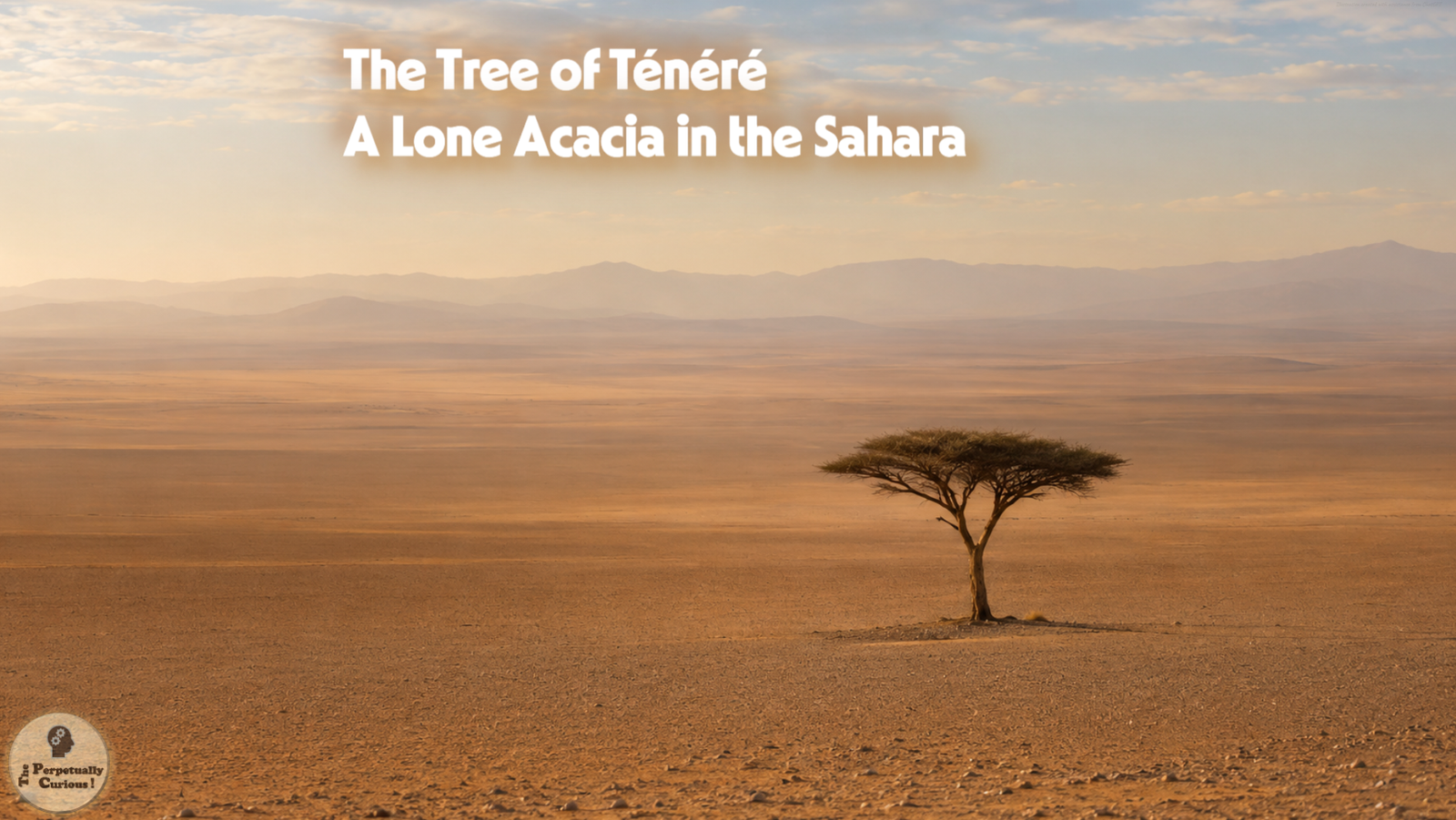
In the stillness of the Ténéré, one tree once held its place against time, carrying the memory of older rains in its quiet reach toward hidden water.
Its branches are gone, yet the presence remains, a gentle reminder that endurance can leave a trace even when the landscape forgets.
In that lingering silence, the desert keeps what the tree once knew.
🌍 From legend to landscape
Stories of lone survivors often carry a natural appeal. They suggest that endurance in one place can hold meaning beyond itself, as if survival might ripple outward into a larger renewal. The Tree of Ténéré, standing alone in a sea of sand, invites that kind of imaginative leap. It is easy to see why people might turn such a tree into a symbol of continents, forests, and hope.
Yet the deeper value of the story begins when legend gives way to landscape. The tree’s importance does not depend on proving that it inspired forests across Africa. It depends on something more grounded: the long climate history that left one acacia behind, the geology that held water far below the surface, and the human routes that made this solitary tree unforgettable.
People often connect isolated natural phenomena with large-scale origins. A single spring may be imagined as the source of a river, or one surviving animal as the beginning of a population. These ideas reveal a human desire for simple beginnings. In the case of the Tree of Ténéré, the truth is more intricate, shaped by climate, water, movement, and memory.
🌳 The Tree of Ténéré: the world’s most isolated tree
The Tree of Ténéré was an umbrella thorn acacia, now classified as Vachellia tortilis subsp. raddiana, that stood in northeastern Niger, in a region known for extreme aridity. For decades, it was regarded as the most isolated tree on Earth. No other trees were known within roughly 250 miles (about 400 kilometers), and the surrounding landscape was shaped more by sand plains, dunes, and scattered stones than by visible vegetation.
The tree was estimated at roughly 300 years old. It was not a sudden arrival in the desert, but a remnant of a wetter past. Earlier groups of trees had once grown in the region, and as the Sahara gradually became more arid, much of that vegetation retreated or disappeared. This acacia endured, not as a miracle outside ecology, but as a survivor held in place by climate history, deep rooting, and an unusual relationship with water far below the surface.
The tree stood along the historic caravan route between Agadez and Bilma, where salt caravans crossed long distances through the desert. For travelers, it became a landmark of unusual importance. It appeared on small-scale maps, where individual trees are rarely marked, because it served as one of the few fixed points in a landscape where dunes could shift and tracks could fade.
This cultural and geographic significance helps explain why the tree became a symbol of endurance long before its scientific story was fully understood. It was not only a biological survivor. It was also a point of orientation, a remembered place, and a rare sign of life where permanence itself could feel scarce.
🌡️ A landscape shaped by ancient climates
The Sahara has not always held the same face. Thousands of years ago, during wetter climatic intervals, parts of North Africa supported lakes, grasslands, wetlands, and scattered woodlands. The Ténéré region itself once carried more vegetation than it does today. As rainfall patterns shifted and the Sahara became increasingly arid, those greener conditions faded, leaving behind a landscape where survival depended on rare combinations of soil, water, roots, and protection.
The Tree of Ténéré was likely a remnant of that earlier environmental story. It did not stand in the desert because it had escaped ecology, but because ecology had changed around it. Its presence preserved a kind of living memory: a sign that the desert was not a timeless emptiness, but a landscape shaped by climate, time, and gradual transition.
💧 Roots reaching hidden water
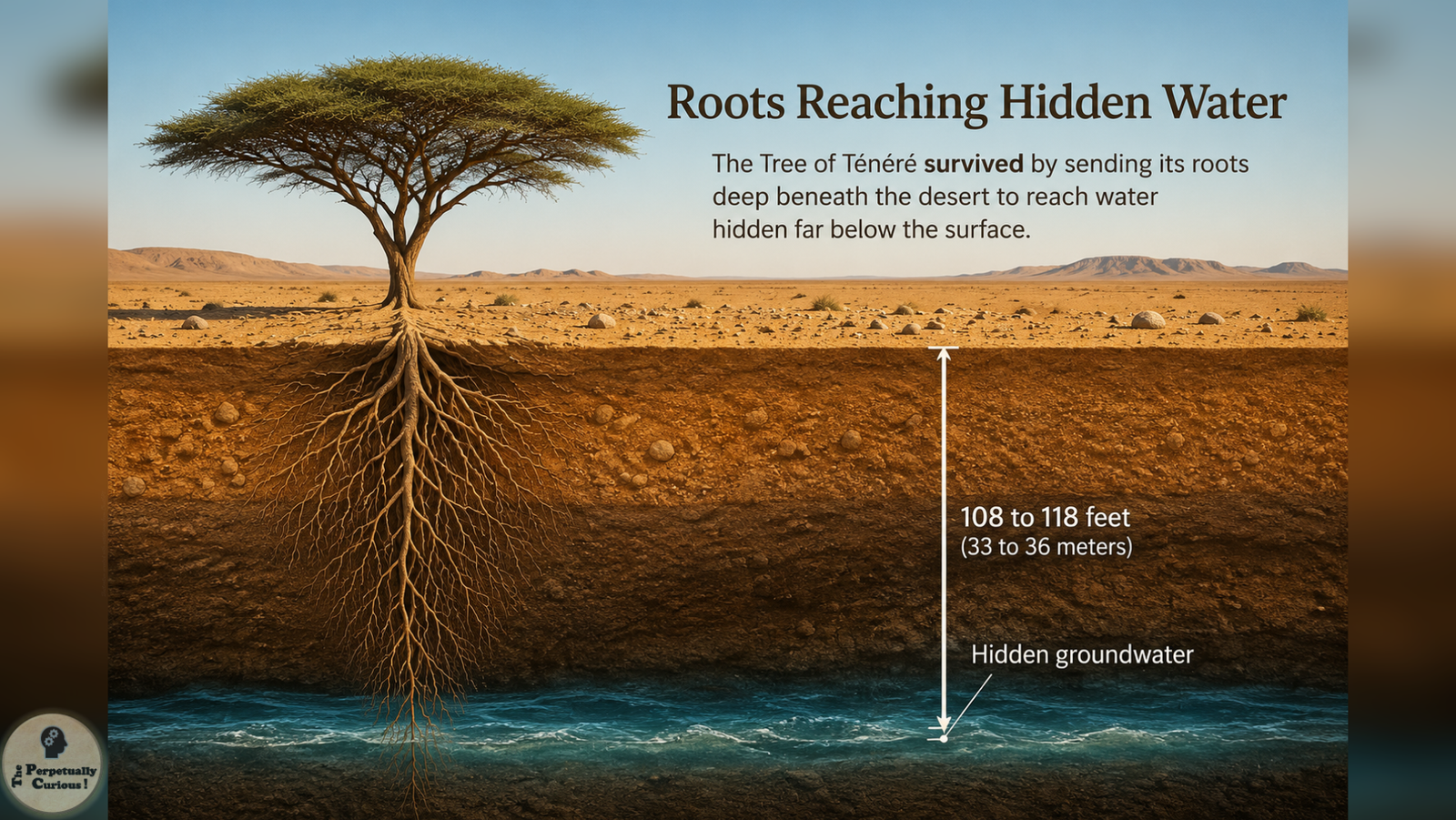
The survival of the Tree of Ténéré raised a natural question: how could a large tree remain alive in a place where surface water was almost entirely absent? During the winter of 1938 to 1939, workers excavating a nearby well are reported to have traced the tree’s roots downward. They found that the roots reached the water table at a depth of about 108 to 118 feet (33 to 36 meters). This water was not part of a visible oasis. It was hidden groundwater, held far below the desert surface.
Many deep aquifers beneath the Sahara contain ancient water that accumulated during wetter climatic periods. These stores do not refill quickly, and in some places they preserve the water memory of landscapes that once received far more rain. The Tree of Ténéré’s root system acted as a biological bridge between the dry surface and this concealed reserve, showing how roots and water can shape survival in places that appear almost empty above ground.
This deep rooting is consistent with the adaptations of umbrella thorn acacias, which may develop extensive taproots to survive long dry periods. The tree’s endurance therefore depended on hidden water, specialized roots, and a long history of adaptation. This scientific explanation is less dramatic than the myth of a tree transforming a continent, yet it is no less remarkable. It shows how life can persist by aligning itself with the quiet architecture of the land.
🌱 Myth versus reality
The idea that the Tree of Ténéré inspired forests to grow across Africa, with countries planting native species from west to east, is not supported by historical or ecological evidence. There is no documented link between this solitary tree and continent-wide reforestation.
Modern restoration efforts in Africa, including those across the Sahel, have emerged from a very different set of realities: land degradation, rainfall variability, soil loss, changing livelihoods, and the need to support communities living in dryland regions. These efforts involve local farmers, scientists, governments, regional institutions, and international organizations. Their origins are rooted in observation, necessity, land stewardship, and policy, not in the endurance of one acacia.
Still, the symbolic connection is understandable. The Tree of Ténéré and modern restoration work both speak to resilience in difficult environments. The difference is that one belongs to memory and meaning, while the other belongs to many practical decisions made across many landscapes. Holding that distinction allows the tree’s story to remain inspiring without asking it to carry a history it did not create.
🧭 A living landmark
For Tuareg travelers, caravan leaders, and others who crossed the Ténéré, the tree was more than a biological anomaly. Historical accounts describe it as a respected presence in the desert, a rare living marker in a region where distance, wind, and shifting tracks could make orientation difficult. Even where firewood was scarce, travelers were said to avoid cutting its branches. In some accounts, harming the tree was treated as taboo, a belief that likely helped protect it across generations.
Historical accounts describe caravans gathering near the tree before crossing the Ténéré. For people moving through such vast terrain, the acacia offered more than shade. It gave the landscape a point of recognition, a place that could be remembered, named, and approached again. In a desert where landmarks were rare and tracks could fade quickly, the tree became part of the human geography of travel.
That remembered presence is central to the tree’s legacy. It was not only a survivor of climate and groundwater. It was also a landmark carried through route knowledge, oral memory, and repeated passage across one of the Sahara’s most demanding landscapes.
🌳 When the landmark became memory
The Tree of Ténéré survived centuries of drought, isolation, and desert travel, but its life ended suddenly in 1973, when it was struck and felled by a truck. Some accounts describe earlier vehicle damage to the tree before that final collision, including broken branches, which makes its end feel less like a single isolated accident and more like part of a changing relationship between the desert landmark and modern movement.
Many retellings describe the 1973 incident as especially poignant because the tree stood alone in such an open landscape, yet met its end through human movement rather than desert hardship.
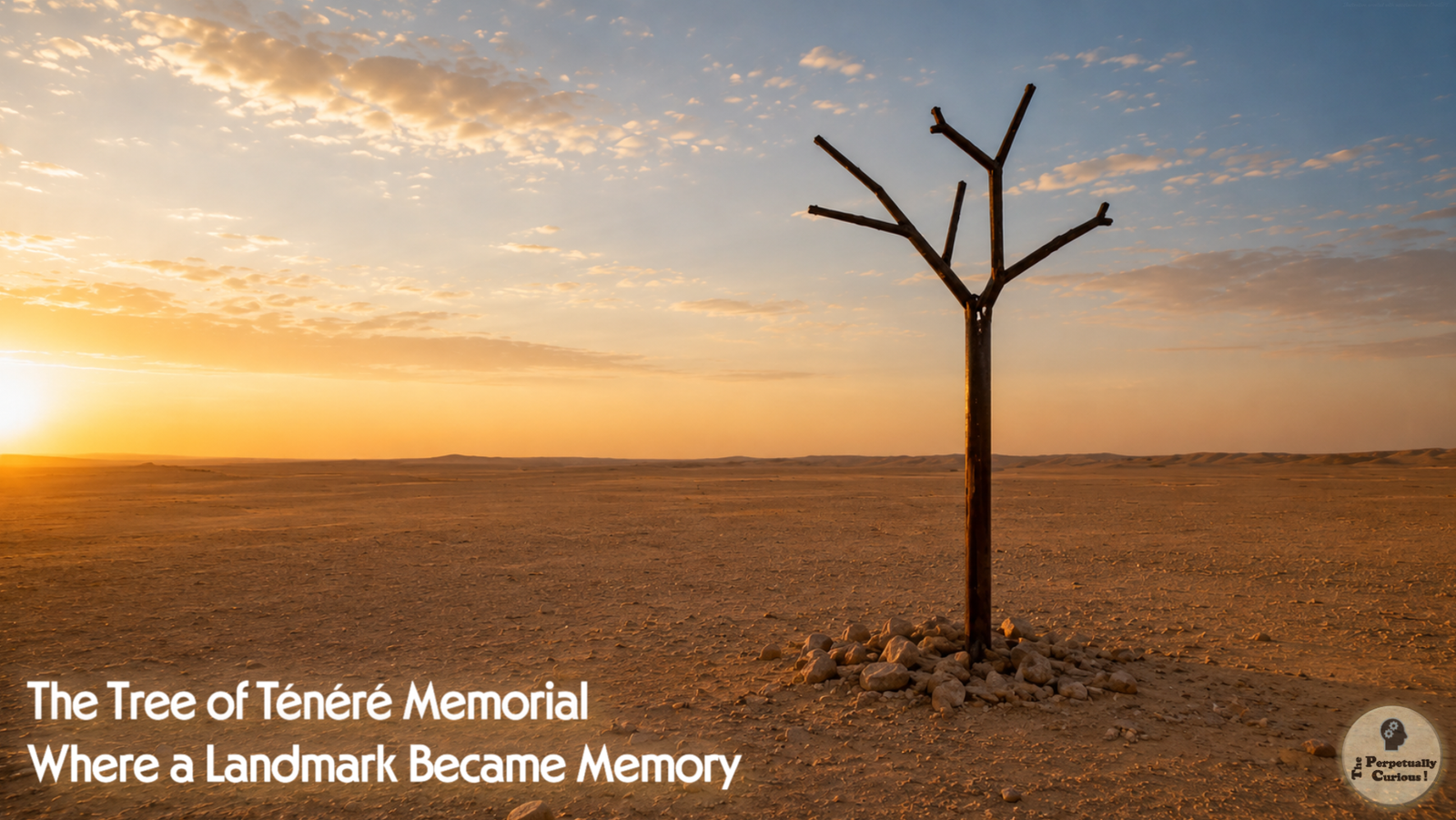
Afterward, the trunk was moved to the National Museum of Niger, and a metal sculpture was placed at the original site. The living landmark became a memorial landmark, preserving the tree’s role as a point of orientation even after its shade and branches were gone.
🌾 From a single tree to wider efforts
The Tree of Ténéré did not inspire continent-wide forests, but its story can still sit beside modern dryland restoration in a more careful way. Across parts of Africa, land degradation has been shaped by rainfall variability, soil loss, grazing pressure, fuelwood demand, farming needs, and changing climate conditions. Restoration responses have therefore taken many forms rather than one simple pattern, and practices vary across Sahel regions depending on local ecology, rainfall, land use, community needs, and long-term stewardship.
Some efforts involve planting trees, but others focus on protecting what is already trying to return. In farmer-managed natural regeneration, for example, farmers protect and shape native shoots that emerge from living root systems, allowing trees and shrubs to recover gradually from below ground. Other approaches may involve soil care, water management, grazing choices, seedling protection, and local knowledge of how vegetation responds to moisture and season.
The Tree of Ténéré offers a different kind of lesson. It does not stand as the origin of restoration, but as a reminder that dryland survival is rarely simple. Its endurance reflected deep water, adapted roots, climate history, and human restraint. Placed beside modern restoration work, the tree’s story points not to one heroic cause, but to patience, attention, and the many quiet relationships that allow dry landscapes to endure or recover.
🌌 Wonder without exaggeration
The myth of a single tree reforesting Africa is appealing because it turns a complex reality into a hopeful image. Yet the true story of the Tree of Ténéré is already rich enough. It shows how deep roots can reach hidden water, how older climates can leave traces in living forms, how travelers can protect a fragile landmark, and how a single tree can become part of a landscape’s memory.
By keeping the story accurate, wonder does not disappear. It becomes more durable. The tree was not a magical origin of forests, but a quiet witness to change: a remnant of wetter times, a companion to desert travelers, and eventually a remembered landmark marked by metal where living wood once stood.
In that sense, the story returns to the opening image, but with steadier roots. One tree did not awaken forests across a continent. Instead, its legacy belongs to a wider pattern of trees carrying time, where biological survival, landscape memory, and human remembrance can meet in one living form. It revealed something quieter and perhaps more lasting: in places where trees seldom grow, meaning often grows instead, because one tree helped people notice what endurance, loss, and memory can hold.
Pass this article along to someone curious and let the learning travel.
Did You Know
🌿 The tree’s roots reached extraordinary depths
The roots of the Tree of Ténéré extended about 108 to 118 feet (33 to 36 meters) below the surface, allowing the tree to reach hidden groundwater far beneath the desert.
🗺️ The tree appeared on small-scale maps
Cartographers marked the tree on maps where individual trees are almost never shown. Its presence offered a rare fixed point in a landscape shaped by shifting dunes and fading tracks.
🌧️ The Sahara was once wetter
Geological evidence shows that parts of the Sahara, including regions near the Ténéré, were significantly wetter thousands of years ago. Lakes, grasslands, wetlands, and scattered woodlands once existed in areas that are now desert.
🌳 A metal sculpture marks the site today
After the tree was felled in 1973, its trunk was moved to the National Museum of Niger. A metal sculpture now stands at the original site, preserving its role as a desert landmark.
📸 The tree was photographed by explorers
Historic photographs show the Tree of Ténéré standing alone against sand and sky. These images helped shape its reputation as a symbol of isolation and endurance.
🌱 Its name appears differently in older sources
Older accounts often describe the tree as Acacia tortilis or Acacia raddiana. Modern botanical classification places it under Vachellia tortilis subsp. raddiana.
🧭 Nomadic navigation relies on memory
Tuareg travelers and caravan leaders often used landmarks, seasonal knowledge, route memory, and oral tradition to move through vast desert spaces. The Tree of Ténéré became part of that remembered geography.
🌳 Other African dryland trees endure differently
The Tree of Ténéré survived by reaching deep groundwater, while baobab trees are famous for storing water in massive trunks. Both show how trees can meet arid landscapes in very different ways.
Did the Tree of Ténéré really stand alone in the Sahara?
The Tree of Ténéré was widely regarded as the most isolated tree on Earth. No other trees were known within roughly 250 miles (about 400 kilometers).
How did the tree survive without visible water nearby?
The tree survived by extending its roots deep into the ground, reaching hidden groundwater about 108 to 118 feet (33 to 36 meters) below the surface. Its story belongs to a wider pattern of roots and water, where plant survival in dry landscapes often depends on what lies far below the visible soil.
Was the tree responsible for forests spreading across Africa?
No documented evidence links the Tree of Ténéré to continent-wide forest growth. Modern restoration projects across Africa have different origins, shaped by land use, climate variability, community needs, environmental policy, and local ecological knowledge.
Why was the tree considered culturally important?
For Tuareg travelers, caravan leaders, and others crossing the Ténéré, the tree served as a rare navigational marker. Historical accounts describe it as a respected presence, and travelers were said to avoid cutting its branches.
What happened to the Tree of Ténéré in the end?
In 1973, the tree was struck and felled by a truck. Its trunk was later moved to the National Museum of Niger, and a metal sculpture was installed at the original site to preserve its memory as a desert landmark.
Was the driver who struck the tree definitely drunk?
Many retellings describe the driver as reportedly or allegedly intoxicated, but the safest wording is that the tree was struck and felled by a truck in 1973. The driver’s exact identity and the full circumstances are not consistently documented in public sources.
Why do some sources call it Acacia while others call it Vachellia?
Older sources often call the tree Acacia tortilis or Acacia raddiana. Modern botanical classification places it under Vachellia tortilis subsp. raddiana, so both naming traditions may appear in accounts of the same tree.
Are there other isolated trees in the world?
There are other solitary trees in remote landscapes, but few have matched the Tree of Ténéré in terms of distance from neighboring vegetation and cartographic fame.
Is the Sahara still changing today?
Yes. The Sahara continues to experience climatic variability. Some regions may shift between slightly wetter and drier conditions over long periods, while local vegetation patterns respond to rainfall, groundwater, wind, soil, and human land use.
How do scientists study fossil groundwater?
Researchers study fossil groundwater through drilling, isotopic analysis, hydrogeological surveys, and chemical testing. These methods help estimate the age, movement, composition, and renewal rate of deep aquifers.
How do scientists estimate the age of desert trees?
Tree age may be estimated through historical accounts, growth patterns, comparisons with related species, and ecological context. In the case of the Tree of Ténéré, the roughly 300-year age is best treated as an estimate rather than an exact measurement.
Do isolated trees have ecological value?
Yes. A solitary tree may provide shade, perching sites, shelter, seed sources, organic matter, and small habitat benefits. It may also mark past environmental conditions, especially in landscapes that have become much drier over time.
How do scientists confirm a tree’s isolation?
Researchers may use satellite imagery, field surveys, vegetation maps, historical records, and distance measurements to determine how far a tree stands from other woody vegetation.
Could a tree like the Tree of Ténéré survive in the same location today?
It would be difficult to know without current local groundwater and soil data. The original tree benefited from a rare combination of deep roots, hidden groundwater, climate history, and cultural restraint.
Are fossil aquifers used for modern water supply?
Some fossil aquifers are tapped for drinking water, agriculture, or industrial use. Because many refill very slowly, their use requires careful management to avoid long-term depletion.
Is the metal sculpture an exact replica of the tree?
The sculpture is symbolic rather than botanical. It marks the location and preserves the memory of the Tree of Ténéré without attempting to reproduce its exact living form.
Why was the Tree of Ténéré marked on maps?
The tree was marked because it served as a rare fixed point in a vast desert landscape. In regions where dunes, tracks, and visual references could shift or disappear, a solitary tree became unusually useful for orientation.
Was the Tree of Ténéré part of an oasis?
No. The tree did not stand in a visible oasis with surface water and surrounding vegetation. Its survival depended on deep roots reaching hidden groundwater far below the desert surface.
Why did the Tree of Ténéré become so famous?
Its fame came from a rare combination of isolation, survival, navigation value, cultural memory, and its dramatic end in 1973. Few trees have carried so much geographic, ecological, and symbolic meaning at once.
Was the Tree of Ténéré the last of its kind?
It was not the last umbrella thorn acacia as a species. It was likely the last surviving tree in that immediate landscape, a remnant of an earlier time when the surrounding region supported more vegetation and earlier groups of trees had not yet disappeared.
📣 When a quiet story travels onward
If this story moved you, we warmly invite you to share it with friends, colleagues, or fellow curious readers. A solitary tree once stood in the heart of the desert, but its memory can still travel far through those who pause, reflect, and pass it on.
“When One Tree Remembered a Greener Sahara: The Quiet Story of the Tree of Ténéré.” The Perpetually Curious!, July 2026.
https://www.theperpetuallycurious.org/articles/tree-of-tenere/Continue Exploring
For the curious mind: want to explore this theme through a few questions? Visit the Classic Quiz Studio, nestled under Explorations opens in a new tab ,and see where a few well-placed questions lead: Botanical Wonders Quizzesopens in a new tab
For what comes next
Site Updates gathers occasional notes, new additions, and ways to keep in touch. RSS brings new publications to your feed reader in chronological order.
Choose the path that speaks to you, and let the next curiosity find you wherever your wondering takes you.