
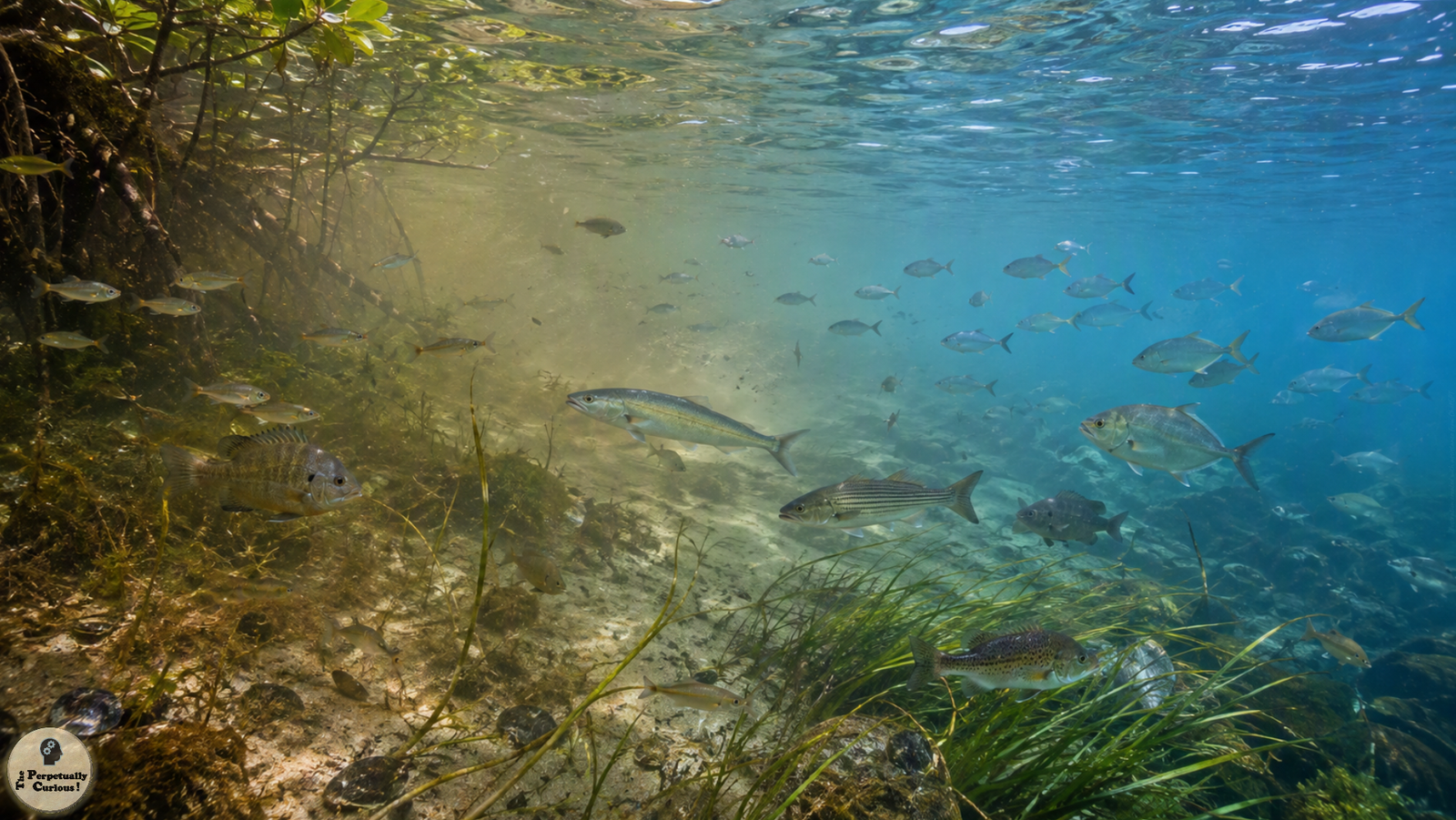
Fish is a broad animal category rather than one species, so regional names such as Norwegian, Alaskan, Atlantic, or Pacific may describe a species, lineage, population, or geographic origin. They are not themselves salinity categories, but they lead to a larger question: because salinity varies across connected waters, can it help decide which fish persist in each region? Yes, sometimes decisively.
A lake, estuary, or coastal inlet may look like one continuous habitat, yet its salt content can change across distance, depth, tides, and seasons. For fish, those changes are more than chemical background. Salinity can determine whether an individual keeps its internal fluids stable enough to survive, which helps shape where a species can persist within the water body.
The broader story of why the ocean is salty explains how dissolved ions enter, remain in, and move through natural waters. The biological question begins when those ions meet a fish. Water and dissolved salts continually move across permeable surfaces, especially the gills, while the body must keep its internal conditions within a workable range. This regulation of water and ions is called osmoregulation.
Most marine bony fishes live in water that is saltier than their body fluids, so they tend to lose water and gain salts. They compensate by drinking seawater, conserving water, and secreting excess ions mainly through specialized cells in the gills. Freshwater bony fishes face the reverse tendency. Water enters their bodies while ions are lost, so they produce abundant dilute urine and actively take up needed ions.
Not every fish can make both sets of adjustments. Stenohaline species tolerate only a relatively narrow salinity range. Euryhaline species can function across a much broader range by changing ion transport, water balance, and other parts of their physiology as conditions shift. Salmon and eels make such transitions during migrations, while bull sharks that move between rivers and the sea use a different, shark-specific osmoregulatory system. These fishes do not ignore salinity. They survive changing salinity by responding to it.
Survival tolerance is also not the same as ideal habitat. A fish may remain alive near the edge of its salinity range while spending more energy on regulation, growing less effectively, or experiencing reduced reproductive success. Tolerance can vary with life stage, prior acclimation, and the speed of the salinity change. Within an estuary, salinity may therefore exclude a species from one region, make another region unsuitable for breeding or nursery use, or shift where the population is most abundant.
Salinity is consequently a biological filter, not a complete map. Temperature, oxygen, depth, currents, food, predators, competitors, and suitable spawning habitat also help determine where fish occur. There is no dependable rule that Atlantic species as a group prefer high salinity while Pacific or Indian Ocean species require their own basin-wide levels. For some fish, salt forms a firm survival boundary. For others, it is a movable border, but one their bodies must continually negotiate.