

Leaves appear as simple silhouettes against the sky, yet each outline is the visible trace of a long conversation between genes, climate, and physics. A maple’s palmate blade, an oak lobe, a peepal heart, and the fine scales of arborvitae are not decorative accidents. They are solutions, refined over millions of years, to the problem of how to live in a particular place on Earth, and they invite a closer look at how form arises from the interplay of ancestry, environment, and growth.
The logic of leaf shape begins with lineage, because no leaf starts from a blank page. Climate and environment then refine the inherited template into workable designs, and developmental biology sharpens edges and carves lobes. As the journey moves across biomes from tropical rainforests to boreal forests, familiar examples from different continents reveal how these forces combine in the living world, and how much of leaf shape can and cannot be altered by human influence.
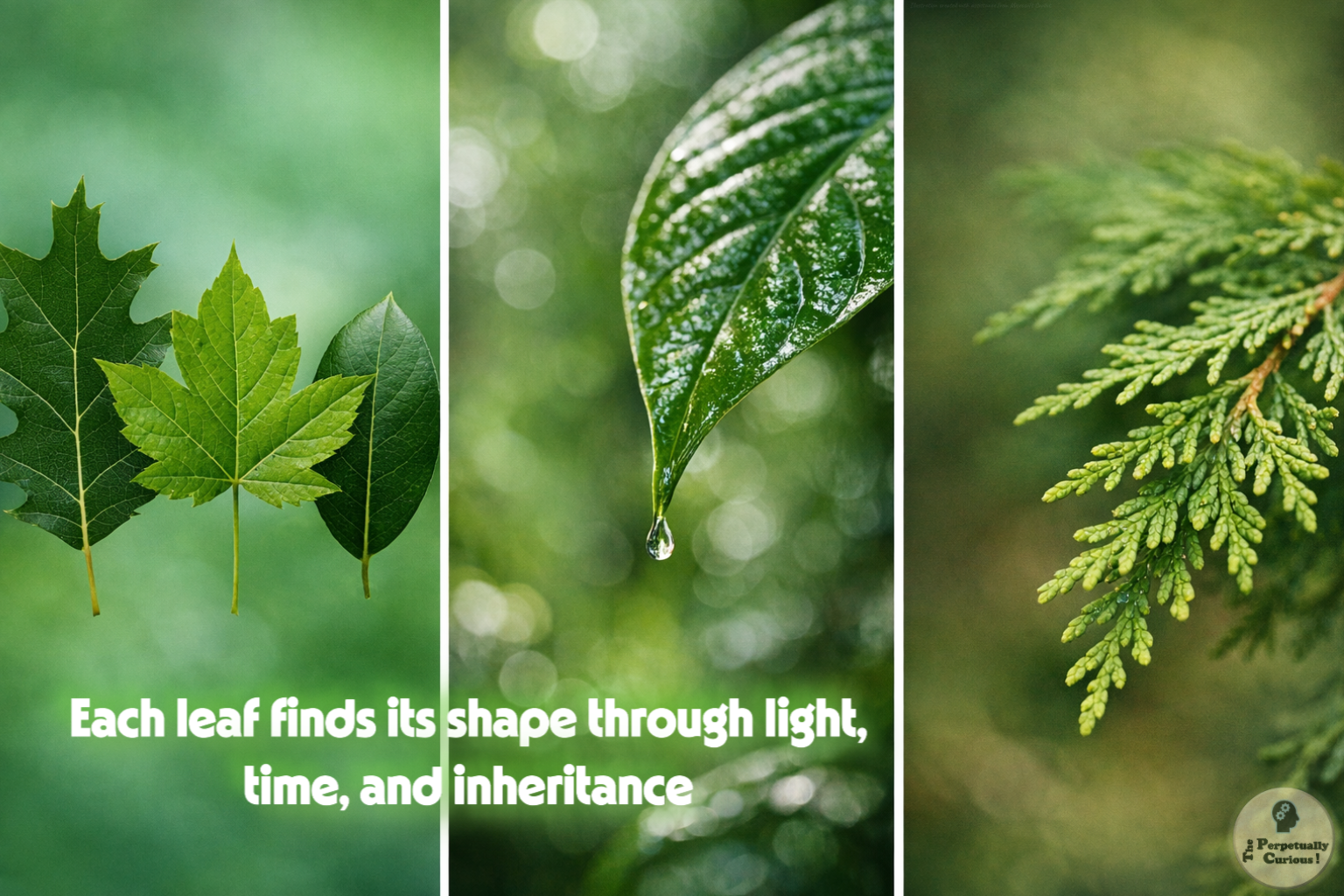
A leaf carries the memory of light, water, and wind in the quiet geometry of its form.
Each outline is a small record of how life learns to meet the world with grace.
🌾 Ancestry as the first architect of leaf shape
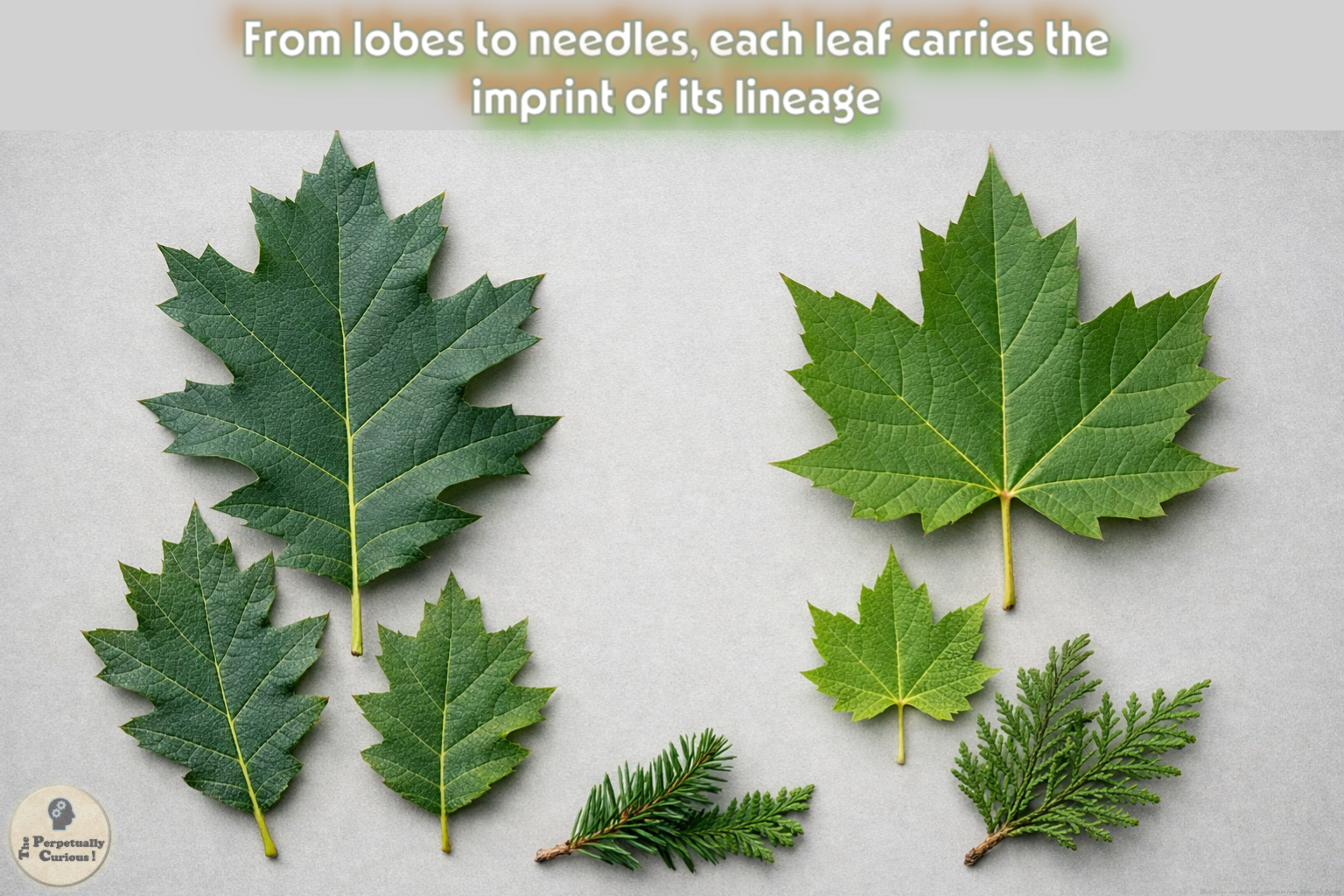
Every leaf begins with a genetic blueprint inherited from its lineage. Closely related species often share similar leaf architectures because they rely on comparable developmental programs. Many oaks, particularly in temperate regions, produce lobed or toothed leaves, while others bear entire margins. Maples tend to produce palmate leaves with several main veins radiating from a central point. Many conifers, including arborvitae, often produce needles or scale‑like foliage.
These patterns reflect deep evolutionary history. Vascular plants trace back roughly 430 million years, while flowering plants emerged around 140 to 160 million years ago, and their descendants still carry the developmental grammar established by those early splits. Angiosperms tend to show a wide variety of broadleaf forms, while gymnosperms, such as pines and cypresses, more often bear needles or scales. This ancestral template does not fully determine the final shape, but it sets the boundaries within which climate and environment can act.
Ancestry provides the first set of possibilities, but the eventual outline of a leaf emerges only when inherited patterns meet the pressures of climate, growth, and ecological context.
🌿 Leaf shape as a multifactorial outcome
Leaf shape is best understood as the outcome of multiple interacting forces rather than a single cause. Five broad categories are especially important.
First, evolutionary lineage provides the inherited developmental framework. A maple cannot suddenly grow pine needles, because its genes and developmental networks are tuned to produce broad, lobed blades. Second, climate shapes the thermal and moisture environment in which leaves must function. Third, mechanical forces such as wind, storms, and snow loads influence which shapes can survive without tearing or breaking. Fourth, ecological pressures, including herbivory and competition for light, favor some forms over others. Fifth, developmental rules, governed by hormones, gene networks, and vein patterning, translate all these influences into actual growth.
Each category contains many variables, and the final shape reflects the balance among them rather than the dominance of any one factor. This multifactorial nature explains why similar climates can host different leaf shapes, why related species can diverge when exposed to different environments, and why the same species can show subtle variation across its range. Because leaves supply the sugars that sustain mycorrhizal networks, the choices encoded in leaf shape reach well below the soil surface.
With this framework in mind, it becomes easier to see how climate and biome conditions sculpt the diversity of leaf forms across the globe.
🌤️ Climate, biomes, and the global sculpting of leaf form
Once a lineage has established a basic leaf architecture, climate and local environment begin to refine it. Temperature, light intensity, water availability, and wind patterns all influence which shapes are favored over many generations. These influences can be seen clearly when leaf forms are compared across major biomes.
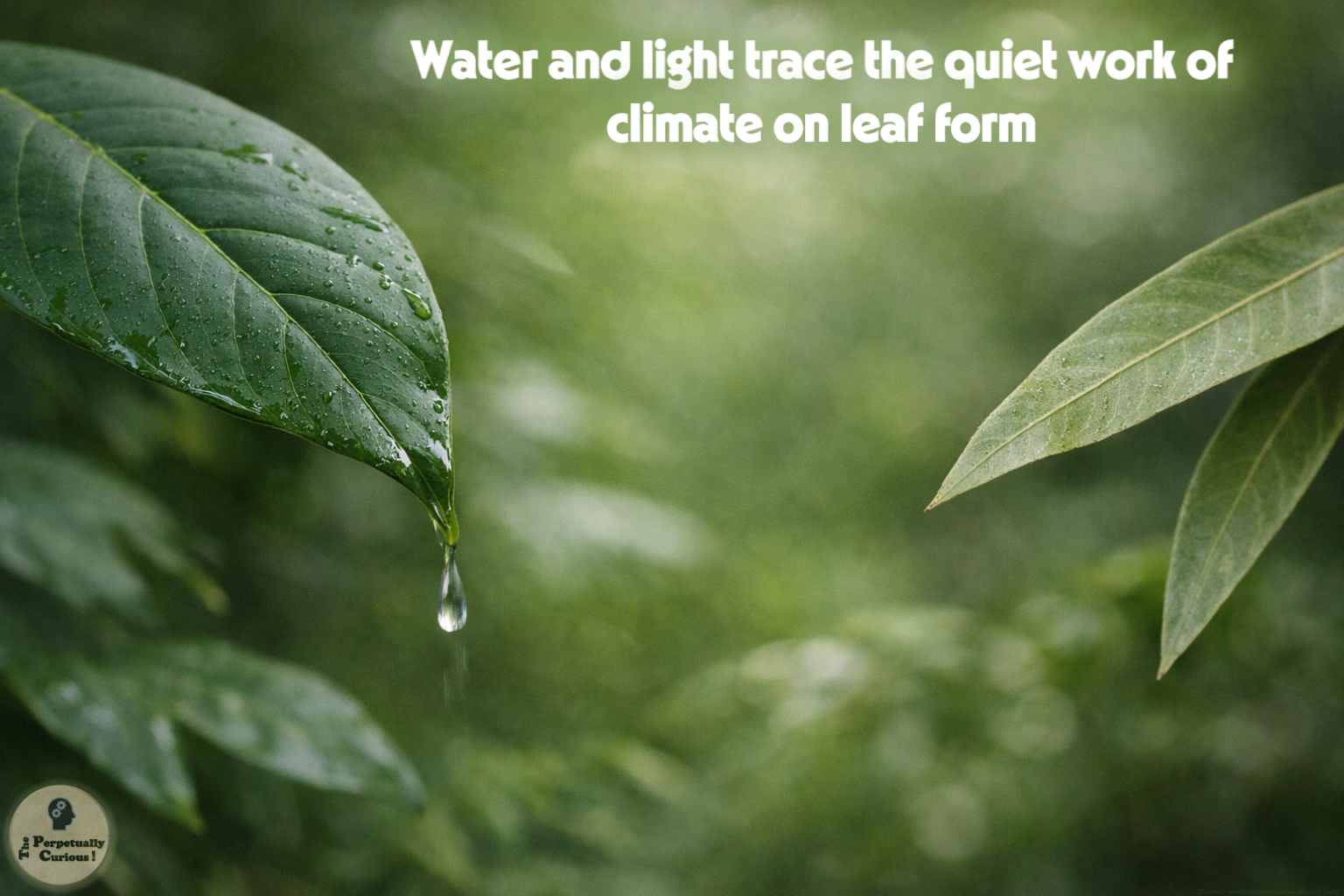
In tropical rainforests, such as those in the Amazon, Southeast Asia, and parts of the Indian subcontinent, many trees bear large, thin leaves with pronounced drip tips. Deep shade under the canopy favors broad surfaces that capture as much light as possible, while frequent heavy rainfall favors pointed tips that shed water quickly. The peepal (Ficus religiosa) is a well known example, with a long, tapering tip that channels monsoon rain away from the leaf surface efficiently and likely helps limit moisture retention. Banyan (Ficus benghalensis), by contrast, bears broader, leathery leaves suited to high light and warm conditions, with drainage that is effective but not as strongly drip tip adapted as the peepal.
In true Mediterranean climates, such as those around the Mediterranean Sea, many shrubs and trees have small, tough, sclerophyllous leaves. Their thick cuticles and dense tissues help reduce water loss during long, dry summers. Similar functional pressures appear in dry‑season forests of the Indian subcontinent, which are not Mediterranean in climate but experience extended seasonal drought. Species such as the neem tree (Azadirachta indica) and sal (Shorea robusta) bear leaves that are relatively tough and resistant to desiccation, illustrating how analogous environmental stresses can shape similar leaf traits.
Deserts present a different challenge. In arid regions, including the Thar Desert in India, the Sahara in Africa, and deserts in North and South America, many plants reduce their leaves or transform them into spines. Succulent species store water in thickened leaves or stems, while photosynthesis may shift to the stem in extreme cases. Reduced leaf area limits water loss, and spines can deter herbivores and cast small patches of shade on the plant surface.
Alpine regions, such as the Himalayas, the Andes, and high mountain ranges elsewhere, often host plants with small, hairy leaves. The hairs trap a thin layer of air, which reduces heat loss and buffers against cold winds. Thick, leathery leaves, as seen in some Himalayan rhododendrons, help protect against intense ultraviolet radiation and freezing temperatures.
Savannas, including African savannas and some open woodlands in India, often feature trees with compound leaves. Acacia species, for example, bear many small leaflets that reduce heat load and allow air to move freely between them. These open woodland systems also include the baobab, whose massive water‑storing trunks and palmate leaves reflect a strategy shaped by pronounced dry seasons rather than true desert conditions.
Temperate forests, such as those in Europe, North America, and parts of East Asia, are often dominated by broadleaf species with seasonal strategies. Maples, oaks, beeches, and chestnuts bear relatively large leaves during the growing season, then shed them in autumn in a cascade of autumn leaf color that marks the end of each year’s photosynthetic investment.
Boreal forests, which stretch across northern North America, Europe, and Asia, are dominated by conifers with needles and scale leaves. Spruce, fir, pine, and arborvitae maintain evergreen foliage that can withstand cold temperatures and short growing seasons. Needles and scales have small surface areas, thick cuticles, and internal structures that reduce water loss when the soil is frozen and liquid water is scarce.
🌿 Function, trade-offs, and the daily work of a leaf
Every leaf must capture light, exchange gases, regulate temperature, conserve water, and resist mechanical damage and herbivory. Leaf shape is one of the ways a plant balances these tasks.
Broad leaves with large surface areas often capture light efficiently, which is useful in shaded or moderately lit environments such as forest understories. However, they may lose more water and may be more vulnerable to tearing in strong winds. Narrow leaves or needles lose less water and are more resistant to mechanical stress, but they capture less light per leaf. Lobed leaves can represent a compromise, maintaining relatively large area while allowing air to flow between lobes, which may aid cooling and reduce drag.
Hydraulic constraints also influence leaf size. Larger leaves tend to have thicker boundary layers of still air, which can slow cooling and gas exchange. This means that very large leaves are more common in humid environments, such as tropical rainforests, where overheating is less likely and air movement is often reduced.
Herbivores and insects add another layer of pressure. Tough, thick leaves, sometimes with serrated or spiny margins, may be less palatable or more difficult to consume. Compound leaves, which are divided into multiple leaflets, may limit the impact of damage because losing one leaflet does not remove the entire photosynthetic surface.
Leaf function also depends on timing, because the daily rhythm of stomatal opening and gas exchange is governed by plant biological clocks shaped by light and temperature.
These functional trade‑offs help explain why different environments favor different leaf syndromes. However, they do not yet explain why the shapes are so precise and geometric. To understand that, it is necessary to move from ecology to development and look at how a leaf grows from a tiny primordium into a full sized organ.
🧬 Developmental rules and the quiet mathematics of leaf edges
Leaf development begins at the shoot apical meristem, where a small group of undifferentiated cells bulges outward to form a primordium. From that point onward, the shape of the leaf is guided by interacting gradients of plant hormones, gene expression patterns, and mechanical forces.
Growth is not uniform across the leaf surface. Regions with higher concentrations of growth promoting signals, such as the hormone auxin, may expand more rapidly, creating protrusions that later become lobes or teeth. Regions where growth is relatively suppressed may form sinuses, the inward curves between lobes. This differential growth creates sharp points and repeating patterns along the margin. A useful way to imagine this process is to picture a sheet of living tissue being pulled and nudged in different directions, with some areas stretching outward while others hold back.
Veins form early and act as both transport channels and structural scaffolds. Major veins often define the main axes of the leaf, and lobes frequently align with these axes. For example, many maple leaves have several primary veins that radiate from a central point, and each vein often supports a major lobe. The vascular network therefore helps set the overall geometry. In species with pinnate venation, such as many oaks and neem, a central midrib with side veins supports a different pattern of lobes or serrations.
Mechanical forces also influence shape. As cells expand, they generate tension within the tissue. Gene regulatory networks respond to these stresses, adjusting growth rates in ways that refine the final outline. This interaction between biochemical signals and physical forces contributes to the geometric precision that many leaves display. Some of the most striking examples of developmental specialization appear in the evolution of carnivorous plants, which transform leaves into highly specialized structures.
These developmental rules are consistent and repeatable, which is why leaves of a given species tend to have similar outlines. Over evolutionary time, small changes in the timing, intensity, or spatial pattern of these processes can generate new shapes, which are then tested by climate and ecological pressures. To see how these layers come together, it is helpful to look closely at a few familiar trees from different regions.
🍁 Maple, oak, arborvitae, and other familiar solutions
Maple, oak, and arborvitae provide a clear illustration of how ancestry, environment, function, and development combine to produce distinct leaf shapes, and they can be complemented by examples from the Indian subcontinent and other regions.
Maples typically bear broad, palmate leaves, often several inches across for many common temperate species, with several main lobes. The palmate venation reflects the maple lineage and sets up a natural framework for lobes. Many maple species grow in temperate forests with mixed light conditions. Their broad leaves help capture light in spring and summer, while the lobes allow some light to pass through to lower leaves and may aid cooling. Because maples are deciduous, they can afford relatively thin, delicate leaves that are shed before winter.
Oaks often have tougher, more leathery leaves, particularly in temperate species, and these may be rounded, pointed, toothed, or entire depending on lineage and habitat. Leaf sizes vary widely across the genus. Many temperate oaks experience a combination of wind exposure and herbivore pressure in their environments. Lobed leaves can reduce drag in strong winds, and the tougher texture, sometimes combined with chemical defenses, may reduce herbivory. Some oak species retain dead leaves on branches through winter, a phenomenon known as marcescence, although its adaptive significance remains a subject of ongoing study rather than a settled indicator of durability.
Arborvitae, a common name for species in the genus Thuja, presents a very different strategy. Instead of broad blades, arborvitae bears flattened sprays of tiny, overlapping scale‑like leaves. Each individual scale is small, often only a fraction of an inch long, and the overall spray can be several inches in length. This architecture is typical of certain conifers and reflects both lineage and climate. Arborvitae species often grow in regions with cold winters. Their evergreen habit requires foliage that can survive freezing temperatures and periods when liquid water is limited. Small surface area helps reduce water loss, and the flexible sprays shed snow efficiently, which reduces mechanical damage.
In the Indian subcontinent, peepal and banyan offer contrasting broadleaf strategies. Peepal leaves are heart shaped with long drip tips that help shed monsoon rain, while banyan leaves are broader and more leathery, suited to high light and warm conditions. Neem bears serrated, compound leaves that reduce heat load and may deter herbivores. The arjuna (Terminalia arjuna), whose thick, glossy leaves tolerate intense sunlight and seasonal flooding along riverbanks, provides a clear example of how riparian habitats shape leaf form.
Together, these examples show how inherited developmental programs, environmental pressures, and functional demands converge to produce distinct and purposeful leaf shapes in different parts of the world.
🧪 How much can humans change leaf shape artificially
Given this complexity, it is natural to ask how much of leaf shape can be altered by human influence in greenhouses, gardens, or bonsai practice.
Some aspects of leaves are quite responsive to environment. Leaf size can change with light, humidity, and nutrient levels. Leaves grown in shade are often larger and thinner, while those grown in full sun may be smaller and thicker. Leaf thickness can increase under high light, and leaf color can shift with nutrient availability. Texture and orientation can also change, as plants adjust leaf angles to capture or avoid light.
However, the fundamental outline of the leaf is far more constrained. The basic geometry, including the number and position of lobes, the overall venation pattern, and the character of the margin, is controlled by genetic programs and developmental rules established early in leaf formation. Environmental conditions can influence how fully these features are expressed, but they do not rewrite the underlying pattern.
Bonsai techniques provide a clear example. Through pruning, root restriction, and careful management, bonsai practitioners can reduce leaf size and alter branch structure, creating miniature versions of trees. Yet the leaves of a bonsai specimen retain the characteristic shapes of their species, regardless of how dramatically the tree’s scale and structure have been altered.
Greenhouse conditions can similarly alter size, thickness, and sometimes the apparent expression of lobing or serration, especially if light levels differ greatly from outdoor conditions. Houseplants may grow larger, thinner leaves in low light or develop slightly different proportions. Nevertheless, the fundamental shape remains consistent with the species.
To truly change the basic outline of a leaf, such as turning a broadleaf into a needle or altering the number of primary lobes, would require changes to the genetic and developmental programs that control leaf formation. This can occur over evolutionary timescales through natural selection, or through deliberate genetic modification, but it is not achieved simply by changing temperature, humidity, or pruning practices. These horticultural boundaries are also evident in the practice of grafting, where the scion retains its species-specific leaf identity even though the rootstock can influence vigor and sometimes leaf size or thickness.
🌍 From individual leaves to global patterns
When these processes are viewed across many species and regions, broader patterns emerge. Studies that compare leaf shapes across climates suggest that certain traits tend to correlate with particular environmental conditions. Smaller leaves are often more common in hot and dry regions, where reducing overheating and water loss is important. Larger, thinner leaves are more frequent in humid, shaded environments, where efficient cooling and light capture are advantageous. Lobed or dissected leaves may be associated with improved cooling and hydraulic function in some contexts.
Leaf traits also align with the leaf economic spectrum, a framework that describes how species balance investment in leaf construction with expected lifespan and performance. Evergreen species often invest in tougher, longer lived leaves, while deciduous species invest in leaves that are cheaper to produce but shorter lived. Mediterranean sclerophylls, boreal needles, and tropical evergreen broadleaves occupy different positions along this spectrum.
Fossil leaves provide additional insight. Paleobotanists use leaf traits, such as margin type and size, to infer aspects of past climates because certain features tend to correlate with temperature and moisture regimes. The presence of many toothed leaves, for example, can indicate cooler conditions, while smooth margins may be more common in warmer climates. This connection between form and environment reinforces the idea that leaf shape is both a local solution and part of a global mosaic of adaptations. Taken together, these patterns suggest that leaf form, for all its regional variation, also reflects broader ecological rhythms that carry forward into the living world.
📚 A quiet conclusion: shape as remembered negotiation
By following leaf shape from ancestry through climate, function, development, and human influence, a coherent picture emerges. Different trees have different leaf shapes because each lineage begins with its own developmental grammar, each environment applies its own set of pressures, and each leaf grows according to precise, rule‑based processes that translate those influences into geometry.
The sharp edges of a maple lobe, the firm curves of an oak leaf, the heart of a peepal leaf, and the fine scales of arborvitae are not decorative flourishes. They are the visible outcomes of negotiations among light, water, temperature, wind, herbivores, and inherited genetic programs. The result is a world where every silhouette against the sky is both a biological instrument and a quiet record of adaptation. A leaf invites a slower gaze, and with it, the recognition that even the most familiar shapes carry stories that reach far beyond their outlines.
Pass this article along to someone curious and let the learning travel.
💡 Did You Know
🍂 Maple leaves are often used as symbols in national and regional emblems because their palmate shape is easily recognized and stylized.
🌳 Some oak species show noticeable variation in leaf shape on the same tree, with leaves near the base sometimes more deeply lobed than those higher up.
🌲 Arborvitae foliage can appear different on young and mature parts of the same plant, which illustrates how developmental phase can influence leaf form.
🧭 Leaf venation follows branching patterns that resemble fractals, and the total length of veins in a single broadleaf can exceed one meter in the largest tropical species.
🍃 Leaf teeth tend to be more common in cooler climates, a pattern that appears in both modern and fossil floras.
🌱 Some plants exhibit heteroblasty, producing different leaf shapes at different life stages as developmental programming changes during maturation.
🌧️ Peepal leaves have long, tapering drip tips that channel monsoon rain away from the leaf surface efficiently, while banyan leaves rely more on their broad, leathery surfaces for drainage in high light and warm conditions.
🔥 Eucalyptus leaves often hang vertically, which reduces exposure to intense sunlight and may help limit overheating in Australian landscapes.
🌾 Savanna species such as acacia use compound leaves with many small leaflets, which reduce heat load and allow air to move freely between them.
❄️ Himalayan plants, including some rhododendrons, often develop thick, leathery leaves that protect against cold winds and strong ultraviolet radiation.
🌴 Many tropical species, such as banana and giant taro, have very large leaves because humid air reduces the risk of overheating and allows efficient cooling.
💧 Hydathodes, small pores at the tips or margins of certain leaves, can secrete droplets of water in a process called guttation, which is distinct from the passive rain shedding of drip tips.
Why do leaves of the same species usually look so similar to one another?
Leaves of the same species generally follow the same developmental program, guided by shared genes and regulatory networks. Although environment can influence size and some details, the overall pattern of veins and margin growth is consistent.
Can a single tree produce different leaf shapes in different conditions?
Many species show some degree of plasticity. Leaves that develop in full sun may be smaller and thicker, while those in shade may be larger and thinner, and these environmentally induced differences are examples of heterophylly. In some plants, juvenile and adult leaves also differ in form through a genetically programmed shift in developmental phase known as heteroblasty, which is distinct from environmentally driven variation.
Are lobed leaves always better for cooling or wind resistance?
Lobed leaves may aid cooling and reduce drag in some contexts, but the relationship is not absolute. The functional effects of lobing depend on leaf size, thickness, venation, and the specific environment.
Why do some trees keep their leaves year round while others drop them?
Evergreen and deciduous habits represent different strategies. Evergreen species maintain leaves through multiple seasons, which can be advantageous where conditions allow year‑round photosynthesis. Deciduous species shed leaves during unfavorable seasons and regrow them when conditions improve.
Is leaf shape mainly determined by genes or by environment?
Both play important roles. Genes provide the framework for how a leaf develops, including vein patterns and margin behavior. Environment influences how that framework is expressed, affecting size, thickness, and sometimes the degree of lobing or serration.
Do leaf shapes change as climates change over evolutionary time?
Leaf shapes can shift over long timescales as species adapt to new climates. Fossil records show that leaf traits often track changes in temperature and moisture, although the pace and direction of change depend on many factors.
Why do tropical leaves often have drip tips?
Drip tips help water run off quickly, which likely reduces moisture retention on the leaf surface and prevents excess weight from accumulating during heavy rainfall, and may help limit the conditions that favor fungal growth on persistently wet surfaces.
Why are some leaves extremely large, such as those of banana or giant taro?
Large leaves are common in humid, low‑wind environments where overheating is less likely. Their size helps maximize light capture and cooling through evaporation.
Why are some leaves extremely small, such as those of heathland shrubs or alpine plants?
Small leaves reduce water loss, resist wind damage, and help maintain stable temperatures in harsh or exposed environments.
Why are desert leaves often reduced to spines?
In many desert plants, leaves are reduced to spines to minimize water loss and deter herbivores. Photosynthesis often shifts to the stem, which can store water and withstand high temperatures.
Is it possible to change leaf shape artificially in greenhouses, houseplants, or bonsai?
Environmental conditions can influence leaf size, thickness, color, and sometimes the degree of lobing or serration. Bonsai techniques can reduce leaf size and alter branch structure. However, the fundamental outline, venation pattern, and basic margin character are controlled by genetic and developmental programs and do not change under normal horticultural conditions. This principle is also evident in the practice of bonsai.
Why do houseplants sometimes grow different looking leaves indoors compared to outdoors?
Indoor conditions often provide lower light, more stable temperatures, and higher humidity. These factors can influence leaf size, thickness, and sometimes texture. The basic shape, however, remains consistent with the species, even if proportions shift.
Can leaf shape evolve quickly in response to climate change?
Leaf traits can shift over evolutionary timescales, and some species may show measurable changes in response to altered temperature or moisture. However, most changes occur gradually because they depend on genetic variation and selection across generations.
Why can young and mature leaves on the same plant look different?
Some species display heteroblasty, in which juvenile and adult leaves differ in shape, size, or texture. This shift reflects changes in developmental programming as the plant matures and can influence how the plant captures light or resists herbivory at different life stages.
How do fossil leaves help scientists reconstruct past climates?
Fossil leaves preserve traits such as margin type, size, and venation density. These features correlate with temperature and moisture in modern floras, allowing paleobotanists to infer aspects of ancient climates by comparing fossil traits with patterns observed in living species.
What are compound leaves, and how do they differ from simple leaves?
A simple leaf has a single continuous blade, while a compound leaf is divided into multiple leaflets attached to a single petiole. Each leaflet functions like a small leaf, and this arrangement can reduce heat load, limit damage from herbivores, or improve airflow around the foliage.
⭐ A gentle invitation to share
We kindly invite you to share and spread the word. Under this quiet canopy of forms and stories, your gesture of sharing helps this exploration of leaf geometry reach more curious readers. If you found this journey through shapes and patterns meaningful, you may consider passing it along to friends, students, or colleagues who might appreciate seeing familiar trees through a more attentive lens. Your willingness to share is received with gratitude.
“Why Leaves Have Different Shapes: The Science Behind Nature’s Geometry.” The Perpetually Curious!, May 2026.
https://www.theperpetuallycurious.org/articles/why-leaf-shapes-differ/Continue Exploring
For the curious mind: want to explore this theme through a few questions? Visit the Classic Quiz Studio, nestled under Explorations opens in a new tab ,and see where a few well-placed questions lead: Botanical Wonders Quizzesopens in a new tab
For what comes next
Site Updates gathers occasional notes, new additions, and ways to keep in touch. RSS brings new publications to your feed reader in chronological order.
Choose the path that speaks to you, and let the next curiosity find you wherever your wondering takes you.