

The inside of the hand is familiar, yet quietly mysterious. At first glance, it appears simple, a pale surface crossed by a few deep palm lines and a scattering of finer ones. When the gaze lingers, however, the palm begins to resemble a landscape of ridges, crossings, forks, and gentle curves, as though a small map had been folded into the skin.
Palm lines are palmar flexion creases that begin forming before birth as the developing hand takes shape. They create predictable folding points in the thick, anchored skin of the palm, helping the hand bend and grip, while genetics and fetal development shape the individual pattern. Across cultures, these lines have also invited symbolic interpretation. To understand why palm lines form and why they differ from one hand to another, the story begins in the earliest weeks of life, when the palm is still forming in the quiet interior of the womb.
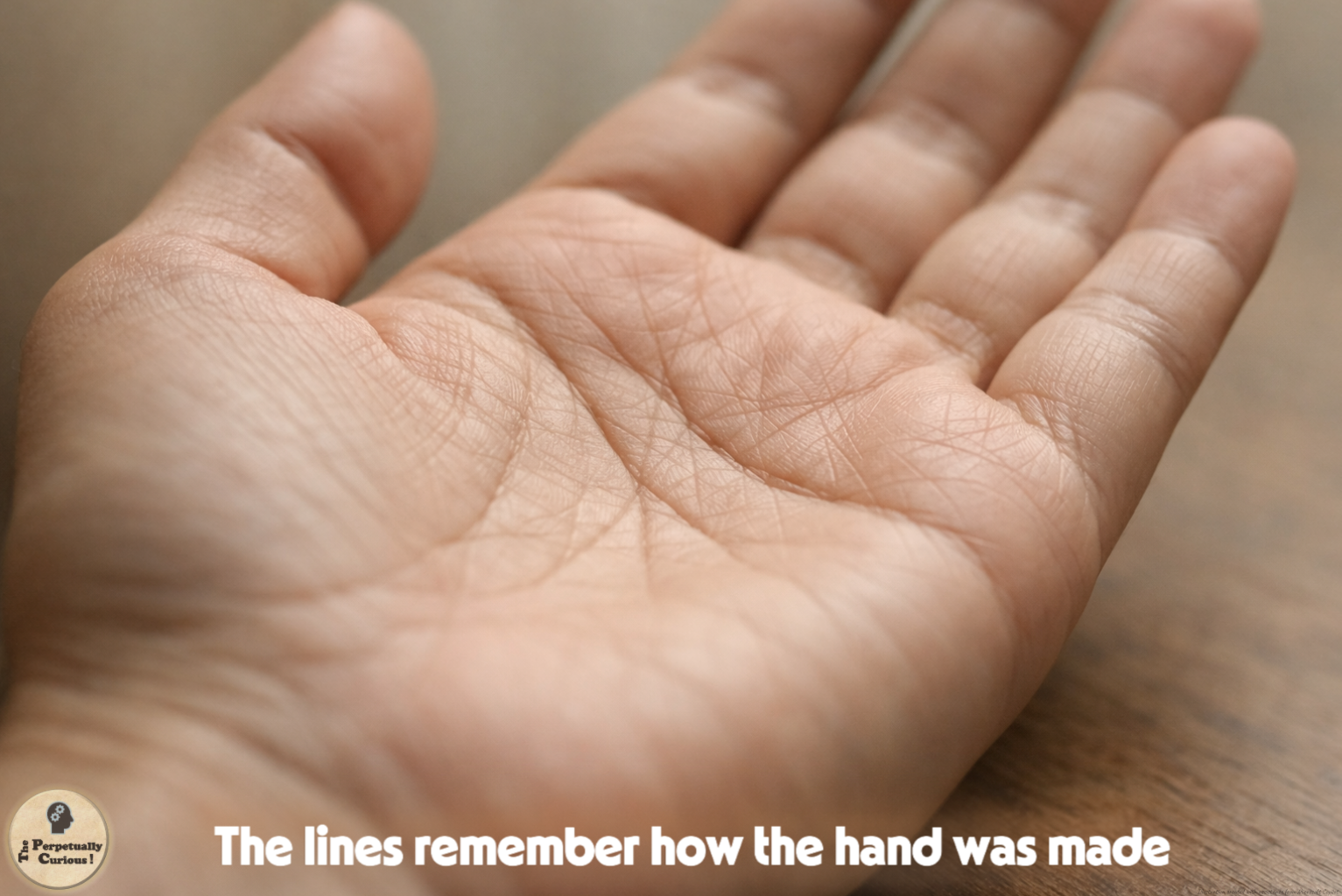
A small geography rests within the hand, shaped long before memory.
The lines rise and fall like quiet traces of movement held in the skin.
They remain as a soft reminder of how the body learns to fold and unfold through time.
🌱 When palm lines first appear before birth
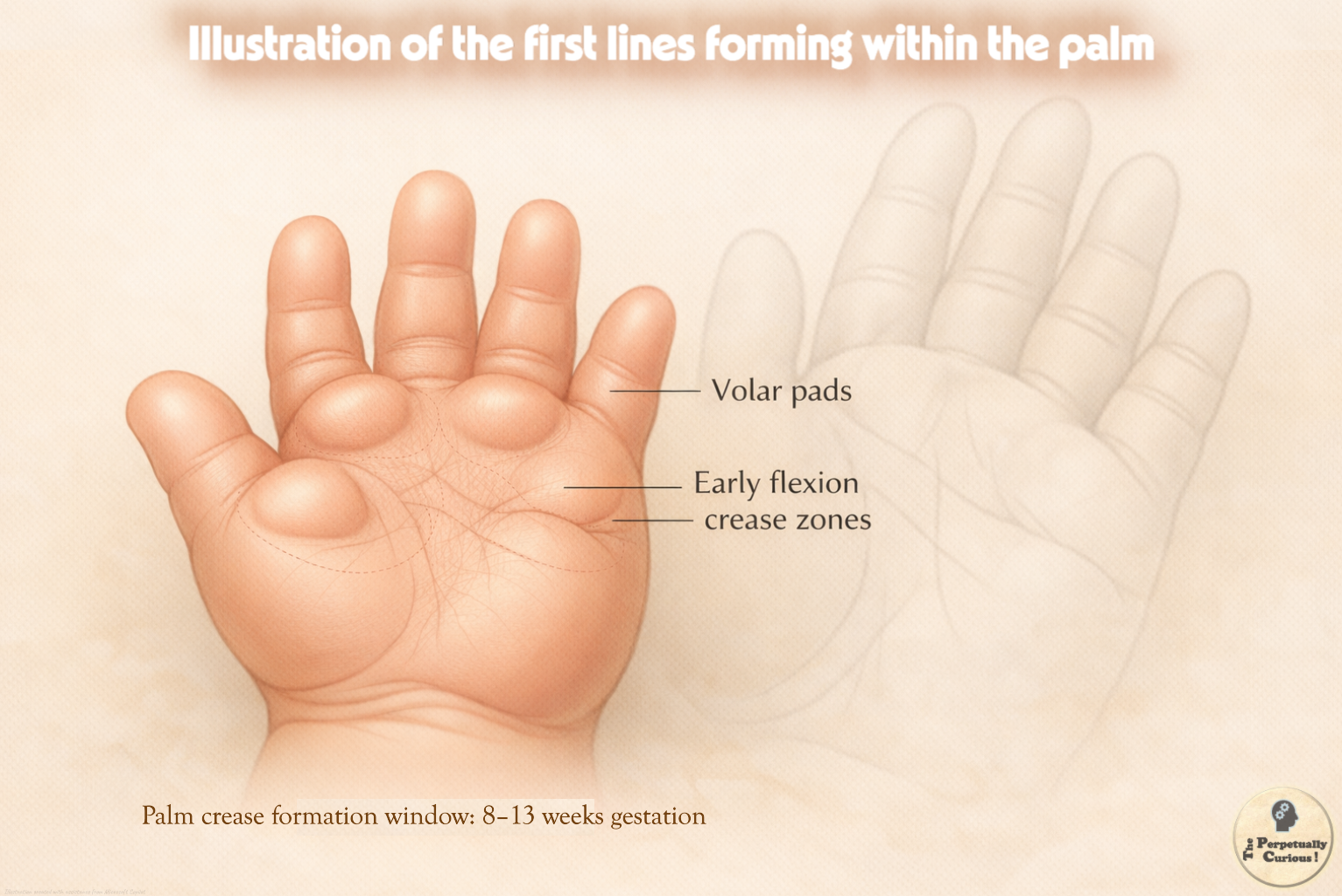
Long before a newborn curls a hand around a finger, the basic pattern of palm lines is already in place. During the first trimester of pregnancy, around the eighth to about the thirteenth week of gestation, the skin of the palm begins to form permanent folds known as palmar flexion creases. These creases do not arise because the fetus repeatedly uses its hands. Instead, they emerge as part of the coordinated growth of skin, connective tissue, and developing bones, and although early fetal movement may contribute to the deepening of certain creases, the initiation of the primary flexion creases appears to be independent of movement. The precise timing of this developmental sequence reflects the body’s internal rhythms of growth, which are part of the broader landscape of biological clocks that guide development.
At this stage, the palm is not a flat surface. Temporary swellings called volar pads rise on the fetal palm and fingers. Volar pads are present during much of this developmental window, and as they gradually regress, the skin in certain regions remains more tightly tethered to the underlying fascia and tendons; where this tethering is strongest, growth and movement are slightly restricted, and the skin folds along predictable lines that become the major creases visible throughout life.
Although fingerprints and palm creases form during overlapping developmental windows, they arise through distinct processes. Fingerprints are shaped by the interaction of volar pad regression, local growth forces, and genetic influences. Palm creases, by contrast, reflect deeper mechanical and structural constraints. Other familiar features of the skin can arise through very different biology: melanocytic moles, for example, reflect localized proliferation of melanocytic cells rather than the developmental folding that creates palm lines. Twin studies suggest that both features have genetic components, yet even identical twins may show subtle differences in their palm patterns. Monozygotic twins show notably higher concordance in crease patterns than dizygotic twins, reinforcing the genetic contribution.
This developmental origin matters for two reasons. First, it explains why the main palm lines are already present at birth. Second, it shows that they are shaped by a combination of genetic influences and early mechanical forces, rather than by habits formed later in life. The palm is not a record of how often one has gripped a tool. It is a record of how the hand itself was built.
🖐 How palm lines support movement and grip
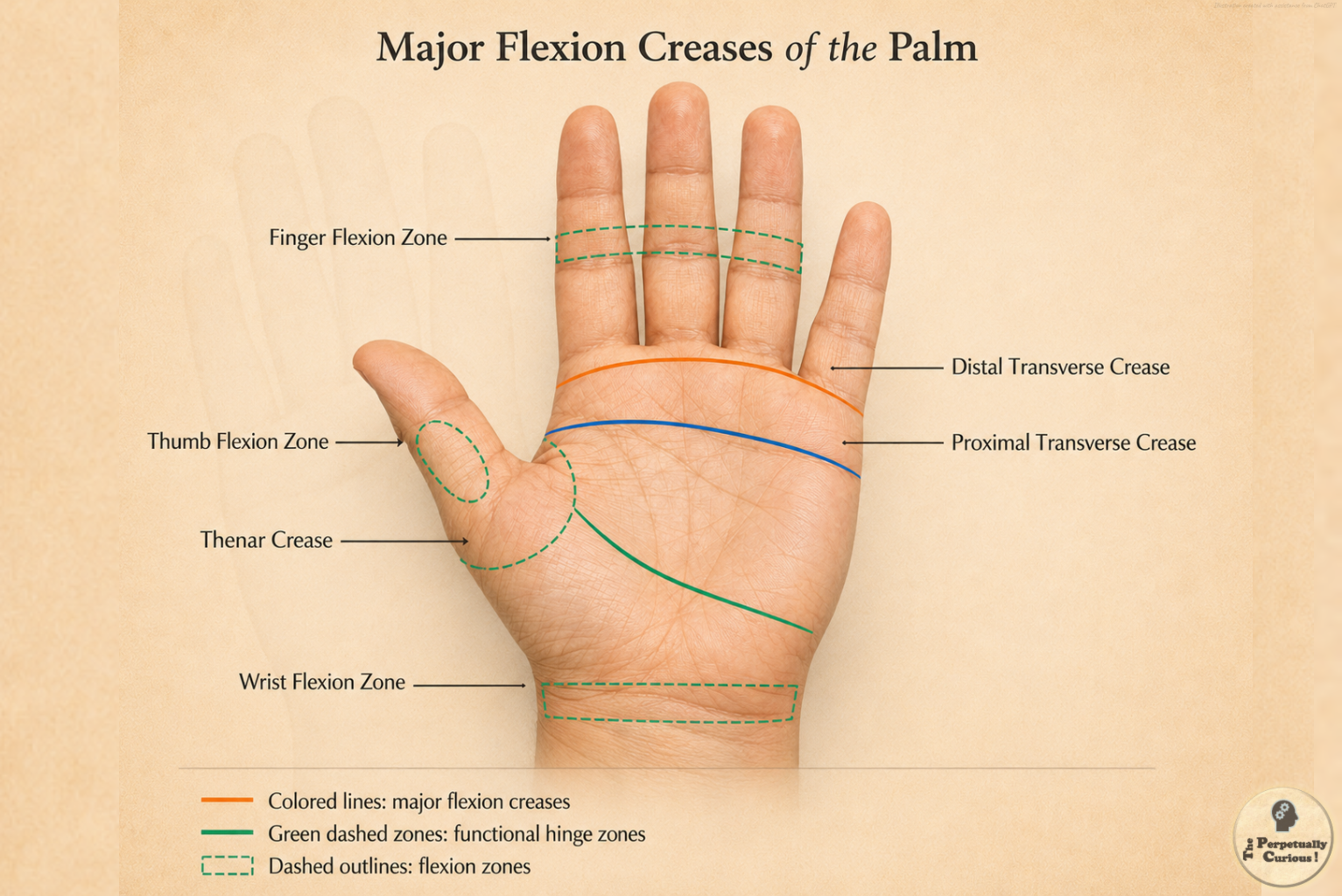
When the fingers curl into a fist, the skin of the palm must fold rather than stretch. The major creases act as hinge zones that allow the thick skin of the palm to bend in a controlled way. Without them, every strong grip would pull and strain the skin, making movement uncomfortable and less efficient.
The skin of the palm is thicker and more firmly anchored than most skin on the body. This anchoring provides stability for gripping and weight bearing, but it also means that the skin cannot stretch freely. Creases solve this problem by creating predictable folding points. Those same folds and ridges also shape how henna patterns appear across the hand, while darker henna stains on the palms and fingertips reflect the greater mass of keratinized tissue in their thicker outer layer.
The three most prominent creases are often described in anatomical terms as the distal transverse crease, the proximal transverse crease, and the thenar crease. The distal transverse crease runs across the upper part of the palm and aligns with the bending of the knuckles where the fingers meet the hand. The proximal transverse crease lies lower, closer to the wrist, and follows the fold created when the fingers flex more deeply. The thenar crease curves around the base of the thumb, marking the muscular pad that allows the thumb to oppose the fingers.
Each of these lines corresponds to underlying structures. Tendons glide, joints flex, and the palmar aponeurosis, a fibrous sheet in the palm, supports the soft tissues and protects underlying tendons and neurovascular structures. The creases help the outer skin follow these movements with minimal friction. In everyday life, this design allows a person to hold a mug, tie a shoelace, or lift a suitcase without thinking about the complex choreography beneath the surface. Yet for all the elegance of this shared design, the details of those creases differ markedly from one person to the next.
🌈 Why palm lines vary from person to person
Although most people share the same basic set of major creases, the details of palm patterns vary widely. The depth, length, branching, and subtle secondary lines differ from hand to hand. Even the two hands of the same person may not match perfectly. These differences reflect both genetic influences and small variations in how the hand developed and moved in the womb.
In the general population, the most common pattern includes two distinct transverse creases across the palm, along with the thenar crease around the thumb. Studies suggest that this typical pattern appears in approximately 90 to 95 percent of people in surveyed groups. A smaller proportion of individuals have variants in which one or more creases are fused, interrupted, or extended.
One well known variation is the single transverse palmar crease. In this pattern, the two main transverse creases appear as one continuous line that crosses the palm. Estimates vary, but it appears in approximately 1.5 to 4 percent of the general population, with some populations showing higher rates. It is more frequent in certain genetic conditions. In Down syndrome, for instance, a single transverse palmar crease is commonly reported in a large minority of affected individuals, with estimates often ranging from about half to around 60 percent depending on the source. It also occurs in people who have no associated health concerns. Its presence alone is therefore not a diagnosis, but rather one feature among many that clinicians may consider in a broader context.
Other named patterns, such as the Sydney crease or additional longitudinal creases, have been described in medical and anthropological literature. They are less common and may be associated with particular populations or conditions. However, for most individuals, palm lines are simply part of their personal anatomy, unique yet entirely normal.
📜 How cultures have interpreted the palm
Across many cultures, the visible lines of the palm have invited interpretation. Traditions of palm reading, often grouped under the term palmistry, have appeared across many regions of the world, with ancient strands particularly associated with South Asian, Middle Eastern, East Asian, and Greco‑Roman traditions. In these systems, the major creases are often given names such as the heart line, headline, and lifeline, and are thought to reflect aspects of personality, emotion, or destiny.
Palmistry is not a traditional medical system, but it belongs to the same broader pattern as traditional medicine systems in which cultures have interpreted visible signs of the body through inherited frameworks of meaning.
From a scientific perspective, these symbolic interpretations do not have empirical support as predictors of future events or inner traits. However, they remain part of cultural history and practice. They show how people have long used visible patterns on the body as a canvas for meaning. The same line that an anatomist calls the distal transverse crease may be seen by a palm reader as a sign of emotional depth or resilience.
Palmistry traditions vary widely. Some emphasize the shape of the hand, others focus on the length or curvature of specific lines, and still others consider the interplay of multiple features. These systems reflect cultural beliefs, storytelling traditions, and the human desire to understand the self through visible signs.
Recognizing palmistry as a cultural phenomenon rather than a scientific tool allows for a respectful and clear distinction. The anatomical facts describe how the lines form and function. The symbolic traditions describe how humans have chosen to read those lines. Both layers can be acknowledged without blurring the boundary between evidence and belief.
Having traced how cultures have read meaning into these lines, it is worth turning to how those lines themselves evolve, and how little their fundamental architecture changes over time.
⏳ How palm lines change as we age
The major palmar creases are remarkably stable. Because they are anchored to deeper structures, their overall position and orientation tend to remain constant from infancy through old age. A photograph of a palm taken in childhood will often show the same main lines that are visible decades later. This stability reflects the way the primary flexion creases are tethered to the palmar aponeurosis and deeper fascia, which maintain their architecture even as the surface of the skin changes.
However, the appearance of the palm does not remain entirely static. With age, the skin may lose some collagen and elasticity. It may become drier or thinner in some individuals. These changes can make existing creases appear more pronounced and can lead to the formation of additional fine lines and wrinkles, especially in areas that experience frequent movement or environmental exposure.
Occupational and environmental factors may also influence the surface of the skin. Repeated contact with tools, exposure to water or chemicals, or outdoor work may alter texture, callus formation, or minor markings. Musicians, for example, may develop localized thickening or subtle changes in the skin from repeated practice. Even so, the primary flexion creases that define the basic map of the palm usually persist in their original configuration.
This combination of stability and subtle change brings the narrative back to a central theme. The palm carries both the imprint of early development and the traces of lived experience, yet its lines remain primarily a record of structure rather than a script of fate.
🔍 Why humans look for meaning in palm lines
The human mind is highly attuned to patterns. It is natural to look at the palm and wonder whether the crossing of two lines or the fork of a crease might say something about a life story. This tendency is not limited to hands. People see shapes in clouds, faces in rock formations, and significance in coincidences.
This impulse reflects the mind’s broader tendency to create coherence from complexity, a theme explored through the mind’s interpretive habits in related work.
In psychology, this inclination to perceive meaningful patterns in random or complex information is sometimes discussed as pattern recognition that can extend into pattern seeking, a tendency sometimes described in technical terms as pareidolia or apophenia. It is a powerful capacity that supports learning and creativity, but it can also lead to interpretations that go beyond what the evidence supports. Palm lines provide a clear example. They are real anatomical structures with a clear functional role, yet they also invite imaginative readings.
The palm, in this sense, becomes both an anatomical fact and a quiet invitation for the mind to find a story in structure.
🌌 A quiet conclusion in the palm of the hand
When all of these threads are brought together, the palm becomes a place where biology and imagination meet. The lines that cross it formed when the body was still hidden from view, shaped by genes, growth, and the mechanics of movement. They help the hand fold, grip, and gesture. They vary from person to person in ways that are sometimes medically relevant, often simply individual.
The body’s capacity to carry both function and meaning finds another expression in emotional expression, where physiology and human interpretation meet on equally quiet terrain.
Around this anatomical foundation, cultures have woven narratives, reading character and future into the same creases that guide a grip. The science does not support those predictions, yet the stories themselves reveal something about human curiosity and the desire to find meaning in visible patterns.
To look at one’s own palm with this understanding is to see both the precision of development and the richness of interpretation. The hand becomes not a script of fate, but a quiet record of how the body makes movement possible, and how the mind turns structure into story.
Pass this article along to someone curious and let the learning travel.
💡 Did You Know
⚧ A single transverse palmar crease appears more often in males than in females in several population studies, although the reasons for this difference are still being investigated.
🧬 Dermatoglyphics, the study of skin patterns on the hands and feet, includes both fingerprints and palm creases and has been used in fields ranging from anthropology to medical genetics and forensic identification.
🌀 Fingerprints and palm creases form during overlapping developmental windows, but they arise through different mechanisms. Fingerprints reflect ridge formation on the surface, while palm creases reflect deeper structural folding.
🐒 Many primates have flexion creases on their hands and feet that serve similar functional roles in movement and gripping. The exact patterns differ by species, reflecting differences in anatomy and locomotion.
✂️ Deep injuries or scars can disrupt the original continuity of palm creases, and healing may leave scar patterns that do not follow the earlier crease architecture.
🩺 Palm creases may be used as approximate surface landmarks in hand anatomy, but they are not reliable substitutes for deeper anatomical assessment.
Are palm lines formed by how much we use our hands?
Palm lines are not formed by repeated use of the hands after birth. The major palmar creases develop during early fetal life and are already present at birth. Later hand use may influence skin texture and minor markings, but the main lines reflect developmental processes rather than daily habits.
Do palm lines change significantly as we age?
The primary creases usually remain in the same positions throughout life. With age, the skin may become thinner or less elastic, which can make existing lines appear deeper and can lead to additional fine wrinkles. However, the basic pattern of the major palm lines tends to stay stable.
Can doctors learn anything about health from palm lines?
In some cases, certain palm crease patterns are more common in specific genetic or developmental conditions. For example, a single transverse palmar crease appears more frequently in some chromosomal disorders. Clinicians consider such features as part of a broader assessment, rather than as stand‑alone diagnostic tools.
Is there scientific evidence that palm lines predict personality or future events?
Scientific studies have not shown that palm lines can predict personality traits or future life events. Traditions that interpret the palm in this way are part of cultural and symbolic practices rather than evidence‑based methods.
Why do the lines on my two hands look different from each other?
It is common for the lines on the dominant and non‑dominant hand to differ slightly in depth, branching, or minor markings. Small differences in development, hand use, and local skin changes over time can all contribute to asymmetry. The main structural creases, however, usually follow the same general pattern on both hands.
Are palm lines unique like fingerprints?
Palm lines are not as uniquely identifying as fingerprints, but they do show individual variation. Fingerprints are more commonly used for identification because their ridge patterns are highly detailed and stable.
Why do some people believe the life line predicts lifespan?
The life line is a feature of palmistry traditions, not anatomy. Its interpretation as a marker of lifespan reflects cultural storytelling rather than scientific evidence. The anatomical crease that palmistry calls the life line is simply the thenar crease that curves around the base of the thumb.
Are palm lines related to fingerprints?
Palm lines and fingerprints form during overlapping developmental periods, but they arise through different mechanisms. Fingerprints reflect surface ridge formation, while palm lines reflect deeper structural folding.
Why do some people have very faint or very deep palm lines?
Variations in collagen density, skin thickness, hydration, and genetic factors can influence how pronounced palm lines appear. Some individuals naturally have deeper creases, while others have finer or more delicate lines.
Do animals also have palm lines or similar structures?
Many primates, including chimpanzees, gorillas, and macaques, have flexion creases on their hands and feet that serve similar biomechanical purposes. These creases help the skin fold during gripping and climbing. Other mammals may have skin folds or pads that support movement, but the specific pattern of human‑like palm creases is most characteristic of primates.
Are palm lines related to any traditional medical systems beyond palmistry?
Some cultural and traditional frameworks have interpreted the lines, mounts, and zones of the hand as reflections of inner states. These practices sit near the broader landscape of traditional medicine systems, although palmistry itself is not an evidence‑based or clinical practice.
🌺 A gentle invitation to share
We kindly invite you to share and spread the word. Under this gentle request lies a simple hope: that this exploration of the lines in the palm may spark curiosity in others as well. If you found these reflections on anatomy and meaning engaging, you may wish to pass them along to friends, family, or colleagues who enjoy learning about the quiet details of the human body.
By sharing this piece, you help more readers discover how something as familiar as the inside of a hand can open into a landscape of science and story. Your support in spreading the message is deeply appreciated and helps this conversation reach a wider circle of thoughtful readers.
“The Quiet Maps in Our Hands: Why Palm Lines Form and What They Reveal About Development, Movement, and Meaning.” The Perpetually Curious!, May 2026.
https://www.theperpetuallycurious.org/articles/palm-lines-explained/Continue Exploring
For the curious mind: want to explore this theme through a few questions? Visit the Classic Quiz Studio, nestled under Explorations opens in a new tab ,and see where a few well-placed questions lead: Biology & Health Quizzesopens in a new tab
For what comes next
Site Updates gathers occasional notes, new additions, and ways to keep in touch. RSS brings new publications to your feed reader in chronological order.
Choose the path that speaks to you, and let the next curiosity find you wherever your wondering takes you.