
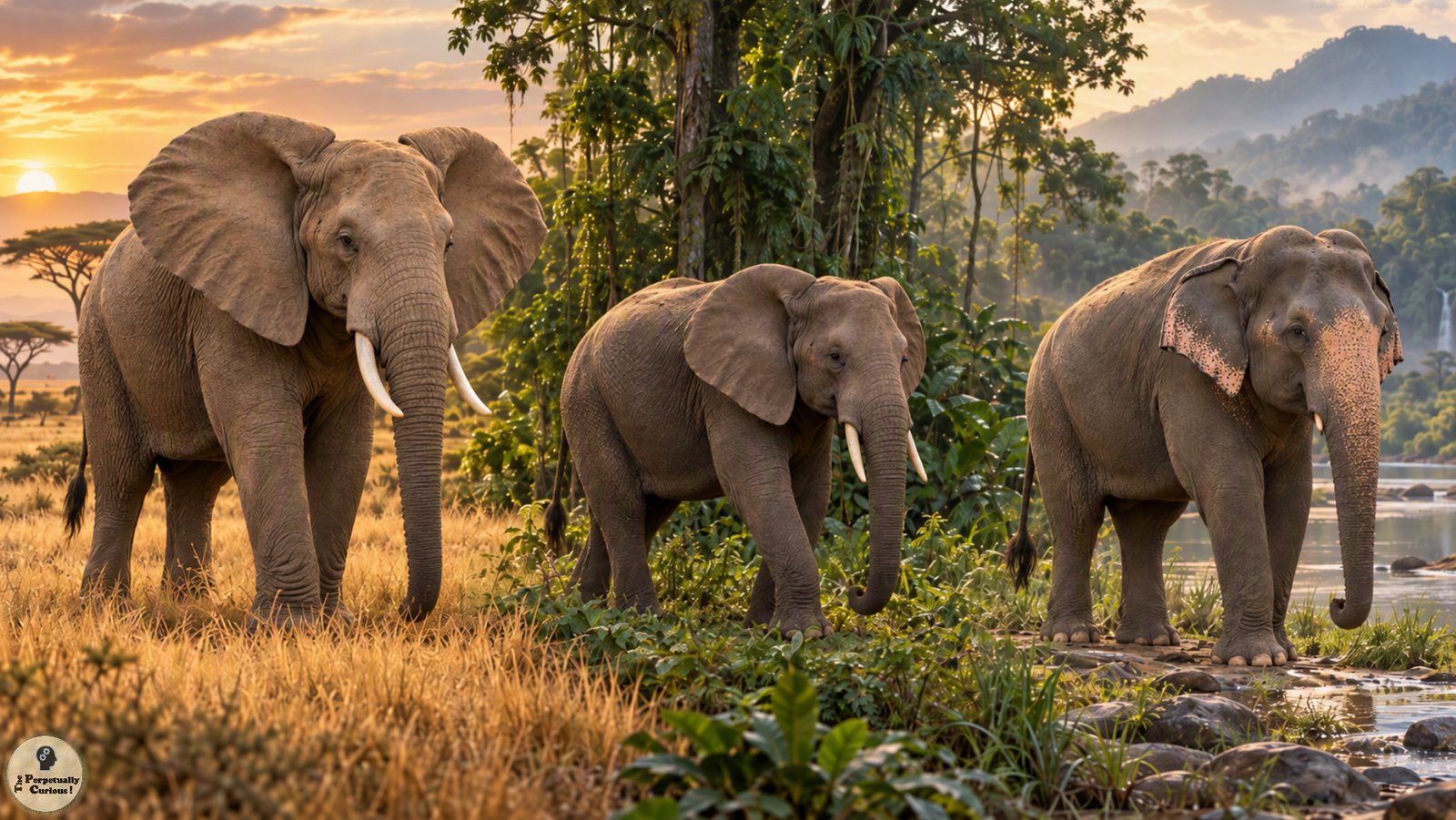
At a distance, an elephant is unmistakable. Up close, the differences between elephants in Africa and Asia are written into the ears, forehead, back, tusks, and even the tip of the trunk. One correction matters before any comparison begins: “African elephant” does not name a single living species. Today, three elephant species are recognized: the African savanna elephant (Loxodonta africana), the African forest elephant (Loxodonta cyclotis), and the Asian elephant (Elephas maximus).
The familiar side-by-side comparison usually places an African savanna elephant beside an Asian elephant. The savanna species generally has much larger ears, a fuller single-domed head, and a back that often dips between the shoulders and hips. Asian elephants have smaller ears, a distinctly twin-domed forehead, and a back that is usually more level or arched. African forest elephants complicate the shortcut. They are generally smaller and more compact than savanna elephants, with rounder ears, straighter tusks, and a less strongly saddle-shaped back.
The trunk offers one of the cleanest anatomical clues. Both African species have two finger-like projections at the trunk tip, while the Asian elephant has one. The trunk-tip difference also corresponds to different grasping tendencies. African savanna elephants tend to use the two projections to pinch smaller objects, while Asian elephants more often wrap or grasp with more of the trunk, although both are remarkably flexible in using the trunk to sense and manipulate the world.
Tusks are a weaker identification clue. Males and females of both African species commonly develop tusks, although tusklessness occurs. Among Asian elephants, prominent tusks are mostly seen in some males, while many males and most females lack large externally visible tusks. Size also needs care: the African savanna elephant is the largest living elephant, but the African forest elephant is generally the smallest of the three species.
No single feature works perfectly in every individual. Ears, forehead, back profile, trunk tip, tusks, and overall build work best as a pattern of clues. The shared elephant silhouette therefore belongs to three living species with distinct evolutionary histories, each expressed in small differences in form.
Related path: Why elephants use mud and dust to protect their skin