
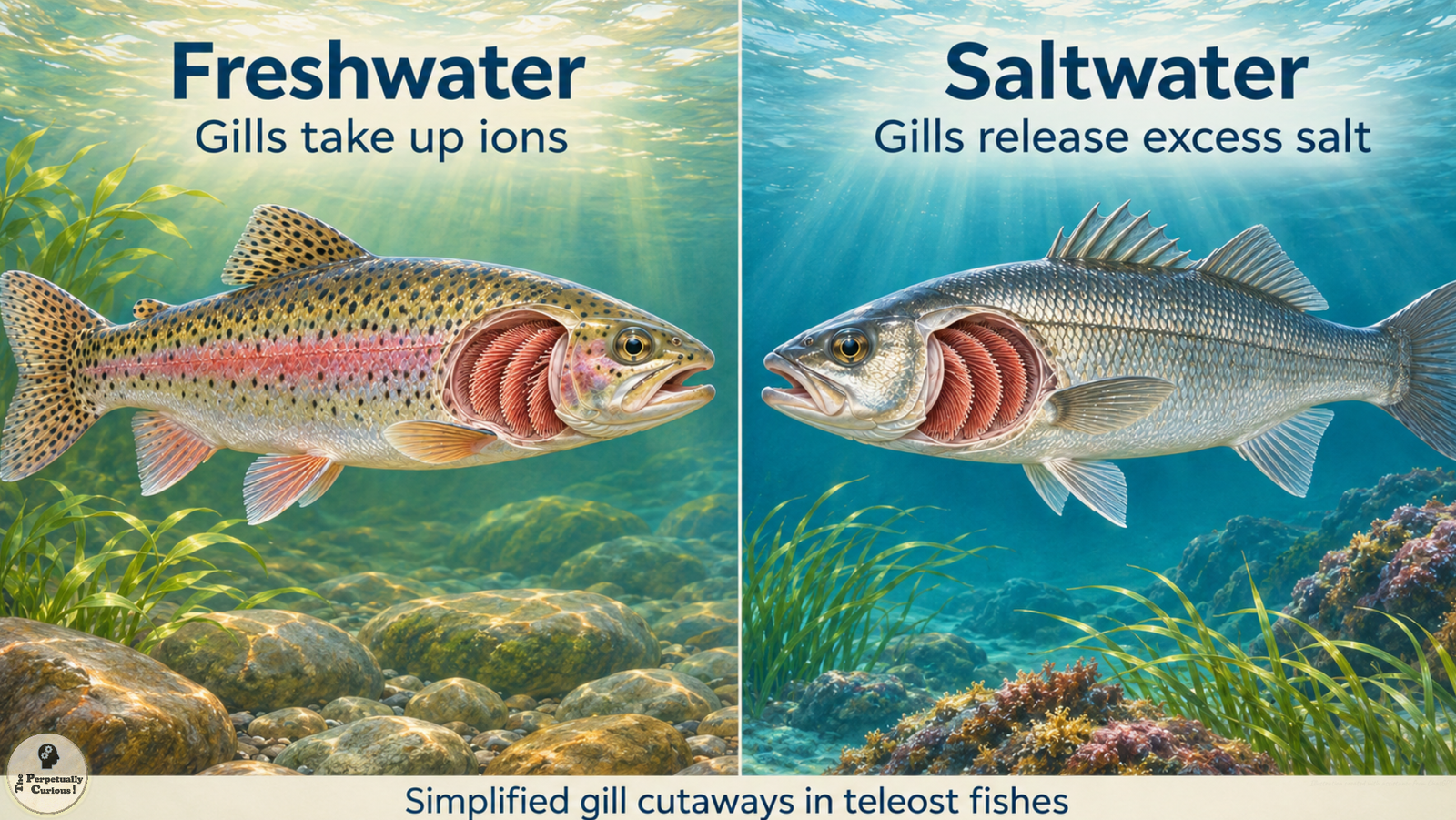
Water passing over a fish’s gills carries both the oxygen it needs and a chemical challenge. The same surface that brings blood close enough to the surrounding water for gases to cross also allows water and dissolved ions to move between body and environment. A fish cannot simply seal that boundary without interfering with breathing. Its gills must exchange gases while helping keep its internal fluids stable. [1]
The contrast is especially clear in teleosts, the large group of bony fishes that includes trout, salmon, and many familiar freshwater and marine species. Their body fluids generally contain more dissolved particles than freshwater but fewer than seawater. The discussion here concerns this common pattern. Sharks and rays use a different overall strategy, so the same explanation cannot be applied to every fish. [1, 2]
Inside a gill, slender filaments bear thin plates called lamellae. Water passes between these plates while blood flows within them. The large surface area and short distance between water and blood support oxygen uptake and carbon dioxide release. Those same features also expose the fish to unwanted exchanges of water and salts. Breathing and maintaining fluid balance therefore share a physical boundary. [1]
In freshwater, water tends to enter the body by osmosis: net water movement across a selectively permeable barrier toward the side with a greater concentration of dissolved particles. Meanwhile, ions such as sodium and chloride tend to leak outward. These are separate movements. Water entering does not carry a matching supply of the salts being lost, and the fish must compensate for both tendencies. [2]
Specialized cells in the gill lining, called ionocytes, help meet that need. They contain abundant mitochondria, which support the production of ATP, the chemical energy used by cellular pumps. Transport proteins in their membranes move selected ions along controlled routes. The gill is therefore more than a passive exchange surface: particular cells can move substances in directions that passive movement alone would not sustain. [1, 3]
Freshwater ionocytes take up needed ions from the surrounding water and transfer them toward the blood. The exact combination of channels, pumps, and exchangers varies among species and cell types. Their shared result is the recovery of ions from a dilute environment. Freshwater still contains dissolved minerals; the task is to absorb selected ions even when their external concentrations are low. [1, 2, 3]
The kidneys complement this work by releasing relatively large amounts of dilute urine, removing excess water while conserving much of the body’s salts. Freshwater teleosts generally drink little. Gill uptake and kidney function address the same imbalance: the gills mainly replace lost ions, while the kidneys remove surplus water and limit salt loss. [1, 2]
In seawater, the difficulty changes direction. A typical marine teleost tends to lose water across its permeable surfaces and gain salts. It generally drinks seawater, and its digestive tract absorbs water from the swallowed fluid. That restores water but also introduces an additional salt load. The gills become a major route for removing excess sodium and chloride, while the kidneys and other organs contribute to the wider balance. [1, 2, 4]
Salt removal involves coordinated routes rather than a single outward-facing pump. In a well-established seawater model, a sodium-potassium pump on the blood-facing side of an ionocyte uses ATP to maintain gradients that support other transport proteins. A cotransporter brings chloride into the cell from the blood side; chloride then exits through channels facing the water. Sodium can leave between adjacent cells rather than through their interiors, following the electrical gradient associated with this transport system. [1, 3]
The distinction matters: saying that a marine gill “pumps out salt” describes the overall result, but the ions need not follow the same path. Nor does a fish entering seawater simply run every freshwater pump backward. The arrangement and activity of transport proteins, and the properties of the surrounding tissue, determine whether the gill achieves net uptake or net secretion. [1, 3, 4]
Atlantic salmon provide a concrete example. In a study published in 2009, researchers used antibodies to distinguish forms of the sodium-potassium pump in gill ionocytes, termed chloride cells in the study. After seawater acclimation, they found opposite shifts in the abundance of two pump forms: the form abundant in freshwater declined, while another increased. [4]
The changes in a salmon’s gill transport proteins are part of a wider adjustment involving the gills and other organs. The extent of these responses varies among species, and many fishes cannot make both sets of adjustments. These physiological limits help explain how salinity shapes fish survival and distribution, alongside other features of the habitat. [1, 3]
With each passage of water, the gill remains both a breathing surface and a regulated boundary. In freshwater it helps recover scarce ions; in seawater it helps release an excess. The surrounding water changes what must be retained and what must leave, while the living tissue keeps the two sides different.
Selected sources
- Evans, D. H., Piermarini, P. M., and Choe, K. P. (2005). The multifunctional fish gill: Dominant site of gas exchange, osmoregulation, acid-base regulation, and excretion of nitrogenous waste. Physiological Reviews, 85(1), 97–177. doi:10.1152/physrev.00050.2003
- Evans, D. H. (2008). Teleost fish osmoregulation: What have we learned since August Krogh, Homer Smith, and Ancel Keys. American Journal of Physiology-Regulatory, Integrative and Comparative Physiology, 295(2), R704–R713. doi:10.1152/ajpregu.90337.2008
- Hiroi, J., and McCormick, S. D. (2012). New insights into gill ionocyte and ion transporter function in euryhaline and diadromous fish. Respiratory Physiology & Neurobiology, 184(3), 257–268. doi:10.1016/j.resp.2012.07.019
- McCormick, S. D., Regish, A. M., and Christensen, A. K. (2009). Distinct freshwater and seawater isoforms of Na+/K+-ATPase in gill chloride cells of Atlantic salmon. Journal of Experimental Biology, 212(24), 3994–4001. doi:10.1242/jeb.037275