
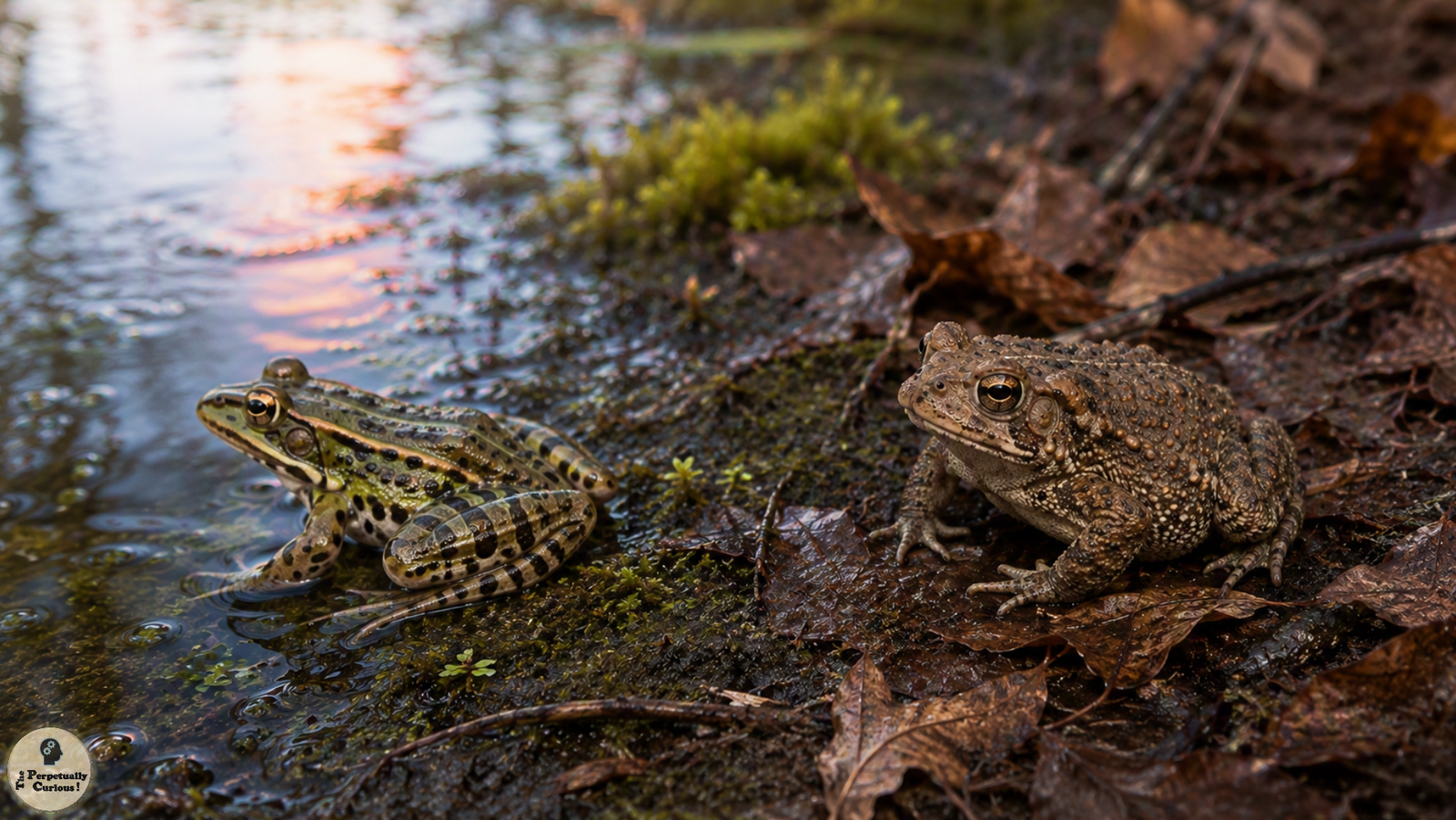
At the edge of a pond, a smooth-skinned animal with long hind legs is usually called a frog. A stockier animal with bumpier skin, sitting farther from the water, is likely to be called a toad. The contrast seems obvious, but the two names do not define separate scientific groups.
Both belong to Anura, the order of tailless amphibians that includes every species commonly called a frog or a toad. When frog is used broadly for this order, toads are frogs, which is why the familiar phrase “all toads are frogs, but not all frogs are toads” is useful shorthand. The formal part of the picture is Bufonidae, the family known as the true toads.
Common names, however, do not remain neatly inside that family. Spadefoot toads belong to families outside Bufonidae, while some bufonids carry frog names. The Panamanian golden frog, for example, is a member of Bufonidae even though it has smooth skin, a slender body, and long limbs.
The familiar field clues are still useful. Many true toads are stout, with bumpier skin and conspicuous parotoid glands behind the eyes that can release defensive secretions; they often walk or take short hops. Animals called frogs more often look smoother and more visibly moist, and many make longer leaps. These recurring patterns often accompany different degrees of terrestrial or water-associated life, but they remain tendencies rather than a universal identification key.
Even the famous “warts” do not establish a boundary. The wart-like bumps are not human warts, and touching a frog or toad cannot cause warts. A rough surface may support an everyday label, but it cannot reveal an animal’s lineage by itself.
Frog and toad therefore remain useful common words, but they are not opposite scientific categories. One describes a familiar set of shapes and habits; taxonomy follows ancestry. The animal in front of us may look toad-like, while its family tree tells a more precise story.
Related path: How wolves, foxes, and jackals branch within the dog family