
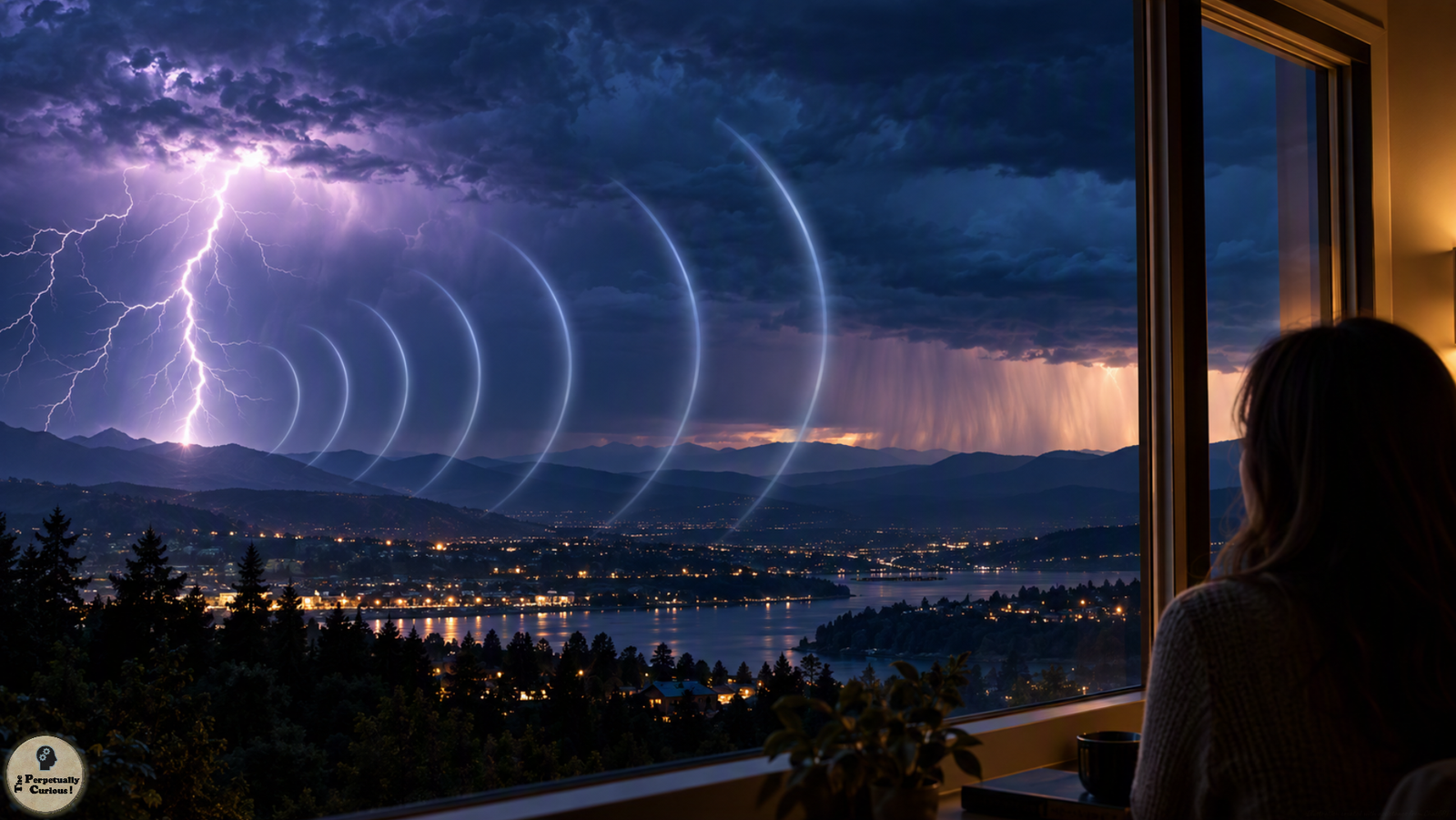
During a storm, a bright flash can split the sky and vanish before the first rumble reaches you. It can feel as though two events happened in sequence. In fact, the light and the thunder belong to the same electrical discharge. What separates their arrival is not the storm’s timing, but the very different speeds at which light and sound travel.
Lightning heats the narrow channel of air along its path extraordinarily quickly, with temperatures that can reach about 54,000 °F (30,000 °C). The surrounding air expands abruptly, producing a shock wave that travels outward and becomes the sound we call thunder.
The light from the discharge moves through air at nearly 186,000 miles per second (300,000 kilometers per second). Thunder is much slower. Near Earth’s surface, sound travels at roughly 1,100 feet per second (335 meters per second), although its exact speed changes with atmospheric conditions such as temperature. Across ordinary thunderstorm distances, the travel time of the light is too small to notice, while the sound may need several seconds to arrive.
That delay can even serve as a rough measure of distance. Thunder takes about five seconds to travel 1 mile, or roughly three seconds to travel 1 kilometer. A ten-second gap between flash and thunder therefore corresponds to a distance of about 2 miles (3.2 kilometers). The estimate remains approximate because the atmosphere affects sound propagation and because sound from different parts of a long lightning channel can reach an observer at slightly different times.
Rain is not the clock that controls this sequence. A thunderstorm can produce lightning while much of its precipitation remains aloft or while the main rain shaft is still elsewhere. That is why lightning and thunder can reach an observer before rain reaches the ground at that location.
The familiar flash-then-rumble experience is therefore one event stretched by distance. Light arrives almost immediately. Sound follows at the pace the atmosphere allows.