
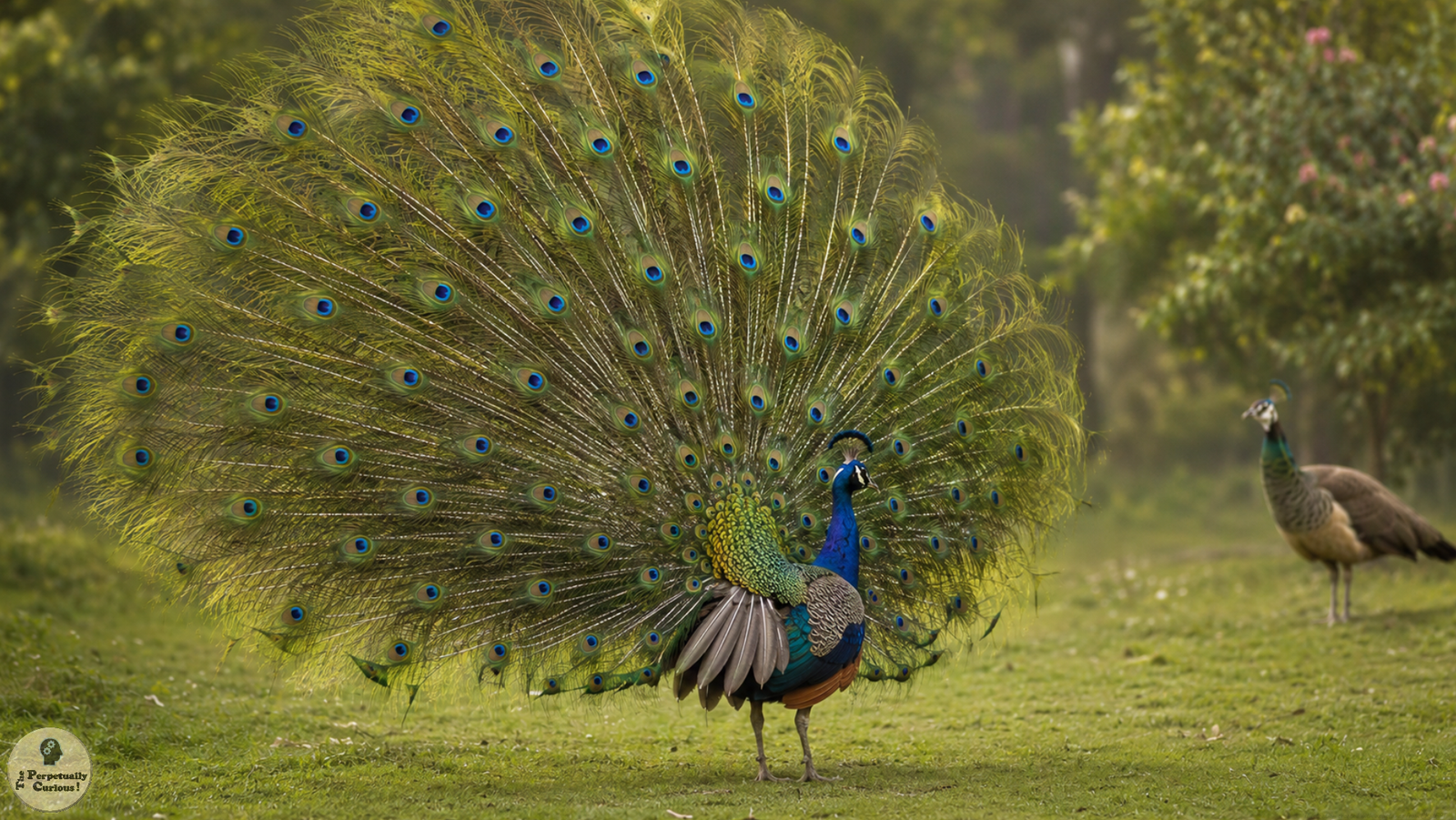
A male Indian peafowl spreads an enormous eye-spotted fan during courtship, but most of this display is not the bird’s true tail. The broad fan is made of peacock train feathers, which are elongated upper tail coverts. The true tail is shorter, consists of rectrices, and sits behind and beneath the train.
That distinction is more than a matter of naming. The two feather systems play different roles. The train provides the broad visual surface, carrying the familiar eyespots, or ocelli. The true tail remains partly hidden, but it helps animate the ornament above it.
During a behavior called train-rattling, a male rapidly moves his rectrices from side to side against the erect train. Field measurements recorded this motion at an average of about 25.6 vibrations per second. The true tail helps drive the train’s vibrations as the rectrices stridulate against the train feathers. Laboratory measurements also found that the tail and train have broad resonant responses near the frequencies peacocks use during these displays, allowing the feather arrays to vibrate efficiently.
The display creates a striking contrast in motion. Loose feather barbs around the eyespots can vibrate visibly, while the eyespots themselves move far less. Against that shifting background, the patterned spots can appear comparatively steady to a nearby peahen even as the surrounding train flickers and shimmers.
What looks like a single extravagant fan is therefore a layered mechanical and visual system. The longest, most conspicuous feathers are not the true tail at all. They are elongated coverts forming the train, while the shorter rectrices underneath help set that train in motion.
The familiar phrase “peacock tail” is convenient, but the anatomy tells a more precise story: the ornament we notice most is carried by one set of feathers and animated, in part, by another.
A companion article on peafowl explores their coloration, courtship, cultural history, biology, and conservation in greater depth.