
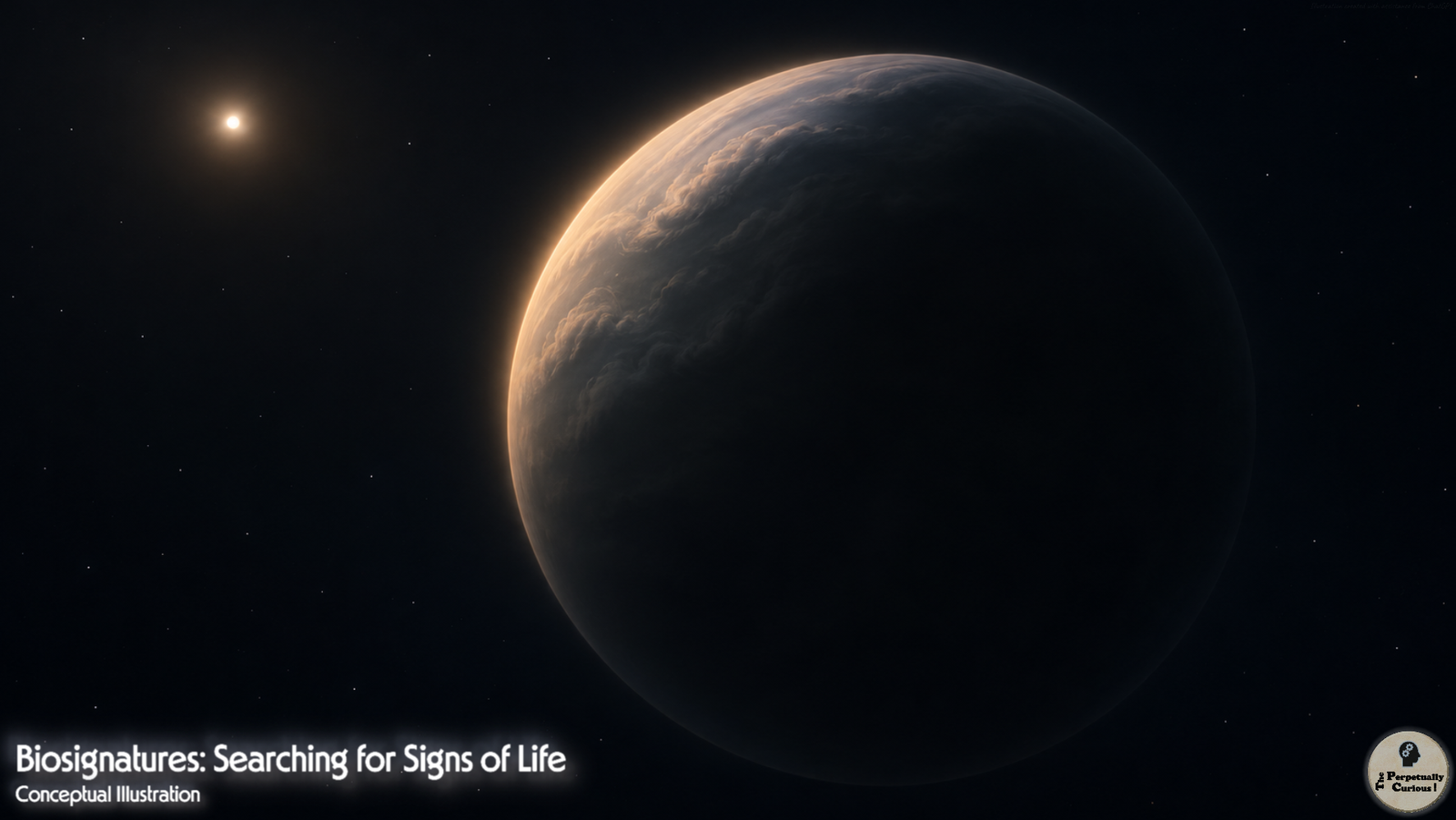
A newly discovered world can have water in its atmosphere, an intriguing chemical signal, or conditions that might support organisms. Each finding can make it worth studying. None, by itself, tells us that anything lives there. The difficult step is moving from a world that could support life to evidence that life has actually left a trace. That step depends on how convincingly biology explains an observation compared with the alternatives. [1]
The distinction begins with habitability. For life as we know it, scientists look for liquid water, usable energy, and suitable chemical ingredients. They also consider whether the environment allows those ingredients to participate in sustained chemistry. A promising habitat gives researchers a reason to look more closely, but a place can offer the conditions for life without being inhabited. Finding water is therefore a starting point rather than a biological verdict. [2, 3]
To move beyond that starting point, researchers investigate possible signs of life, or potential biosignatures: substances, structures, or patterns that might result from life. Their first question concerns the measurement itself. Does the signal survive repeated observations and different ways of analyzing the data? Could an instrument effect, contamination, or another substance explain it? Establishing what was measured and testing explanations for its origin are both necessary for interpreting the signal. [1, 3]
Sulfur compounds show why these questions matter. Hydrogen sulfide, H₂S, can arise through biological activity, but it also has nonbiological sources. Its detection in the atmosphere of the hot gas giant HD 189733 b helped researchers investigate planetary chemistry. It did not establish a living world. A molecule can participate in biology on Earth while forming through ordinary chemistry elsewhere. Its name alone cannot settle its origin. [4, 5]
Hydrogen sulfide is also different from dimethyl sulfide, DMS, and dimethyl disulfide, DMDS. DMS and DMDS have been investigated as candidate biosignature gases. Interest in DMS draws strongly on its association with marine biological activity on Earth. Yet even a secure identification elsewhere would leave another question: could nonbiological processes produce and maintain the inferred amount under that world’s conditions? Identifying a substance and identifying its source are separate scientific achievements. [6]
For worlds beyond our solar system, that separation is especially demanding. Astronomers can examine how gases absorb particular wavelengths in light passing through an atmosphere. The resulting spectrum can constrain composition, but different molecules may produce overlapping features, and the interpretation depends on the data and models. A spectrum samples atmospheric chemistry rather than revealing organisms directly. Understanding the host star, the atmosphere, and plausible chemical reactions helps determine what a candidate signal means. [1, 5]
That is why combinations can be more informative than isolated ingredients. Oxygen and methane together, in suitable abundances and environmental circumstances, could suggest that something keeps replenishing reactive gases. On Earth, biology contributes to both. However, sunlight, atmospheric escape, and reactions involving rocks can also create or reshape potential biosignatures. Scientists therefore compare production and destruction processes, asking whether a plausible nonliving planet could sustain the observed mixture. An unusual atmosphere deserves an explanation, and that explanation must be tested. [5]
Within our solar system, the same reasoning can draw on different evidence. A rover can examine a rock in its geological setting; a spacecraft can analyze material encountered near a moon. Depending on the mission, researchers may investigate molecular distributions, isotope patterns, or microscopic structures alongside the surrounding chemistry. These clues still need controls. A cell-like shape can have a mineral explanation, and material carried from Earth can confuse a biological interpretation. Nearby evidence can be richer without being automatically decisive. [3]
Enceladus makes the distinction tangible. Cassini detected molecular hydrogen in material venting from this icy moon, whose subsurface ocean offers a possible habitat. Hydrogen can provide chemical energy for certain microbes on Earth. Its presence therefore strengthens the case for studying whether the ocean could support life; it does not demonstrate that microbes are using that energy there. The observation concerns an available resource, while the biological question concerns whether anything consumes it. [2]
The standard of reasoning is therefore shared, even when the instruments and accessible clues differ. A distant atmosphere and a nearby sample both require reliable measurements, an environmental explanation, and tests of nonbiological alternatives. Several independent observations that support the same biological interpretation can strengthen a case. No single molecule, by itself, establishes that an unfamiliar world is inhabited. [1, 3]
But does beginning with Earth mean expecting life elsewhere to resemble our own? Earth supplies the only confirmed examples available for study, so its biology gives searches a practical foundation. That does not establish that all life must breathe oxygen, look familiar, or use precisely the same molecular machinery. Some of Earth’s most resilient organisms live in environments hostile to humans. They broaden the range of known habitats while sharing the basic biochemistry of other Earth life. Familiar biology is evidence about what is possible, not a complete inventory of everything that could be alive. [5, 7]
Researchers address that limitation through approaches called agnostic biosignature searches. These investigate broader features, such as patterns of chemical complexity, organized concentrations of substances, or evidence of energy use, while reducing dependence on a particular Earth biochemistry. Such methods still need testing against nonliving chemistry. They widen the search without guaranteeing that every possible form of life would be recognizable. [7]
A promising world, then, invites a sequence of questions: what was measured, what could produce it, and what further evidence would distinguish the explanations? The search can begin with the life we know while remaining open to what we have never encountered. A clue earns its importance by helping us ask the next question more precisely.
Selected sources
- NASA. (2025, April 18). How NASA’s Webb Telescope Supports Our Search for Life Beyond Earth.
- NASA. (2017). Ingredients for Life at Enceladus.
- Neveu, M., et al. (2018). The Ladder of Life Detection. Astrobiology, 18(11), 1375–1402.
- Fu, G., et al. (2024). Hydrogen sulfide and metal-enriched atmosphere for a Jupiter-mass exoplanet. Nature, 632, 752–756.
- Schwieterman, E. W., et al. (2018). Exoplanet Biosignatures: A Review of Remotely Detectable Signs of Life. Astrobiology, 18(6), 663–708.
- Pica-Ciamarra, L., Madhusudhan, N., Cooke, G. J., Constantinou, S., & Binet, M. (2026). A Systematic Search for Trace Molecules in the Atmosphere of Exoplanet K2-18 b. The Astrophysical Journal Letters, 1002, L34.
- Kaufman, M. (2019, August 13). “Agnostic Biosignatures,” And the Path to Life as We Don’t Know It. NASA Astrobiology; interviews with the Laboratory for Agnostic Biosignatures investigators.