
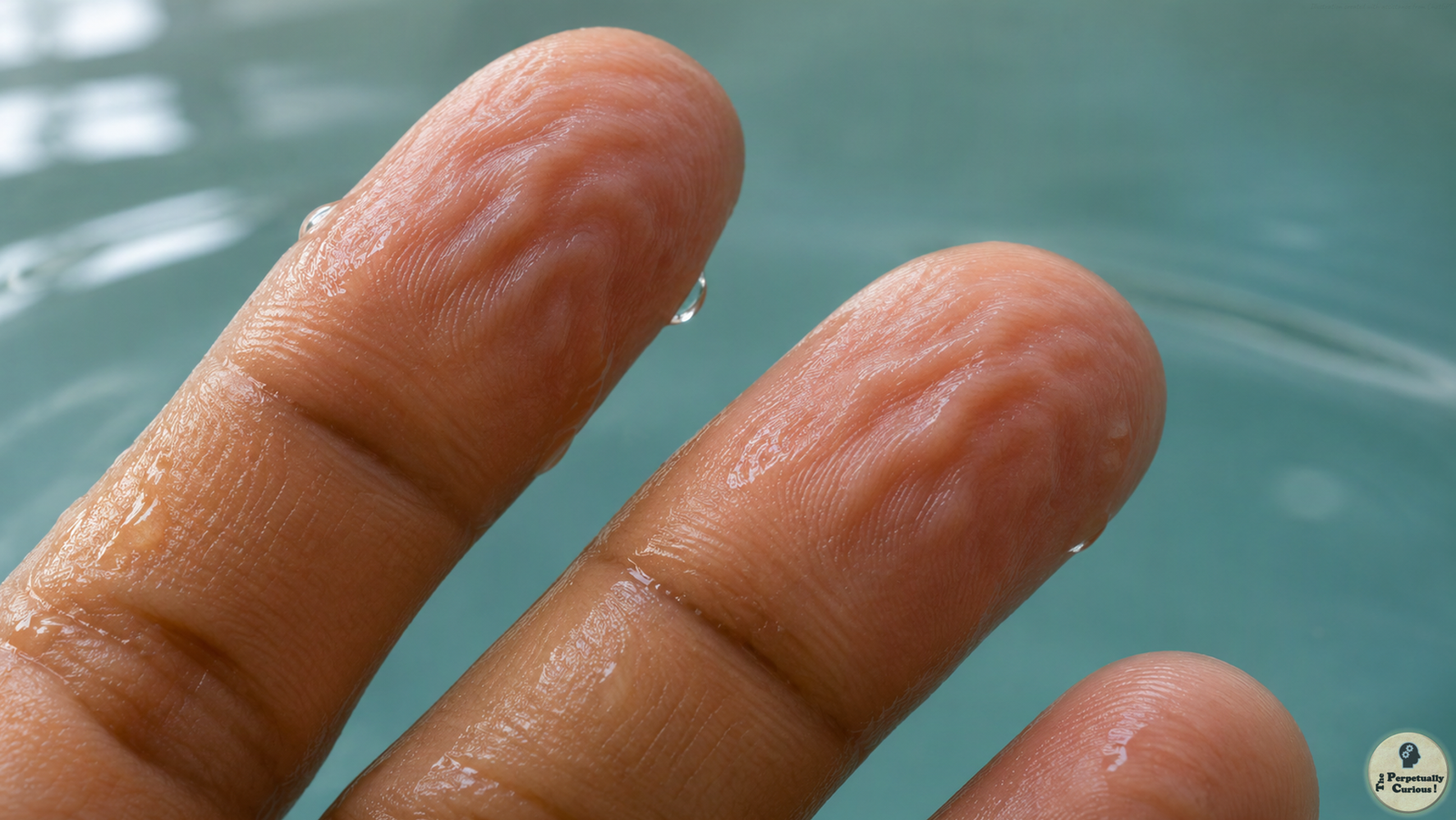
After a long bath, broad folds can cross the fine ridges on the pads of your fingers. The ridges were there when you got in. The folds can linger after the water has run off.
Water can soak into the outer layer of skin. The familiar folds also involve a change in the soft pad underneath. In one study, researchers measured how fast blood moved through vessels in the hand during immersion. Blood moved more slowly as wrinkles appeared. The largest drop in speed was in the finger vessels. [1]
The sympathetic branch of the autonomic nervous system helps control the width of those vessels. As the vessels narrow, the pad is thought to lose volume, drawing the overlying skin inward into folds. [2] The same branch controls how goosebumps form by signaling tiny muscles attached to hair follicles. How water sets off the fingertip response is less clear. One proposal is that water entering through sweat ducts changes the balance of dissolved salts near nerves. [2]
A study of surgically reattached fingers helped show why the nerves matter. Researchers exposed the reattached fingers and their counterparts on the other hand to the same warm saltwater soak. On average, blood flow fell in the unaffected fingers, which wrinkled, and rose in the reattached fingers, where the skin stayed smooth. The researchers took this difference as evidence of the role of sympathetic nerves. [3]
Do the folds help with grip?
A wet pebble can leave a thin layer of water between the stone and a fingertip. Researchers studying the shapes of the wrinkles compared them to tire treads and proposed that the grooves could channel water away from where the fingertip touches an object. [4]
One team timed volunteers as they transferred small objects, including glass marbles. With wrinkled fingertips, they moved objects that started underwater faster. The team found no clear effect on transfer times for dry objects. [5] In a later study, researchers found no speed advantage for submerged objects and no clear change in the ability to distinguish fine surface patterns or detect vibrations. [6]
A third study recorded how hard volunteers squeezed during a controlled pull. Volunteers chose which condition to try. During the steady part of the pull, the group with wrinkled fingertips used a lighter grip relative to the pulling force than the group with wet, unwrinkled fingertips. [7] The transfer studies timed how quickly people moved objects. The pull test measured how firmly people squeezed relative to how hard they pulled. Whether the grooves carry water away during a grasp, and whether any such effect explains why the response evolved, remain open questions. [4] [6] [7]
After the bath, the broad folds fade and the fine ridges are still there. For a little while, the folds made a change beneath the skin visible.
Selected sources
- Wilder-Smith, E. P. V., & Chow, A. (2003). Water-immersion wrinkling is due to vasoconstriction. Muscle & Nerve.
- Wilder-Smith, E. P. V. (2004). Water immersion wrinkling: Physiology and use as an indicator of sympathetic function. Clinical Autonomic Research.
- Hsieh, C.-H., Huang, K.-F., LiLiang, P.-C., Jeng, S.-F., & Tsai, H.-H. (2006). Paradoxical response to water immersion in replanted fingers. Clinical Autonomic Research.
- Changizi, M., Weber, R., Kotecha, R., & Palazzo, J. (2011). Are wet-induced wrinkled fingers primate rain treads? Brain, Behavior and Evolution.
- Kareklas, K., Nettle, D., & Smulders, T. V. (2013). Water-induced finger wrinkles improve handling of wet objects. Biology Letters.
- Haseleu, J., Omerbašić, D., Frenzel, H., Gross, M., & Lewin, G. R. (2014). Water-induced finger wrinkles do not affect touch acuity or dexterity in handling wet objects. PLOS ONE.
- Davis, N. J. (2021). Water-immersion finger-wrinkling improves grip efficiency in handling wet objects. PLOS ONE.