Explore by topic, question, or idea. Find articles, reflections, videos, puzzles, and curiosity pathways gathered across the site.
Press Enter or select Search. A newly typed query starts globally; filters are applied only through the visible rail.
8 results for “how seeds become cooking oil”
- The Perpetually Curious! › Archives › PhysicsArticle
❄️⚡ The Peltier Effect: When Electricity Becomes Heat Flow
From section: 🌍 IntroductionThat symmetry has since become the foundation of technologies that quietly shape modern life.
- The Perpetually Curious! › Archives › PhysicsArticle
⚖️ Solar Luminosity: The Universal Stellar Power Scale
☀️ Every second, our Sun unleashes energy equivalent to 1.8 billion Tsar Bombas, the most powerful nuclear weapon ever detonated. Yet this cosmic violence sustains all earthly life through a number that has become astronomy's gold standard: 3.828×10²⁶ watts.
- The Perpetually Curious! › Archives › PhysicsArticle
⚗️ The Invisible Revolution: Understanding the Ancient Art and Modern Science of Glass Manufacturing
From section: Where Sand Becomes Transparent 🏛️The ancient Roman historian Pliny the Elder recounted a legendary story of Phoenician merchants accidentally discovering glass when cooking fires on sandy beaches fused sodium-rich plant ashes with silica.
- The Perpetually Curious! › Archives › PhysicsArticle
✨ Clean Chemistry: The Curious Physics Behind Soap Bubbles
From section: 🧪 Amphiphilic Molecules at WorkThey break the oils into tiny droplets, dispersing and emulsifying them so that water and oil can finally mix.
- The Perpetually Curious! › Archives › PhysicsArticle
🌫️ How Radar Listens to the Sky: The Quiet Science Behind the Sweep
This article follows that journey from the first whisper of a pulse to the structured images that appear on weather maps, tracing how physical principles become the patterns that many viewers recognize on their screens.
- The Perpetually Curious! › Archives › PhysicsArticle
🦈 Why Do Sharks Float? The Science Behind Their Buoyancy
From section: 🌊 Opening DiveAs cartilaginous fishes, many sharks approach near‑neutral buoyancy through a combination of oil‑rich livers, lightweight skeletons, and hydrodynamic lift.
- The Perpetually Curious! › Archives › PhysicsArticle
🌌 Why Space Looks Dark: Light, Matter, and the Quiet Cosmos
Space can look surprisingly dark, even in a universe filled with stars. That darkness is not simply the absence of light. It is often the result of how light travels, what it meets, and what it does not meet. On Earth, daylight becomes a bright blue sky because sunlight…
- The Perpetually Curious! › Archives › PhysicsArticle
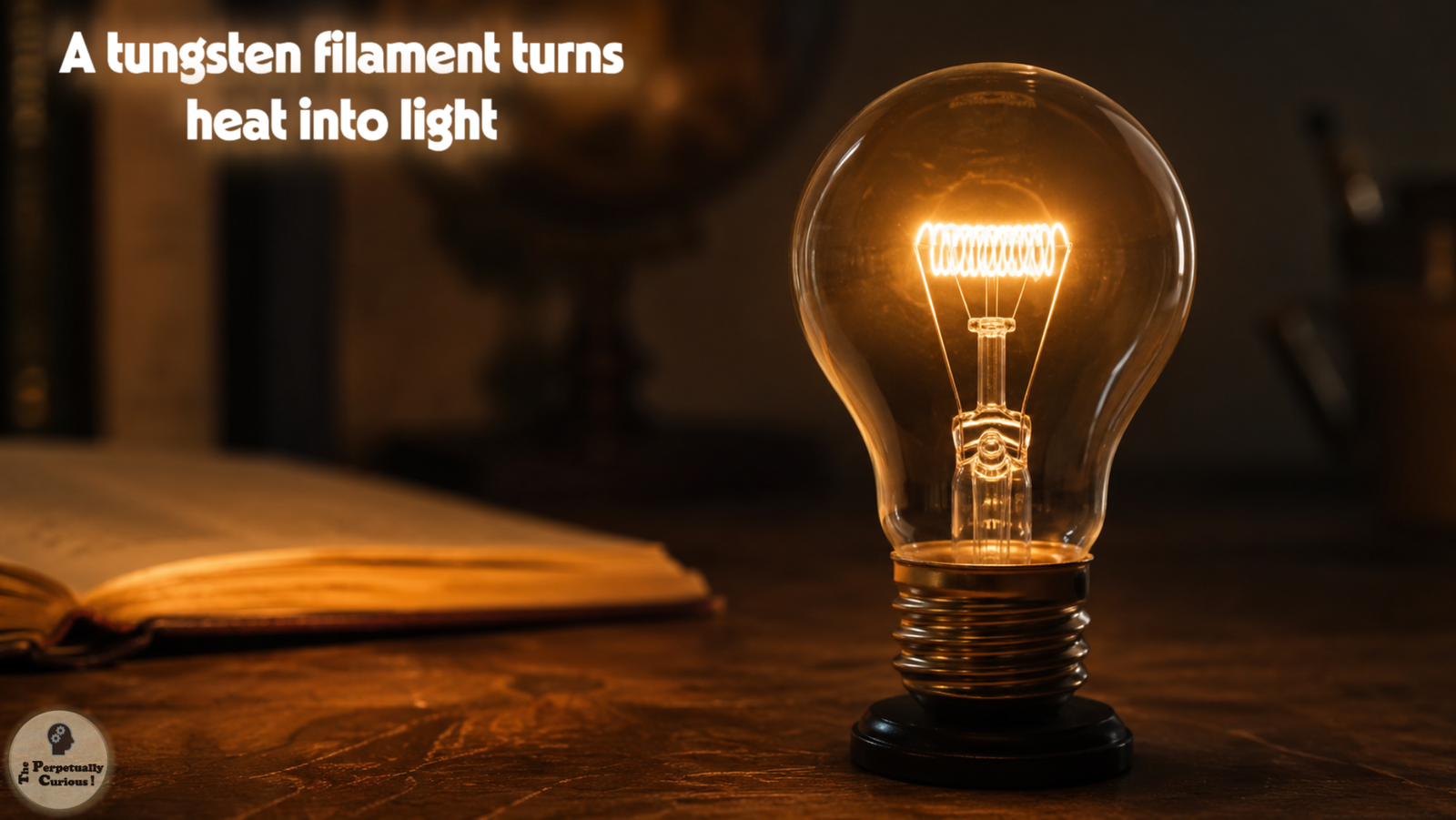
💡 How an Incandescent Filament Turns Resistance into Warm Light
An incandescent bulb seems to awaken all at once. The switch closes, the filament brightens, and a room takes on a warm amber cast. Inside the glass, however, the change is not sudden magic.