Explore by topic, question, or idea. Find articles, reflections, videos, puzzles, and curiosity pathways gathered across the site.
Press Enter or select Search. A newly typed query starts globally; filters are applied only through the visible rail.
61 results for “beneath hardness”
- The Perpetually Curious! › Canonical › ChemistryArticle
💧 When Water Turns Gentle: The Science and Story of Water Softening
A glass of water can appear perfectly clear and still carry a record of the ground beneath it. As water moves through soil, limestone, chalk, dolomite, and other mineral-bearing layers, it can gather calcium and magnesium ions that change how it behaves without changing how it looks. …
- The Perpetually Curious! › Archives › Botanical WondersArticle
🌲 The Wood Wide Web: How Trees Whisper Beneath Our Feet
When you walk through a forest, you might first notice the crunch of leaves underfoot, the shafts of sunlight filtering through the canopy, or the rich scent of earth in the air. Yet beneath your feet lies another world, an unseen network as alive and dynamic as any city.
- The Perpetually Curious! › Canonical › Biology & HealthArticle
🌫️ Why We Get Hiccups: The Reflex Beneath Every Small “Hic”
… First comes the physical event itself: a sudden muscular contraction, a quick interruption of airflow, and the familiar “hic.” Beneath that small interruption is a wider story about breath, timing, reflexes, and the nervous system’s ability to coordinate the body in fractions of a second.
- The Perpetually Curious! › Archives › Biology & HealthArticle
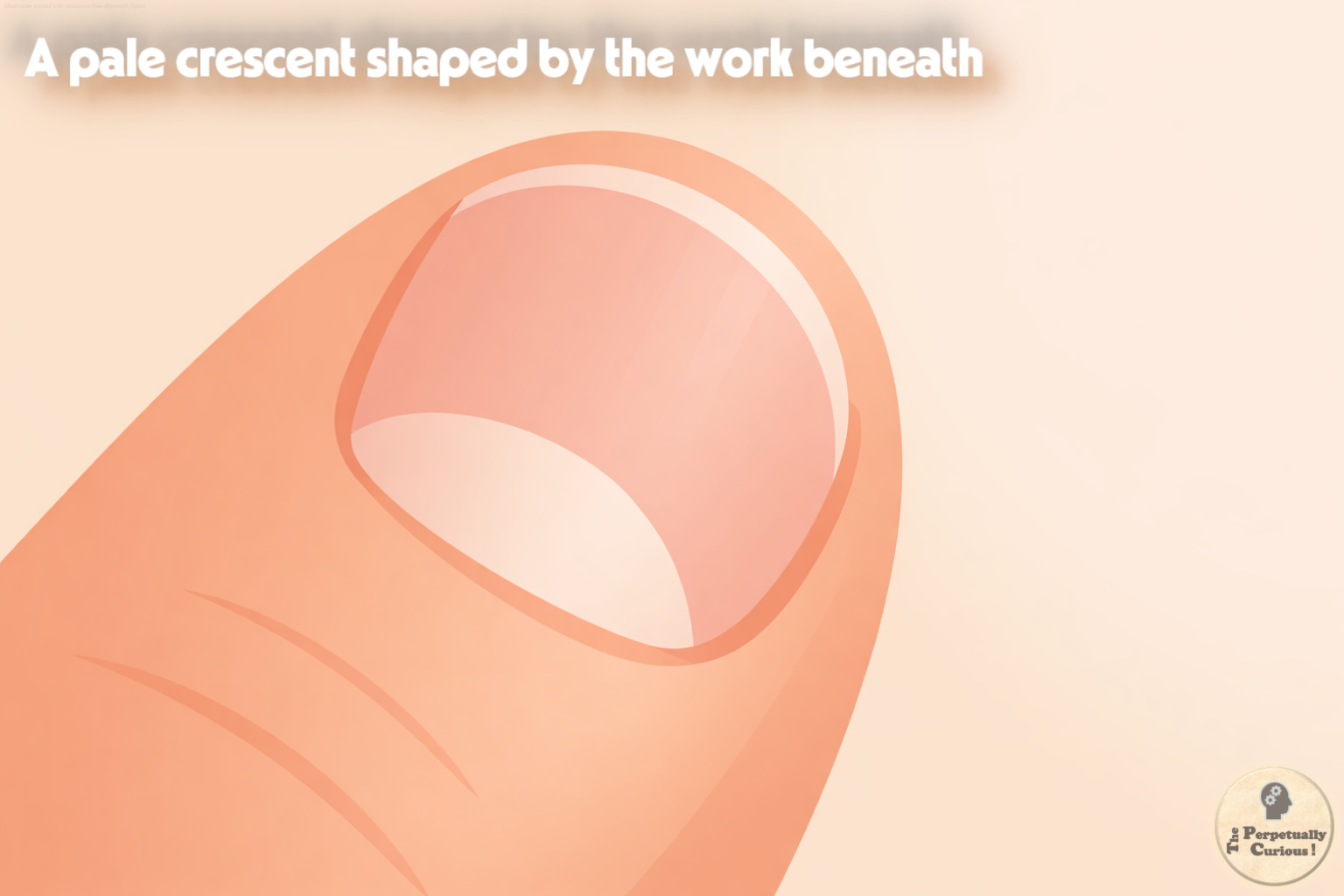
🌙 White Half Moon on Nails: The Quiet Growth Zone Beneath
From section: Why the thumb often shows it bestWhy the thumb often shows it best The thumb usually has the most obvious lunula because the thumb nail is broader and the matrix beneath it is often more exposed.
- The Perpetually Curious! › Canonical › Biology & HealthArticle
🌙 Little Moons at the Base of Our Nails: The Quiet Science of the Lunula
From section: 🌱 The foundation beneath the crescent: How the nail growsTo understand the lunula, it helps to begin with the architecture of the nail itself. A fingernail is not simply a plate resting on the finger. It is a layered structure shaped by living cells beneath the skin.
- The Perpetually Curious! › Archives › Engineering & TechnologyArticle
The Journey Beneath Our Wheels: How Asphalt Roads Have Evolved Through the Ages 🛤️
The story of asphalt begins not in a laboratory or construction site, but in the ancient seeps of Mesopotamia, where natural bitumen bubbled to the surface like Earth's own industrial secret.
- The Perpetually Curious! › Archives › PhysicsArticle
🐋 How Do Whales Float? The Science of Buoyancy Beneath the Waves
Whales are the giants of the ocean, with blue whales reaching up to 200 tons. Yet they move through the water with surprising grace. If you have ever wondered how such colossal animals manage to float, sink, and swim so smoothly, the answer lies in the fascinating blend of…
- The Perpetually Curious! › Archives › Wilderness & Homestead CreaturesArticle
🦈 Sharks’ Multisensory Brilliance: Precision Hunting Beneath the Waves
💡 Did you know sharks, such as the great white, have adaptations that protect their eyes during predation, a key defensive mechanism? Many sharks have a nictitating membrane, a protective third eyelid that shields the eye while still allowing limited vision.
- The Perpetually Curious! › Canonical › Planet EarthArticle
🌑 How Coal Is Formed: The Slow Birth of Black Stone Across Deep Time
From section: Frequently Asked Questions+Can coal form beneath glaciers? Coal formation requires abundant vegetation, so active glacial environments do not usually produce coal. However, glacial sediments can later bury, cover, or disturb peat and coal-bearing layers that formed during earlier warmer intervals.
- The Perpetually Curious! › Canonical › Planet EarthArticle
🌍🌑 Where Two Soils Part Ways: Earth, Moon, and the Stories Written in Dust
Soil on Earth and soil on the Moon appear, at first glance, to be simple surfaces beneath our feet or beneath a distant sky. One is familiar, often damp, and threaded with roots. The other is pale, powdery, and silent, seen mostly through photographs and the memories of a few explorers.