

There is a moment when breath falters, the chest lifts, and a small sound escapes that no one intends. The humble hiccup arrives without warning, interrupts a sentence or a quiet thought, and then fades as gently as it appeared. Yet behind this fleeting disturbance lies a carefully timed reflex, a pattern of nerves and muscles that has accompanied mammals through infancy, adulthood, and perhaps even deeper evolutionary time. To understand why we get hiccups is to follow a thread that leads from the diaphragm to the brainstem, from everyday triggers to ancient rhythms, and from the earliest stages of life to the occasional interruptions of adulthood.
A hiccup may seem like a tiny accident of breathing, but it is better understood as a reflex with a recognizable sequence. First comes the physical event itself: a sudden muscular contraction, a quick interruption of airflow, and the familiar “hic.” Beneath that small interruption is a wider story about breath, timing, reflexes, and the nervous system’s ability to coordinate the body in fractions of a second.
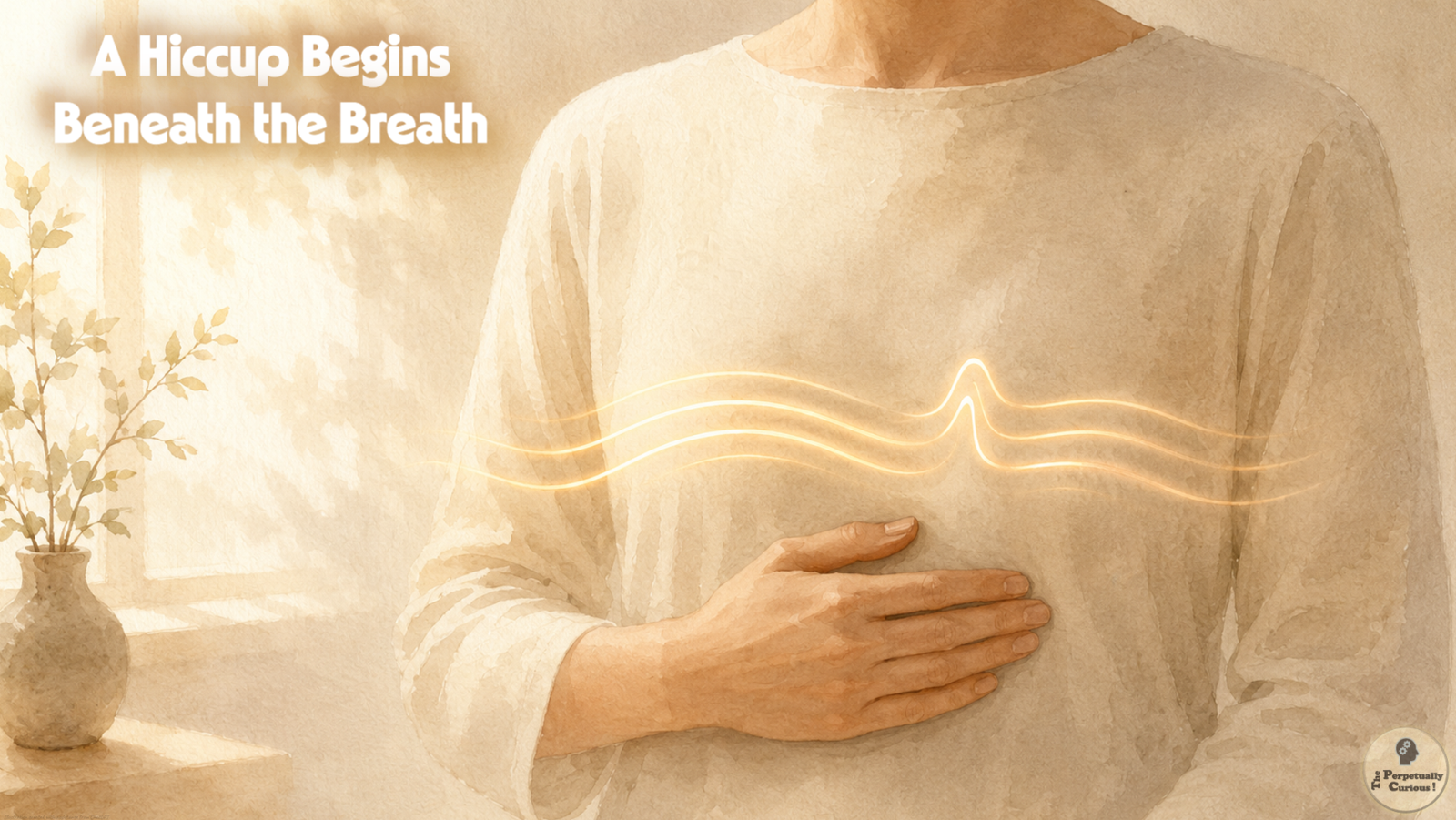
A small breath rises and pauses, a quiet rhythm shaped by nerves and time.
It moves through bodies and ages with the same soft surprise.
In that moment of stillness, the reflex becomes a reminder of how life stirs within us.
🌬️ Inside a hiccup: a brief spasm of breath
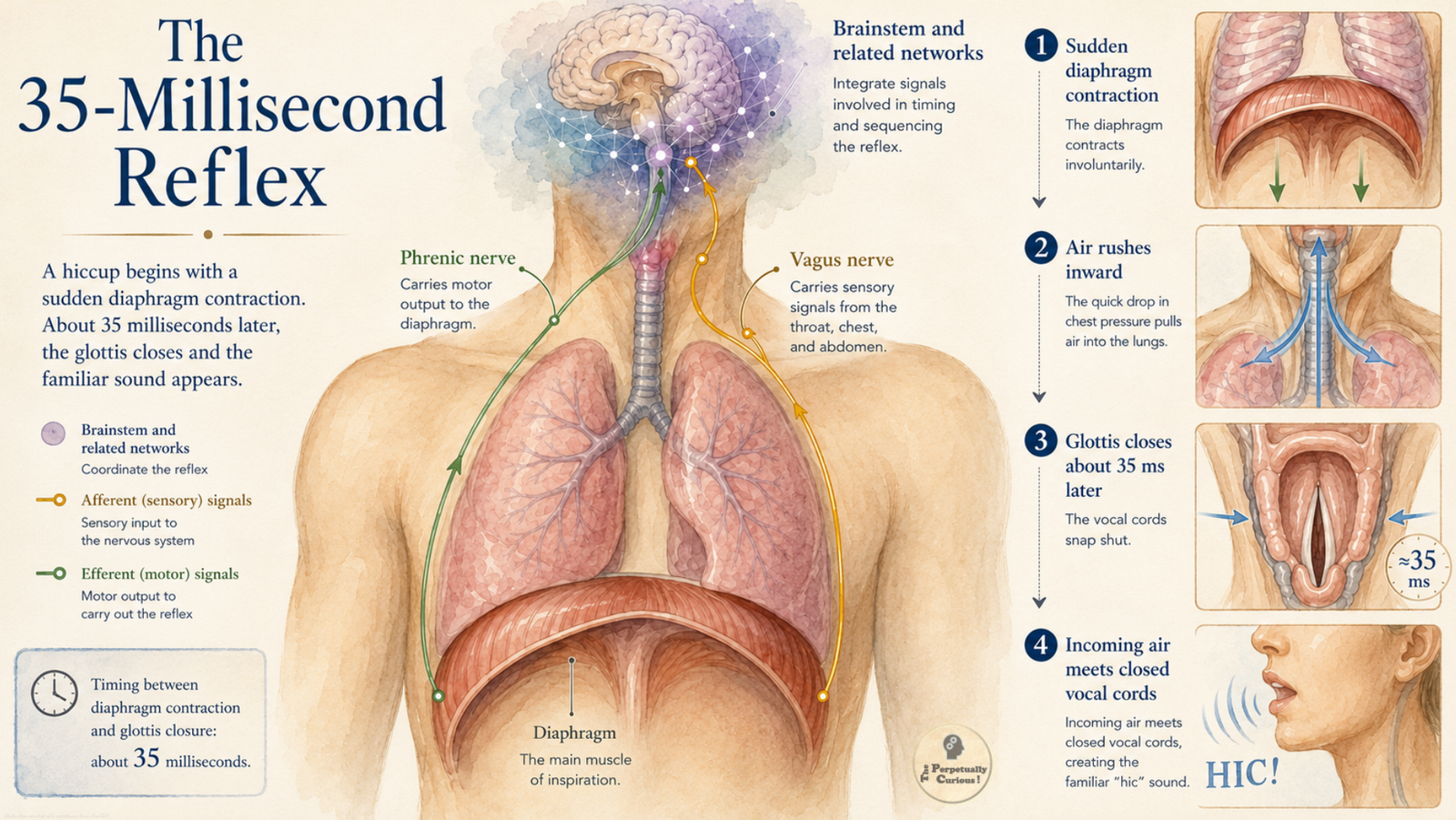
A hiccup begins with a sudden involuntary contraction of the diaphragm, the dome-shaped muscle that separates the chest from the abdomen and drives breathing. When this muscle tightens abruptly, air rushes into the chest. Within about 35 milliseconds, the glottis, which is the opening between the vocal cords at the top of the windpipe, closes sharply. Airflow stops in mid-breath, and the collision of incoming air with closed vocal cords produces the familiar sound.[1]
The sensation of a hiccup is distinctive. It can feel like a small internal ripple, a brief jump beneath the ribs, or a tiny tug that rises and falls before conscious control can catch it. This rapid sequence is not voluntary. It resembles the way a knee jerks when tapped during a reflex test. The diaphragm and the inspiratory muscles between the ribs contract together, and the glottis closes shortly afterward. The timing is remarkably precise, which hints that the event is not simply a random spasm but part of a coordinated reflex pattern.
To understand that coordination, it is helpful to look beneath the movement itself and follow the reflex along its neural pathways.
🧠 The hiccup reflex arc: nerves, brainstem, and timing
The hiccup reflex travels along a loop of nerves that connect the diaphragm and surrounding structures to the brainstem and nearby midbrain networks. Sensory signals often move through the phrenic nerve, which innervates the diaphragm, and the vagus nerve, which carries information from the chest and abdomen to the brain. Additional fibers from the upper spinal cord and sympathetic pathways may also participate. These signals converge in neural regions involved in breathing, airway control, and protective reflexes, although studies describe the exact central processing pattern with different emphasis. It is best understood as a distributed, not fully mapped control network rather than a single hiccup center.
From these central networks, motor signals return to the diaphragm through the phrenic nerve and to the muscles between the ribs through spinal motor pathways. The closure of the glottis is integrated into the same timed pattern through laryngeal control of the vocal folds. A similar logic appears in sneezing, where sensory input is translated into a coordinated respiratory reflex. In hiccups, sensation enters, the nervous system processes the input, and muscle contraction follows, with the airway shutting just after the diaphragm contracts.
Researchers often describe this sequence as a central-pattern-generator-like rhythm, meaning a small coordinating network capable of producing a repeated pattern once activated. Central pattern generators also help organize rhythmic behaviors such as chewing and breathing. In hiccups, this model helps explain why the reflex can continue for several cycles after it begins, especially when the underlying trigger has not fully settled.
Neurochemistry adds another layer. Several neurotransmitter systems, including GABA, dopamine, and serotonin, may influence the excitability of the reflex arc. Much of this evidence comes from medication associations, case reports, and treatment responses rather than direct mapping of a single hiccup switch. A wider view of diverse neurons helps explain why even a tiny reflex depends on many kinds of electrical and chemical signaling rather than one simple on-off command.
With the reflex arc in view, it becomes easier to understand how everyday experiences, such as eating, laughing, or sudden emotional shifts, can activate the same neural loop.
🍽️ Everyday triggers: stomach stretch, temperature shifts, and emotion
Short-lived hiccups are often linked to simple mechanical or sensory triggers. Rapid eating can cause the stomach to expand, which may press upward against the diaphragm and stimulate the nerves that feed into the reflex arc. Drinking carbonated beverages introduces gas that distends the stomach further. Alcohol and spicy foods may irritate the lining of the esophagus or stomach, which can influence the vagus nerve.
Sudden temperature shifts, such as drinking very cold liquid after a warm meal, may also activate the reflex. Swallowing air while chewing gum or smoking can contribute. Laughter deserves particular mention because it changes breathing rhythm, recruits the diaphragm, and places hiccups near other breath-linked reflexes such as yawning. A burst of laughter can stretch the diaphragm and briefly disturb the timing of breathing, creating conditions in which the hiccup reflex may begin.
Emotional triggers add another dimension. A surge of anxiety, surprise, or excitement can influence the autonomic nervous system, including pathways connected with the vagus nerve. In these moments, the diaphragm responds not only to physical changes but also to internal states. This overlap between sensation, emotion, and autonomic tone gives hiccups a quiet kinship with goosebumps, another reflex that can be raised by both physical and emotional triggers.
These diverse triggers share a common theme. They alter the environment of the diaphragm, the stomach, or the nerves that connect them to central respiratory circuits. Once the reflex arc is activated, the familiar pattern unfolds. This raises a deeper question. If hiccups can be set off by such ordinary events, why does this reflex exist at all, and does it serve any purpose beyond occasional interruption?
🐾 Evolutionary echoes: infants, amphibians, and possible origins
Scientists have proposed several hypotheses to explain why mammals hiccup. None is universally accepted, and each is supported by different lines of evidence, so careful hedging is appropriate. One influential idea suggests that hiccups may have evolved as a way for young mammals to expel swallowed air during nursing. When infants drink milk, they often swallow air along with it. That air occupies space that could otherwise hold milk.
In this hypothesis, the presence of an air bubble in the stomach, beneath the diaphragm, may help trigger the reflex. The diaphragm and the inspiratory muscles between the ribs contract together, and the glottis closes shortly afterward. The sudden pressure shift may help draw the air bubble upward into the esophagus, where it can then move out of the mouth as a burp. This would free additional room in the stomach for milk and could offer a modest advantage to nursing mammals. Hiccups are indeed more common in infants than in adults, which aligns with this idea, although it does not prove it.[2]
Another hypothesis looks further back in evolutionary history. Some researchers have noted that the pattern of muscle contraction and airway closure in hiccups resembles movements used by certain amphibians and lungfish to move water across gills while protecting air-breathing structures. Tadpoles, for example, use rhythmic buccal or throat-pump movements, coordinated with glottis closure, to move water across their gills. Researchers have noted similarities in the timing, muscle patterns, and responses to certain chemical signals in these movements and mammalian hiccups. These parallels support an evolutionary hypothesis, but they do not establish that the same ancestral circuit has been retained in mammals.[3]
These evolutionary ideas are not mutually exclusive. Hiccups may have been repurposed for different functions at different stages, from fetal development, where they may help the nervous system receive feedback from the diaphragm, to infancy, where they may assist with air clearance, and finally to adulthood, where they persist as a largely vestigial reflex. The evidence remains incomplete, and ongoing research continues to refine these possibilities.
With these evolutionary echoes in mind, it is helpful to return to the present and consider how hiccups appear across the lifespan.
👶 Hiccups across life: from fetus to adult
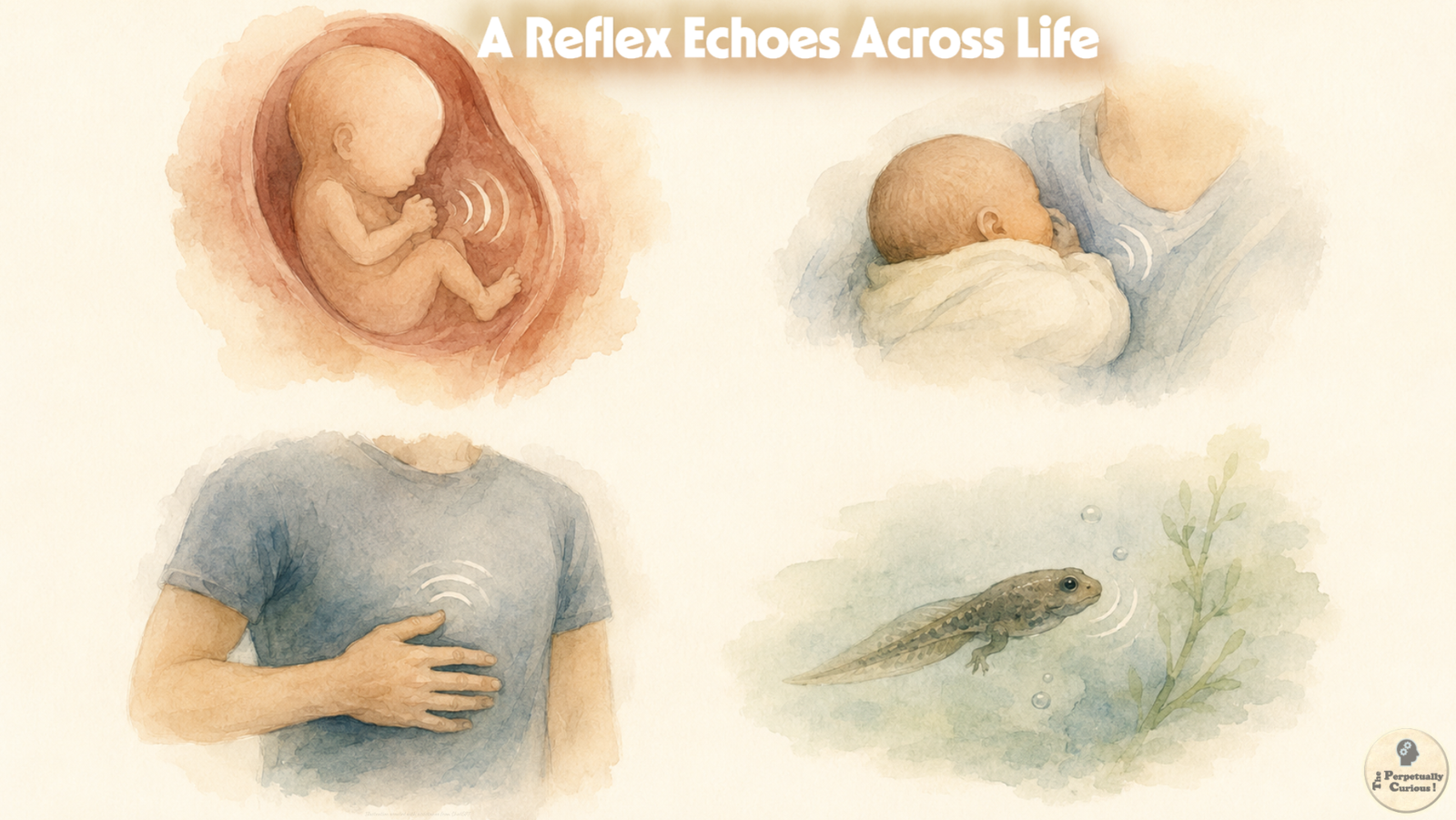
Hiccups are observed very early in human development. Fetuses can begin to show hiccup-like movements in the uterus, and these may occur regularly. Some researchers propose that these rhythmic contractions provide sensory feedback to the developing brain, helping it register the position and behavior of the diaphragm before independent breathing begins. In this view, fetal hiccups may be less like a nuisance and more like an early signal between muscle, nerve, and brain. They may also form part of the wider rehearsal of respiratory patterns that will later support breathing after birth.
In newborns, hiccups are common and often occur during or after feeding. They are usually brief and do not appear to cause distress. As individuals age, hiccups tend to become less frequent, although most people experience occasional bouts throughout life. In adults, short episodes are usually benign and resolve spontaneously. The reflex remains, but its everyday impact is usually limited to minor interruptions of speech or eating.
There is, however, a distinction between transient hiccups and those that persist. This distinction does not change the basic mechanism of the reflex, but it does influence how clinicians think about duration, context, and possible underlying causes.
⏱️ When hiccups linger: persistence and underlying conditions
Most hiccup episodes last only a few minutes. Episodes lasting less than about 48 hours are usually considered acute or transient. Hiccups that continue beyond 48 hours are often described as persistent or protracted, while episodes lasting longer than about one month are commonly called intractable.[4] These longer-lasting bouts are uncommon. When they occur, they may be associated with a wide range of underlying conditions or influences that affect the reflex arc.
Potential associations include disorders that affect the central nervous system, metabolic disturbances, and conditions that irritate or damage the vagus or phrenic nerves. Some infections and medications have also been reported in connection with prolonged hiccups. In these situations, hiccups are not a diagnosis in themselves. They are one possible sign among many that clinicians may consider when evaluating a person’s overall health.
The reflex arc is usually stable and self-limiting, which is why prolonged episodes are rare. Short bouts often fade once a temporary trigger settles, while longer episodes suggest that the reflex pathway is being repeatedly stimulated or unusually sustained. With the main narrative complete, the article can now turn to a few concise curiosities that extend the discussion.
Pass this article along to someone curious and let the learning travel.
Did You Know
🧩 Hiccups can occur during sleep, showing that the reflex can activate outside waking awareness. This suggests that brainstem and related timing circuits can briefly coordinate the pattern without conscious control.
🌊 In amphibians, a hiccup-like pattern can involve throat-pump movements and glottis closure that help move water across gills while protecting air-breathing structures. This resemblance is one reason evolutionary biologists consider hiccups a possible echo of older respiratory strategies.
🔍 The interval between hiccups in a bout can be surprisingly regular. Researchers have used this timing to study rhythm generation in the nervous system, although hiccups are reflex rhythms rather than daily biological clocks.
👶 Newborn hiccups may send measurable signals to the developing brain. These early contractions may provide sensory feedback from the diaphragm as the nervous system learns the body’s breathing muscles.[5]
🌬️ Hiccups sometimes stop around the time a person begins slow, steady breathing. This may occur because stable breathing patterns can influence the neural circuits that coordinate the reflex.
🐈 Several mammals, including cats, dogs, rabbits, and horses, appear to experience hiccup-like reflexes. This cross-species presence suggests that the reflex is embedded in mammalian physiology.
📘 The scientific term often used for hiccups is “singultus,” a word derived from Latin that refers to a sob or gasp. The word captures the sudden, involuntary quality of the familiar “hic.”
What exactly is a hiccup in scientific terms?
A hiccup is an involuntary reflex that involves a sudden contraction of the diaphragm and nearby breathing muscles, followed by rapid closure of the glottis. This sequence produces the characteristic sound and is coordinated by brainstem and related neural networks involved in breathing and airway control.
Why do hiccups make a “hic” sound?
The sound arises when air rushing into the chest meets the closed vocal cords at the glottis. The abrupt stop in airflow creates the small, sharp noise associated with a hiccup.
Are hiccups more common in infants than in adults?
Hiccups are often more frequent in infants. Newborns may experience regular bouts, particularly during or after feeding. As individuals grow older, hiccups usually become less frequent, although occasional bouts remain common.
Why do newborns hiccup so often?
Newborn hiccups may reflect feeding-related stomach stretch, swallowed air, and an immature but active reflex pathway. They may also provide sensory feedback from the diaphragm to the developing nervous system.[5]
Do other animals get hiccups?
Several mammals appear to experience hiccup-like reflexes, including cats, dogs, rabbits, and horses. This suggests that the underlying reflex pattern is not unique to humans.
Can hiccups occur during sleep?
Hiccups can occur during sleep or sleep-like states. This indicates that the reflex arc can activate outside conscious awareness and does not require intentional control of breathing.
Do breathing patterns influence hiccups?
Steady breathing patterns may influence the neural circuits that coordinate hiccups. This is one reason slow, purposeful breathing sometimes coincides with the end of a hiccup bout.
Is there a single agreed-upon evolutionary explanation for hiccups?
There is no single explanation that is universally accepted. Hypotheses include a possible role in expelling swallowed air during infancy and a possible connection to older respiratory patterns seen in amphibian ancestors.
Do hiccups serve any clear purpose in adults?
In adults, hiccups are generally considered a reflex without a clear ongoing function. They may represent a pattern that persists from earlier developmental or evolutionary roles.
Can hiccups occur during exercise?
Hiccups may occur during exercise when rapid breathing, diaphragm movement, or stomach motion stimulates the reflex arc. They are usually brief and resolve as breathing stabilizes.
Why do some people hiccup more easily than others?
Individual sensitivity varies. Factors may include diaphragm responsiveness, vagus nerve sensitivity, stomach distension patterns, and emotional triggers. These differences are usually part of normal variation.
Can hiccups influence breathing efficiency?
During a hiccup, airflow is briefly interrupted, but the event is too short to meaningfully alter oxygen or carbon dioxide levels during ordinary brief bouts.
Do hiccups ever occur in clusters across several days?
Some individuals experience intermittent clusters of hiccups over several days. These clusters may reflect temporary sensitivity of the reflex arc, while longer-lasting patterns are considered differently from brief, ordinary episodes.
Why do some approaches seem to interrupt hiccups?
Some approaches may briefly alter breathing, swallowing, or vagus nerve activity, which can interrupt the reflex pattern. Effects vary, and many episodes stop on their own.
🌱 Share this quiet reflex story
We kindly invite you to share this piece with friends, family, or colleagues who may enjoy seeing a familiar “hic” in a new way. A small everyday interruption can open a larger curiosity about breath, reflexes, and the quiet coordination that helps the body move through each moment.
Selected sources
- Davis JN. (1970). An experimental study of hiccup. Brain, 93(4), 851-872. [PMID: 5490279]
- Howes D. (2012). Hiccups: a new explanation for the mysterious reflex. BioEssays, 34(6), 451-453. [PMID: 22377831]
- Straus C, Vasilakos K, Wilson RJA, et al. (2003). A phylogenetic hypothesis for the origin of hiccough. BioEssays, 25(2), 182-188. [PMID: 12539245]
- Moretto EN, Wee B, Wiffen PJ, et al. (2013). Interventions for treating persistent and intractable hiccups in adults. Cochrane Database of Systematic Reviews, 2013(1), CD008768. [PMID: 23440833]
- Whitehead K, Jones L, Laudiano-Dray MP, et al. (2019). Event-related potentials following contraction of respiratory muscles in pre-term and full-term infants. Clinical Neurophysiology, 130(12), 2216-2221. [PMID: 31677560]
“Why We Get Hiccups: The Reflex Beneath Every Small “Hic”.” The Perpetually Curious!, July 2026.
https://www.theperpetuallycurious.org/articles/why-we-get-hiccups/Continue Exploring
For the curious mind: want to explore this theme through a few questions? Visit the Classic Quiz Studio, nestled under Explorations opens in a new tab ,and see where a few well-placed questions lead: Biology & Health Quizzesopens in a new tab
For what comes next
Site Updates gathers occasional notes, new additions, and ways to keep in touch. RSS brings new publications to your feed reader in chronological order.
Choose the path that speaks to you, and let the next curiosity find you wherever your wondering takes you.