Explore by topic, question, or idea. Find articles, reflections, videos, puzzles, and curiosity pathways gathered across the site.
Press Enter or select Search. A newly typed query starts globally; filters are applied only through the visible rail.
14 results for “the hyena paradox power care and clan life in africa night”
- The Perpetually Curious! › Archives › Cosmic ExplorationArticle
🌌 When Worlds Shine: Why Some Planets Outglow Others in Our Night Sky
The night sky often feels calm and timeless, yet the brightness of the planets tells a dynamic story of light, distance, geometry, and illumination. When Venus blazes in the evening or morning sky, it can appear almost unreal, while Mars, Jupiter, and Saturn each take turns as…
- The Perpetually Curious! › Archives › Cosmic ExplorationArticle
The Unlikely Astronauts: What Earth’s Toughest Survivors Teach Us About the Possibility of Life Elsewhere 🦠
For decades, our search for alien life focused on finding another Earth: a comfortable, temperate world with liquid water and gentle sunshine. But life, as we have discovered, finds a way in the most hostile environments imaginable.
- The Perpetually Curious! › Archives › Cosmic ExplorationArticle
🌌 The Cosmic Silence: Unraveling the Fermi Paradox in an Age of Discovery
In 1950, physicist Enrico Fermi posed a question that still feels disarmingly direct: “Where is everybody?” It was not a claim about what must exist, but a moment of clear reasoning in a universe that seems generous with stars and unexpectedly quiet with replies.Read more »
- The Perpetually Curious! › Archives › Cosmic ExplorationArticle
🌌 The Silent Storm Above: Understanding Our Orbital Debris Challenge
The night sky appears serene and infinite, yet beyond our atmosphere swirls an invisible tempest of our own making. ESA estimates about 140 million debris fragments in the 0.04 to 0.4 inch (1 mm to 1 cm) range, plus about 1.2 million objects between 0.4 and 4 inches (1 to 10…
- The Perpetually Curious! › Archives › Cosmic ExplorationArticle
🌞 The Solar Wind: When the Sun Breathes Across Space
🌠 Introduction Have you ever looked up at the night sky and wondered why shimmering curtains of green, red, and other hues ripple across the poles? These auroras are the visible traces of the solar wind’s interaction with Earth’s magnetic field, where charged particles guided…
- The Perpetually Curious! › Archives › Cosmic ExplorationArticle
🌔 Lunar Eclipses: Earth’s Shadow on the Moon
🌕➡️🔴 The Allure of a Lunar Eclipse: Earth’s Shadow Play in the Night Sky Among the many wonders of the night sky, few spectacles are as enchanting as a lunar eclipse. On these special nights, our familiar Moon is transformed, slipping into Earth’s shadow.
- The Perpetually Curious! › Archives › Cosmic ExplorationArticle
The Cosmic Clock: How Stars Age Through Billions of Years ⏰
When we gaze at the night sky, the stars appear eternal and unchanging. Yet our Sun offers the perfect window into stellar aging. Currently 4.6 billion years old and middle-aged by stellar standards, it demonstrates the stable hydrogen burning that characterizes stellar prime.
- The Perpetually Curious! › Archives › Cosmic ExplorationArticle
Lunar Regolith: The Moon's Ancient Chronicle Written in Dust 🌙
Opening Reflection ✨ Imagine holding a handful of powder made from rocks that formed long before life emerged on Earth, each grain a microscopic witness to billions of years of cosmic history.
- The Perpetually Curious! › Archives › Cosmic ExplorationArticle
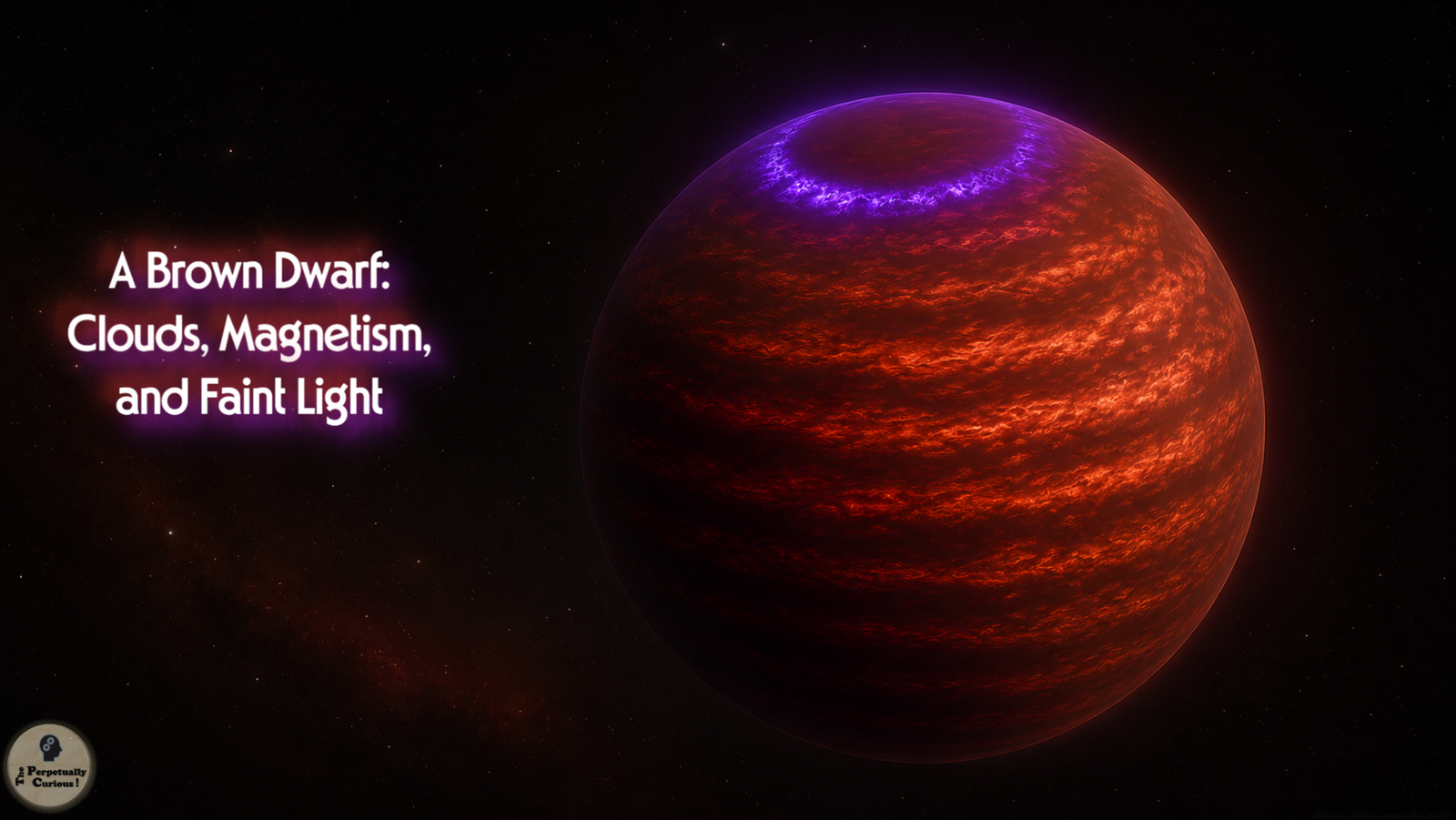
🌟 Brown Dwarfs: Why Stellar Ignition Never Takes Hold
From section: 🌌 A life powered by stored heatAmong objects of similar age and composition, a more massive brown dwarf can even be slightly smaller than a less massive one. 🌌 A life powered by stored heat Once any early deuterium burning and lithium depletion have run their course, no enduring nuclear source replaces the energy escaping into space.
- The Perpetually Curious! › Archives › Cosmic ExplorationArticle
🔭 The Ten Largest Moons in Our Solar System: A Journey Through Worlds of Ice, Fire, and Hidden Oceans
The long tradition of naming these worlds after mythological figures reflects the cultural patterns embedded in planetary names, which often mirror the stories humans have projected onto the night sky.Read more »