Explore by topic, question, or idea. Find articles, reflections, videos, puzzles, and curiosity pathways gathered across the site.
Press Enter or select Search. A newly typed query starts globally; filters are applied only through the visible rail.
43 results for “the ten largest moons in our solar system a journey through worlds of ice fire and hidden oceans”
- The Perpetually Curious! › Archives › Cosmic ExplorationArticle
🔭 The Ten Largest Moons in Our Solar System: A Journey Through Worlds of Ice, Fire, and Hidden Oceans
To explore the ten largest moons is to follow a path through the outer solar system, where ice and rock shape worlds that are both familiar and profoundly alien.
- The Perpetually Curious! › Canonical › Cosmic ExplorationArticle
🌙 Quiet Worlds, Vast Stories: Some Lesser-Known Moons of Our Solar System
From section: 🔭 Why lesser-known moons matterAfter learning about the largest moons, it is natural to wonder what lies beyond the giants. Smaller moons may seem modest at first glance, yet they often preserve clues about the early solar system. Their surfaces record ancient impacts. …
- The Perpetually Curious! › Canonical › Cosmic ExplorationArticle
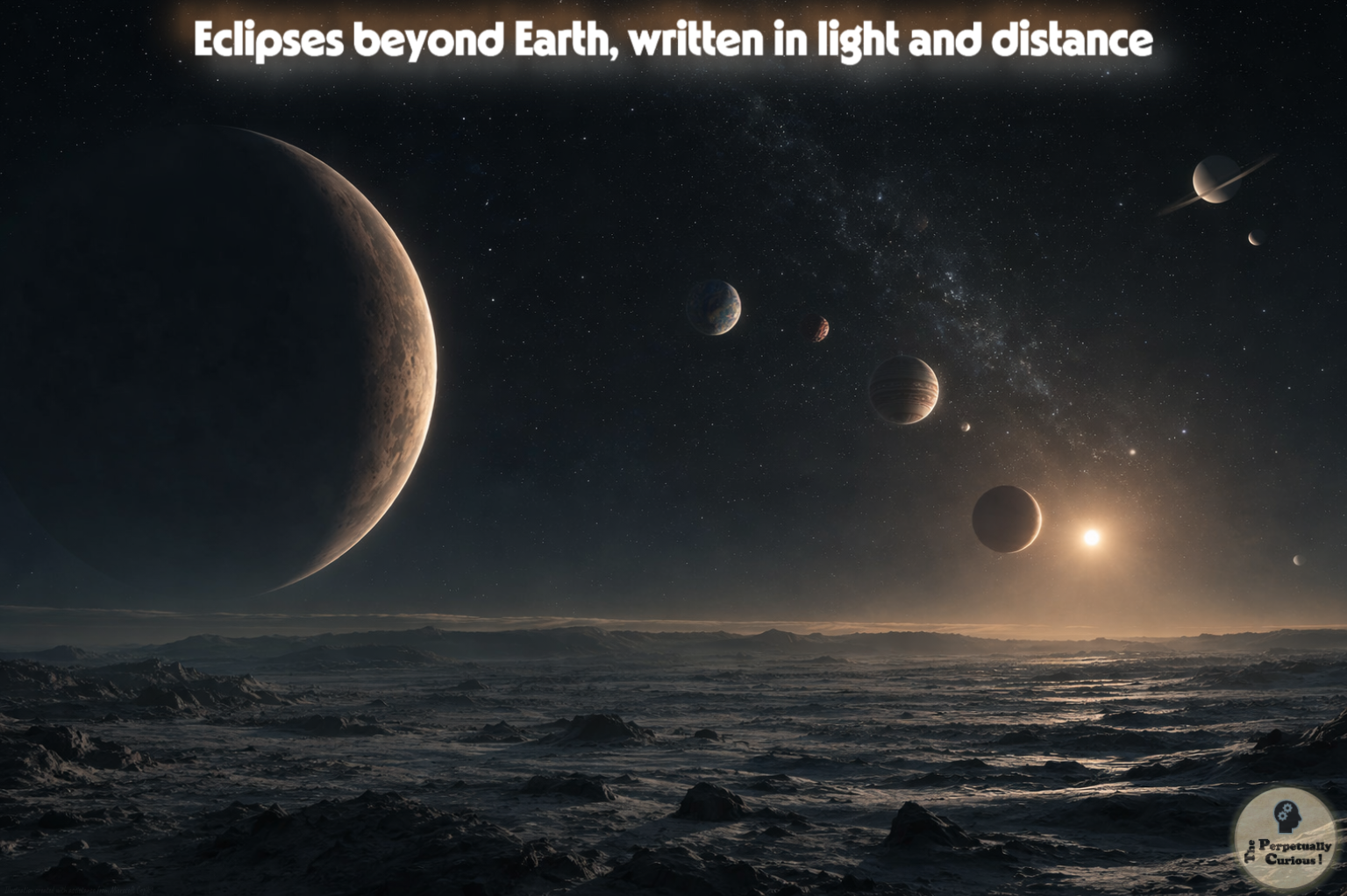
🌑 Shadows Across the Solar System: How Eclipses Unfold Beyond Earth
From section: 🌞 Solar eclipses across the Solar SystemThe scale of Martian eclipses becomes easier to appreciate when compared with the dimensions of the largest moons in the Solar System.
- The Perpetually Curious! › Canonical › Cosmic ExplorationArticle
🌌 Why Space Looks Dark in a Universe Filled with Light: Understanding the Quiet Cosmos
From section: 🚀 Sunlight, astronauts, and a black skyIn space, or on the surface of the Moon, there is no thick atmosphere to scatter sunlight. The Sun appears extremely bright, and surfaces directly illuminated by it can be dazzling. The Sun’s radiative power is measured through solar luminosity, but even powerful sunlight does not brighten a sky unless surrounding…
- The Perpetually Curious! › Archives › Cosmic ExplorationArticle
When the Sky Falls: Extraordinary Precipitation Across Our Solar System 🌧️
Our journey begins with Earth's familiar rain, moves inward to Mercury's impossibility, then ventures outward through planets where precipitation ranges from the sulfuric acid storms of Venus to the diamond hail of distant giants, pauses at the dwarf planets marking our solar system's frontier, then explores the…
- The Perpetually Curious! › Archives › Cosmic ExplorationArticle
Where the Solar System Whispers Its Secrets: A Journey to the Kuiper Belt 🌌
Like a library written in ice, each world preserves a different chapter of our solar system's ancient history.Read more »
- The Perpetually Curious! › Archives › Cosmic ExplorationArticle
🌌 When Stars Become Worlds: A Journey Through the Largest Stars We Know
The largest stars in the universe are not simply scaled-up versions of the Sun. They are vast, unstable, and luminous structures whose outer layers drift in slow, turbulent motion. Their atmospheres are so extended that the idea of a clear surface begins to dissolve into gradients of thinning gas.
- The Perpetually Curious! › Canonical › Cosmic ExplorationArticle
🌍 When Worlds Pull: Gravity Across the Planets and What It Reveals About Them
Gravity is the quiet sculptor of the cosmos. It shapes the paths of planets, guides the drift of moons, and anchors every step taken on the surface of a world. When we compare gravity across the Solar System, we begin to see how each planet carries its own gravitational signature.
- The Perpetually Curious! › Archives › Cosmic ExplorationArticle
🌘 Eclipses Across the Solar System: When Shadows Travel
Across the Solar System, the same geometry repeats with different planets, moons, rings, distances, and atmospheres.
- The Perpetually Curious! › Archives › Cosmic ExplorationArticle
The Asteroid Belt: Ancient Fragments of Our Solar System's Story 🌌
On New Year's Day 1801, Italian astronomer Giuseppe Piazzi made a discovery that would transform our understanding of the solar system. While searching for a suspected planet between Mars and Jupiter, he found something else entirely: the first of millions of rocky fragments…