Explore by topic, question, or idea. Find articles, reflections, videos, puzzles, and curiosity pathways gathered across the site.
Press Enter or select Search. A newly typed query starts globally; filters are applied only through the visible rail.
11 results for “through the ages the naming of the months in our calendar history art culture podcast tpc8”
- The Perpetually Curious! › Canonical › PhysicsArticle
💡 Listening to Matter When It Learns to Glow: How an Incandescent Light Bulb Works
Every time an incandescent light bulb brightens a room, something remarkable begins inside its fragile glass world. A current enters through the base, flows through a tightly coiled tungsten filament, and raises the metal to a temperature hot enough to shine.
- The Perpetually Curious! › Archives › PhysicsArticle
🔬 The Light That Sees Through You: How X-Rays Illuminate the Hidden World Within
On the evening of November 8, 1895, a quiet laboratory in Würzburg, Germany, became the setting for one of science's most luminous accidents. Wilhelm Conrad Röntgen, a methodical and deeply curious physicist, had been experimenting with cathode ray tubes, which were sealed glass…
- The Perpetually Curious! › Canonical › PhysicsArticle
🌟 When Light Learns to Answer Back: The Quiet Science of Mirrors
From section: 🧪 Why mirrors are usually made of glass and metalIn a typical household mirror, the glass serves as a smooth, protective window, while the metal layer is the true reflective surface. Light enters through the glass, reaches the metal, reflects from it, and then passes back through the glass to the observer. …
- The Perpetually Curious! › Archives › PhysicsArticle
⚗️ The Invisible Revolution: Understanding the Ancient Art and Modern Science of Glass Manufacturing
Where Sand Becomes Transparent 🏛️ Glass surrounds us so completely that we rarely pause to consider its profound mystery. This transparent solid, neither truly liquid nor conventionally crystalline, represents one of humanity's most transformative discoveries.
- The Perpetually Curious! › Archives › PhysicsArticle
⚖️ Solar Luminosity: The Universal Stellar Power Scale
☀️ Every second, our Sun unleashes energy equivalent to 1.8 billion Tsar Bombas, the most powerful nuclear weapon ever detonated. Yet this cosmic violence sustains all earthly life through a number that has become astronomy's gold standard: 3.828×10²⁶ watts.
- The Perpetually Curious! › Archives › PhysicsArticle
❄️⚡ The Peltier Effect: When Electricity Becomes Heat Flow
🌍 Introduction In 1834, French physicist Jean‑Charles‑Athanase Peltier revealed a direct way to control heat flow using electricity. When an electric current passes through the junction of two dissimilar conductors, one side becomes cooler while the other becomes warmer.
- The Perpetually Curious! › Archives › PhysicsArticle
🐋 How Do Whales Float? The Science of Buoyancy Beneath the Waves
Whales are the giants of the ocean, with blue whales reaching up to 200 tons. Yet they move through the water with surprising grace. If you have ever wondered how such colossal animals manage to float, sink, and swim so smoothly, the answer lies in the fascinating blend of…
- The Perpetually Curious! › Archives › PhysicsArticle
✨ Clean Chemistry: The Curious Physics Behind Soap Bubbles
From section: 🧪 Amphiphilic Molecules at WorkBeneath this everyday ritual lies a remarkably elegant story of chemistry and physics, one that transforms simple molecules into bubbles carrying both function and culture. …
- The Perpetually Curious! › Archives › PhysicsArticle
🦈 Why Do Sharks Float? The Science Behind Their Buoyancy
From section: 🌊 Opening DiveAs cartilaginous fishes, many sharks approach near‑neutral buoyancy through a combination of oil‑rich livers, lightweight skeletons, and hydrodynamic lift.
- The Perpetually Curious! › Archives › PhysicsArticle
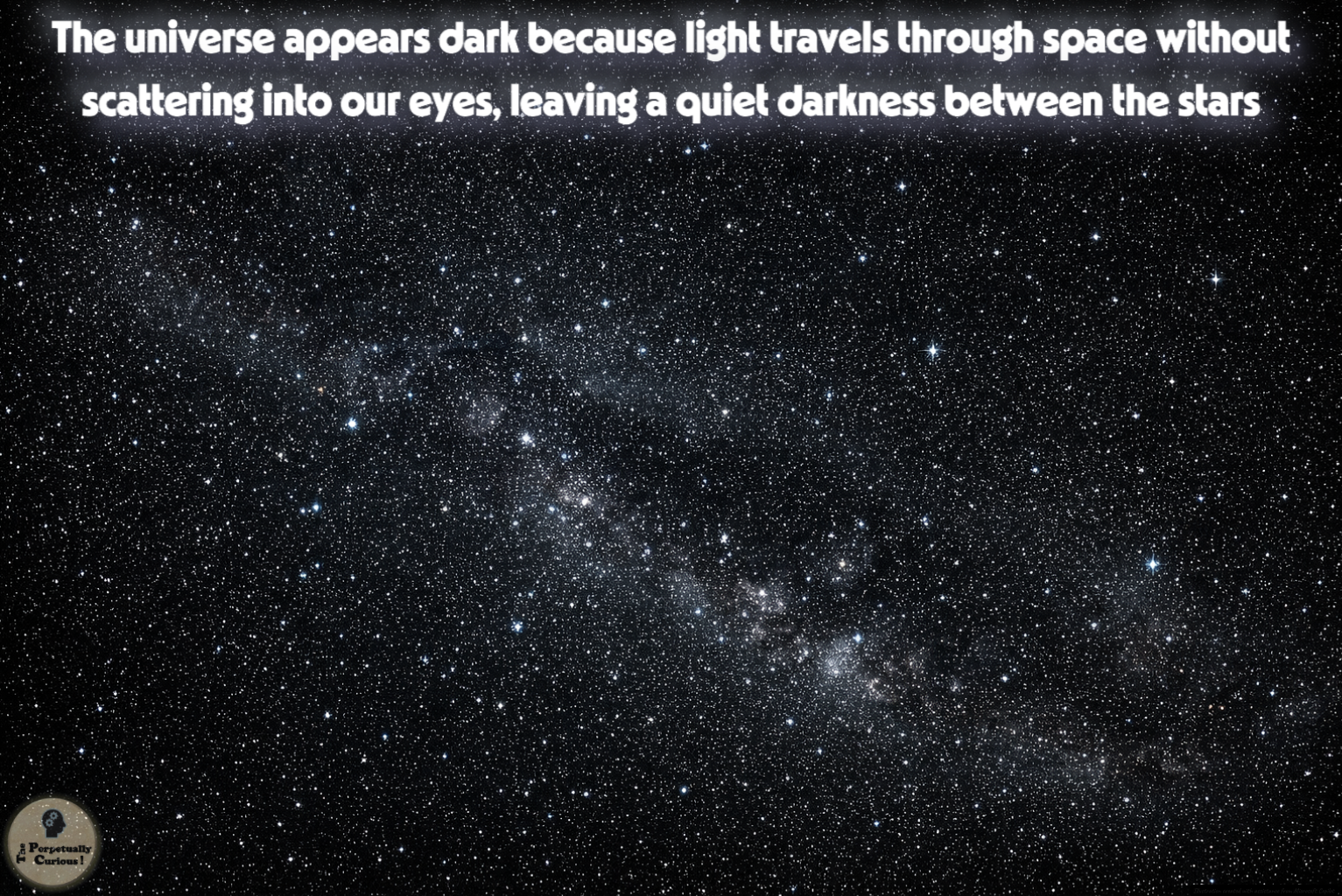
🌌 Why Space Looks Dark: Light, Matter, and the Quiet Cosmos
Without those particles, the beam itself would be harder to see, even though the light is still moving through the room.