Explore by topic, question, or idea. Find articles, reflections, videos, puzzles, and curiosity pathways gathered across the site.
Press Enter or select Search. A newly typed query starts globally; filters are applied only through the visible rail.
126 results for “trees that drink the sky how certain species shape water and land in south india”
- The Perpetually Curious! › Archives › Wilderness & Homestead CreaturesArticle
Where Rivers Meet the Sea: The World of Bull Shark Habitats 🦈
In July 1916, a series of shark attacks shocked New Jersey, including fatal encounters in Matawan Creek, 16 miles (26 kilometers) from the ocean. While debate continues about the exact species responsible, these incidents introduced the world to a possibility that defied…
- The Perpetually Curious! › Archives › Planet EarthArticle
🌊 The Great Lakes: North America's Temporary Inland Seas
Picture yourself holding a glass of water in Chicago. That water contains a mixture of ages, with some molecules that fell as rain just years ago and others that have circulated through Lake Superior for nearly two centuries.
- The Perpetually Curious! › Archives › Cosmic ExplorationArticle
🌌 The Silent Storm Above: Understanding Our Orbital Debris Challenge
The night sky appears serene and infinite, yet beyond our atmosphere swirls an invisible tempest of our own making. ESA estimates about 140 million debris fragments in the 0.04 to 0.4 inch (1 mm to 1 cm) range, plus about 1.2 million objects between 0.4 and 4 inches (1 to 10…
- The Perpetually Curious! › Archives › Cosmic ExplorationArticle
🌞 The Solar Wind: When the Sun Breathes Across Space
🌠 Introduction Have you ever looked up at the night sky and wondered why shimmering curtains of green, red, and other hues ripple across the poles? These auroras are the visible traces of the solar wind’s interaction with Earth’s magnetic field, where charged particles guided…
- The Perpetually Curious! › Archives › Cosmic ExplorationArticle
🌍 Why Earth Has a Living Atmosphere
A Cosmic Story of Gravity, Distance, and the Long Evolution of Air 🔭 Opening the Question Every planet carries a story in the sky above it. Some worlds hold thick blankets of gas, others keep only a faint whisper, and many have none at all.
- The Perpetually Curious! › Archives › MathematicsArticle
⚡ The Curve That Seemingly Defies Gravity: The Brachistochrone and the Fastest Path Down
Gravity pulls everything straight down. Or so it seems. Drop a stone and it falls vertically. Pour water and it seeks the most direct path downhill. Our intuition tells us that the shortest route is always the fastest.
- The Perpetually Curious! › Archives › Environment & SustainabilityArticle
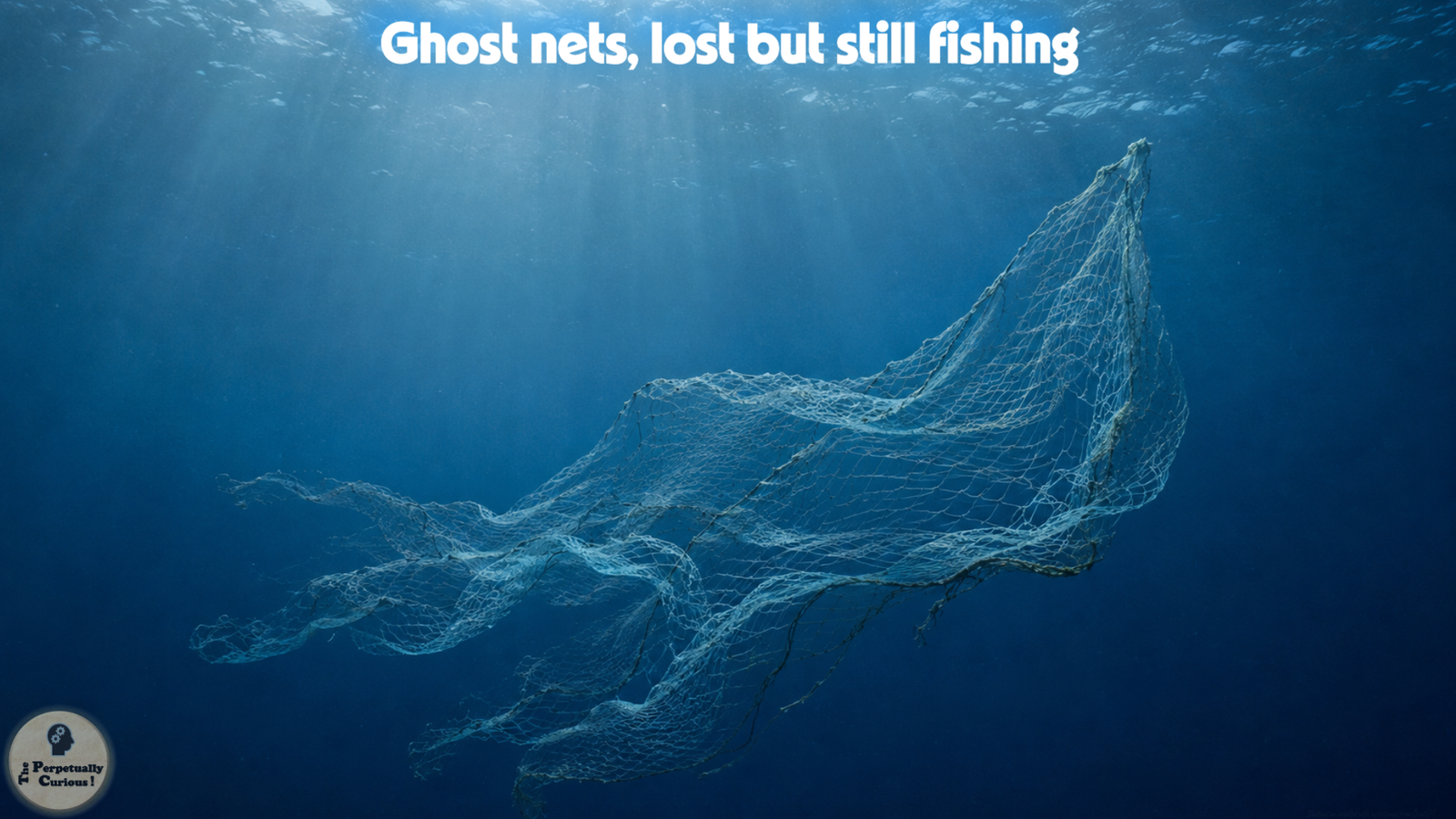
🕸️ Ghost Nets: Silent Killers Threatening Our Oceans and Reefs
🌊 Beneath the calm surface of the ocean, a hidden danger can keep moving long after people lose sight of it: ghost nets. These abandoned, lost, or discarded fishing nets may drift through open water, settle on reefs, tangle with other debris, or remain suspended where marine…
- The Perpetually Curious! › Archives › Cosmic ExplorationArticle
🌔 Lunar Eclipses: Earth’s Shadow on the Moon
🌕➡️🔴 The Allure of a Lunar Eclipse: Earth’s Shadow Play in the Night Sky Among the many wonders of the night sky, few spectacles are as enchanting as a lunar eclipse. On these special nights, our familiar Moon is transformed, slipping into Earth’s shadow.
- The Perpetually Curious! › Archives › Wilderness & Homestead CreaturesArticle
🐻 Sleeping Giants of Winter: How Bear Hibernation Rewrites the Rules of Survival
❄️ A quiet den beneath the snow Winter settles slowly across northern forests. Snow gathers on branches, streams stiffen under thin ice, and deep beneath roots or rock a bear curls into a darkened den. For months this large mammal generally will not eat, drink, urinate, or defecate.
- The Perpetually Curious! › Archives › Planet EarthArticle
🌊 Harbor Wave, Ocean Pulse: The Science of Tsunamis from Seafloor to Shore
Some ocean hazards announce themselves with wind, foam, and a rising sky. A tsunami often does not. Far from shore, it may pass as a long, subtle lift, more like a slow breath than a breaking wave. Even the word “wave” can mislead, because a tsunami is not simply the surface…