Explore by topic, question, or idea. Find articles, reflections, videos, puzzles, and curiosity pathways gathered across the site.
Press Enter or select Search. A newly typed query starts globally; filters are applied only through the visible rail.
15 results for “when clouds let go why it rains and how raindrops are born”
- The Perpetually Curious! › Canonical › Cosmic ExplorationArticle
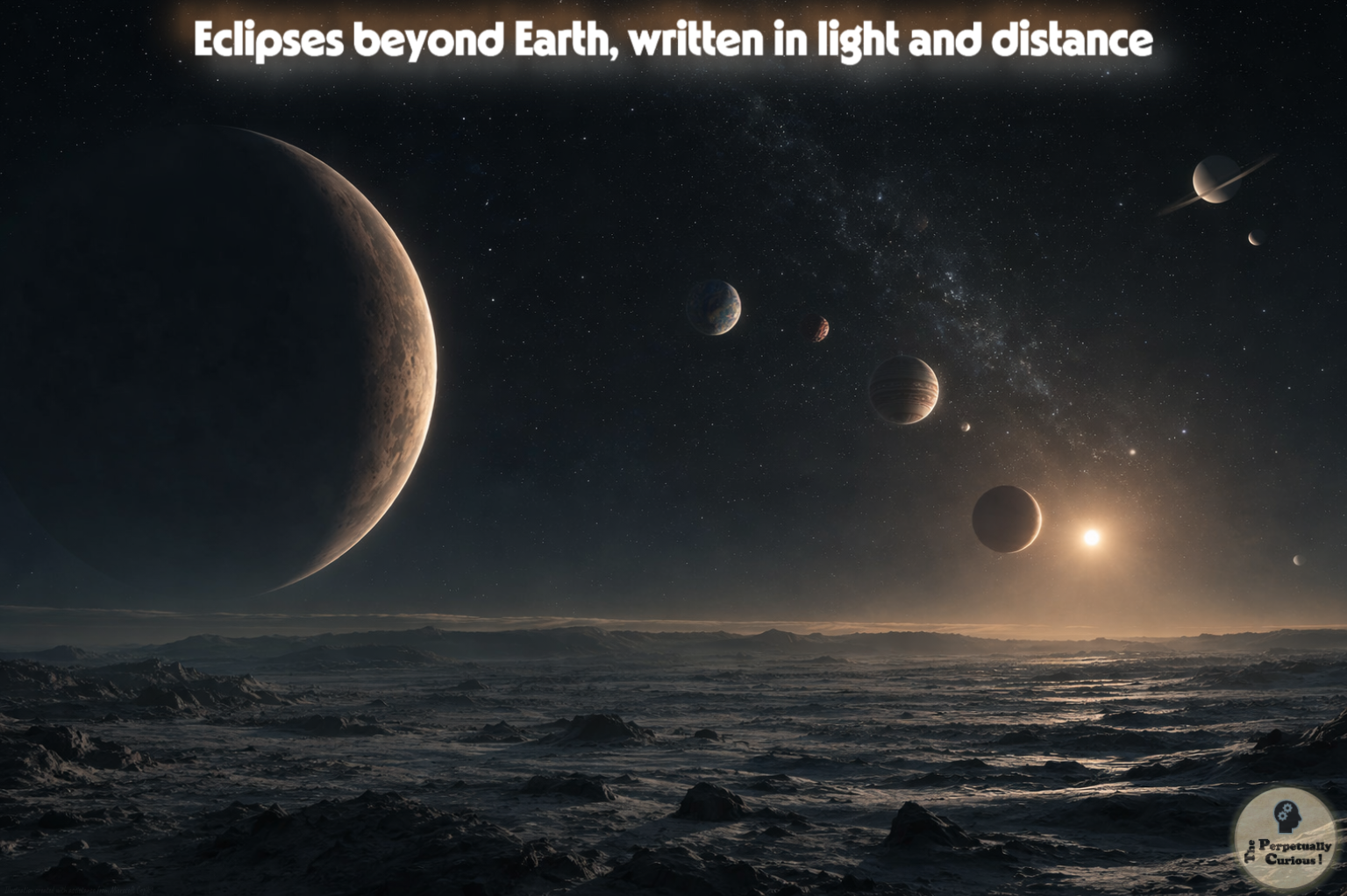
🌑 Shadows Across the Solar System: How Eclipses Unfold Beyond Earth
From section: 🔭 The geometry that shapes every eclipseEvery eclipse begins with a simple arrangement: a light source, an object that blocks the light, and a surface where the shadow falls. In our Solar System, the Sun is the light source, planets and moons are the objects that cast shadows, and the surfaces range from rocky ground to swirling clouds.
- The Perpetually Curious! › Archives › Cosmic ExplorationArticle
When the Sky Falls: Extraordinary Precipitation Across Our Solar System 🌧️
We call it rain when water falls from Earth's clouds, but that simple word stretches and transforms across our solar system into phenomena that challenge our earthbound vocabulary. Should we call it rain when methane cascades onto Titan's hydrocarbon shores?
- The Perpetually Curious! › Canonical › Cosmic ExplorationArticle
🌙 Quiet Worlds, Vast Stories: Some Lesser-Known Moons of Our Solar System
Most sky‑watchers can name a handful of large moons such as Ganymede, Titan, or Earth’s own Moon, yet scattered across the outer darkness are smaller, quieter companions that rarely appear in familiar summaries. These lesser-known moons do not dominate by size.
- The Perpetually Curious! › Archives › Cosmic ExplorationArticle
🌌 When Worlds Shine: Why Some Planets Outglow Others in Our Night Sky
It is a story of how sunlight interacts with surfaces and clouds, how far that light must travel, and how large each world appears from Earth.
- The Perpetually Curious! › Archives › Cosmic ExplorationArticle
🌘 Eclipses Across the Solar System: When Shadows Travel
From section: Atmosphere, rings, and distanceA moon without much atmosphere would experience a sharper edge, while a world with clouds, haze, or scattered particles may turn the same geometry into a muted wash of color.