Explore by topic, question, or idea. Find articles, reflections, videos, puzzles, and curiosity pathways gathered across the site.
Press Enter or select Search. A newly typed query starts globally; filters are applied only through the visible rail.
38 results for “why space looks dark in a universe filled with light understanding the quiet cosmos”
- The Perpetually Curious! › Archives › Cosmic ExplorationArticle
The Universe's Ancient Whisper: Decoding the Cosmic Microwave Background 🌌
From section: When Static Revealed Creation 📡Little did they know that this stubborn interference would soon reshape humanity's understanding of cosmic origins.
- The Perpetually Curious! › Archives › Cosmic ExplorationArticle
💫 When Galaxies Feast: The Quiet Art of Cosmic Cannibalism
Galaxies often appear serene when viewed from a distance, as if they drift through the universe in gentle isolation. Yet their histories are shaped by encounters that unfold over immense spans of time. These encounters are not always dramatic or violent.
- The Perpetually Curious! › Archives › Cosmic ExplorationArticle
The Universe's Greatest Mystery: Why You Exist at All 🌌
The Cosmic Coin Flip That Created Everything In the universe's first moments after the Big Bang, the universe played a game of annihilation that should have left nothing behind. Matter met antimatter in a cosmic battlefield, particle pairs destroying each other in perfect flashes of pure energy.
- The Perpetually Curious! › Archives › Cosmic ExplorationArticle
🌌 When Worlds Shine: Why Some Planets Outglow Others in Our Night Sky
When these ideas come together, the familiar points of light become characters in a quiet celestial drama.Read more »
- The Perpetually Curious! › Archives › Cosmic ExplorationArticle
🌌 The Cosmic Silence: Unraveling the Fermi Paradox in an Age of Discovery
In 1950, physicist Enrico Fermi posed a question that still feels disarmingly direct: “Where is everybody?” It was not a claim about what must exist, but a moment of clear reasoning in a universe that seems generous with stars and unexpectedly quiet with replies.Read more »
- The Perpetually Curious! › Archives › Cosmic ExplorationArticle
Worlds Beyond Worlds: The Extraordinary Story of Exoplanets 🌌
In the vast theater of space, thousands of alien worlds dance around distant stars, each one rewriting our understanding of what a planet can be.Read more »
- The Perpetually Curious! › Archives › Cosmic ExplorationArticle
☀️ Our Sun’s Mass | Also Called the Solar Mass | The Celestial Mass Scale
In astronomy, our Sun’s mass is the definition of one solar mass, the standard unit used to compare the masses of stars and other celestial objects. This single measure anchors our understanding of the cosmos, allowing astronomers to place everything from small planets to…
- The Perpetually Curious! › Archives › Cosmic ExplorationArticle
🌌 When Stars Become Worlds: A Journey Through the Largest Stars We Know
The largest stars in the universe are not simply scaled-up versions of the Sun. They are vast, unstable, and luminous structures whose outer layers drift in slow, turbulent motion. Their atmospheres are so extended that the idea of a clear surface begins to dissolve into gradients of thinning gas.
- The Perpetually Curious! › Archives › Cosmic ExplorationArticle
The Moon's Ancient Dance: Understanding Lunar Phases Through Science and Story 🌙
Every approximately 29.5 days, Earth’s sole natural satellite completes a shape-shifting performance that has captivated humanity since our species first gazed skyward.
- The Perpetually Curious! › Archives › Cosmic ExplorationArticle
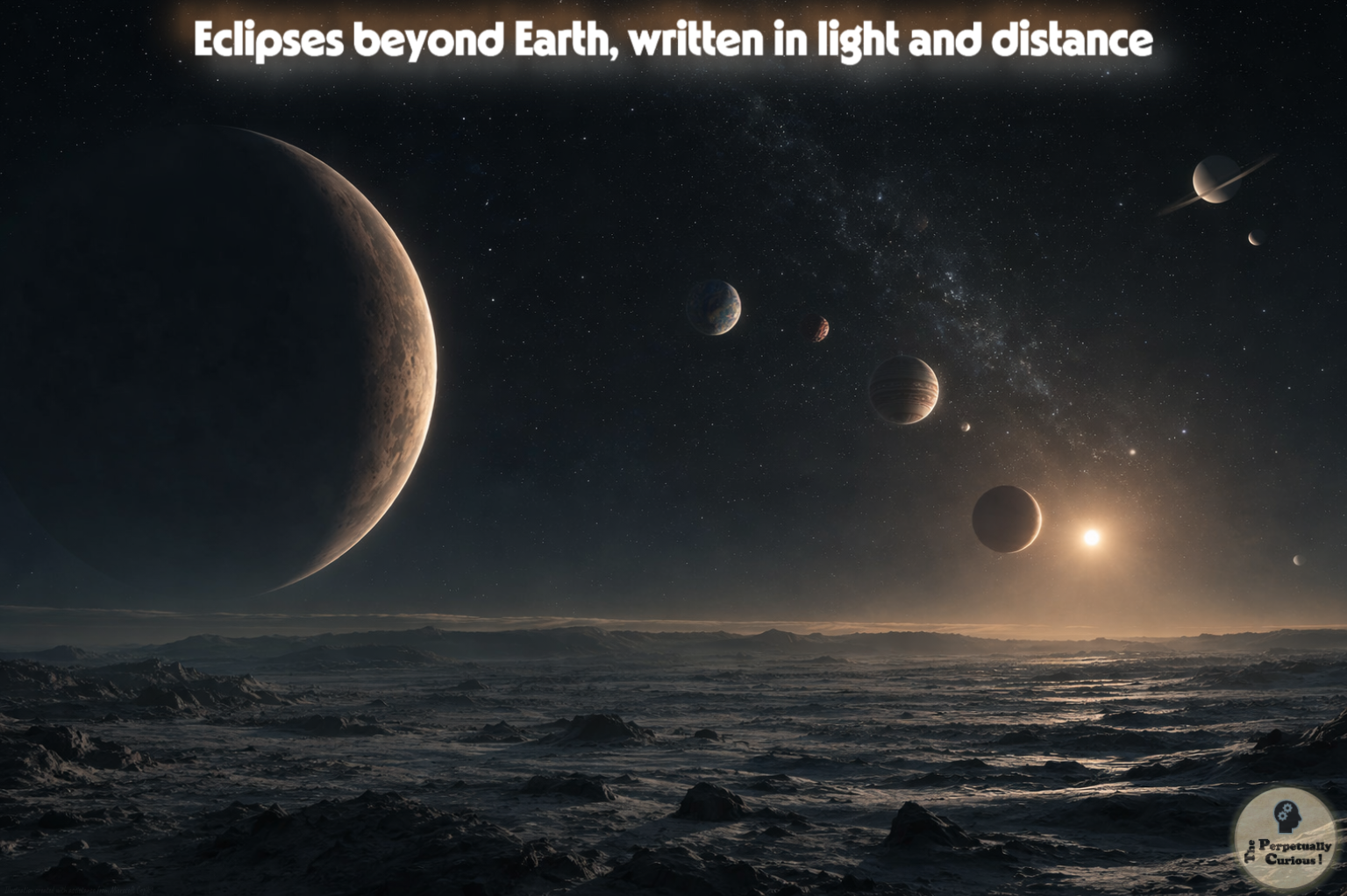
🌘 Eclipses Across the Solar System: When Shadows Travel
An eclipse can feel like a rare celestial exception, but the underlying arrangement is simple. A light source shines, one world blocks that light, and another surface receives the shadow. On Earth, the Sun, Moon, and our planet create the examples we know best.