

There are moments when the body seems to answer before the mind has found its words. A sudden chill moves through the air, a musical phrase rises toward its quiet summit, or a story reaches a point that feels suspended in time. In these moments, the skin responds with a familiar texture. Tiny bumps rise along the arms, the hairs lift slightly, and a familiar pattern appears across the surface of the skin. These are goosebumps, and although they appear simple, they are the visible trace of an ancient reflex that links cold, emotion, and evolution in a single gesture of the skin.
To understand why this small reflex persists, it helps to begin at the surface and then move inward, from the bumps we can see to the microscopic structures that create them. From there, the story widens into the nervous system, the history of mammals, and the surprising ways in which art, awe, and memory can activate overlapping autonomic pathways that once helped our ancestors survive.
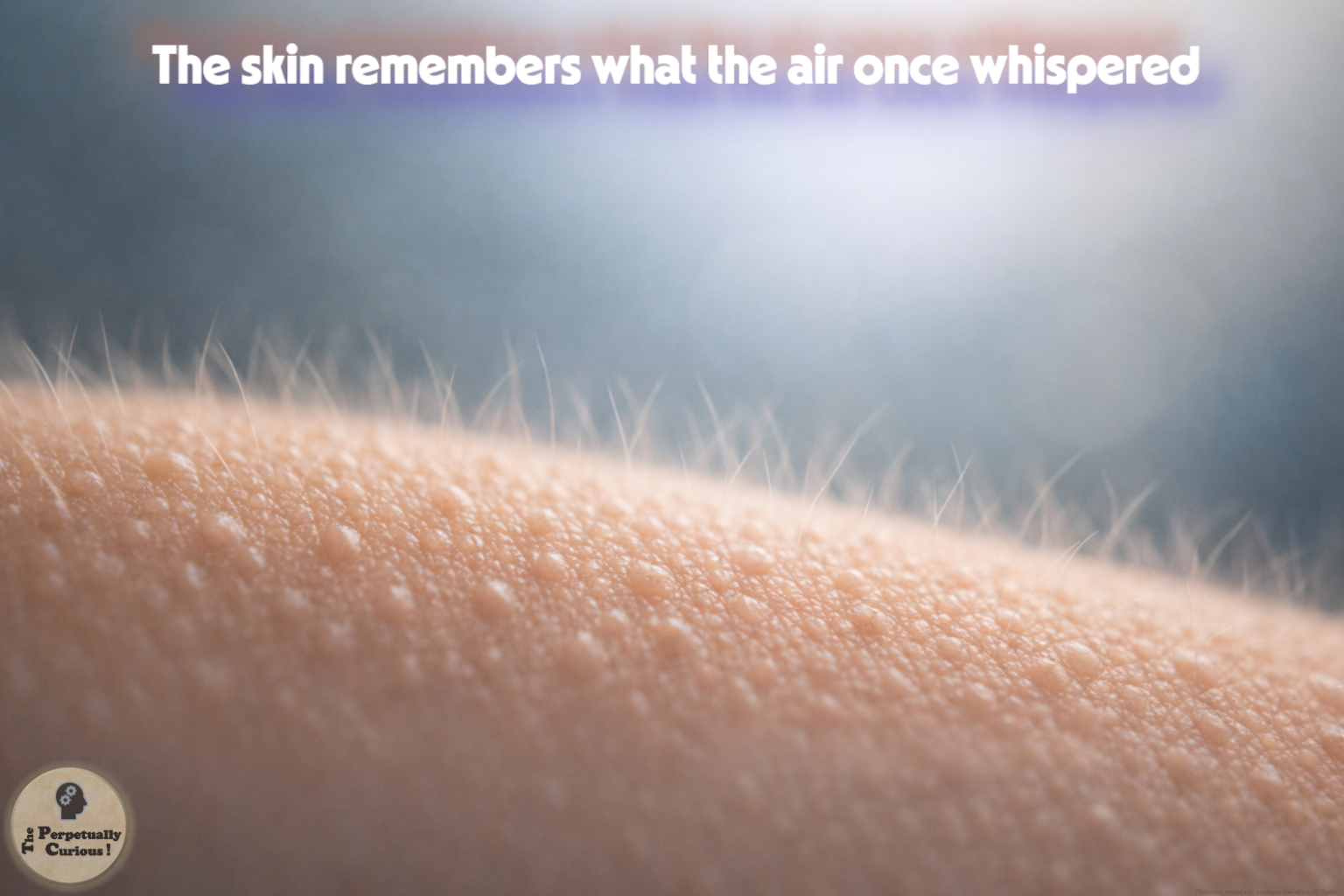
The skin holds a memory of cold that rises without sound.
Each small lift of a hair recalls a world shaped by wind and feeling.
A quiet signal moves through us as if the body remembers something older than thought.
🧬 Beneath Each Bump: The Tiny Muscles That Lift the Hair
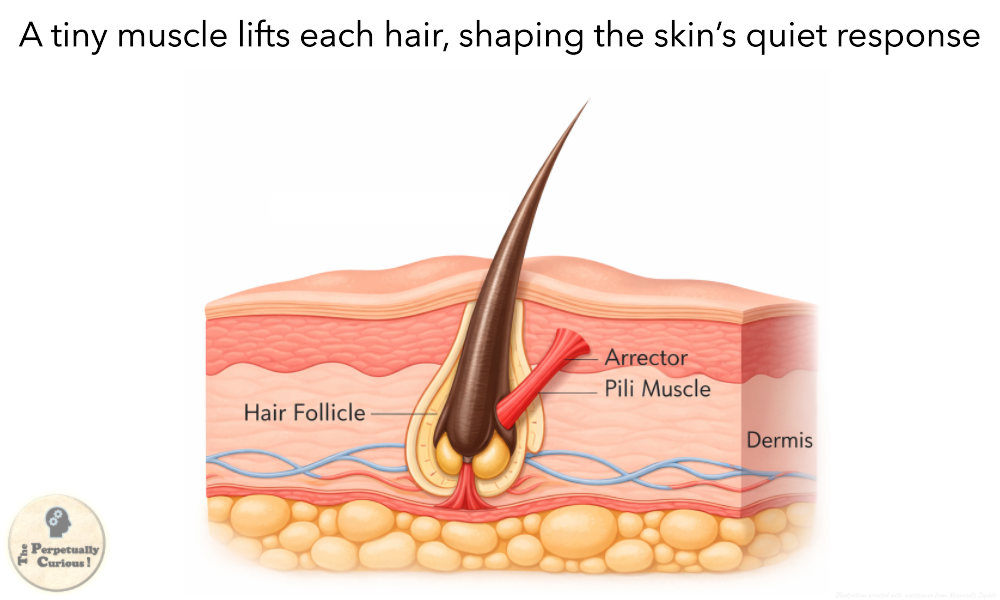
Every goosebump begins with a structure that is almost too small to notice. In hair-bearing skin, many follicles are associated with a small smooth muscle called the arrector pili muscle. This muscle connects the hair follicle to the dermis, pulling the follicle more upright and creating the familiar surface ridge when it contracts. When the muscle tightens, it lifts the hair and gently tugs on the surrounding skin, forming the small raised bump that we recognize as a goosebump.
These muscles are made of smooth muscle fibers, which means they are not under voluntary control. They respond automatically to signals from the autonomic nervous system. A helpful way to imagine their action is to picture a thread sewn into fabric. When the thread is pulled, the cloth puckers. In a similar way, when the arrector pili muscle contracts, the skin forms a small ridge.
Understanding this structure provides the foundation for everything that follows. Once the mechanism is clear, the next question becomes how the body decides when to activate this tiny system.
⚡ The Sympathetic Nervous System and the Pilomotor Reflex
The reflex that produces goosebumps is called piloerection, sometimes referred to as the pilomotor reflex. In older or more formal medical language, it is also known as horripilation. It is controlled by the sympathetic branch of the autonomic nervous system, which also regulates heart rate, blood vessel diameter, and many other involuntary processes.
When the body detects a relevant trigger, such as a drop in temperature or a sudden emotional surge, sympathetic nerve fibers release chemical messengers, including norepinephrine, onto the arrector pili muscles. These signals prompt the muscles to contract, which raises the hairs and forms the bumps. This pathway depends on the coordinated activity of many diverse neurons, which work together to translate sensory information into rapid physiological responses.
The sympathetic system handles both cold and emotion because it evolved to manage rapid, whole-body responses to environmental challenges. Whether the challenge is a sudden chill or a moment of fear, the body engages overlapping autonomic pathways to prepare for action.
With this physiological foundation in place, the next step is to understand why cold air is such a powerful trigger for this reflex.
❄️ Cold Air, Insulation, and a Reflex From a Furrier Past
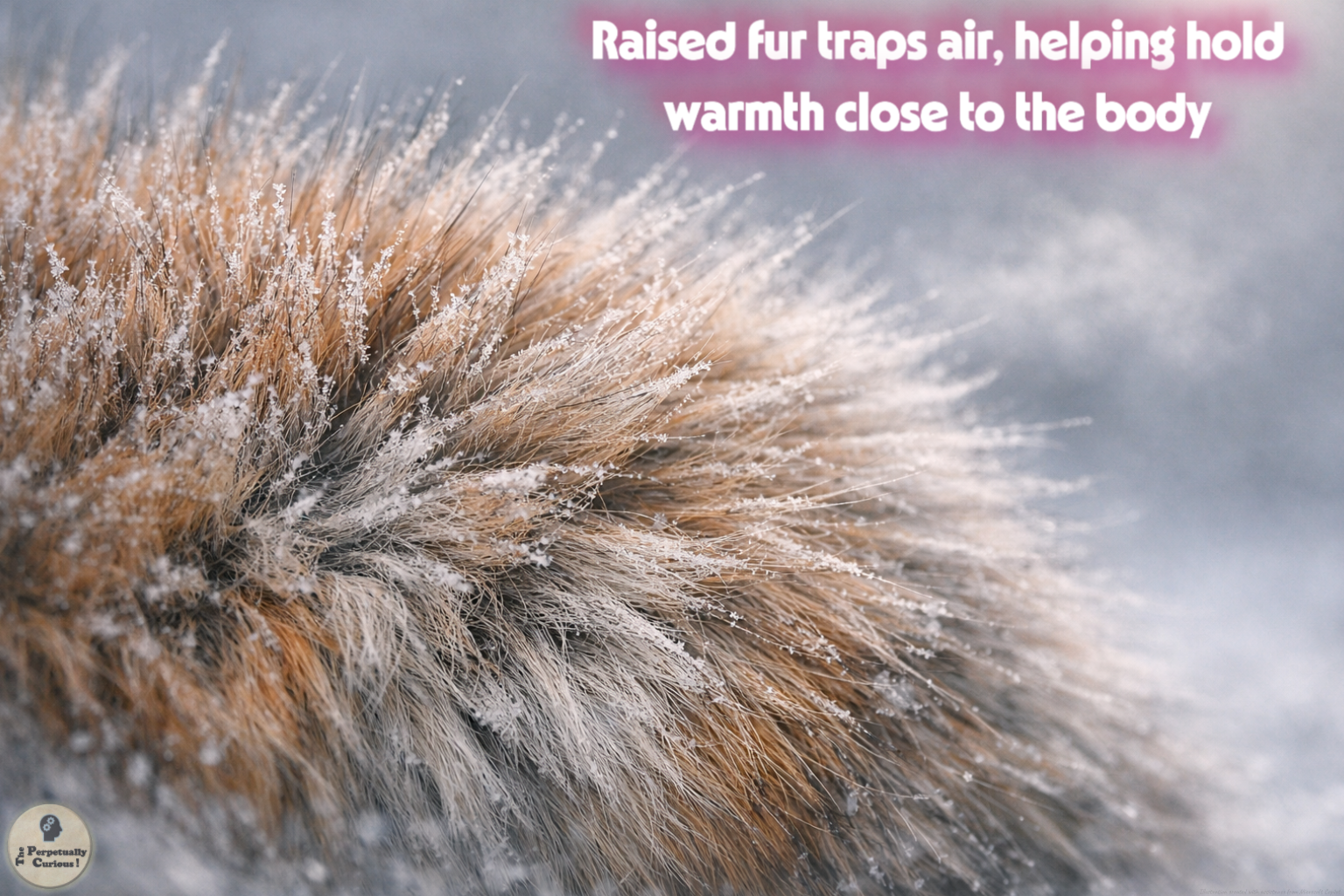
Cold is one of the most common triggers for goosebumps. When the surrounding air cools quickly, the body attempts to conserve heat. In mammals with thick fur, piloerection serves a clear purpose. As the hairs stand up, they trap a layer of air close to the skin, creating insulation that reduces heat loss. In animals with dense coats, such as wolves or foxes, this effect can be significant.
Humans, however, have relatively fine and sparse body hair. The insulating effect is minimal. The reflex persists, but its practical benefit for warmth is limited. Many researchers therefore describe goosebumps in humans as a vestigial reflex, meaning that it is a leftover from an earlier stage in our evolutionary history when our ancestors had thicker body hair and relied more heavily on this mechanism for thermoregulation.
The cold sensing function is only one part of this reflex’s history. In many mammals, overlapping autonomic pathways are also recruited in a very different context, confrontation.
🐾 Fear, Threat, and the Appearance of Size
In many mammals, piloerection appears not only in the cold but also during moments of fear, aggression, or heightened alertness. When a cat arches its back and its fur stands on end, or when certain primates fluff their hair during a confrontation, they are using piloerection to increase their apparent size. This can make them look more imposing to potential predators or rivals.
The sympathetic pathways that respond to cold also activate during fear. This shared circuitry explains why goosebumps appear in both contexts. Although humans no longer rely on raised body hair as a primary threat display, the underlying neural machinery remains. During a sudden fright or a moment of intense anxiety, the sympathetic nervous system can activate the arrector pili muscles, producing goosebumps even in the absence of thick fur.
This connection between cold and fear sets the stage for a more surprising link. If overlapping autonomic pathways respond to physical threats, can they also respond to emotional ones?
🎶 Music, Stories, and the Chills of Awe
Many people notice that goosebumps appear not only in response to cold or fear, but also during moments of emotional intensity. A musical passage may rise toward a sudden crescendo, a film scene may reveal an unexpected turn, or a story may touch on a deeply meaningful theme. In such moments, the skin may respond with a wave of goosebumps, sometimes described as chills or shivers.
Researchers studying these emotional chills have found that they are often associated with strong activation of the sympathetic nervous system. The difference lies in the nature of the trigger. Instead of a physical threat or a drop in temperature, the stimulus is an emotionally salient pattern, such as a powerful harmony or a narrative revelation. Studies also show that self-reported chills do not always correspond to objectively measured piloerection, which highlights the complexity of how the body registers emotional experience.
The brain appears to link abstract experiences, such as art and meaning, to bodily states. Emotional chills also share features with the production of tears, which arise from similarly layered interactions between emotion and physiology. Research on musical frisson has identified several contributing factors, including the personality trait of openness to experience and increased connectivity between auditory regions and areas involved in emotional processing.
Researchers continue to explore why certain patterns in sound or story can activate ancient pathways, but the phenomenon suggests that goosebumps during awe may be an emotional echo of older survival responses.
This raises another question. If the reflex persists in humans, does it serve any deeper purpose beyond emotion and cold?
🌱 Beneath the Surface: Hair Growth, Stem Cells, and Tissue Maintenance
For many years, piloerection was viewed primarily as a mechanical reflex that raised hairs and altered the skin surface. More recent research has suggested that the system may have additional roles. Studies in mice have shown that the sympathetic nerves and arrector pili muscles that participate in goosebumps are closely associated with hair follicle stem cells. These stem cells are involved in hair growth and regeneration.
In these experimental models, activation of the sympathetic nerves in response to cold has been linked to changes in stem cell activity, which may influence hair growth cycles. While the exact implications for humans are still being explored, and the findings have not yet been fully replicated in human tissue, this line of research indicates that piloerection is not only a surface phenomenon. It may also participate in deeper regulatory processes within the skin.
This broader perspective helps explain why the reflex remains. Even if its original functions have diminished, the underlying structures may still contribute to tissue maintenance.
🧩 Why the Reflex Remains: Vestiges and Continuity
Given that humans have relatively little body hair, it is reasonable to ask why the goosebump reflex persists at all. One explanation is that evolution often modifies existing structures rather than removing them entirely. Once a network of nerves, muscles, and stem cells is in place, it may be easier for evolution to repurpose or adjust it than to dismantle it.
In this view, piloerection in humans is partly vestigial and partly integrated into newer roles. It remains linked to the autonomic responses that shape how the body reacts to cold, fear, and awe, and it may also contribute to the regulation of hair follicles and skin maintenance.
This continuity helps explain why goosebumps appear in contexts as varied as temperature shifts, emotional intensity, and moments of heightened attention.
🔍 Individual Differences: Why Some People Notice Goosebumps More Than Others
Not everyone experiences goosebumps in the same way. Some individuals report frequent and intense goosebumps in response to music or emotional scenes, while others rarely notice them. Several factors may contribute to these differences, including variations in skin sensitivity, hair density, and the responsiveness of the sympathetic nervous system. These differences resemble other forms of individual variation in physiology, which influence how people respond to a wide range of physiological stimuli.
Some people also experience sensory phenomena such as ASMR, which may involve tingling sensations or chills in response to specific auditory or visual triggers. These experiences may overlap with the pathways that produce goosebumps, although the relationship is still being studied.
These individual differences remind us that goosebumps are both a shared human phenomenon and a personal one. The underlying anatomy and physiology are broadly similar, but the way each person experiences the reflex can vary with context, attention, and emotional life.
🌍 A Quiet Bridge Between Body, Mind, and History
When viewed as a whole, the story of goosebumps forms a quiet bridge between several domains. At the microscopic level, there are smooth muscles, nerve fibers, and stem cells working together in the skin. At the physiological level, there is the sympathetic nervous system, coordinating responses to cold, fear, and awe. At the evolutionary level, there is a history of fur, insulation, and threat displays that still echoes in the human body.
In everyday life, these layers come together in simple moments. A chill in the air, a line of music, or a powerful memory can all call the same reflex into action. The bumps that rise on the skin are small, but they carry with them a story that stretches from ancient mammals to modern concert halls. This attention to small visible features mirrors the quiet significance of the lunula, which also reveals how subtle structures can hold deeper meaning.
The same quiet bumps that rise on the skin today echo the ancient rhythms that shaped our ancestors. To notice them is to notice that the body remembers more than the present moment. It remembers cold nights, watchful ancestors, and the long conversation between environment and physiology.
Pass this article along to someone curious and let the learning travel.
💡 Did You Know
🟤 Goose flesh terminology Many languages use terms that translate to goose flesh or cutis anserina, reflecting the resemblance to a plucked bird.
🐈 Animal threat displays Cats, rodents, and primates use piloerection to appear larger during confrontations.
🎧 Emotional chills research Emotional chills during music are studied with tools such as skin conductance sensors and direct skin imaging, which help researchers examine sympathetic activation and visible piloerection.
🔀 Asymmetrical goosebumps Goosebumps can appear unevenly across the body because local stimulation and regional autonomic activation do not always affect all arrector pili muscles at the same time.
🎼 Frisson phenomenon Some individuals experience frisson, a specific type of emotional chill studied in music psychology.
🌡️ Fever chills Goosebumps may accompany fever chills because the body can activate heat-conserving responses while trying to raise or defend its internal temperature.
🧫 Developmental origins Arrector pili muscles are first detectable in human fetal tissue at around 24 weeks of gestation, linking hair follicles to the nervous system well before birth.
🧊 Voluntary piloerection A small proportion of people can consciously produce goosebumps without any external trigger, a phenomenon called voluntarily generated piloerection. Current research suggests the ability is rare, but its underlying mechanism is still being studied.
🦃 The “cold turkey” expression One proposed explanation for the phrase “going cold turkey” connects it to the goosebump-like skin that can appear during opioid withdrawal, resembling the surface of a chilled, plucked turkey.
🌏 Language diversity While English and several Germanic languages refer to geese, many other languages use hens or chickens (French, Vietnamese, Korean, Japanese), duck (Hebrew), or even an ant crawling sensation (Ukrainian, Russian) to describe the same experience.
What exactly are goosebumps?
Goosebumps are small raised bumps that appear on the skin when tiny muscles at the base of hair follicles contract.
Why do humans still get goosebumps if we have little body hair?
Humans likely inherited the reflex from furrier ancestors for whom raised hair provided insulation and made the body appear larger during threats.
Why do goosebumps appear when I listen to music or feel moved by a story?
Strong emotional experiences can activate the sympathetic nervous system, which also controls the muscles that produce goosebumps. These emotional responses share features with the production of tears, which also arise from layered interactions between emotion and physiology.
Are goosebumps the same as shivers?
Goosebumps involve the contraction of small muscles in the skin, while shivering involves rapid contractions of skeletal muscles that generate heat.
Can goosebumps appear during fever or illness?
Yes. Fever, chills, and certain autonomic responses can activate overlapping pathways involved in piloerection.
Why do goosebumps sometimes feel like a wave moving across the skin?
This wave-like sensation may reflect the way sympathetic signals travel across nerve pathways that activate the arrector pili muscles in sequence.
Can goosebumps occur without any emotional or cold trigger?
Yes. Spontaneous piloerection can occur due to fluctuations in autonomic activity, medication or withdrawal effects, or certain medical conditions, although these cases are less common.
Can some people produce goosebumps voluntarily?
A small number of individuals appear to be able to consciously initiate piloerection without any external stimulus. This ability, called voluntarily generated piloerection, is rare, and research has not yet established whether it can be learned. Some studies have explored personality traits in people who report this ability, but the findings remain limited and should be treated cautiously.
Do goosebumps serve any purpose in humans today?
Their original functions are greatly reduced, but the reflex remains integrated into the autonomic nervous system and may play subtle roles in skin physiology. These subtle roles resemble the quiet significance of palm lines, which also reflect deeper biological processes.
Why do some people get goosebumps more easily than others?
Individual differences in skin sensitivity, hair density, and nervous system responsiveness may influence how often and how strongly goosebumps appear. These differences are one expression of the broader individual variation in physiology that shapes how people respond to many bodily stimuli.
🌾 A Gentle Invitation to Share
We kindly invite you to share this article with friends, colleagues, or anyone who may enjoy a quiet look at how the body responds to cold, fear, and awe. Your support in helping these stories of everyday physiology travel farther is deeply appreciated.
“When the Skin Remembers the Cold: Why We Get Goosebumps.” The Perpetually Curious!, June 2026.
https://www.theperpetuallycurious.org/articles/why-do-we-get-goosebumps/Continue Exploring
For the curious mind: want to explore this theme through a few questions? Visit the Classic Quiz Studio, nestled under Explorations opens in a new tab ,and see where a few well-placed questions lead: Biology & Health Quizzesopens in a new tab
For what comes next
Site Updates gathers occasional notes, new additions, and ways to keep in touch. RSS brings new publications to your feed reader in chronological order.
Choose the path that speaks to you, and let the next curiosity find you wherever your wondering takes you.