

A yawn often arrives softly, as if carried on an internal tide. A slow, deep inhalation gathers the body, the jaw opens wide, the eyes close for a moment, and then a long exhalation follows. It is a gesture so familiar that it often passes without notice, yet it carries a quiet mystery. A yawn may appear when we feel tired, when we are wide awake and straining to focus, or even when we simply see someone else yawn. This small reflex feels ordinary, although it opens a window into the subtle ways the brain and body shift between states.
This article follows the path of that window. It begins with the physical mechanics of yawning, then moves into scientific ideas about its possible functions, explores why yawns sometimes ripple through groups, and looks at yawning in early life and across species. Each section builds on the previous one, creating a narrative arc that blends scientific clarity with gentle curiosity.
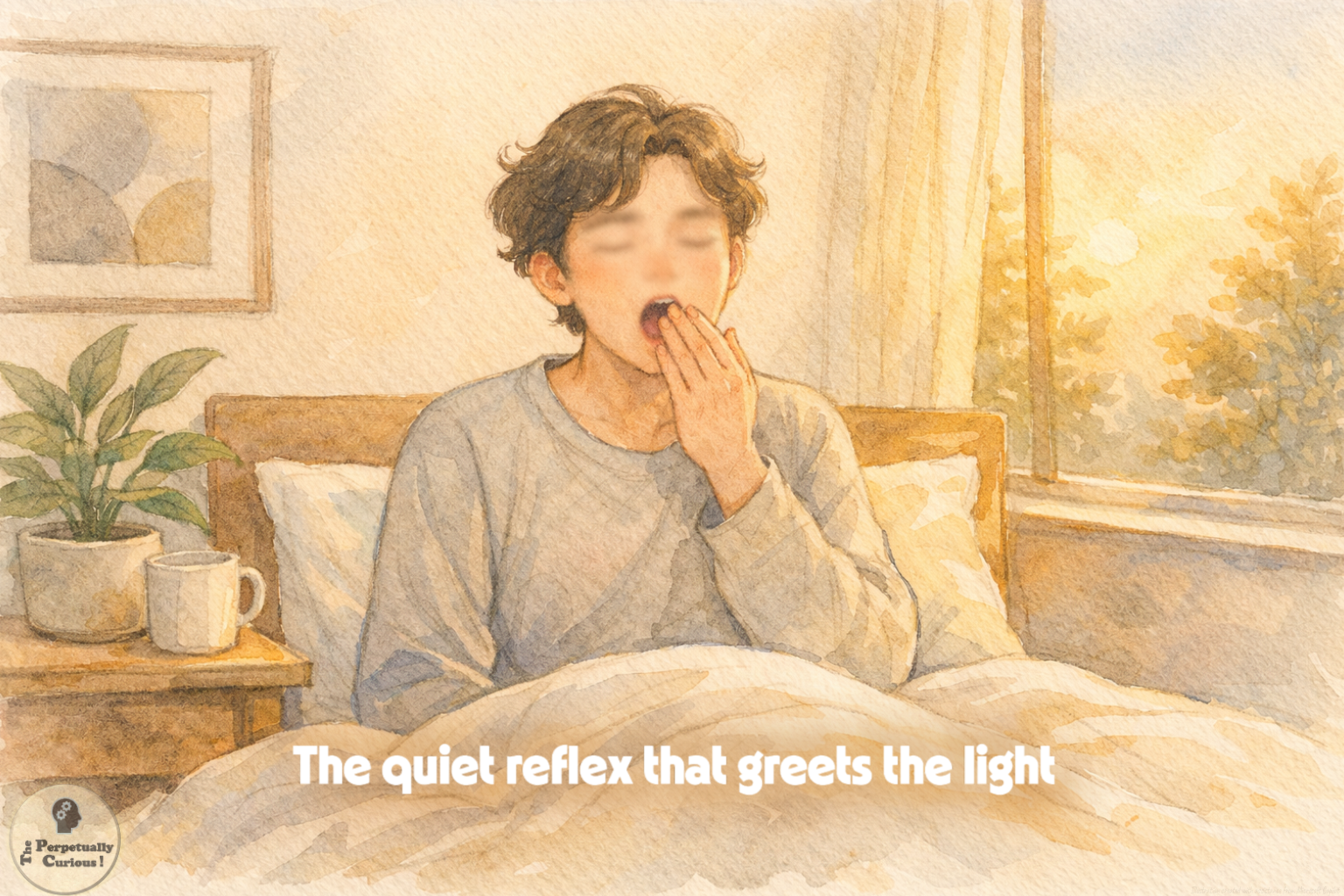
A yawn moves through the body like a small tide, rising from places we rarely notice.
It gathers breath, thought, and a moment of quiet change before it fades again into the rhythm of the day.
In that brief passage, the body reminds us that even the smallest gestures carry their own kind of wonder.
🌬️ A quiet reflex that gathers the whole body
To understand why we yawn, it is helpful to begin with what happens during a yawn. A typical yawn involves a deep inhalation, a wide opening of the mouth, stretching of the jaw and facial muscles, and a slower exhalation. Several systems participate at once, which suggests that yawning is a coordinated reflex rather than a random movement. That shared architecture places yawning near other involuntary patterns, including the hiccup reflex, where breathing muscles, airway closure, and brainstem-related timing briefly converge.
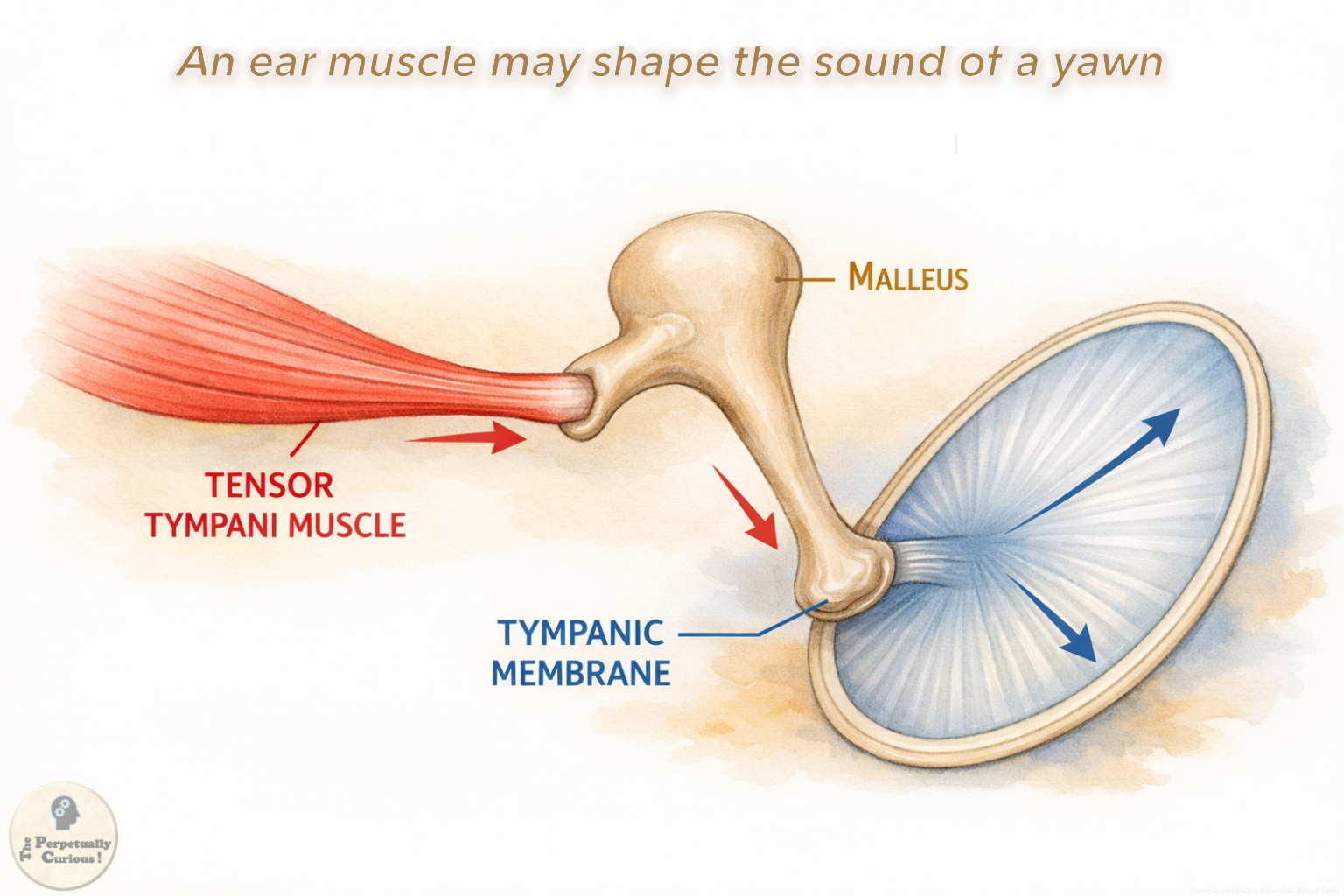
The respiratory system draws in more air than during a usual breath, and the lungs expand more fully. The cardiovascular system may show subtle changes in heart rate and blood flow. Muscles in the face, throat, and sometimes the upper chest and neck engage in a brief stretch. The autonomic nervous system, which helps regulate involuntary processes such as heart rate and digestion, is thought to coordinate these adjustments, helping the body manage shifts in internal state. During a yawn, small muscles in the middle ear, including the tensor tympani, may also contract, pulling on the malleus bone and indirectly tensing the eardrum, which can produce the familiar rumbling or muffled sound that many people notice.
This combination of deep breathing, muscle stretching, and autonomic activity indicates that yawning is a structured event that may help the body shift between internal states. A similar interplay between physiology and arousal appears in the way the body produces goosebumps, which also reflect quiet adjustments in the autonomic nervous system.
Because these shifts often relate to how the brain manages its own activity, the next step is to explore one of the most discussed ideas in yawning research: the possibility that yawning participates in regulating brain temperature and arousal.
❄️ Cooling the brain and adjusting arousal
One influential hypothesis proposes that yawning may help cool the brain. The human body is often described as maintaining a core temperature of approximately 98.6°F (37°C), although normal temperature varies by person, time of day, and measurement site, and the brain itself may run slightly warmer. According to this hypothesis, the deep inhalation and increased airflow during a yawn may assist in lowering brain temperature slightly, which could support optimal neural functioning.
Some studies have reported that yawning occurs more often when brain or head temperature rises and may decrease after cooling. Research also suggests that yawning follows a thermal window, becoming more frequent when ambient temperatures are moderate and cooler than body temperature, and less frequent when temperatures are very hot or very cold, since effective heat exchange requires the inhaled air to be cooler than the brain. Increased blood flow in the face and neck, combined with inhalation of cooler air, may promote this exchange. These observations support the idea that yawning may participate in thermoregulation, at least under certain conditions.
The brain stabilizes its internal environment through several coordinated systems, including the circulation of cerebrospinal fluid, which helps maintain a steady internal milieu and protect neural tissue.
However, the thermoregulation explanation remains under active study. Not all research agrees on the strength or consistency of the temperature changes, and the exact mechanisms are still being examined. Scientists therefore use careful, hedged language, noting that yawning may contribute to brain cooling in some contexts, although it is unlikely to be the only factor involved.
Once we understand these internal functions, it becomes natural to ask how yawning behaves in social settings. This leads to one of the most intriguing aspects of yawning: its contagious nature.
🧠 When one yawn becomes many: contagious yawning and the social brain
Many people notice that yawning can spread through a group. One person yawns, another follows, and soon several individuals are yawning in sequence. This phenomenon, often called contagious yawning, has attracted considerable scientific interest because it appears to link a simple motor reflex to social and cognitive processes.
Experiments have shown that seeing, hearing, or even thinking about yawning can increase the likelihood of yawning in observers. Brain imaging studies suggest that observing a yawn may engage action‑observation and mirroring networks in the brain, which help us simulate and understand the actions of others. These regions are involved in processes such as imitation, empathy, and social understanding.
Some research has reported that contagious yawning may be more frequent among individuals who share close social bonds or who score higher on certain measures of empathy. This has led to the proposal that contagious yawning may reflect a form of social attunement, in which the brain partially mirrors the internal state of others. However, the relationship between contagious yawning and empathy is still being explored, and not all studies find the same patterns. Scientists therefore describe this link with appropriate caution.
Notably, contagious yawning does not fully emerge in children until around four to five years of age, a timeline that roughly overlaps with developing social cognition and theory‑of‑mind skills in structured experimental settings, although some naturalistic observations suggest the behavior may appear somewhat earlier.
Contagious yawning fascinates researchers because it bridges physiology and social cognition. It shows that a reflex rooted in the body may also reflect how we respond to the presence and behavior of others. To understand how deeply this reflex is woven into human development, the narrative now turns to its appearance in early life.
👶 Yawning in early life: practice for a developing nervous system
Yawning appears early in human development, including in infants and in fetuses, and has been observed as early as about 11 weeks of gestation using ultrasound imaging. In these early stages, yawning has been proposed as a form of neuromuscular practice, helping the developing nervous system coordinate breathing, muscle activity, and autonomic responses, although its full range of functions is still being investigated.
During fetal life and infancy, the brain is building the networks that will later support sleep regulation, attention, and social interaction. Repetitive behaviors such as yawning may provide sensory feedback that helps the brain learn how to manage the body’s rhythms. The deep inhalation, muscle stretching, and autonomic adjustments that accompany a yawn may offer the nervous system a structured pattern to rehearse.
More recent observations suggest that variations in fetal yawning frequency may also carry physiological information, and one small recent observational study has reported a link between higher yawning rates in utero and lower birth weight, hinting that yawning may reflect aspects of the fetus’s internal state in ways that are still being studied.
Caregivers often notice yawns as early signs of tiredness in infants, although the relationship between yawning and sleepiness is not perfectly one to one. Some yawns may occur during other transitions, such as changes in stimulation or after feeding. This variability reinforces the idea that yawning is linked to broader shifts in internal state rather than a single cause.
Because yawning appears early in life, researchers view it as a deeply conserved behavior. To see how far this conservation extends, the narrative now widens to consider yawning across species.

🐾 Yawning across species: a shared gesture in the animal world
Yawning is not unique to humans. Many vertebrates, including mammals and some birds, appear to yawn or perform movements that closely resemble yawns. Yawning has been documented across all major vertebrate classes, including fish, amphibians, reptiles, birds, and mammals, suggesting very ancient vertebrate origins. In animals, yawning may occur in contexts such as rest, transitions between activity and inactivity, or social interactions.
Studies in nonhuman primates, such as chimpanzees and gelada baboons, have reported contagious yawning within groups. This suggests that the social component of yawning may extend beyond humans and may be linked to group coordination or shared vigilance. In some cases, yawning in animals appears to cluster around changes in environmental conditions or group activity, which supports the idea that yawning may help adjust arousal or readiness.
Other animals, including some birds and reptiles, show yawning‑like movements that may be associated with thermoregulation or respiratory adjustments. Because animal behavior is shaped by ecological and social factors, yawning may serve slightly different roles in different species, even if the basic movement is similar.
By viewing yawning across species, we gain a sense of its evolutionary breadth. After exploring this wider landscape, it becomes natural to return to everyday experience and ask what yawning may mean for us in ordinary life.
🌗 Between tiredness and attention: yawning in daily experience
In daily life, yawning often feels like a sign of tiredness. Many people associate yawns with late nights, long meetings, or quiet moments when attention begins to drift. While yawning does frequently occur in these situations, it is not limited to them. People may yawn when they feel anxious, when they are trying to stay alert, or when they encounter sudden changes in stimulation. Research in animal models suggests that stress‑induced yawning may involve the central nucleus of the amygdala and its connections to hypothalamic regions, although this pathway has not been fully confirmed in humans.
Yawning also appears during transitions between sleep and wakefulness. Many people notice yawns shortly after rising in the morning or while preparing for rest at night. These transitions reflect the influence of the body’s biological clocks, which help regulate cycles of alertness and rest.
This variety suggests that yawning may be better understood as a marker of state change rather than a simple indicator of sleepiness. It may appear when the body is adjusting its level of arousal, whether that means moving toward rest or toward greater alertness. The deep breath, muscle stretch, and autonomic shift may help the body recalibrate.
Because yawning is influenced by multiple factors, including physiology, environment, and social context, it is difficult to assign a single meaning to every yawn. Instead, yawning may be viewed as a flexible response that participates in several processes at once.
🌌 A quiet gesture of the body: wonder in an ordinary act
Yawning is small, yet it gathers many systems. It involves the lungs, the heart, the muscles, and the brain. It appears in infants, adults, and animals. It can be solitary or contagious, private or shared. It may help regulate temperature, adjust arousal, and mirror the actions of others.
The layered nature of yawning recalls other quiet puzzles of the brain, such as the experience of déjà vu, which also emerges from subtle interactions between perception and memory.
In this way, yawning offers a reminder that even the most ordinary gestures can carry layered meanings. A single breath, stretched into a yawn, may reflect the body’s effort to stay balanced, attentive, and connected. It may show how physiology and social life intertwine, and how the brain quietly manages transitions that we rarely notice.
By paying attention to yawning, we are not trying to assign it a grand purpose. Instead, we are acknowledging that small acts can reveal complex patterns. The next time a yawn arrives, it may be possible to see it not only as a sign of tiredness, but also as a brief glimpse into the body’s ongoing conversation with itself and with the world.
Pass this article along to someone curious and let the learning travel.
💡 Did You Know
🧊 Yawning follows a thermal window. Some research suggests that yawning is most frequent at moderate ambient temperatures and less common when temperatures are very hot or very cold. This pattern supports the idea that yawning may help regulate brain temperature within a narrow range.
🐒 Some primates yawn contagiously. Chimpanzees and gelada baboons show contagious yawning within social groups, which may reflect forms of social coordination or shared vigilance.
🧪 Yawning does not appear to be driven by low oxygen. Older explanations suggested that yawning helps bring more oxygen into the body, but research indicates that oxygen levels do not change significantly during yawning.
👶 Yawning appears before birth. Fetuses have been observed yawning as early as about 11 weeks of gestation using ultrasound imaging, which supports the idea that yawning is a deeply conserved reflex.
🕰️ Yawning has very ancient vertebrate origins. Because yawning appears across all major vertebrate classes, including fish, amphibians, reptiles, birds, and mammals, researchers believe it may have roots that extend deep into vertebrate evolutionary history.
🧠 Neurotransmitters may influence yawning. Research suggests that dopamine, oxytocin, and certain other neurotransmitters may modulate yawning frequency in animals, although the exact pathways are still being studied.
⏱️ A yawn typically lasts around six seconds on average. Duration varies across individuals and contexts, and across species it tends to scale with brain size.
👧 Contagious yawning emerges around age four to five. This developmental timeline roughly overlaps with theory‑of‑mind skills in structured experimental settings, although some naturalistic observations suggest the behavior may appear somewhat earlier.
Is yawning always a sign of tiredness?
Yawning often appears when people feel sleepy, but it is not exclusively tied to tiredness. It may also occur during changes in arousal, periods of low stimulation, or moments of stress.
Why is yawning sometimes contagious?
Contagious yawning occurs when seeing, hearing, or even thinking about a yawn increases the likelihood of yawning in another person. Brain imaging studies suggest that this may involve networks associated with action observation, mirroring, and social understanding.
Do animals yawn in the same way humans do?
Many animals, including mammals, birds, reptiles, amphibians, and even fish, show yawning or yawning‑like movements. In some species, yawning appears during rest or transitions in activity, and in certain primates contagious yawning has been reported.
Does yawning help cool the brain?
Some research suggests that yawning may contribute to brain cooling by increasing airflow and altering blood flow in the head and neck. However, this explanation is still under investigation, and scientists describe it with appropriate caution.
Does yawning increase oxygen levels?
Research indicates that yawning does not significantly increase oxygen levels in the blood. This older explanation has largely been set aside in favor of theories related to arousal and thermoregulation.
Why do I yawn when I feel anxious?
Yawning may appear during moments of stress or anxiety, possibly because the body is adjusting its level of arousal. This relationship is still being studied, and scientists describe it with appropriate caution.
Why do I sometimes hear a clicking or popping sound when I yawn?
A soft sound during yawning may occur when the jaw joint shifts slightly or when pressure changes in the middle ear cause the Eustachian tube to open. These sounds are usually brief and reflect normal mechanical adjustments in the jaw and ear during a wide stretch.
Is yawning controlled by a specific part of the brain?
Yawning appears to be coordinated by regions in the brainstem and hypothalamus that help regulate autonomic functions. Research suggests that the paraventricular nucleus of the hypothalamus may play a role in triggering yawns, and that neurotransmitters such as dopamine and oxytocin may influence yawning frequency. These pathways reflect the broader diversity of neurons that shape human experience.
Is yawning connected to the sleep–wake cycle?
Yawning often appears during transitions between sleep and wakefulness, such as when rising in the morning or preparing for rest at night. Researchers suggest that yawning may help the body adjust its level of arousal during these shifts, although the exact relationship is still being studied.
Can yawning be a sign of boredom?
Yawning may appear during periods of low stimulation, which some people interpret as boredom. However, yawning is not a direct measure of boredom and may reflect broader shifts in arousal rather than a specific emotional state.
Can yawning be suppressed?
People can sometimes delay or partially suppress a yawn, but the reflex often completes itself. Suppression may reduce the intensity of the stretch, yet the underlying shift in arousal still tends to occur.
Why do my eyes water when I yawn?
The strong contraction of muscles around the eyes during a yawn can briefly affect the periorbital region and tear‑drainage pathways, increasing tear flow. This mechanical tearing is related to the same lacrimal pathways described in why we cry, although the trigger is physical rather than emotional.
Why do my ears pop when I yawn?
Yawning can open the Eustachian tubes, equalizing pressure between the middle ear and the environment. The brief pop or shift in sound reflects normal pressure adjustment and does not require any additional interpretation.
Is excessive yawning ever meaningful?
Frequent yawning can appear during fatigue, boredom, stress, or changes in sleep and arousal. Research has also documented yawning as an observed response to certain pharmacological agents, reflecting its connection to neurotransmitter systems.
Do all cultures interpret yawning the same way?
Cultural interpretations vary. Some traditions view yawning as a sign of tiredness or inattention, while others treat it as a natural bodily rhythm. The reflex itself is universal, but social meanings differ across communities.
🌍 A gentle invitation to share and spread the word
Under the quiet rhythm of everyday life, a yawn may seem like a small interruption. Yet, as this exploration shows, it can also be a doorway into the subtle ways the body regulates itself and responds to others. If this article has offered you a new way to see this familiar reflex, we kindly invite you to share it with others.
By sharing this piece with friends, colleagues, or anyone who enjoys thoughtful science and reflective storytelling, you help us reach a wider audience that may find wonder in the ordinary. Your support in spreading the message is deeply appreciated, and it helps keep these gentle stories of the body alive in the shared space of conversation.
“When A Breath Becomes a Yawn: Why We Yawn and What This Quiet Reflex May Reveal.” The Perpetually Curious!, June 2026.
https://www.theperpetuallycurious.org/articles/why-do-we-yawn/Continue Exploring
For the curious mind: want to explore this theme through a few questions? Visit the Classic Quiz Studio, nestled under Explorations opens in a new tab ,and see where a few well-placed questions lead: Biology & Health Quizzesopens in a new tab
For what comes next
Site Updates gathers occasional notes, new additions, and ways to keep in touch. RSS brings new publications to your feed reader in chronological order.
Choose the path that speaks to you, and let the next curiosity find you wherever your wondering takes you.